There was probably a real Viking behind Björn Ironside – just not the one the sagas and the TV series describe. Frankish annals record a Viking leader called Berno who fought on the Seine from 856 to 858 and then swore loyalty to Charles the Bald. That he was Ragnar's son, sailed into the Mediterranean with Hastein in 859, mistook Luni for Rome and died a king at Uppsala only appears in sources from around 1070 onwards. We separate annals, legend and burial mound for you, layer by layer.
Search for Björn Ironside and you meet a towering warrior in war paint, a son of Ragnar, an explorer who sails into the Mediterranean and ends his days as king of Sweden under a vast burial mound. That figure is a mosaic. Its pieces come from texts written between the ninth and the fourteenth centuries, and the gaps between them are wider than most retellings admit.
Strictly speaking, we meet at least three Björns. The first is called Berno and appears in Frankish annals of the 850s: the leader of a band of Seine Vikings who swears loyalty to Charles the Bald, king of West Francia. The second is Bier Costae ferreae, "Björn Iron-Ribs", who turns up around 1070 in the work of a Norman monk who makes him a king's son and the leader of a voyage to Rome. The third is Bjǫrn járnsíða of the Icelandic sagas, son of Ragnar Lothbrok and Aslaug, conqueror of Sweden and founder of a royal line. Whether all three are the same man, nobody can say for certain. And then there is a fourth, a king on Lake Mälaren around 829, who is regularly confused with him.
We will take these layers one at a time, from a terse annal entry to a mound on the island of Munsö. For the whole family, see our article on Ragnar's sons; for the supposed father, Ragnar Lothbrok.
The most solidly attested Björn is also the least dramatic. He appears in two Frankish sources. One is the Annales Bertiniani, the Annals of St-Bertin, the leading West Frankish chronicle of these decades. The other is the Annals of Fontenelle, also known as the Chronicon Fontanellense, compiled at the abbey of Saint-Wandrille on the lower Seine – by monks who had Vikings on their doorstep rather than in rumour. Their dating is shaky, though: raids of 856/857 are partly entered under 855.
The picture that emerges runs like this. In July 856 a Viking leader named Sidroc entered the Seine. In mid-August a second fleet joined him, the one led by Björn. The Annals of St-Bertin note that the Seine Danes settled at a well-placed spot called Jeufosse and wintered there undisturbed. Around the turn of 856/857 Seine Vikings attacked Paris and burned churches. Sidroc eventually left; Björn stayed. He fortified a camp on a river island the sources call Oscellus, probably modern Oissel above Rouen, and in 857 his men ranged as far as Bayeux and Évreux.
Then comes the scene that has earned Björn a small place of honour among historians. Under the year 858 the Annals of St-Bertin report:
"Berno dux partis pyratarum Sequanae insistentium ad Karlum regem in Vermeria palatio venit." – Berno, leader of a part of the pirates based on the Seine, came to King Charles at the palace of Verberie.Annales Bertiniani for 858 (Latin as quoted in Coupland 1998, our own translation)
The annalist goes on to say that he gave the king his hands and swore fidelity in the manner of his people. That is commendation: whoever places his hands between those of a lord becomes that lord's man. The historian Simon Coupland therefore describes Björn as the earliest known Scandinavian outside the Danish royal family to enter the service of a Frankish king. What Björn got in return is not stated. Silver is the likeliest answer: a letter from a synod of bishops in November 858, probably drafted by Archbishop Hincmar of Reims, complains about an "undeserved tribute" being paid to the Northmen.
Even so, Charles besieged the camp at Oissel in July 858 – evidently Seine Vikings who had not submitted were still holding it; the sources do not say exactly who. The siege collapsed in September when Charles's half-brother Louis the German invaded West Francia. After that, Berno simply disappears from the annals: no death, no departure, no betrayal. Coupland cautiously reads this as a sign that he kept his oath.
It is thin material, but it is the only moment where we can pin a Viking-age Björn to a date, a place and an action. How the Franks turned deals like this into policy is the story of the Vikings in France; about fifty years later, an arrangement of exactly this kind produced Normandy under Rollo.
A year after Verberie, one of the longest-ranging expeditions of the entire Viking Age gets under way. The Annals of St-Bertin record it for 859 in a single, almost offhand sentence: Danish pirates, after a long sea voyage between Spain and Africa, entered the Rhône, laid waste to towns and monasteries and settled on an island called Camaria – the Camargue. From there, the annals continue, they went on towards Italy, capturing and plundering Pisa and other cities.
Who led them, the annals do not say. That matters for everything that follows. The contemporary source knows a fleet, not a Björn.
From the other side of the sea come Arabic accounts. The people of al-Andalus called the northerners al-Majūs, originally a word for Zoroastrians, transferred to the heathen strangers from the north. The key texts come from historians of the tenth to fourteenth centuries – Ibn al-Qūṭiyya, Ibn Ḥayyān, al-Bakrī and Ibn ʿIdhārī among them – who drew partly on earlier works now lost. They are closer to events than any saga, but not contemporary, and they disagree on numbers and sequence. In this tradition a fleet, often given as 62 ships, appeared off Iberia in 859. It was driven off in Galicia, ran into coastguard ships of the Emirate of Córdoba along the coast of al-Andalus, and burned the mosque at Algeciras. Al-Bakrī then describes an attack on Nakūr, a small emirate on the Mediterranean coast of Morocco, where the Majūs stayed for a week and took captives. Further raids hit Orihuela in south-eastern Spain and the Balearic Islands.
The historian Ann Christys, who has worked through the Latin and Arabic texts on the Vikings in the south in the original languages, urges caution. Much of this is late, second-hand and dramatised in hindsight, and not every raid an Arabic chronicler pins on the Majūs need have been Scandinavian. The broad outline, though – Iberia, Gibraltar, North Africa, the Rhône, Italy – is supported independently by Frankish and Arabic sources. For the bigger picture, read our piece on the Vikings in the Mediterranean and al-Andalus.
A third voice comes from Ireland. The Fragmentary Annals of Ireland, which survive only in a later copy, tell of a voyage to Spain and Africa and of captives brought to Ireland as fir gorma, "blue men" – apparently dark-skinned North Africans. Tellingly, they name the leaders not as Björn and Hastein but as two sons of a certain Ragnall. The Irish had their own version of who was out there. That North Africans ended up in Norse slave markets this way fits what we know about slavery in the Viking world.
The fleet spent the winter of 859/860 in the Camargue, the marshy Rhône delta: plenty of water, little access by land. In spring 860 the raiders rowed upriver; the Annals of St-Bertin note that they ravaged their way as far as Valence and then returned to their island. Later accounts add Arles, Nîmes and Narbonne, some of them on thin evidence. Then the fleet turned east, towards Italy.
Pisa is named explicitly in the Frankish annals. The trip up the Arno to Fiesole and the capture of Luni, on the border of Liguria and Tuscany, only appear in later texts. Luni, ancient Luna, was a declining episcopal town that Saracen raiders had already hit in 849. Stories of the fleet pushing on to the eastern Mediterranean or even Constantinople Christys considers unsupported – the Rus attack on Constantinople in 860 came from quite different people, travelling down the rivers of eastern Europe.
Consider the scale: a fleet from western Francia rounds Iberia, passes Gibraltar, raids in Morocco, winters in southern France and reaches Tuscany. Thousands of nautical miles in open ships with no safe harbour, food and water supplied by plunder or trade. How such ships were built and what they could take is covered in our article on longships.
Now for the story that keeps Björn's name alive. Its oldest version is in Dudo of Saint-Quentin, a canon who wrote a history of the Normans' ancestors for the dukes of Normandy in the early eleventh century. In Dudo the hero is Hasting – the Latin form of Hastein – alone. Björn does not appear.
The plot: the Northmen want to take Rome, mistress of the world. They land before a city with splendid walls and believe it to be Rome. The walls are too strong. So Hastein sends word to the bishop that he is dying and wishes to be baptised. He is baptised. Soon after, the news comes that he has died and wants a Christian burial inside the city. A funeral procession passes through the gate, weapons hidden under cloaks. In the church the corpse leaps from the bier, kills the bishop, his men throw open the gates – and only then does Hastein learn that he has taken not Rome but insignificant Luni.
William of Jumièges, a monk in Normandy, took the story into his Gesta Normannorum Ducum, the "Deeds of the Dukes of the Normans", around 1070 and inserted Björn as leader of the whole expedition. Only from William onwards do Björn and Hastein stand together before Luni – more than two hundred years after the event.
The legend survived because it offers everything medieval storytellers loved: the cunning heathen, the gullible bishop and the conqueror who storms the wrong city. For another warrior whose life and legend are tangled up, see Harald Hardrada.
For the return, we rely mainly on Arabic tradition and on figures that are repeated again and again in the literature: some 40 ships lost in a storm, more in fighting with the Andalusi fleet near Gibraltar, and of 62 ships only about 20 coming home. None of this is secure; the numbers come from late reports and vary from source to source. The trend fits what we know of the Emirate of Córdoba, though. After the devastating attack on Seville in 844 it had built shipyards and a navy. Gibraltar, a gateway on the way out, became a trap on the way back.
You will also often read that the raiders attacked Pamplona on their way home and held King García Íñiguez for a huge ransom. That account comes from Arabic tradition, and whether the "Banbalūna" it names really refers to a Viking raid on Pamplona is disputed. Around 861/862 the remnants of the fleet reappeared in West Frankish waters.
The honest balance sheet: bold, far-reaching, rich in plunder – and costly in ships and lives. The south had fleets, fortresses and an administration that recorded attacks and answered them.
In William of Jumièges, Björn gets a biography for the first time. William explains that the Danes used to send younger sons abroad so the kingdom would not be divided. So King Lotbrocus – Ragnar Lothbrok – sent his son Björn away, with Hasting as his tutor and foster-father. After raiding in France and the great voyage south, Björn was shipwrecked off the English coast on the way home and eventually died in Frisia.
There are snags. Hastein is only visible in contemporary sources from the 860s, on the Loire, and later in England, where the Anglo-Saxon Chronicle shows him fighting Alfred the Great from 892 to 896. Making him a prince's foster-father in the 850s is a construction. William braids three strands – the Seine Björn, the anonymous Mediterranean fleet and the Lothbrok tradition – into one life. Whether he preserved a genuine memory or simply joined famous names together cannot be decided.
The byname is no firmer foundation. The Frankish annals do not know it. It first appears in William of Jumièges as Bier Costae ferreae, "Björn with the iron ribs". Later it surfaces in the north as Bjǫrn járnsíða, "Ironside", in Ragnars saga loðbrókar, in Ragnarssona þáttr ("The Tale of Ragnar's Sons") and in Hervarar saga – texts written down in the thirteenth and fourteenth centuries, more than four hundred years after Verberie.
An explanation comes from the Danish historian Saxo Grammaticus around 1200 in his Gesta Danorum: Björn's flanks were like iron in battle, hence the name. That is an interpretation, not eyewitness testimony. Whether "Ironside" originally referred to armour, scars, toughness or something else entirely, we do not know; the story behind a byname was often invented after the fact. How Saxo works is explored in our article on Saxo Grammaticus.
In the sagas Björn is Ragnar's son by Aslaug, brother of Ivar the Boneless, Hvitserk and Sigurd Snake-in-the-Eye. With his brothers he defeats King Eysteinn of Sweden. For the Icelandic storytellers he was above all the brother who got Sweden.
Ragnarssona þáttr puts it bluntly. In our own paraphrase: Björn Ironside received Uppsala and all of Sweden with everything that belonged to it. Uppsala – today's Gamla Uppsala north of Stockholm – was for the saga writers an ancient royal seat with great mounds and a famous sanctuary; more in our article on Gamla Uppsala.
Hervarar saga ok Heiðreks, a legendary saga of the thirteenth century, has the fullest genealogy; some versions end with a king list reaching into the twelfth century. Björn founds a new line there: his sons are Eiríkr and Refill, and Eiríkr rules after his father, but only briefly. Kings such as Björn "at the Mound" (at Haugi) and Önund of Uppsala follow, and further down come rulers known from better sources, such as Eric the Victorious and Olof Skötkonung. The links in the middle differ between manuscripts, and for the ninth century the list is not considered reliable. Through Aslaug, daughter of Sigurd the Dragon-Slayer, the pedigree reaches back into heroic legend – it was built to confer prestige.
Scholars today mostly call this royal house, neutrally, "the old dynasty". The popular name "House of Munsö" is a modern label that hangs on the idea that the kings moved their seat to the island of Munsö in Lake Mälaren – and on the very mound we turn to next. Swedish historians largely avoid the term.
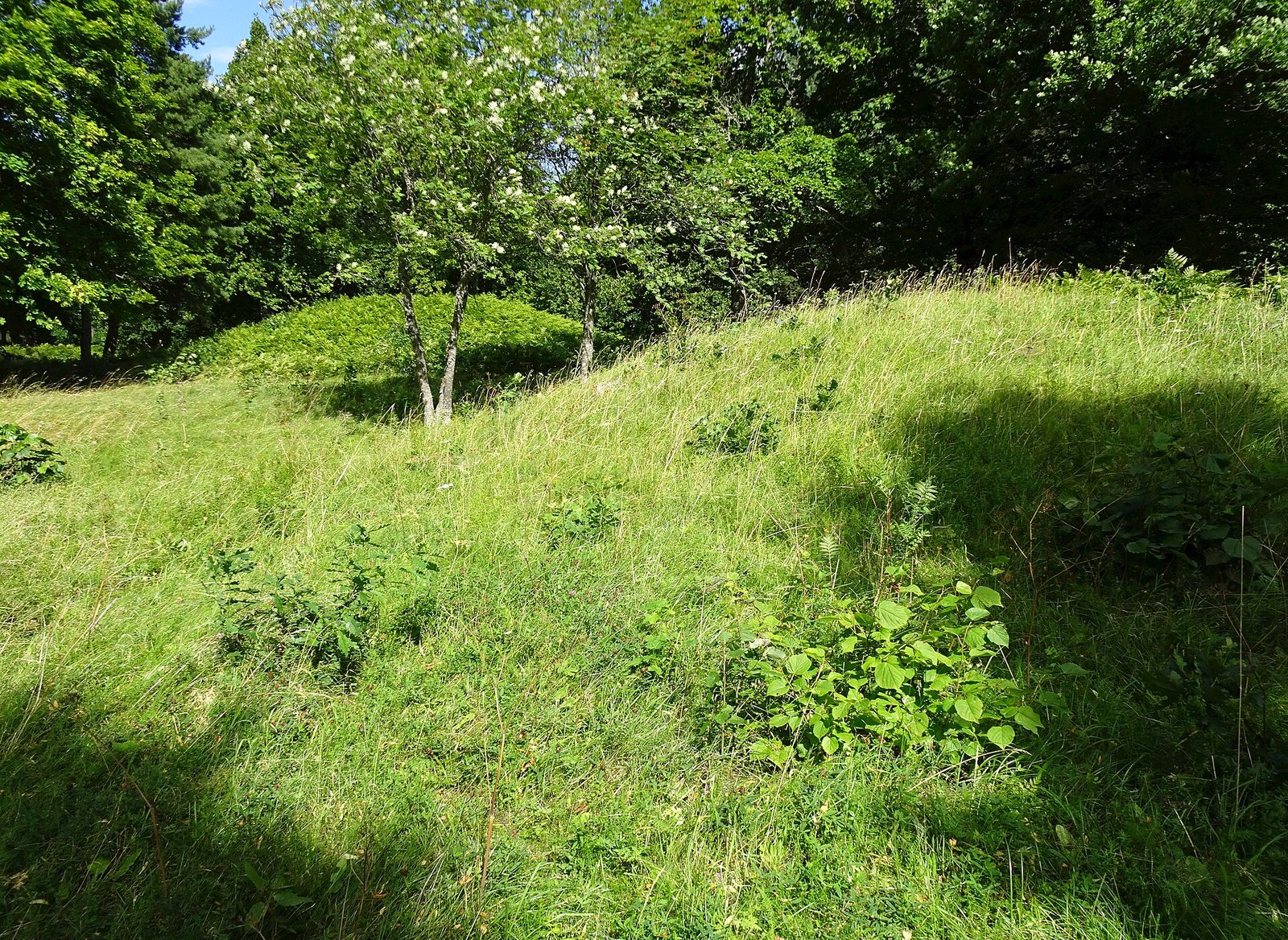
West of Stockholm, on the island of Munsö in Ekerö municipality, stands a large burial mound that has been called Björn Järnsidas hög – Björn Ironside's mound – for centuries. According to the municipality it is about 20 metres across and roughly five metres high. It belongs to a cemetery with numerous smaller mounds, and on top of it lies a fragment of a runestone from the late eleventh century. The stone is centuries younger than any possible Björn and does not mention him.
So where does the name come from? As far as it can be traced, from the study rather than from folk memory. Around 1700 the Swedish antiquarian Johan Peringskiöld set about matching the kings of the sagas to the country's great mounds. Hervarar saga and a seventeenth-century king list linked Björn to Munsö, and so the island's biggest mound acquired its occupant. Ekerö municipality itself notes that Peringskiöld worked with great enthusiasm but not necessarily scientifically.
As for dating: according to the municipality the cemetery belongs roughly to the period 550–800. That would make the mound older than the Björn who stood on the Seine in 858. We know of no modern excavation that could date or identify whoever lies inside. Its size points to a powerful figure of the later Iron Age, perhaps a chieftain or petty king. Who that was remains open.
It is still worth a visit. The cemetery is freely accessible, and not far away lies Adelsö with the royal mounds of Hovgården, where the Björn of 829 probably held court.
For many people Björn Ironside is above all a face: Alexander Ludwig played him in the series "Vikings" (2013–2020) as Ragnar's eldest son, son of the shield-maiden Lagertha, Mediterranean voyager and king of Kattegat. The show made the name better known than all the sources put together – while mixing centuries and inventing relationships. Lagertha as Björn's mother appears in no source; Saxo knows a Ladgerda as Ragnar's wife but does not make Björn her son. More in our "Vikings" fact-check and on Lagertha.
Peel back the layers and you are left with a Viking leader who fought on the Seine from 856 to 858 and then submitted to a Frankish king. Beside him stands an anonymous fleet that made one of the longest raiding voyages of the early Middle Ages between 859 and 861. A Norman monk fused the two around 1070 and added Ragnar as father. Icelandic storytellers turned him into the ancestor of Swedish kings, and eighteenth-century scholars gave him a grave.
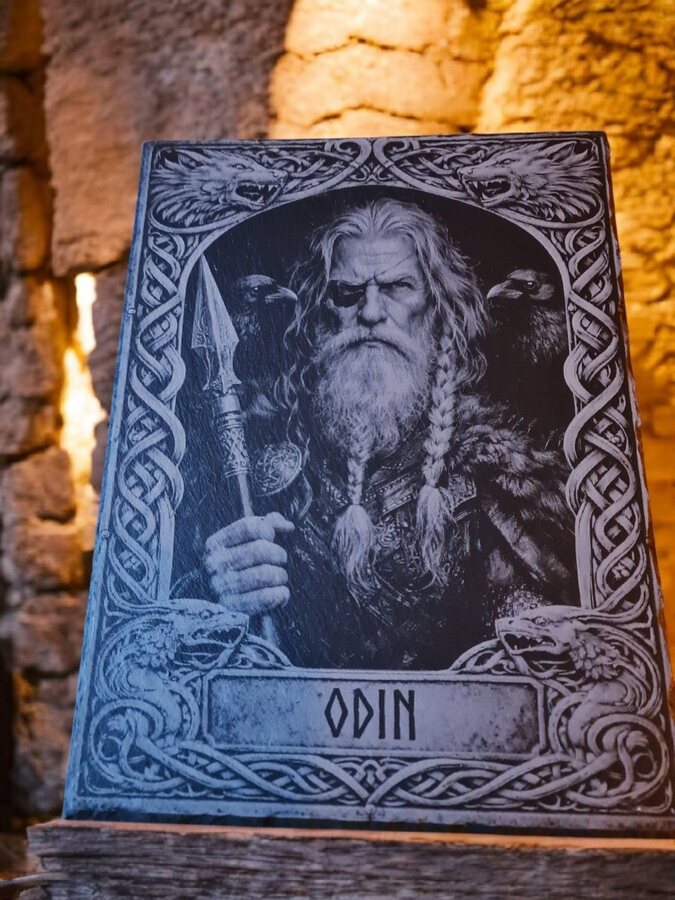
That is not disenchantment. It is a lesson in how a monastery's note becomes a hero to whom kings tie their origins. If you engrave one of Ragnar's sons in slate or wood, you carry both: the man from the annals and the legend he became. To see how other Viking-age rulers sit between source and saga, try our overview of the great kings of the Viking Age, or read about Björn's brother Ivar the Boneless.
For courage. For remembrance. For legends that live on.
Was Björn Ironside a real person? A Viking leader named Björn (Berno) is recorded by contemporary Frankish annals on the Seine between 856 and 858. Whether he is the same man as Ragnar's son in the sagas cannot be proven.
Was Björn Ironside really Ragnar Lothbrok's son? That claim first appears in William of Jumièges around 1070 and in Icelandic sagas of the thirteenth and fourteenth centuries. Contemporary sources name no father.
Did Björn Ironside sail to Rome? A Viking fleet reached Italy around 860 and sacked Pisa. The tale of mistaking Luni for Rome is a later legend, and Vikings never attacked Rome itself.
Where is Björn Ironside buried? The mound called "Björn Järnsidas hög" on Munsö in Lake Mälaren has been attributed to him since around 1700. There is no proof, and the cemetery is probably older than Björn.
Why is he called Ironside? The byname first appears around 1070 as "Costae ferreae". Saxo Grammaticus explained it around 1200 as invulnerability in battle – an interpretation after the fact.
When did Björn Ironside die? Nobody knows. The Seine Björn vanishes from the annals after 858; William of Jumièges has him die in Frisia, the sagas as king in Sweden.
Ragnar's sons · Ragnar Lodbrok · Ivar the Boneless · Lagertha the Shield-Maiden · The longships.
All History & Finds articles →
Sometimes history is found not with the spade but with the computer. For a long time four of Harald Bluetooth's famous …
Read more →