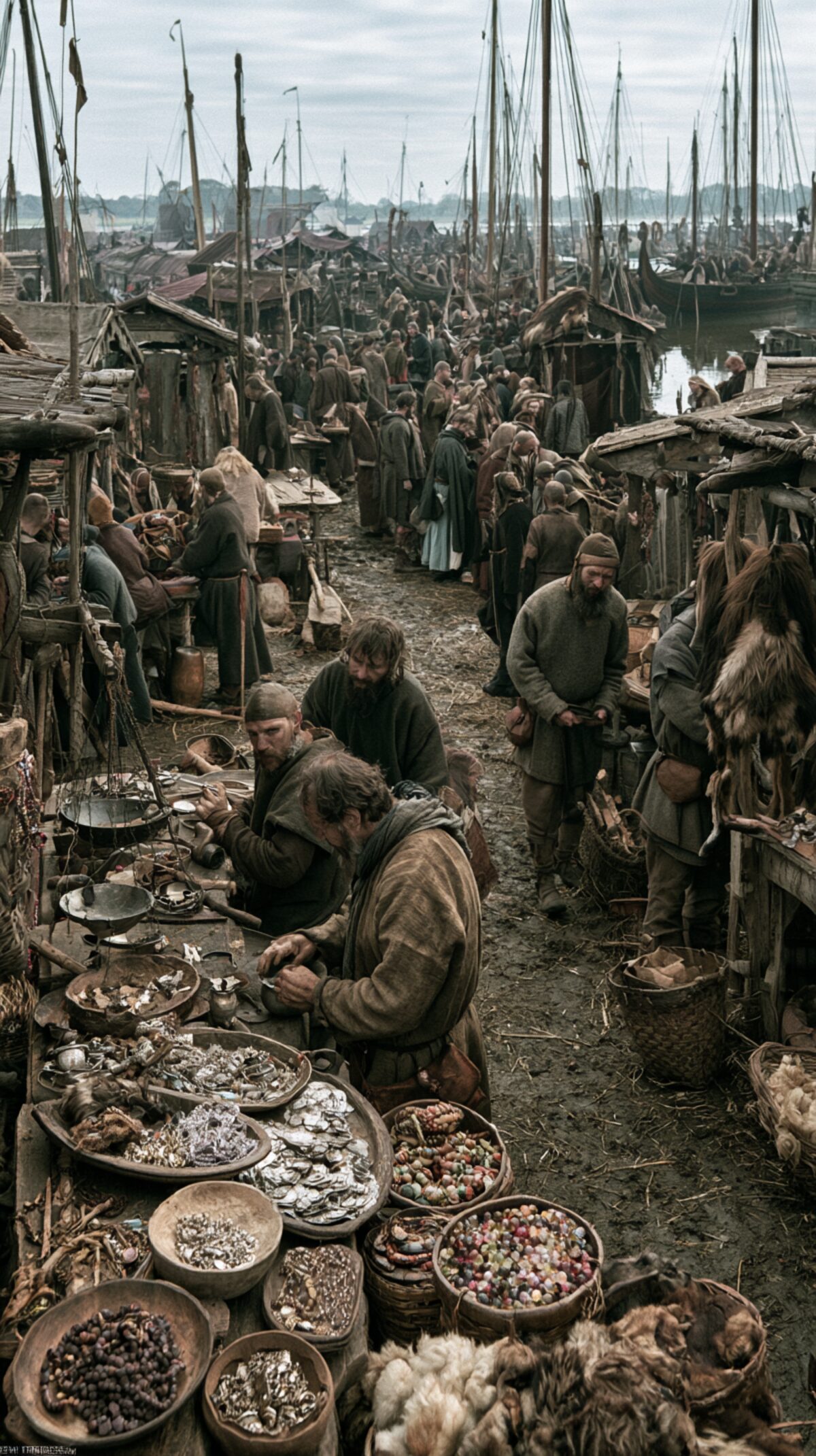
He is called the "Apostle of the North" – yet when Ansgar died in 865, the North was still firmly pagan. The monk from Corbie was one of the first Christians to see Hedeby and Birka with his own eyes, and his life story, written down by his pupil Rimbert, is one of our most important sources on the early trading towns of the Viking Age. An honest look at a man whose fame grew far larger than his success.
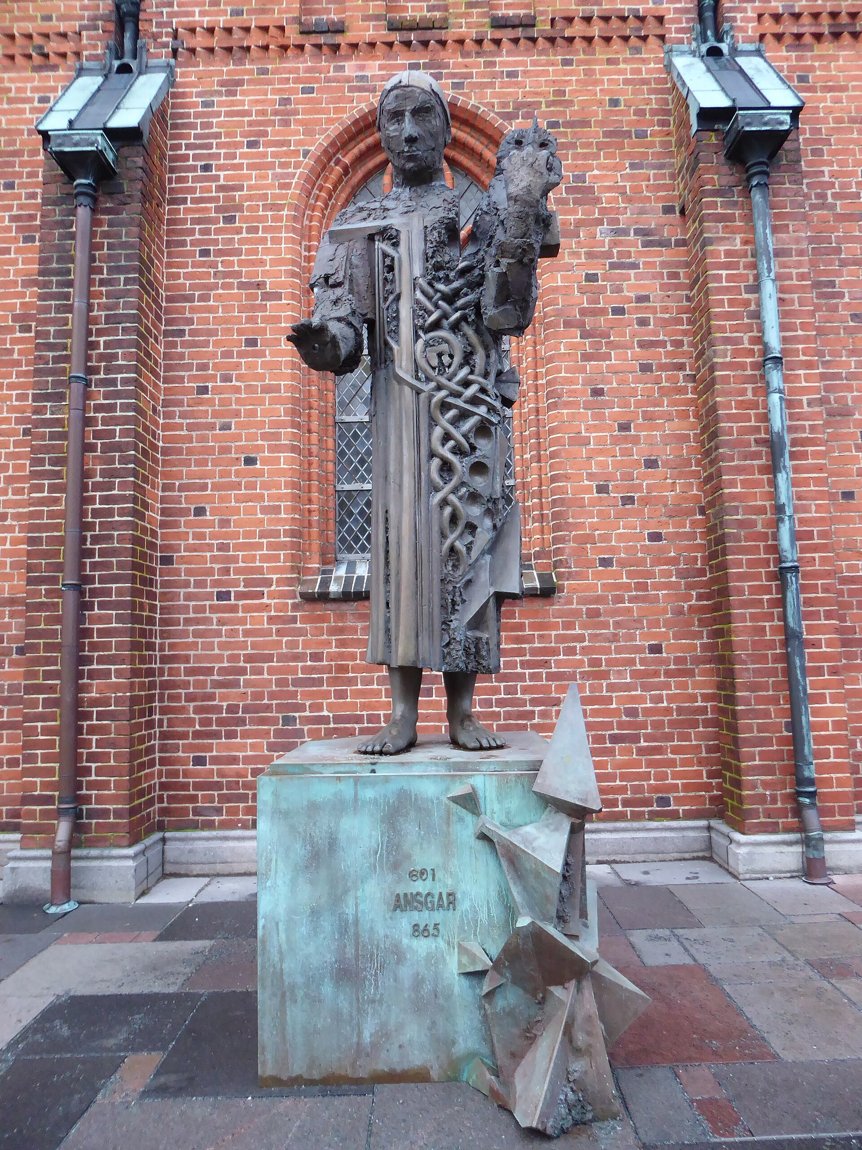
Ansgar was born in 801 in the northern part of the Frankish empire, probably near Amiens in what is now northern France. It was the age of Charlemagne, whose realm had just pushed to the very edge of the pagan world. The Saxons to the north had been Christianised by force, but beyond the Elbe and the Eider lay a world almost untouched by Rome and the Church: the land of the Danes, Swedes and Norwegians.
As a small boy, Ansgar entered the monastery school of Corbie, one of the great centres of learning in the Frankish empire. Later he moved to Corvey, its Saxon daughter house on the Weser – Corvey became an engine of the Christianisation of northern Germany. Here the monk Ansgar became a man with a fixed idea: he wanted to carry the Gospel to where no one had yet heard it – into the pagan North.
The opportunity came in 826. The Danish petty king Harald Klak, under pressure at home, had himself baptised at Mainz – a political move to secure Frankish support. On the journey home a cleric was to accompany him to spread the new faith in Denmark. Ansgar volunteered. For a devout monk this was no comfortable task: he left the safety of the cloister to travel into a land where Christians were strangers and sometimes enemies.
This first mission was a hard beginning. Harald Klak soon lost power again, and with the royal protection gone, the ground shifted beneath Ansgar's feet. But the monk had wedged a foot in the door of the North – and he would return.
A few years later an even longer journey took him to Sweden. A Swedish embassy had come to the court of Louis the Pious and reported that there were people in their land who wished to accept the Christian faith. Ansgar set out – and the voyage turned into an ordeal. On the way, Vikings attacked his ship and robbed him of almost everything, including the precious books he carried.
Ansgar reached Birka all the same, the great trading centre on the island of Björkö in Lake Mälaren, the heart of Swedish long-distance trade. Here he was allowed to preach and baptised a number of people, apparently including respected citizens. For us today this stay is priceless: Ansgar and his circle are among the very few witnesses who knew Birka in its heyday at first hand. What the Vita Anskarii reports about the place complements what archaeologists have dug from the ground – even though the text never meant to be a travel report, but a spiritual testimony.
Ansgar's efforts did not go unrewarded. Around 831 he was raised to Archbishop of Hamburg, and the Pope charged him with leading the entire mission in the North. Hamburg, then a small outpost on the very edge of the Frankish empire, was to become the Church's gateway to the North – the springboard to the Danes and Swedes.
It was an ambitious plan. From Hamburg, Ansgar hoped to spread a net of churches, priests and baptised communities across the North. But Hamburg lay dangerously exposed, less than a day's journey from pagan land. What was meant to be a bridgehead soon became a target.
In 845 disaster struck. A Danish fleet sailed up the Elbe and fell upon Hamburg. The young bishop's town went up in flames – church, monastery and the painstakingly built library were destroyed. Ansgar escaped, but lost almost everything he had built up over fifteen years.
There is a bitter irony in it: the man who wanted to win the North for Christianity was robbed of his seat by those very Northmen. To the Vikings, Hamburg was no holy place, simply a target – a town with supplies, valuables and defenceless inhabitants. The raid shows without mercy how small and vulnerable the early Church in the North still was.
Ansgar did not give up. After the loss of Hamburg he was additionally given the diocese of Bremen, and the two seats grew together into the united archbishopric of Hamburg-Bremen. This union would shape the North for centuries: Hamburg-Bremen became the ecclesiastical headquarters from which the whole North – as far as Iceland and Greenland – was administered. That the two Hanseatic cities are still inseparably tied to the mission history of the North goes back to this makeshift solution of the 9th century.
From Bremen, Ansgar continued his work. He did not become a desk-bound bishop but travelled north again himself, negotiated with kings and patiently courted every single believer.
Ansgar's second great strength was diplomacy. Around 852 he travelled as an envoy of Louis the German to Denmark and won from the Danish king Horik permission to build a church at Hedeby. That was a real breakthrough – Hedeby, the most important trading place in the North on the Schlei, right on the border between the Frankish and Danish worlds, right in the region between the North Sea and the Baltic that is our own home ground.
Rimbert passes on a telling thought: the king recognised that Christian merchants would boost trade and thus the town's toll revenues. Faith was therefore not only a matter of the heart but also of business. In the following years Ansgar managed to found a church at Ribe as well – the oldest town in Denmark. His work wisely focused on exactly these great trading places, where people from many lands met and where the new was tolerated more readily than in the isolated farms of the countryside.
What is considered secure: Ansgar's dates (801–865), his background at Corbie/Corvey, the mission journeys to Denmark (826) and Birka (around 829/830), his elevation to Archbishop of Hamburg, the destruction of Hamburg in 845 and the later union into Hamburg-Bremen are all well attested by the Vita Anskarii and Frankish sources. That he was allowed to found churches at Hedeby and Ribe is among the most reliable news we have about the early Church in the North. Rimbert was Ansgar's pupil and immediate successor – he wrote from close proximity, only a few years after his death (between roughly 869 and 876).
Almost everything we know about Ansgar we owe to a single book: the Vita Anskarii, written by his pupil and successor Rimbert. Without this text Ansgar would be little more to us than a name in a list of bishops. Rimbert knew Ansgar personally, travelled with him and took over the office after his death – a source can hardly stand closer to its subject.
Yet it is precisely this closeness that makes the Vita a text to read with care. Rimbert did not write a neutral biography in the modern sense but a saint's life – a book that places Ansgar's piety, his visions and his miracles at the centre in order to promote his veneration as a saint. Such a text aims to edify and convince, not to report soberly. The miracle accounts, the dreams and heavenly signs belong to the genre and are not factual protocols. For the historian the Vita nonetheless remains invaluable – one simply has to separate the layers: the journeys, the places, the political negotiations are credible; the sanctity is Rimbert's interpretation.
"If I could be found worthy in God's sight, I would ask this one thing of his goodness: that he grant me the grace to be a good man." Rimbert, Vita Anskarii (paraphrased from the Latin tradition; Ansgar's answer to the question about the greatest miracle)
This handed-down saying captures the heart of the Vita: Rimbert tells us that people held Ansgar to be a worker of miracles – but the monk waved this aside and saw the true miracle in a good, honest life. Whether Ansgar said it in exactly these words we cannot know. But it fits the image of a man who preferred to work rather than to shine.
Ansgar died on 3 February 865 in Bremen – not as a martyr in battle, but after an illness, quietly and composed. Rimbert draws the picture of a man who lived simply to the end: he is said to have worn a rough garment, cared for the poor and never set himself above others. No spectacular end, no triumph – but a life that stayed true to its own claim.
It is precisely this quiet close that makes Ansgar likeable. He died without knowing whether his work would last. And, to be honest, at that point it did not look like it would.
Myth check – the "Apostle of the North": The honorary title sounds like sweeping success, but the truth is more uncomfortable. In Ansgar's own lifetime the North did NOT become lastingly Christian. No sooner had he gone than many of his communities lapsed back into paganism; after his death the Swedish mission collapsed almost entirely, and Birka remained pagan at its core. The final Christianisation of Scandinavia came only about 150 years later – through kings such as Harald Bluetooth, Olav Tryggvason and Olav the Holy, who imposed the faith from above. Ansgar was an early missionary, not a successful converter of whole peoples. The title "Apostle of the North" comes from later Church veneration, not from a sober balance-sheet of his own age. And note: Ansgar did not "conquer" or "subjugate" the North – he preached, negotiated and built churches, no more. Anyone who makes him the hero of a completed Christianisation misjudges how fragile and often unsuccessful this early mission really was.
One might ask: a missionary who failed – why bother with him? Because Ansgar and his circle open a window onto a world that otherwise speaks to us almost only through finds in the ground and later sagas. The Vita Anskarii describes Hedeby and Birka not as abstract dots on a map but as living trading towns with kings, merchants, assemblies and a mixed population. It shows how tightly trade, politics and religion were interwoven in the 9th century – that a king tolerated Christians because they were good for business.
Ansgar also reminds us that the Viking Age was no pure "pagan age" but a time of upheaval. Decades before the great Christian kings arrived, the old faith in Odin, Thor and Freyr stood face to face with the new faith of the Frankish monks – sometimes in conflict, often in pragmatic coexistence on the same marketplace. Anyone who wants to understand the Norse world should know these points of friction too. It was out of exactly this that many of the symbols, stories and works of art arose that still fascinate us today.
To this day churches, streets and parishes in Hamburg, Bremen and across northern Germany bear Ansgar's name. His feast day is 3 February. For the region between the North Sea and the Baltic – the home of the great trading places of the Viking Age – he is a key figure in the transition from the old faith to the new. That Hamburg-Bremen of all places became the ecclesiastical metropolis of the North is his legacy.
At Glanz & Gravur we prefer to tell the stories of the North honestly – with all their shine and all their fractures. Ansgar is one such story: the man who wanted to convert the North and did not manage it in his lifetime, yet whose name endured because a faithful pupil wrote it down. A monk from the Frankish empire who saw Hedeby and Birka with his own eyes – and through him made visible a piece of the Viking Age that would otherwise have stayed in the dark.
Hedeby · Birka – the trading hub · The Christianisation of the Germanic Peoples · Harald Bluetooth.
All History & Finds articles →
High above the world of humans, beyond the burning rainbow bridge, lies Asgard – the fortified home of the Æsir. It is …
Read more →