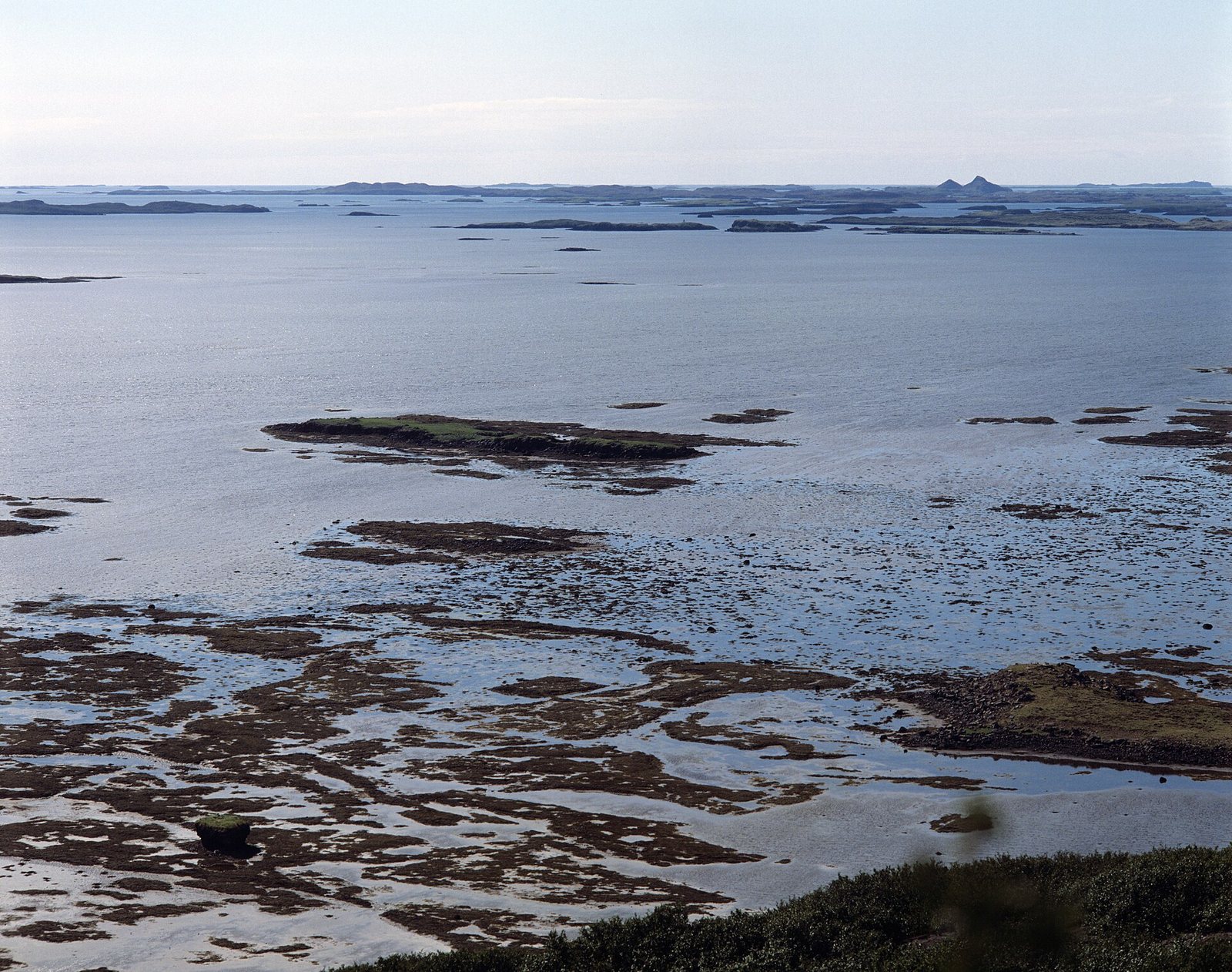
Aud the Deep-Minded (Old Norse Auðr djúpúðga, called Unnr in Laxdæla saga) was one of the four greatest settlers of Iceland: after the deaths of her husband Olaf the White and her son Thorstein the Red, she led her kin from Scotland via Orkney and the Faroes to Iceland and took land at Hvammur on Breiðafjörður in the late 9th century. Here you will find which source says what, where they contradict each other and how much is history – from the slaves she freed and the crosses at Krosshólar to her two very different burials.
Picture an old woman in a Scottish wood, watching men shape planks in secret. Her husband is dead. Her only son has just been killed by the people who now hold the land around her. She has a houseful of grandchildren, retainers, unfree servants and goods, and she has a plan that nobody may hear about until the ship is in the water. That, at least, is how Icelanders told the story some three centuries later. Whether every detail is true is the question that runs through this whole article.
Aud the Deep-Minded is one of the best-known women of the Viking Age, yet no rune stone names her and no grave of hers has ever been found. Her fame is literary and genealogical: half of medieval Iceland wanted to descend from her. To understand her, you have to lay the texts side by side and watch where they disagree.
The confusion starts with her name. Landnámabók, the Icelandic "Book of Settlements", calls her Auðr. Laxdæla saga, which tells her story at greatest length, calls her Unnr. Both are genuine Old Norse women's names: Auðr is linked to "wealth, good fortune", Unnr means "wave". Why two works give one woman two names is not known. That they mean the same person is not in doubt: father, husband, son, home and descendants all match.
The nickname wobbles too. Djúpúðga means roughly "the deep-minded, the profound thinker", and that is the form in Laxdæla saga. The Sturlubók version of Landnámabók and Eyrbyggja saga give djúpauðga instead, "the deeply wealthy". One letter's difference on the page, a whole character sketch in meaning: wisdom or wealth. The scholar Sofie Vanherpen has shown how Sturla Þórðarson, the compiler of Sturlubók, shaped Auðr as a Christian founding mother, while Laxdæla presents a dignified matriarch of a more traditional, pagan-tinged kind. Which epithet came first cannot be settled. We use the familiar "Deep-Minded" and keep in mind that "the Wealthy" is just as well attested.
No contemporary document mentions Aud. Everything we know comes from Icelandic texts of the 12th to 14th centuries; for background on the genre, see our overview of the Sagas of Icelanders. Five works matter most:
Add to these Eiríks saga rauða (the Saga of Erik the Red), which summarises her voyage in its opening chapter and preserves the lovely episode of the freedman Vífill.
Aud's father was Ketill flatnefr, "Ketill Flatnose", a Norwegian chieftain and son of Bjǫrn buna. The sources give him the children Bjǫrn the Easterner (austrœni), Helgi bjóla, Þórunn hyrna (wife of Helgi the Lean, another major settler in northern Iceland) and Aud herself.
How Ketill reached the Hebrides depends on which text you read. Eyrbyggja saga has him conquer the isles for King Harald Fairhair and then keep them for himself. Laxdæla saga has him flee from Harald. Landnámabók combines the two: Harald conquers, leaves, sends Ketill to reconquer, and Ketill stops paying tribute. The historian Alex Woolf regards the tribute story as a later construction serving Norwegian claims to the islands, and the chronology is awkward: Aud's son seems to have been active in Scotland before Harald could plausibly reach that far.
Some scholars have equated Ketill with a Caittil Find, "Ketill the White", whom the Annals of Ulster record under 857 as leader of a mixed Norse-Gaelic force defeated in Munster. Others find this very thin: Ketill was a common name, and in the annals Caittil seems to fight against the very Olaf whom the sagas make his son-in-law. The question stays open. What is clear is that Aud's family lived in a world where Norse and Gaels intermarried, allied and fought.
According to the sagas, Aud married Óláfr hvíti, Olaf the White, a "war-king" (herkonungr) and son of one Ingjaldr. Landnámabók says he won Dublin and its hinterland, became king there and fell in battle in Ireland.
Whether this saga Olaf is the Amlaíb of the Irish annals is one of the classic debates of Viking studies. Amlaíb appears in Ireland in 853 as son of the king of "Laithlind", rules in Dublin and drops out of the Irish record around 871; the Fragmentary Annals have him return to Norway. The Irish texts give his wife as a daughter of a king Áed, not of Ketill, and his father is not called Ingjaldr. Some historians still think the identification likely; others, such as Gwyn Jones, call it unproven. For the Irish side, read our article on Olaf the White.
For Aud this means that her marriage to a Viking king in Ireland is saga tradition, not contemporary record. It is plausible, but Icelandic families had a habit of rounding up when it came to grand ancestors.
Aud and Olaf had a son, Þorsteinn rauðr, Thorstein the Red. After his father's death Aud took him to the Hebrides. Landnámabók says Thorstein allied with Earl Sigurd of Orkney and conquered Caithness, Sutherland, Ross and Moray and more than half of Scotland. Laxdæla is a little more modest: he made peace with the Scots and received half of Scotland. Both end the same way: the Scots broke faith and killed him, by treachery according to Landnámabók, in Caithness according to Laxdæla.
Whether Thorstein really held "half of Scotland" is doubtful; family pride is speaking. We look at the details in our article on Thorstein the Red. What matters here is Aud's position after his death. Laxdæla stresses that her father Ketill was dead by then too. She had no male protector, six granddaughters and a grandson, in a country whose rulers had just killed her son.
Now comes the famous scene. Laxdæla says Unnr had a knǫrr built secretly in the forest, "í skógi á laun". A knarr was a broad, high-sided cargo ship, made for goods, livestock and people on the open sea, not for fast raids. It is exactly the ship you need if you mean to emigrate rather than plunder. Our article on Viking ship types explains the difference.
When the ship was ready she sailed with her family, her wealth and many followers. Eiríks saga gives a number, in John Sephton's translation:
"Afterwards Aud set out to seek Iceland, having twenty free men in her ship."Eiríks saga rauða, ch. 1, trans. John Sephton 1880 (public domain)
Twenty free men, plus women, children and unfree people, who were not counted in tallies like this. Laxdæla's narrator is openly impressed. In Muriel Press's 1899 translation: "scarce may an example be found that any one, a woman only, has ever got out of such a state of war" with so much wealth and so large a following.
Why in secret? The saga does not say. The obvious reading is that anyone fitting out a ship openly without protection invites attack. Whether the forest shipyard is memory or storytelling we cannot tell.
Aud did not sail straight to Iceland. She made two stops, and both served one purpose: marriage politics. In Orkney she married off her granddaughter Gró, Thorstein's daughter. According to Landnámabók and Orkneyinga saga, Gró married Dungaðr, earl of Caithness; their daughter Grélǫð became the wife of Þorfinnr Skull-splitter, one of the Earls of Orkney.
In the Faroes she married off another granddaughter, Ólǫf. From her, says Laxdæla, came the noblest family of the islands, the people of Gata, the Götuskeggjar, from whom the famous Þrándr í Götu of Færeyinga saga sprang. More in our article on the Faroese. In the thinking of the time this was no dumping of granddaughters: every marriage created kinship, and kinship meant protection.
Her arrival in Iceland was anything but triumphant. The ship was wrecked on the south coast at Vikrarskeið, a stretch of shore between the mouths of the Ölfusá and the Þjórsá. People and goods were saved; the ship was lost.
Aud turned to her brother Helgi bjóla, who had settled at Kjalarnes in the south-west. Helgi offered her shelter, but only for part of her company: ten people, according to Laxdæla; half her following, according to Landnámabók. Aud was offended, refused and moved on. Her other brother, Bjǫrn the Easterner at Bjarnarhöfn on Breiðafjörður, took her in with all her people. Two brothers, two kinds of hospitality: finely crafted as literature, impossible to check as history, but a clear picture of what 13th-century Icelanders considered honourable.
In spring Aud and her people sailed into Breiðafjörður to look for land. Landnámabók ties the journey to place names: at Dögurðarnes ("breakfast ness") they ate breakfast, at Kambsnes Aud lost her comb. Such name stories are often invented after the fact to explain an existing name.
Aud claimed the whole district of Dalir ("the Dales"), according to Landnámabók between the rivers Dögurðará and Skraumuhlaupsá, and made her home at Hvammur at the inner end of Hvammsfjörður, an arm of Breiðafjörður. Laxdæla adds that her high-seat pillars (öndvegissúlur) had washed ashore there. It is a familiar motif: settlers threw the carved posts of the high seat overboard and settled where they landed.
Hvammur remained a major farm for centuries. Snorri Sturluson, author of the Prose Edda, was born there in 1179. His father, Hvamm-Sturla, lived there, and Hvamm-Sturla's grandson Sturla Þórðarson later compiled Sturlubók with its most Christian portrait of Aud. A touch of local pride is hard to rule out.
Aud gave much of her land to shipmates and to people she released from slavery. The sources name, among others:
Eiríks saga tells the Vífill episode beautifully. Vífill asked Aud why she gave him no homestead like the others. Her reply, in Sephton's words:
"… he would be esteemed in whatever place he was, as one worthy of honour."Eiríks saga rauða, ch. 1, trans. John Sephton 1880 (public domain)
Then she gave him land anyway. Vífill's granddaughter, incidentally, was Guðríðr Þorbjarnardóttir, who later sailed to Greenland and Vinland. The Vikings of the North Atlantic are linked to Aud through a freed slave.
What lies behind this? Freedmen (leysingjar) held an in-between status in Iceland: free, but still bound to their former master or mistress. By granting them land Aud created a following that settled her territory and stayed loyal to her. Generosity and power politics went hand in hand. How harsh unfree life usually was is the subject of our article on slavery among the Vikings; a rare carved record of a freed slave is the Hørning Stone in Denmark.
The Gaelic origins in Aud's household stand out, and they fit the genetics. Studies of mitochondrial DNA in modern Icelanders by Agnar Helgason and colleagues (2001) found that a large share of female founding lineages came from the Gaelic world, far more than among the male lines. Ancient genomes from Icelandic graves (Ebenesersdóttir et al. 2018) confirm the Norse-Gaelic mix in the first generations. Aud's household is a literary mirror of that, not proof. See also our article on Indigenous DNA in Iceland.
Sturlubók says that Aud said her prayers at Krosshólar, the "Cross Hills", and had crosses raised there "því at hon var skírð ok vel trúuð", because she was baptised and firm in her faith. That makes her a Christian in a country that officially adopted Christianity only around the year 1000.
It is not implausible. Her family had long lived in the Hebrides and Ireland, in a Christian environment. Eyrbyggja saga relates that Bjǫrn the Easterner, on arriving in the west, found his siblings had taken up a different faith; he kept the old one, hence his nickname. Our article on the Christianisation of the Germanic peoples shows how slow and patchy that process was.
Landnámabók's sequel is sobering. Aud's kin later venerated the hills, built a hǫrgr, a pagan cult site, there once sacrifices began, and believed they would pass into the hills when they died. The place of prayer became a hill of the ancestors.
Laxdæla does not mention Aud's Christianity at all. Its Unnr looks like an old-style chieftain and is buried in a ship. Whether Aud was really baptised cannot be proven. It is possible, but Sturla Þórðarson, writing in a long-Christian 13th century, had reasons to present the founding mother of many leading families as an early Christian.
Today a large stone cross stands on Krosshólaborg, a rocky ridge near the shore not far from Hvammur. A women's association from the Dalir district had it raised in 1965, with an inscription quoting Landnámabók. The later pagan cult there is, unsurprisingly, not mentioned.
Late in life Aud named her grandson Óláfr feilan, Thorstein's son, heir to Hvammur, and held a great feast for his wedding to Álfdís of Barra. In Laxdæla she welcomes the guests, hands over the farm and its wealth to Óláfr, and declares that this will be the last wedding feast she prepares. Then she rises and walks briskly down the hall to her sleeping chamber, and people remark how upright the old woman still is. Next morning she is found dead, sitting up against her pillows.
The guests then celebrated wedding and funeral feast together. And then:
"She was laid in a ship in the cairn, and much treasure with her, and after that the cairn was closed up."Laxdæla saga, ch. 7, trans. Muriel Press 1899 (public domain)
A ship burial in a mound with rich grave goods: the very form we know from elite graves such as Oseberg. Our article on boat burial explains it in more detail.
Landnámabók tells a completely different story. There too Aud dies during a feast, in the night after the drinking, and the guests are to carry on in her honour. But she is not laid in a mound. She is buried in the flæðarmál, the strip of shore between high and low tide, as she herself had ordered, because as a baptised woman she would not lie in unconsecrated earth. In our own rendering: "She was buried in the tide-line, as she had directed, for she would not lie in unhallowed ground, since she was baptised."
The foreshore as a burial place is a striking detail. It belongs neither wholly to land nor wholly to sea; for a Christian without a churchyard it was perhaps the least pagan ground available. Whether Sturla shaped it to suit his Christian Aud, we cannot know. For burial customs in the North more generally, see our article on death and the afterlife in the North.
Very probably historical: there was an important woman settler called Auðr who took land at Hvammur in Breiðafjörður in the late 9th century. Ari says so around 1130, only a few generations later, and he was one of her descendants.
Plausible, but known only from sagas: her father Ketill, husband Olaf, son Thorstein and his death in Scotland, the voyage via Orkney and the Faroes, and the land grants to followers and freedmen. The texts agree here; independent evidence is lacking.
Disputed: Olaf's identification with Amlaíb of Dublin, Ketill's with Caittil Find, Thorstein's rule over "half of Scotland", and Aud's Christianity.
Literary elaboration: the secret ship in the forest, the place-name anecdotes, the scene with the brothers, the dignified death sitting upright, and the two contradictory burials. The date "920" printed above the wedding chapter in some translations comes from modern editors, not the saga.
None of this diminishes Aud. A real woman became, over generations, a founding mother in whom each age could read its own ideals. Women with property and real authority did exist in the Viking Age, especially as widows. How far their room for manoeuvre went is discussed in our articles on women in the Viking Age and women among Germanic peoples and Vikings.
Few figures of the settlement era have so many famous descendants. Through her granddaughter Þorgerðr and Dala-Kollr the line runs to Hǫskuldr Dala-Kollsson, whose daughter Hallgerðr langbrók is a central figure of Njáls saga, and to Óláfr pái, father of Kjartan in Laxdæla saga. Through Óláfr feilan and his son Þórðr gellir, a powerful 10th-century chieftain, runs the ancestry of Ari the Learned himself. Bishop Þorlákr Runólfsson of Skálholt also counted her among his forebears.
Icelanders of the 12th and 13th centuries were writing about their own foremothers. In modern times she became the heroine of 18th-century poems, of novels such as Naomi Mitchison's The Land the Ravens Found (1955) and of Vilborg Davíðsdóttir's Icelandic trilogy (from 2009). If you are looking for more figures between history and tradition, try our Lore of Legends.
What we in the workshop like most about Aud is that her greatness lies not in battles but in decisions. Having a ship built when others would have waited. Giving land away instead of hoarding it. Walking out when a brother would take only half her people.
Who was Aud the Deep-Minded? Aud (Old Norse Auðr djúpúðga, called Unnr in Laxdæla saga) was a late-9th-century settler who made her home at Hvammur in west Iceland. According to the sagas she was the daughter of Ketill Flatnose, wife of Olaf the White and mother of Thorstein the Red.
Why is she called both Aud and Unn? Landnámabók and most texts call her Auðr, Laxdæla saga calls her Unnr. The reason is unknown; they mean the same woman.
What does djúpúðga mean? Djúpúðga means roughly "deep-minded". Sturlubók and Eyrbyggja saga have djúpauðga, "deeply wealthy". Both nicknames are attested.
Was Aud the Deep-Minded a Christian? Landnámabók says she was baptised and raised crosses at Krosshólar; Laxdæla saga does not mention it. It is possible, since her family had long lived in Christian Ireland and Scotland, but it cannot be proven.
How was Aud the Deep-Minded buried? Laxdæla saga says in a ship inside a mound with much treasure; Landnámabók says in the tide-line on the shore, because she would not lie in unconsecrated ground. No grave has been found.
Was Aud a real historical person? Very probably. Ari Þorgilsson names her around 1130 as one of the four foremost settlers of Iceland. Many details of her life, however, come from later sagas.
For courage. For remembrance. For legends that live on.
Thorstein the Red · Olaf the White · Erik the Red · Leif Erikson · Hedeby.
All History & Finds articles →
Almost 1,500 years before the first Germanic peoples entered Roman history books, a highly developed Early Bronze Age …
Read more →Between the world of humans and the world of the gods a bridge of light is stretched: Bifröst, the rainbow. It is the …
Read more →Long before the Edda was written down, the people of Gotland told their stories in stone – in images that still puzzle …
Read more →