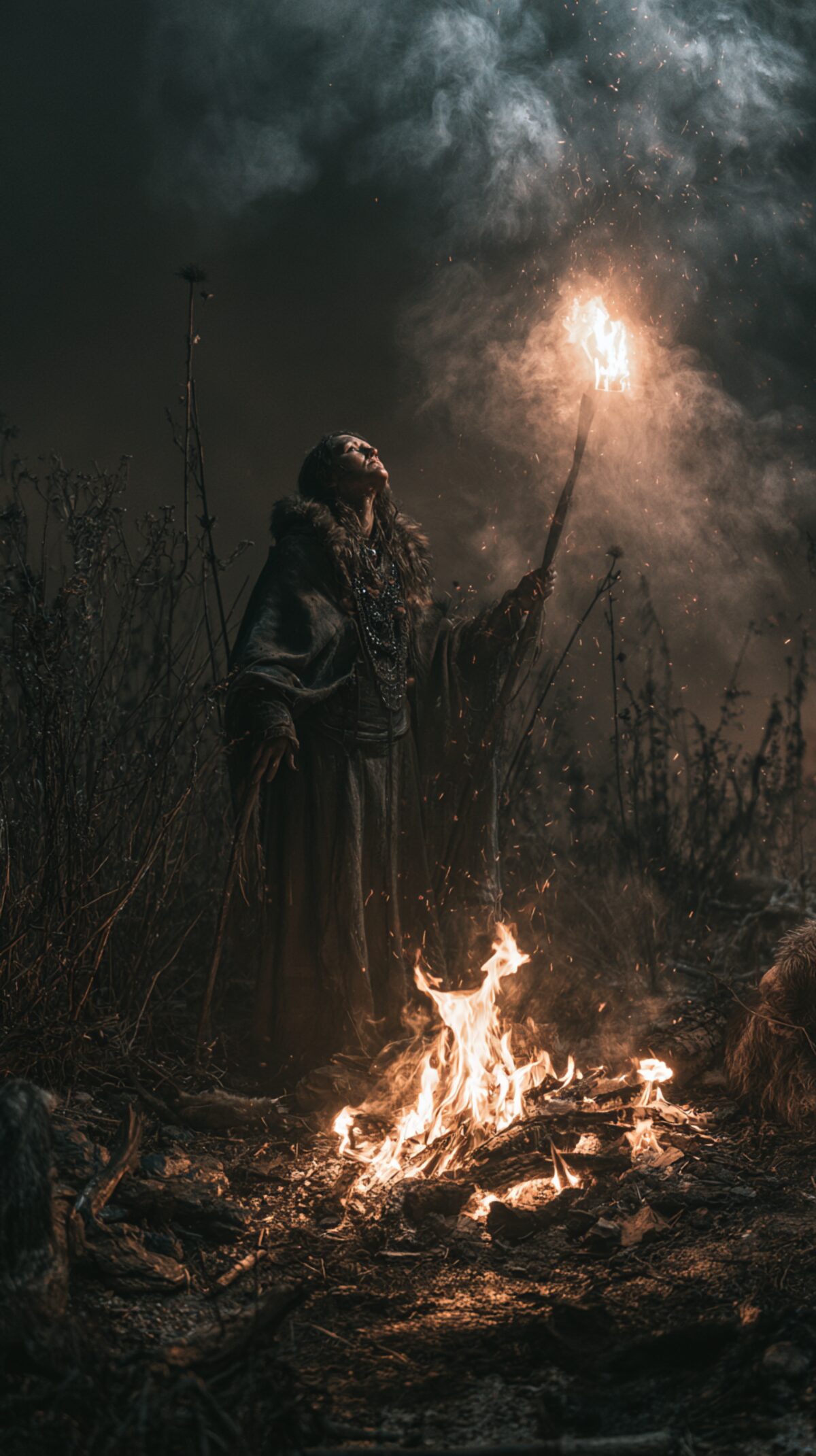
„Did this actually happen?" – few questions come up in the workshop more often when we engrave a dragon, a smith or a famous warrior into slate. The answer leads straight into Old Norse narrative literature: a world of gods and heroes, cursed gold and revenge, passed down orally for centuries and written down only late. This article is a guide through the genres and the great legendary cycles – and through the single most important misconception of all: a legend is not the same thing as history.
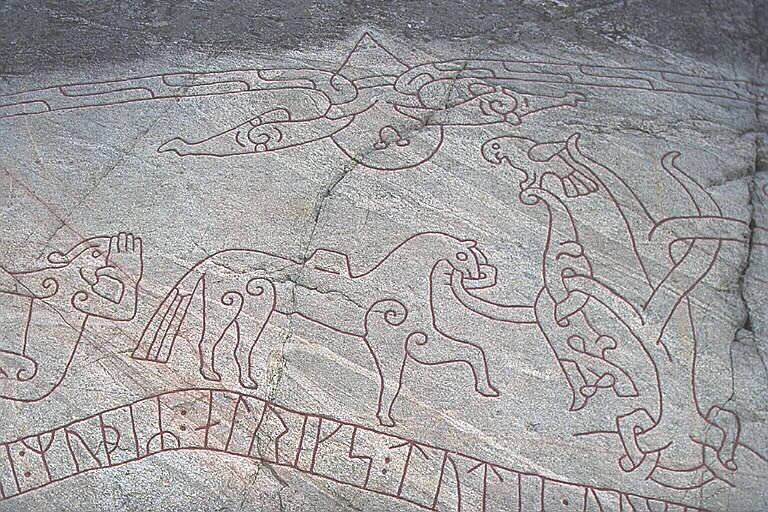
The word saga comes from Old Norse segja – „to say, to tell". A saga is therefore, at its core, something told: a story. What survives today as the written literature of medieval Iceland is the recorded late form of a far older art of telling by the fire. The North left no single „Viking bible", but a whole library of very different texts: poems about gods and heroes, learned handbooks, sober family chronicles, colourful adventure tales and royal biographies. Anyone who wants to understand the Norse world of legend must first keep these genres apart – for they differ greatly in age, tone and claim to truth.
Almost everything we have was written down in the 13th century in Iceland – on calfskin parchment, by Christian scribes, a good two hundred years after the end of the Viking Age proper. That is not a drawback but a stroke of luck: no other Germanic people preserved its old stories as richly as the Icelanders. One only has to remember that in reading them you always have two eras before you at once – the narrated time of the Vikings and the writing time of the High Middle Ages.
At the beginning stands the Poetic Edda, also called the Elder Edda: a collection of poems preserved above all in the Codex Regius, an Icelandic manuscript of the late 13th century. It falls into two great halves. The mythological lays tell of Odin, Thor, Loki and the fate of the world – the most famous being the „Völuspá", the Seeress's Prophecy, which spans from the world's beginning to its end:
Hearing I ask from the holy races, / from Heimdall's sons, both high and low; / thou wilt, Valfather, that well I relate / old tales I remember of men long ago.Völuspá 1, translation Henry Adams Bellows 1923 (public domain)
The second half, the heroic lays, leaves the world of the gods and turns to human heroes – above all the dragon-slayer Sigurd and the fall of the Nibelungs. These lays are terse, forceful and composed in the old alliterative verse, which relies not on end-rhyme but on matching initial sounds. They belong to the oldest core of the tradition; individual stanzas may have originated centuries before they were written down. A precise age, however, cannot be proven – and that too is part of honesty.
Around 1220 the Icelandic chieftain and scholar Snorri Sturluson composed the Prose Edda, also called the Snorra Edda. It is something entirely different from the lays: a textbook for aspiring skalds that orders and explains the old myths so that the intricate poetic circumlocutions (kennings) can be understood at all. A poet had to know why gold is called „Sif's hair" or „the otter's ransom" – and Snorri supplies the stories behind them.
That is precisely why the Prose Edda is our most important yet most problematic source. Much of what today counts as „Norse mythology" we know only because Snorri wrote it down systematically. At the same time he was a Christian scholar of the 13th century, who in his prologue even interprets the heathen gods euhemeristically as immigrant men from Troy. He is a brilliant storyteller – but no neutral record of the old faith.
Perhaps the North's most original achievement are the Sagas of Icelanders – some forty prose narratives about the first settler generations of Iceland between roughly 930 and 1030. They deal not with gods but with farmers, farmsteads, honour, feuds and law. Their tone is astonishingly sober, almost laconic: no introspection, no pathos, but sharp dialogue and a fine feeling for human constraints. Works like Njáls saga or Laxdæla saga rank among the finest European literature of the Middle Ages.
It is precisely because they feel so realistic that they are a trap. The Sagas of Icelanders read like factual reports, yet they were composed two to three hundred years after the events they describe. They are literature about a past, not eyewitness accounts – artfully constructed narratives that blend historical memory, family pride and literary shaping inseparably.
Quite different are the Fornaldarsögur, the „sagas of ancient times". They are set in a misty heroic age before the settlement of Iceland, long before the actual Viking Age, and are full of dragons, giants, cursed swords and berserkers. Here dwell Ragnar Lodbrok, Hrólf Kraki and the Völsungs. The name itself („old-time sagas"), incidentally, is only a 19th-century invention.
This genre makes no secret of its inventiveness. It aims to entertain, not to document – and is thereby more honest than much of what is sold today as „real Viking history". Anyone looking here for historical accuracy is looking in the wrong place; anyone seeking the magic of old heroic legend has come to exactly the right one.
The fourth great group are the kings' sagas – lives of the kings of Norway and Denmark. Their summit is Snorri's „Heimskringla", a history of the Norwegian kings from legendary antiquity into the 12th century. Here we meet figures who really existed: Harald Fairhair, who unified Norway, or the missionary king Olaf Tryggvason.
The kings' sagas stand closest to history writing – they draw in part on older skaldic verse, prized as a source hard to falsify. Yet they too are shaped narratives, with dramaturgy, direct speech and a moral thrust. A king becomes a character, his battle a stage. Closeness to history does not mean identity with it.
The greatest heroic cycle of the North is the story of the dragon-slayer Sigurd. He kills the dragon Fáfnir, wins its cursed gold, understands the speech of birds after a drop of dragon's blood, and is in the end doomed nonetheless, dragging the whole kindred of the Nibelungs down with him. It is told in the heroic lays of the Edda and, as a continuous account, in the Völsunga saga.
For us in the Rhineland this is no distant subject: it is the very same material that lives on in the German Nibelungenlied as the Siegfried legend. North and South tell the same ancient story in two versions. We have unfolded the whole chain of cursed gold, betrayal and revenge in our article on Sigurd the dragon-slayer.
Hardly a name is better known today than Ragnar Lodbrok – „Ragnar Hairy-Breeches". In the legendary sagas he is the great Viking hero who dies in a snake pit and whose sons take bloody revenge. Historically, however, Ragnar is barely graspable: a composite figure in which memories of several 9th-century leaders have merged. We have placed him between legend and evidence in our article on Ragnar Lodbrok.
Far better attested are his „sons" – Ivar the Boneless, Björn Ironside, Ubbe and others, who with the „Great Heathen Army" overran England from 865. Here legend and documented history touch in a fascinating way; we show this in the article on Ragnar's sons.
Heroic legend knows no national borders. The Old English „Beowulf" – the longest surviving Germanic heroic epic – is not set in England at all, but among Danes and Geats, and shares characters with the North: the Danish king Hrothgar and his hall Heorot lead straight to the Norse legendary figure Hrólf Kraki, around whose hall at Lejre its own tales cluster. And Starkad, the overlong, sombre champion, appears both in Saxo Grammaticus and in Norse sources.
These figures show that there was a shared Germanic store of legend from which England, Scandinavia and the Continent alike drew. The same heroes, the same motifs – simply retold in different languages and versions.
A special case is Weland, Old Norse Völund – the master smith who is captured and crippled by a king and takes cruel revenge before rising into the air on self-forged wings. His story stands in the Edda (Völundarkviða), but is equally depicted on the Anglo-Saxon Franks Casket around 700 and was known throughout the Germanic world.
For an engraving workshop, Weland is of course a motif close to the heart: the smith as creator and avenger, craft as power. We have devoted the article Weland/Völund the smith to him – and the famous image in our piece on the Franks Casket.
Between pure legend and graspable history stands Egil Skallagrímsson, hero of one of the great Sagas of Icelanders. Egil is Viking, farmer and at the same time one of the North's most important skalds: a grim fighter who in York appeases his mortal enemy Erik Bloodaxe with a praise poem, and who laments the death of his sons in one of the most moving poems of world literature. In him the two sides of Norse culture fuse – sword and word. More about him in our article Egil Skallagrímsson.
All these narratives have travelled the same long road. They first lived orally – by the hearth, at feasts, in the recitation of skalds and storytellers. Only once Iceland had become Christian and literate, from the 12th and above all the 13th century, were they committed to parchment. Between the narrated events of the Viking Age and the writing down often lie two to three hundred years – a span in which stories shift, condense and become charged with the concerns of the writing age.
Here lies the misunderstanding we hear most often. The sagas feel true – realistic farmsteads, concrete names, a sober tone. But they are literature of the High Middle Ages, not the diary of the Vikings. Whoever reads a Saga of Icelanders is reading a scribe's view around 1250 of the year 1000, not the report of a witness.
A second error: pop culture. Series, games and films sell „real Vikings" – cheerfully mixing legend, history and free invention. That is perfectly fine as entertainment, but it replaces no source. The television Ragnar is not historical evidence, but a modern character built on an already legendary name.
If none of it happened „exactly like that" – why does it move us? Because legends never had the task of keeping a record. They preserve what mattered to a culture: courage and measure, loyalty and revenge, the right word at the right moment, the good death. They hold the worldview of the Northmen more precisely than any date ever could.
For us at Glanz & Gravur, that is exactly why we engrave Sigurd's dragon, Weland's wings or a band of runes into slate and wood. We do not sell a fantasy costume, but a piece of honestly framed legendary culture – knowing what is evidence and what is story. History rather than kitsch: that turns a motif into more than decoration, into a piece of living heritage.
Sigurd the dragon-slayer · Ragnar Lodbrok · Ragnar's sons · Völund the Smith · Egill Skallagrímsson.
A feast of the gods, ale in plenty – and a guest who exposes every single one of them. The Lokasenna („Loki’s flyting") …
Read more →Every misdeed has its price, and Loki’s bill is settled all at once. After the death of Baldr and his merciless mockery …
Read more →A stranger offers the gods an unbreachable wall around their stronghold - in a single winter. His price is outrageous …
Read more →Most people know Ragnarök only as a world-fire: gods die, the sun goes out, the earth sinks. Yet the great world-poem …
Read more →