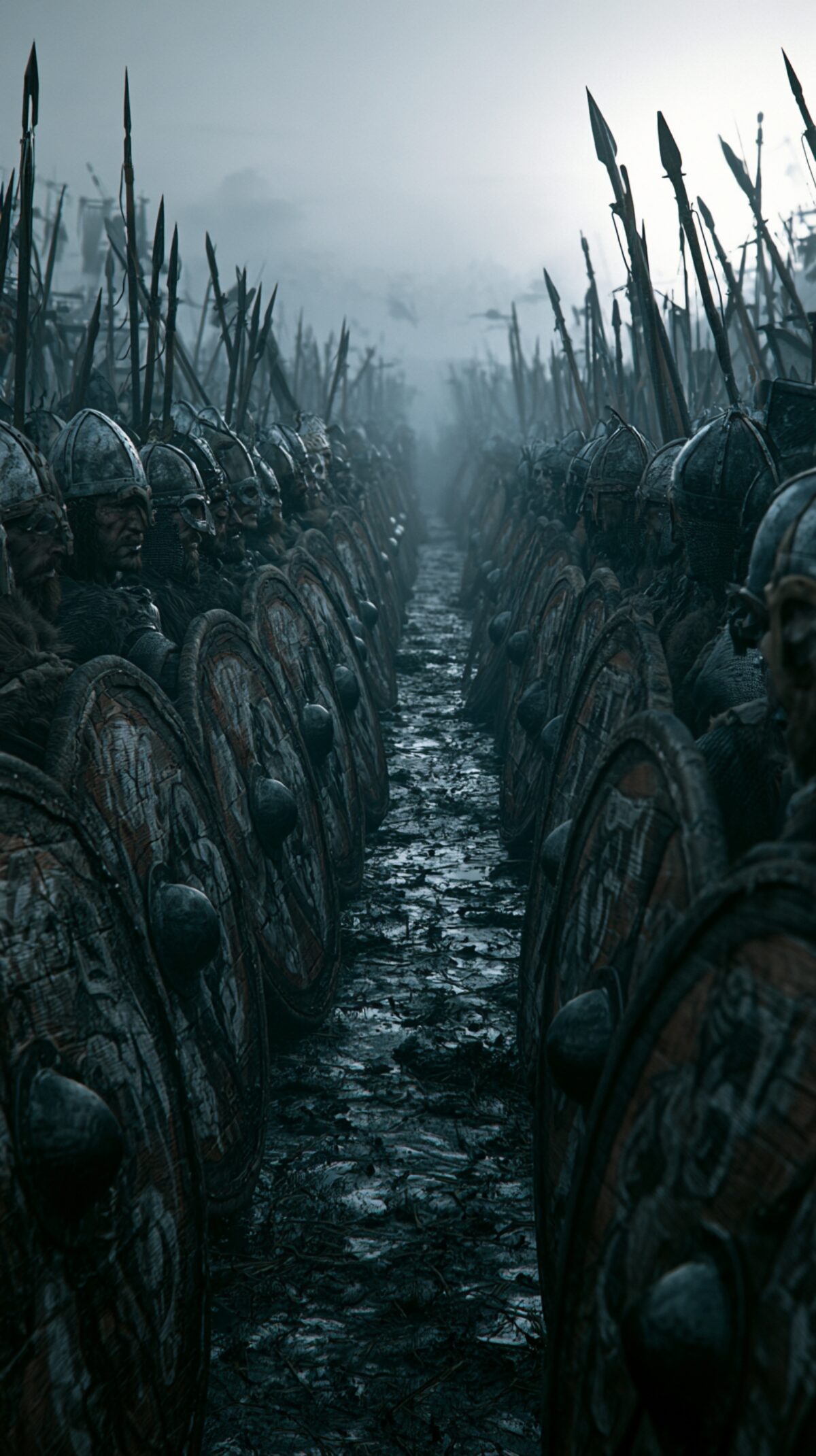
He is said to have sworn never to cut or comb his hair and beard until all of Norway obeyed him – and in the end he was remembered as "Fairhair". Harald Hárfagri is celebrated as the man who forged a patchwork of petty kingdoms into a single realm. It is a magnificent story. It is just a pity that it was written down this smoothly only about three hundred and fifty years after his death. Let us look at what seems certain, what is interpretation and what is simply a fine saga.
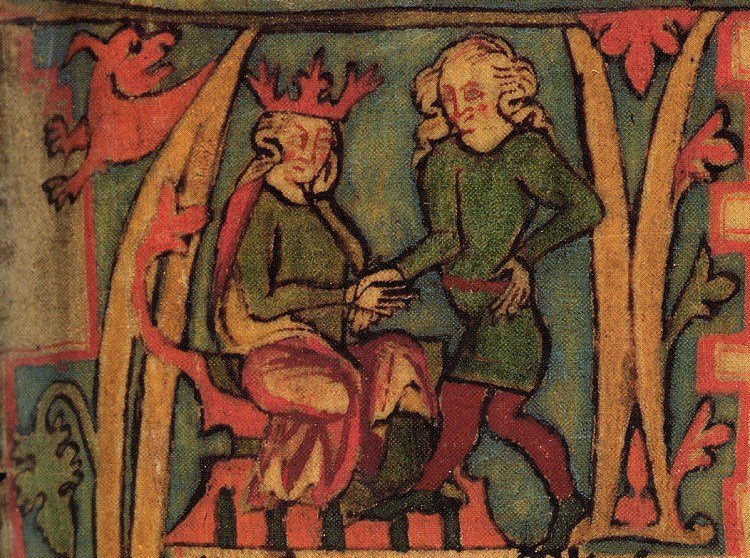
The Old Norse sources give Harald two very different bynames. The famous one is hárfagri, "Fairhair" – that is how posterity knows him. Before that, however, he was reportedly called lúfa, which one might render as "shaggy-head" or "mop-head". This very contrast carries the whole tale: the unkempt king's son will not pick up a comb again until he has reached his great goal. Until then his hair stays wild – a walking promise to himself.
As a historical figure Harald belongs to the second half of the 9th century; the sagas make him the son of a petty king named Halfdan the Black from south-eastern Norway (Vestfold). There are no solid contemporary documents about his life – we hear of him almost only through poetry and through later Icelandic prose.
The best-known scene is told by Snorri Sturluson in Heimskringla. The young Harald woos a woman named Gyda, but she haughtily refuses him – she wants no king who rules over just a few valleys. Only when he has subdued all of Norway will he be worthy of her. Instead of taking offence, Harald accepts the challenge and swears not to have his hair and beard cut nor combed until the whole land is under his sway.
This vow I make, and thereto call to witness the god who made me and rules over all things, that never shall my hair be cut or combed until I have won all Norway.after Snorri Sturluson, Heimskringla (Saga of Harald Fairhair), public-domain translation by Samuel Laing, 1844
Whether this vow was ever spoken, no one knows. It is a narratively perfect frame: the byname "Fairhair" is given an origin story, and the untamed hair becomes an emblem of untamed ambition. Such motifs – a hero binding his appearance to a great promise – are popular in saga literature and should make us cautious.
According to the saga, Harald spends years fighting his way across the land, subduing one petty king after another and breaking the resistance of the old landed nobles. The crowning finale is a great sea battle in the Hafrsfjord near Stavanger, where an alliance of stubborn lords from western and south-western Norway is decisively beaten. Afterwards, it is said, Harald finally had his hair cut – and from then on bore the name Fairhair.
By convention the battle of Hafrsfjord is dated to around 872. That figure appears in many books, but it is not a fixed date; it is a scholarly estimate derived from back-calculated king-lists. All that is certain is this: at some point in the late 9th century a markedly larger lordship emerged in Norway than before – how large exactly and how lasting is quite another question.
More interesting than the battles is what Harald reportedly did with the conquered land. The sagas say he seized the right of ownership over the soil: the free farmers henceforth had to pay dues for their ancestral inherited land, the odal, and over the provinces he set jarls and retainers as administrators. Many independent petty kings and proud landholders thus became – in the saga's picture – subjects of a single ruler.
Historically this picture should be taken with care. It reflects at least as much the concerns of the 13th-century Icelandic writers, who were wrestling over the freedom and odal rights of their own age, as the actual conditions around 880. That Harald shifted the balance of power is plausible. That he built a well-organised tax kingship over all of Norway is probably an exaggeration.
As a consequence of Harald's heavy hand, the sagas tell, many proud chieftains left the country: they sailed out to the islands and across the North Atlantic – to the Orkneys, the Faroes, the Hebrides and above all to Iceland. The Norwegian unification thus becomes the starting signal of the Icelandic settlement. Whoever would not bow under Harald sought his fortune in the west.
This explanatory pattern is elegant, but should be read with judgement. Many emigrants had solid reasons – land, trade, feuds, plain love of adventure – and the notion that "everyone fled from Harald" is partly a literary founding motif of the Icelanders, who liked to give their ancestors a proud, freedom-loving origin. Anyone wishing to dive deeper into this world will find it with Erik the Red, who pushed even further west to Greenland, with the settler Aud the Deep-Minded, and in the broad overview of the Vikings in the North Atlantic. That Vikings were winning land in the south at the same time is shown by the story of Rollo and Normandy.
Harald was, by tradition, married several times and had a whole crowd of sons. This is not gossip but the root of the next chapter: where there are many heirs, the quarrel over the inheritance is near. After Harald's death the laboriously joined realm promptly fell apart into rivalries. His son Erik, who bore the far from flattering byname "Bloodaxe", tried to eliminate his brothers by force and thereby manoeuvred himself into isolation. Only the younger Håkon, raised as a Christian at the English royal court and therefore called "the Good", restored calm for a while.
This exposes the real problem with the smooth saga narrative: a realm supposedly united in one battle falls apart into sub-realms immediately after the death of its unifier. Norwegian kingship was not a finished state but a wobbly construction that had to be fought for anew in every generation.
Attested: That in the late 9th century there was a powerful King Harald in Norway who bundled lordship over several provinces is supported by skaldic poetry, composed in his lifetime or shortly after, which praises him and the victory at Hafrsfjord – poetry passed on orally and later written down. It is also certain that the settlement of Iceland began in this era and that Norwegian royal power did in fact keep growing in the following generations.
Myth-check: The connected life story comes from Snorri's Heimskringla and related sagas – that is, from the 13th century, roughly 350 years after the events. The image of "one man uniting Norway in a single battle" is a saga simplification. The dating, scope and even the exact historical significance of the battle of Hafrsfjord are disputed; "~872" is a back-calculation, not a recorded date. The vow of the uncut hair is attested only late and is a typical narrative motif. And the formula "everyone fled to Iceland because of Harald" is to a good part a literary founding motif, not a sober travel report. For a broader picture of who sailed where and why, see Regional Vikings.
As towering as Harald's reputation is, the ground beneath it is thin. Not a single witness described him during his lifetime. The earliest anchor comes from Ari fróði Þorgilsson, the Icelandic chronicler of the early 12th century, who used Harald's reign as a fixed point for the settlement of Iceland — a good two hundred years after the events. Then come the kings' sagas: the terse Ágrip (around 1190), the Fagrskinna and finally, around 1230, Snorri Sturluson's great Heimskringla, which gives Harald his first detailed portrait. Between the man and his biographers lie roughly three centuries of oral tradition, skaldic verse and literary embellishment. The only genuinely contemporary voices are skalds such as Þorbjörn hornklofi, whose Haraldskvæði praises a victorious king and a great sea-battle — praise-poetry, mind you, not a history book.
The famous year 872 for the battle in Hafrsfjord is therefore a convention, not a measurement. Modern scholarship places the event somewhere between 872 and around 900; some historians doubt there was any single, realm-founding decisive battle at all, suspecting instead a long, untidy process of many small power struggles. Even the reach of Harald's rule — all of Norway, or only the western and south-western coast? — is disputed. Anyone standing at Hafrsfjord today sees the mighty monument "Sverd i fjell", three bronze swords driven into the rock. It looks ancient, but it dates from 1983. We're fresh out of contemporary photographs from the day of the battle, sadly.
The sagas tell Harald's rise as a cool administrative revolution: he supposedly subdued the petty kings and defiant chieftains one after another, divided their lands into administrative districts (fylki) and set a jarl or governor over each to collect dues and dispense justice. Whoever refused to bend lost land and rank — or his life. The sharpest and most disputed point, however, concerns the soil itself.
King Harald made this law over all the lands he conquered, that all the udal property should belong to him; and that the bondes, both great and small, should pay him land dues for their possessions.Snorri Sturluson, Heimskringla, Harald Harfagre's Saga; trans. Samuel Laing, 1844
That is a strikingly modern idea of the state — the king as supreme landlord, the free farmer suddenly a taxpayer on his own inherited soil. And this is exactly where caution is due. Many experts regard this tidy "nationalisation" of udal land as a back-projection: Snorri and his predecessors wrote in the high Middle Ages, when the Norwegian monarchy really did possess such a system of taxation and tenure, and put its logic into the mouth of the realm's founder. That Harald rewarded powerful followers, dispossessed opponents and built up a layer of loyal governors is plausible; that he conjured a fully organised system of dues out of the bare rock is more a wish-image of the later crown than secured administrative history. The unification of Norway was probably less a founding act than a stubborn beginning — much like what was later credited to the Danish kings at the stone of Jelling.
Among Harald's most loyal allies the sagas count Rögnvald Eysteinsson, the jarl of Møre. When vikings from the islands in the west kept raiding the Norwegian coast — often the very men who had fled from Harald — he is said to have led a punitive expedition across the sea and afterwards granted the Orkneys and Shetlands to Rögnvald's family. That was the birth of the mighty Orkney earldom, which shaped the Norse islands off northern Britain for centuries.
More consequential still is another claim of Icelandic tradition: a son of Rögnvald, Gǫngu-Hrólfr — "Hrólf the Walker", allegedly too heavy for any horse — was banished from Norway and eventually landed in Normandy as that Rollo who in 911 received a duchy from the Frankish king and became the ancestor of William the Conqueror. Harald would thus have indirectly founded a line that ended on the English throne in 1066. As elegantly as this thread is spun, the identification of the Norwegian Hrólfr with the Norman Rollo is centuries younger, and Danish sources claim Rollo for themselves in turn. His origin simply cannot be settled — a textbook case of how fondly the sagas tie famous names into a single gleaming family tree.
Harald, if the sources are to be believed, was as diligent in fathering as in conquering. The sagas credit him with numerous wives and a good dozen sons — and in doing so planted the seed of the realm's collapse along with everything else. In his lifetime he installed individual sons as sub-kings and finally handed overlordship to Eirik, who bore the unflattering byname "Bloodaxe" because he cleared several of his brothers out of the way. Another son, Håkon, grew up far away at the court of the English king Æthelstan, was raised there as a Christian, and returned as "Håkon the Good" to drive Eirik out.
The result was family feud rather than orderly succession. No sooner was Harald dead than the laboriously forced unity broke apart again into competing lordships; Norwegian kings, Danish overlords and rebellious jarls wrestled for generations over the inheritance the great unifier had left behind. Whoever wished to escape this tug-of-war, stood on the losing side, or simply wanted to remain his own master often sought his fortune far away — in the North Atlantic, in Iceland and beyond. Harald's realm was thus less a lasting state than a moment his descendants had to fight for again and again.
Harald became the great unifier of the fatherland only long after his death — and most thoroughly in the 19th century. As Norway sought to assert its national identity against Denmark and Sweden, a primal king who had united the country "for the first time" arrived as if on cue. Poets, historians and speech-makers turned the legendary Harald into the foundation of a thousand-year nation, and Hafrsfjord became a founding myth complete with monument and festive shine. A hero who fits so well is rarely questioned too closely.
The main source for all of this remains Snorri — a brilliant storyteller, but an author of the 13th century with a taste for drama and for royal genealogies that pleased his own patrons. His Heimskringla is great literature and a treasure for cultural history, but not a record. That the North was never a single block, but that vikings oriented themselves quite differently depending on the region, belongs to the honest picture. Harald Fairhair therefore remains a fascinating double figure: half historical man of power, half nationally polished memory — and it is precisely this blend that makes him endure.
Attested: Little is certain, and it comes late. Ari fróði (early 12th c.) names Harald's reign as a time-anchor for the settlement of Iceland; skaldic verse such as Þorbjörn hornklofi's Haraldskvæði praises a victorious king and a great sea-battle. Detailed portraits appear only in Ágrip, Fagrskinna and Snorri's Heimskringla (around 1230) — roughly three centuries after the events.
Myth-check: "872" is a convention (scholarship: c. 872–900), and whether Hafrsfjord was even the one realm-founding battle is open. The tidy "nationalisation" of udal land is regarded by many as a back-projection of the high Middle Ages. Rollo as a son of Rögnvald of Møre is unprovable; his origin remains disputed. The "Sverd i fjell" monument looks ancient but was only erected in 1983 — and Harald as "father of the nation" is largely a picture of the 19th century.
The Vikings before Aachen · Hedeby · Dorestad – the great trading place · The North Frisian ring forts · The Viking winter camps.
All History & Finds articles →
The Vikings came, raided – and stayed. Over the winter, at least. Instead of sailing home after every raid, they …
Read more →Many call the Varus battle the „big bang of Germany". Yet another battle shaped our lands far more deeply – one in …
Read more →High above the world of humans, beyond the burning rainbow bridge, lies Asgard – the fortified home of the Æsir. It is …
Read more →Almost 1,500 years before the first Germanic peoples entered Roman history books, a highly developed Early Bronze Age …
Read more →