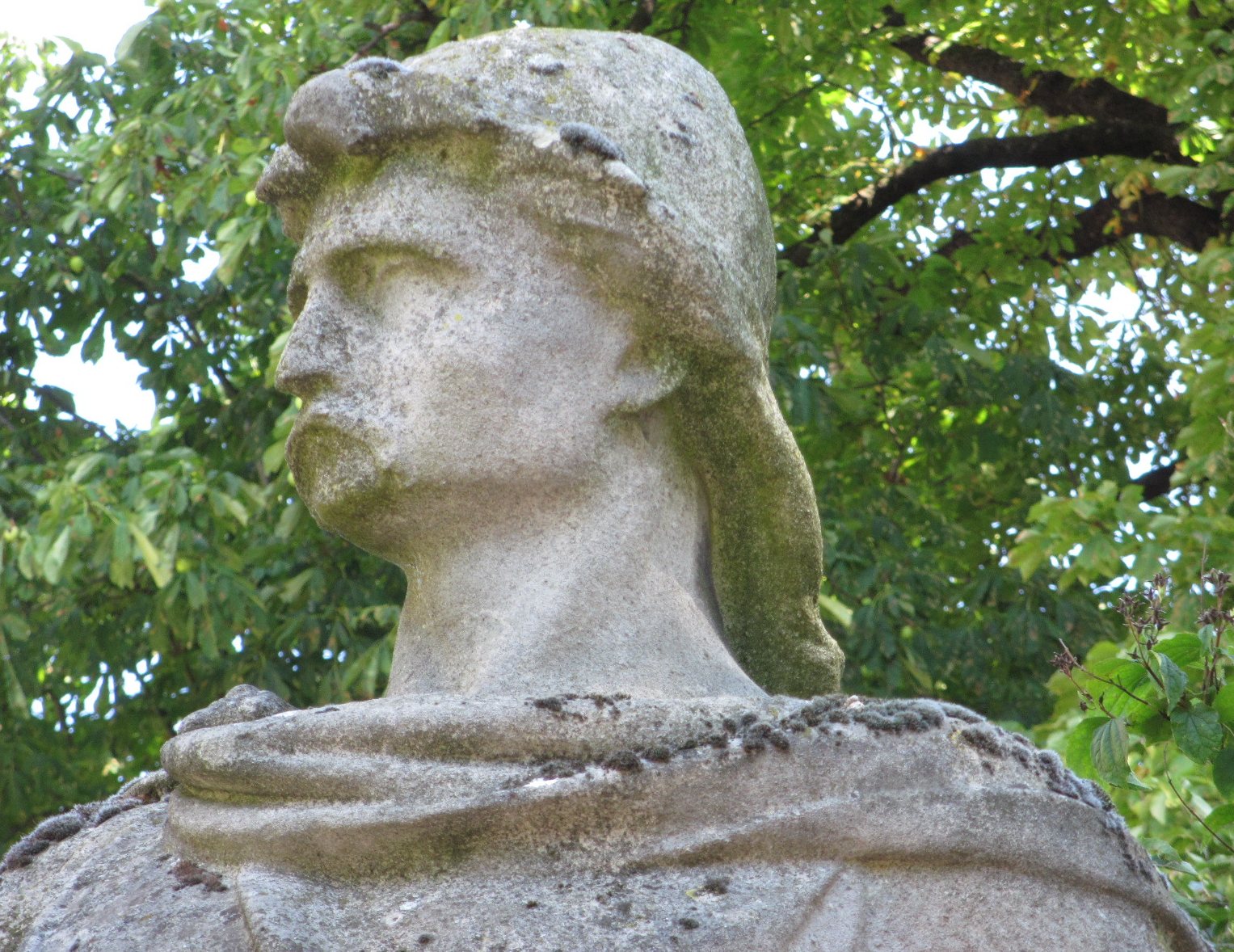
Rollo was a Scandinavian Viking leader on the Seine who, around 911, received land around Rouen from the West Frankish king Charles the Simple in exchange for baptism and for guarding the realm against other Northmen. That grant grew into Normandy, and his family line led to William the Conqueror. Yet almost everything we are told about him comes from a court chronicle written generations later. We untangle charter, chronicle, saga and TV drama: who was the real Rollo, where did he come from, and what is legend?
Chartres, high summer of the year 911. A Viking army has been camped around the cathedral city since spring. Then a Frankish relief force appears on the horizon, the defenders sally out, and the Northmen are caught between the two. Their leader escapes with a handful of men. A few months later the same man is no longer a raider on the Seine but the recognised lord of Rouen, and soon after that he is standing in a baptismal font. Normandy begins here, and it begins with a defeat.
The Latin sources call him Rollo. Few people of the Viking Age left a mark you can still find on any map: the name Normandy simply means "land of the Northmen". Yet almost everything told about the man comes from a single court chronicle commissioned by his own descendants. So in this article we separate the layers carefully. What do charters and annals actually say, what did later chroniclers embroider, and what did television add?
With Rollo, the whole problem lies in the evidence. The first layer is contemporary Frankish material. The most important item is a charter of King Charles III, known as Charles the Simple, from 918. Next come the annals of Flodoard of Reims (died 966), a cathedral canon whose terse year-by-year entries begin in 919. He mentions Rollo several times in the 920s in connection with fighting against Frankish magnates, the last time in 928. Add the annals of Sainte-Colombe at Sens, which preserve the date of the battle at Chartres.
The second layer is the man responsible for most of the Rollo stories: Dudo of Saint-Quentin. Dudo was a canon from the Vermandois who came to the Norman court in the 990s. Duke Richard I, Rollo's grandson, asked him to write a history of the first Norman rulers. The work, usually called De moribus et actis primorum Normanniae ducum ("On the customs and deeds of the first dukes of Normandy"), was only finished under Richard II. Scholars date its completion somewhere between about 1015 and 1026, depending on whom you read, so roughly eighty to ninety years after Rollo's death.
Dudo was a court historian in the most literal sense. He wrote ornate rhymed prose studded with verse and modelled his story on Virgil's Aeneid. His Rollo is a chosen pagan to whom God reveals a Christian future in a dream, and the dukes appear not as heirs of a plunderer but as a dynasty called by heaven and blessed by the Frankish crown. Historians such as Eric Christiansen, who translated Dudo into English, therefore read him as evidence for how the Norman court saw itself around the year 1000, not as a reliable report on 911.
The third layer is Dudo's successors. William of Jumièges abridged and revised him around 1070 in the Gesta Normannorum ducum, dedicated to William the Conqueror. Orderic Vitalis expanded the Gesta in the early twelfth century, and the poet Wace turned the material into an Old French verse epic, the Roman de Rou, around 1160–1170. All three lean on Dudo. When an anecdote appears in all four, it has not been confirmed four times; it has been copied four times.
Where did Rollo come from? People have been arguing about it since the Middle Ages.
Dudo has him come from Dacia, by which he means Denmark. That rests on a learned mix-up, since Dacia was really a Roman province on the Danube. Dudo's Rollo is the son of a nobleman, driven out by a Danish king after his father's death, loses his brother Gurim and travels via England to Francia. The monk Richer of Reims, writing at the end of the tenth century, gives Rollo a father called Catillus, which probably renders Old Norse Ketill.
The Scandinavian tradition tells a different story altogether. In Heimskringla, the history of the Norwegian kings written by Snorri Sturluson around 1230, and in the Orkneyinga saga, the man is Hrólfr, nicknamed Göngu-Hrólfr, "Hrolf the Walker". He is the son of Earl Rögnvald of Møre, a close friend of Harald Fairhair. Snorri explains the nickname in a line that Samuel Laing's public-domain translation of 1844 renders like this:
"… of so stout a growth that no horse could carry him, and wheresoever he went he must go on foot."Heimskringla, Saga of Harald Harfager, ch. 24, tr. Samuel Laing 1844 (public domain)
Because Hrolf carried out a cattle raid in Viken on the Norwegian coast, although King Harald had banned plundering inside his own realm, he was outlawed. His mother Hild pleaded for him in vain. Hrolf then sailed west, by way of the Hebrides, to Valland, the Norse name for northern France, and conquered a great earldom that was called Normandy after the Northmen who settled it. The Latin Historia Norwegie, from the late twelfth or early thirteenth century, says much the same. If this is right, Hrolf's half-brother was Torf-Einarr, earl of Orkney.
Medieval writers wavered even then. Geoffrey Malaterra (around 1100) and William of Malmesbury named Norway, while the poet Benoît de Sainte-Maure gave a birthplace called "Fasge", which could be Faxe on Zealand or Fauske in northern Norway.
Both sides have weak spots. Dudo is closer in time, but he tells a literary origin legend, and in Francia "Dane" was a catch-all word for Scandinavians. The Icelandic texts are three centuries younger and liked to attach famous foreigners to Norwegian noble houses. That Rollo is a Latinised Hrólfr is likely, but it proves nothing, since Hrólfr was a common name. You can read more about how such names were built in our article on Viking names.
Ever since the Danish historian Johannes Steenstrup reopened the question in the nineteenth century, many Norwegian, British and French scholars have leaned towards a Norwegian origin. There is no consensus. Norman place-names do not settle it either: they show Danish and Norwegian elements as well as Anglo-Saxon and Gaelic ones, which points to mixed groups of settlers rather than to one homeland for their leader.
From the 840s onwards Scandinavian fleets sailed up the Seine almost routinely. In 845 an army stood before Paris and was paid off in silver; in 885–886 a great army besieged the city for nearly a year. Other bands sacked Aachen in 881, as we describe in our article on the Vikings in Aachen, and built winter camps on the Rhine and the Meuse. For the wider picture, see the Vikings in France.
Dudo has Rollo take part in the siege of Paris in 885–886 and then rule on the Seine for decades. The contemporary accounts of the siege name other leaders, though, and if you followed Dudo's chronology Rollo would have lived well past a hundred. It is more likely that Rollo took command around 900 of a group already established on the lower Seine, with Rouen, an old bishop's seat and trading town, as its natural centre.
In spring 911 Rollo's men moved south and laid siege to Chartres, which was defended by Bishop Gantelme (also called Jousseaume). A Frankish relief army arrived under Robert, margrave of Neustria and later King Robert I, together with Richard the Justiciar of Burgundy and Count Ebles of Poitiers. On 20 July 911 the Northmen were beaten; the date comes from the annals of Sainte-Colombe at Sens.
A pious legend soon grew around the day. Bishop Gantelme is said to have displayed the tunic of the Virgin Mary, the cathedral's most precious relic, from the walls, and the attackers fled in panic. Soberly put, it was the intervention of the Frankish magnates that won the battle.
The logic of what came next matters. Rollo was beaten, not destroyed, and he still controlled the lower Seine. For Charles III this was an opportunity: a defeated but dangerous leader who accepted vassalage could close the river mouth to other Viking fleets. The idea was not new. In the ninth century Frankish rulers had already handed Northmen land in Frisia on similar terms, and in Brittany Norse leaders managed for a time to make themselves masters too.
What followed is known to every French schoolchild as the Treaty of Saint-Clair-sur-Epte, agreed in the autumn of 911. Charles III is said to have granted Rollo the land between the little river Epte and the sea. In return Rollo would be baptised, do homage to the king and defend the realm against further attacks.
The catch: no treaty text exists. The place-name Saint-Clair-sur-Epte appears first in Dudo. There was probably no written agreement in the modern sense at all, just a spoken settlement sealed by homage and baptism.
The only contemporary evidence for the grant is the charter of Charles III dated 14 March 918. In it the king gives property to a monastery and explicitly excludes a part that he had handed over to the Northmen:
"praeter partem ipsius abbatiae quam annuimus Normannis Sequanensibus, videlicet Rolloni suisque comitibus, pro tutela regni"Diploma of Charles III, 14 March 918; our translation: "except for the part of this abbey which we have granted to the Northmen of the Seine, namely to Rollo and his companions, for the protection of the realm"
That single clause is worth its weight in silver. It confirms Rollo as leader of the "Seine Northmen", it confirms the land grant, and it states its purpose: the protection of the realm. That is the core of the later treaty legend, minus the place, the date and the ceremony.
How large was the grant? Most historians think the first concession roughly matched the districts of Rouen, Évreux and Lisieux, the eastern part of later Normandy, and Pierre Bauduin has argued it may have been smaller still. According to Flodoard the Northmen received further lands around Bayeux and Le Mans in 924, although Lucien Musset doubted that whole counties were meant. The west, with the Cotentin and the Avranchin, was added only in 933 under Rollo's son.
According to Dudo, Rollo was baptised at Rouen in 912. His godfather was none other than Robert of Neustria, the man who had beaten him at Chartres, and Rollo took his name: the pagan became Robert. That Rollo was baptised is plausible and fits the wording of the 918 charter; the precise year comes from Dudo alone. It was, above all, a political act.
How deep his Christianity went is another matter. The Aquitanian chronicler Adémar of Chabannes claimed around 1030 that before his death Rollo both endowed churches and sacrificed captives to pagan gods. Scholars treat the story as doubtful. Such double-tracking is, however, familiar from Scandinavia itself, where pagan and Christian practice ran side by side for generations.
Dudo also tells us that Charles III gave Rollo his daughter Gisela in marriage. No contemporary document knows of this match, and since Charles had married only in 907, a legitimate daughter would have been four or five years old at most in 911. Gisela belongs in the legend drawer.
Poppa stands on firmer ground. Dudo says Rollo took her captive when he seized Bayeux and made her his wife, calling her the daughter of a Count Berengar; that pedigree is uncertain too. The union counted as a marriage "in the Danish manner", more danico, a partnership without a church wedding as was usual in the North. From it came the heir, William Longsword. Even William the Conqueror was born out of wedlock, hence his other nickname, "the Bastard".
The most famous Rollo anecdote comes from Dudo. At the act of homage, Rollo was told to kiss the king's foot, as befitted a vassal. He refused: never would he bend the knee to any man or kiss anyone's foot. Instead he ordered one of his warriors to do it. The man grabbed the king's foot, lifted it to his mouth without stooping and tipped Charles over backwards. The Franks were outraged; the Northmen roared with laughter.
The same goes for the Clameur de Haro, an old Norman legal cry against wrongdoing that still survives in the Channel Islands. Popular tradition explains it as an appeal to Rollo, "Ha, Rou!". That is charming folk etymology and nothing more.
Here is a detail that many accounts get wrong: Rollo was not "Duke of Normandy". Contemporary sources give him no such title. He led the Seine Northmen and was probably regarded as count of Rouen; Dudo, looking back, calls him dux and patricius. The ducal title only became established under his successors, regularly so under Richard II in the early eleventh century.
His rule was anything but peaceful. For the 920s Flodoard reports raids by the Seine Northmen on Beauvais, Amiens and Arras, counter-attacks by King Rudolf and Count Herbert of Vermandois, fighting over the stronghold of Eu and a revolt in the Bessin. Rollo remained a warlord in a disintegrating kingdom, all the more so after his lord Charles III was overthrown by the magnates in 922–923.
At the same time the roots went down. The settlers took over existing structures: bishoprics, monasteries, the Frankish administration of counties. Scandinavian traces survive above all in place-names ending in -tot (from topt, a homestead plot), -bec (brook), -dal (valley) or -hogue (mound). Norse seems to have faded quickly in Rouen; Dudo reports that the young Richard I was sent to Bayeux to learn it, because it was still spoken there. How Vikings turned into French-speaking Normans within a few generations is the subject of our article Vikings, Normans, Northmen, Varangians.
When Rollo died is unclear. Flodoard last mentions him alive in 928. Richer of Reims claims he fell as early as 925 in fighting around Eu. Dudo has him abdicate in favour of his son and live another five years. Most historians now place his death around 930, often more narrowly between 928 and 933. What is certain is that by 933, according to Flodoard, Rollo's son William was acting as lord of the Northmen and received from the king the land of the Bretons on the coast.
Visitors to Rouen Cathedral will find, in the south ambulatory, a tomb with a recumbent figure attributed to Rollo. A Latin epitaph begins In sinu templi Rollo quiescit ("In the bosom of the church Rollo rests") and gives 933 as the year of death and an age of over eighty. The present effigy, however, is a nineteenth-century copy that was installed in its current position only in 1956; the older fourteenth-century effigy was lost in the Second World War. Whether any of Rollo's bones lie inside is not known.
Rollo's real significance lies in what came after him. The line of succession is well documented, and many texts miscount it:
So William was Rollo's descendant in the fifth generation, his great-great-great-grandson. In 1066 he crossed to England and won the Battle of Hastings, only weeks after Harald Hardrada had fallen at Stamford Bridge. The descendant of a Seine Viking now sat on the English throne, and every later English and British monarch counts him among their ancestors.
The links with England began earlier, though. Rollo's great-granddaughter Emma, daughter of Richard I, married first the Anglo-Saxon king Æthelred and then the Dane Cnut the Great. Through her the Norman house was entangled with the English crown decades before 1066; her son Edward the Confessor grew up in exile in Normandy. Rollo's daughter Gerloc, baptised Adela, married William Towhead, count of Poitou.
Other Normans, not from Rollo's house directly, went south in the eleventh century, served as mercenaries and became lords of Apulia, Calabria and Sicily. More on that in our article on the Normans in southern Italy. Within less than two centuries Rollo's lost battle at Chartres had grown into a European power.
Many people know Rollo today mainly from the TV series Vikings (2013–2020), where he is played by Clive Standen. There he is the brother of the legendary Ragnar Lothbrok, betrays him, switches sides, marries a Frankish princess called Gisla and becomes Duke of Normandy.
Historically, very little of this fits. Ragnar, if he existed as a single person at all, belongs to the middle of the ninth century and is linked to the attack on Paris in 845. Rollo received his land more than sixty years later. No source knows of any kinship between them. Princess Gisla, at least, is not pure screenwriting: she picks up Dudo's Gisela legend. The show retells Dudo, and Dudo tells a court story. For what the sources actually say about Ragnar's supposed sons, read on in Ragnar's sons.
For us at the workshop in Alsdorf, Rollo is a special figure because he shows that the Viking Age was not only about raids. His is a story of transition: from war leader to landlord, from pagan to baptised Christian, from Old Norse to French. It did not happen in one solemn moment on the Epte but over generations.
He is also a lesson in honesty. Of the founder of one of the most powerful ruling houses of the Middle Ages we know neither the homeland nor the year of death. We have one line in a charter, a few annal entries and a brilliantly told family legend. That is not much, but it is enough to marvel at.

Who was Rollo of Normandy? Rollo was a Scandinavian leader of the Seine Vikings to whom the West Frankish king Charles III granted land around Rouen in about 911. That territory grew into Normandy, and Rollo became the ancestor of the Norman dukes.
Was Rollo Danish or Norwegian? It is still disputed. Dudo of Saint-Quentin calls him a Dane, while Icelandic sagas identify him with the Norwegian Göngu-Hrólfr, son of Earl Rögnvald of Møre; the sources do not allow a firm decision.
Was the Treaty of Saint-Clair-sur-Epte real? An agreement between Charles III and Rollo is confirmed by a royal charter of 918. No treaty text survives, however, and we know the place and ceremony only from Dudo's later chronicle.
Were Rollo and Ragnar Lothbrok brothers? No. That is an invention of the series Vikings. No source mentions any kinship, and around sixty years separate Ragnar's supposed lifetime from Rollo's land grant.
Where is Rollo buried? A tomb in the south ambulatory of Rouen Cathedral commemorates him. The effigy is a nineteenth-century copy, though, and it is not known whether Rollo's remains lie there.
How is William the Conqueror related to Rollo? William was Rollo's great-great-great-grandson: the line runs through William Longsword, Richard I, Richard II and Robert I to the William who conquered England in 1066.
For courage. For remembrance. For legends that live on.
Ragnar's sons · Cnut the Great · Harald Bluetooth · Stamford Bridge 1066 · Hedeby.
All History & Finds articles →
The Viking battle was no wild scramble but a hard struggle shield to shield. A look at tactics and weapons beyond the …
Read more →Long before the Viking Age and before the Icelandic Edda there was Germanic cult – and one of the most striking stood …
Read more →Silver was the lifeblood of Viking trade – weighed, chopped up, buried. Three of the greatest hoards show how far the …
Read more →