When people picture Vikings, they see longships off the coast of England or in the fjords of Iceland. Yet a substantial chapter of Viking history unfolded on the European mainland — in West Francia, the forerunner of today's France. And it did not simply end with plunder and retreat, but with something remarkable: a Norse county of their own on the coast, Normandy. From there a thread runs all the way to England in 1066 and — hard as it is to believe — right up to the doorstep of our own workshop on the Rhine. This page gathers the broad lines and points to our individual articles for the depth.
West Francia was wealthy, richly endowed with monasteries and laced with a dense network of navigable rivers — for Norse fleets less a fortress than an invitation. The Seine, Loire, Somme, Garonne and Meuse led deep inland, straight to where the monasteries, trading places and royal residences lay. A shallow-draught longship could row far upstream, into waters no heavy war fleet could reach. Not chance but geography: whoever controlled the river mouths controlled access to the wealth.
All of this was helped along by the Carolingians' internal quarrels. After the death of Louis the Pious in 840 and the Treaty of Verdun in 843, the Frankish realm was divided, its border defence frayed, and rival rulers could more reliably agree on mutual distrust than on a joint response. That the Northmen exploited this weakness can hardly be held against them — it was simply shrewd.
At first the fleets came in spring, plundered and sailed home with their loot. But the pattern soon changed fundamentally: the armies stayed. They built fortified winter camps on river islands or at easily defended banks, turning the seasonal raid into a lasting presence. Such a camp was base, marketplace and fortress in one — from here the surrounding country and its monasteries could be stripped systematically over months. What these camps looked like and how they worked we describe in detail in our article on the Viking winter camps.
A special case of this logic lay in the north, in the Frisian-Frankish borderland: Dorestad, the great emporium in the Rhine-Meuse delta, was raided repeatedly and at times even granted to Norse leaders as a fief. So this was never only about raw violence, but about trade, control and politics. The most famous name linked to the early raids on Francia is Ragnar — a figure poised between history and saga, to whom we have devoted a separate article on Ragnar Lodbrok.
In 845 a large fleet rowed up the Seine and stood before Paris. The West Frankish king Charles the Bald found himself unable to drive it off by force of arms — and paid. It was one of the first great silver payments of this kind in West Francia, and a signal that would echo for a long time: Paris was reachable, and resistance was expensive.
The famous siege of 885/886 was a very different matter. An enormous Norse army encircled the city, then centred on the Île de la Cité, whose bridges blocked the further route up the Seine. The defenders under Count Odo and Bishop Gauzlin held out for months — the bridges held, and with them the barrier. Emperor Charles III ("the Fat") finally advanced with an army, but instead of giving battle he negotiated: silver again, plus free passage for the besiegers onward into Burgundy. Militarily Paris had remained unbeaten; politically it was further proof of how brittle Carolingian leadership had become. Odo's standing grew — he later became king himself.
Such payments became a system. "Danegeld" is the name for the tributes with which rulers bought themselves peace or withdrawal. For the Carolingian kings it was a double-edged sword: in the short term it bought quiet, in the long term it financed the next fleet and taught the Northmen that persistence paid off in silver. Churches had to melt down their treasures, taxes were levied, and more than one contemporary must have noted grimly that they were feeding the very wolf they wished to be rid of.
Yet one should not narrow the view to a tale of victims alone. The Northmen were at the same time traders, mercenaries and settlers; silver flowed in both directions, and more than one warlord became a treaty partner. It is precisely at this junction of violence and negotiation that the perhaps most consequential episode begins.
Around 911 the West Frankish king Charles the Simple made an arrangement with a Norse leader named Rollo (Old Norse Hrólfr, Latinised Rollo) that later came to be called the Treaty of Saint-Clair-sur-Epte. The core: Rollo and his followers received land around the lower Seine near Rouen — in return they were to defend the territory against other Norse fleets and accept baptism. The raider became a march-lord, and the borderland became the seed of Normandy, the "land of the Northmen". Rollo is thus one of the key figures of the whole era; we tell his story in a dedicated article on Rollo.
As clear as the core is, one must be careful with the details — more on that in the myth-check below. What is certain: the settlement was a pragmatic bargain. The king gained a buffer against further attacks, Rollo gained legitimacy and land. Both sides likely knew that a paid watchman on the river is cheaper than an enemy who returns every summer.
What happened next is almost more astonishing than any raid: the Northmen became Normans. Within a few generations Rollo's descendants adopted the Old French language, Christianity and Frankish administration — and forged from it something of their own. The Norse place names along the Norman coast (endings such as -tot, -bec, -fleur) and traces in seafaring vocabulary still recall the origin; daily life, however, quickly became Romance in character. A band of warriors turned into a duchy with ambitions of its own.
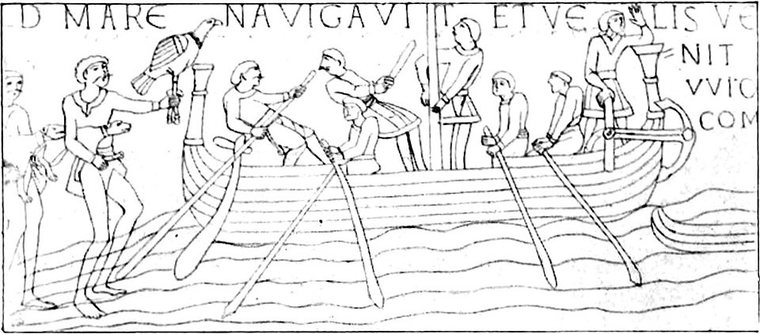
That ambition culminated in 1066: Duke William the Conqueror, a direct descendant of Rollo, crossed to England with a fleet, won at Hastings and became king. The descendants of those Northmen who had once plundered monasteries on the Seine now sat on the English throne — the long reach of a land deal struck in 911. Anyone wishing to place the various directions and characters of the Vikings in a wider context will find the overview in our article on the regional differences of the Vikings.
The raids were not confined to the Seine and Loire. The Rhine-Meuse region was reached too — and with that the great story suddenly draws very close to our home. In the years 881 and 882 a Norse army pushed into the heartland of the realm; the sources record devastation in the area of Aachen, Cologne and the monasteries of the region. For us as a workshop in the Aachen city region this is no distant chapter but, in a sense, neighbourhood history: the North once stood at the gates of our home. What actually happened then, and how much of it is attested and how much embellishment, we treat in our article on the Vikings before Aachen.
Cattle die, / and kinsmen die, / And so one dies one's self; / But a noble name / will never die, / If good renown one gets.Hávamál 77 · translation by Henry Adams Bellows, 1923
Perhaps that is exactly why these names have outlasted the centuries. Silver is spent, camps decay, treaties yellow — but the story of people who rowed up a river and ended up founding a duchy is still being told today.
Attested: The great river raids and winter camps are well documented, as is the siege of Paris in 885/886 (Abbo of Saint-Germain-des-Prés was an eyewitness), the Carolingian Danegeld payments (among others in the Frankish annals), the existence of Norse rule around Rouen from the early 10th century, and the later Norman conquest of England in 1066 under William. The devastation in the Rhine-Meuse region in 881/882 is likewise recorded in Frankish sources.
Myth-check: Rollo was NOT Ragnar's brother — that kinship comes from the television series "Vikings", not from the sources; the historical Rollo lived roughly a century after the events associated with "Ragnar". For the Treaty of Saint-Clair-sur-Epte in 911 NO contemporary treaty text survives; our knowledge rests above all on Dudo of Saint-Quentin, who wrote only about a hundred years later and on behalf of the Norman ruling house — that is, with a clear self-interest. And the often-quoted lament "A furore Normannorum libera nos, Domine" ("From the fury of the Northmen deliver us, O Lord") cannot be traced in any medieval liturgy; it is most likely a later, romanticising invention.
The Vikings before Aachen · Hedeby · Dorestad – the great trading place · The North Frisian ring forts · The Viking winter camps.
All History & Finds articles →
The Vikings came, raided – and stayed. Over the winter, at least. Instead of sailing home after every raid, they …
Read more →Many call the Varus battle the „big bang of Germany". Yet another battle shaped our lands far more deeply – one in …
Read more →High above the world of humans, beyond the burning rainbow bridge, lies Asgard – the fortified home of the Æsir. It is …
Read more →Almost 1,500 years before the first Germanic peoples entered Roman history books, a highly developed Early Bronze Age …
Read more →