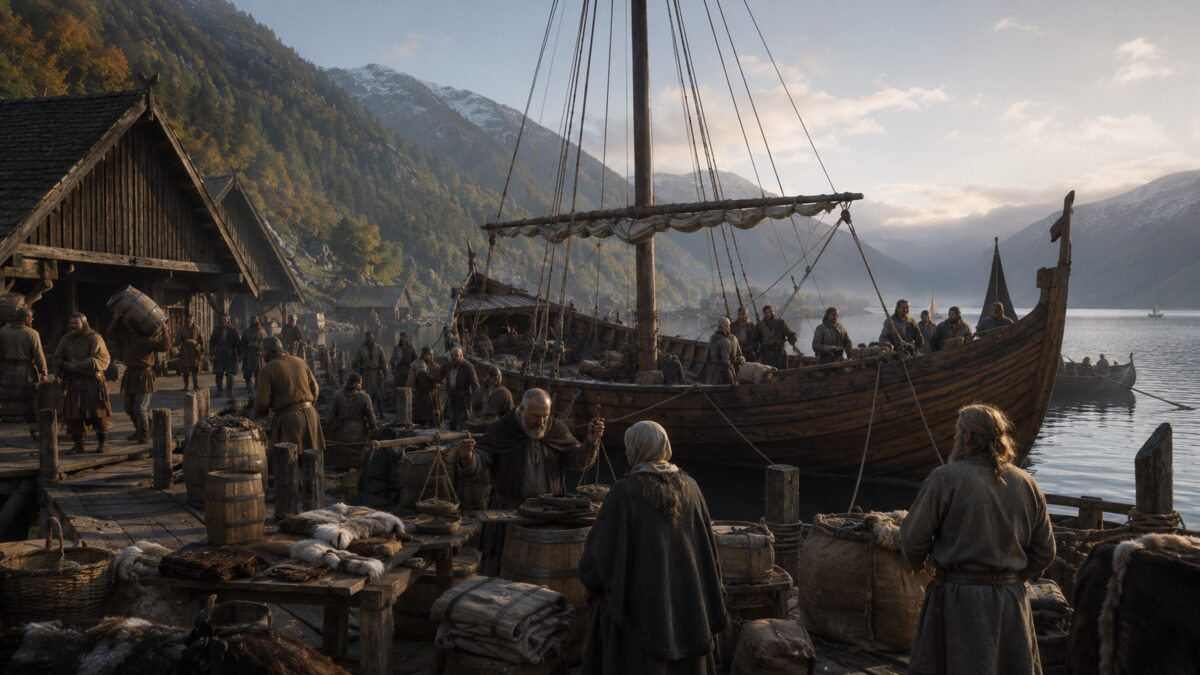
Dorestad was one of the largest trading places of the Frankish empire in the 8th and early 9th centuries: a port of timber jetties on the Kromme Rijn, just outside today's Wijk bij Duurstede in the Dutch province of Utrecht. From 834 Viking fleets hit it almost every year, and in 850 Emperor Lothar I handed it to the Danish chieftain Rorik as a fief. Yet Dorestad did not die in a single raid. The Rhine shifted its course, trade drifted to Tiel and Deventer, and by around 900 the former metropolis had vanished.
Picture a riverbank without a single stone quay. Instead there is a forest of timber posts. Long wooden jetties run out into the water; behind them stand warehouses and workshops under a haze of smoke. Frisian merchants roll wine casks from the upper Rhine across the planks, potters from the hills near Cologne deliver crates of jugs, and somewhere a moneyer is striking silver pennies stamped with a ship. This is Dorestad around the year 820. Fourteen years later, different ships appear on the river. With them begins a story in which a Danish Viking ends up governing on behalf of the emperor.
For us in Alsdorf, near Aachen, this is not some far-off episode. Dorestad stood on the same river that flows past Cologne and Xanten, the river the Northmen would use half a century later to reach the gates of Aachen. If you want to understand why Vikings sacked Charlemagne's palace at Aachen in 881, you have to start downstream, in the Rhine delta, where trade and violence, emperors and sea-kings lived side by side.
Dorestad sat at the point where the early medieval Rhine split in two. The main branch, the Kromme Rijn ("Crooked Rhine"), ran north-west towards Utrecht and on to the coast; a second branch, the Lek, peeled off to the west. Anyone heading north, to Frisia, Jutland and the Baltic, took the Kromme Rijn. Anyone heading for England sailed west towards the estuaries. Upstream lay Cologne, Mainz and the whole of wine country. In trade, location is everything, and Dorestad had the best location the delta could offer.
Today the site lies on the northern edge of Wijk bij Duurstede, roughly 20 kilometres south-east of Utrecht. The name survives in "Duurstede"; the castle of Duurstede was only built around 1270, and the little town received its charter around 1300. It is often assumed that the settlement grew up near the Roman fort of Levefanum, an outpost on the Lower German frontier, but that link has not been firmly proven.
During the 7th century a market and harbour grew up on the riverbanks. The area belonged to the sphere of the Frisians, a coastal people who lived on artificial dwelling mounds and took to long-distance trade early. "Frisian merchants" turn up in sources of the period in London, York, Cologne and Mainz. But the Franks wanted the Rhine too. Towards the end of the 7th century, usually dated to around 690, the Frankish mayor of the palace Pippin of Herstal defeated the Frisian king Radbod in the Dorestad area. After Radbod's death in 719, the Franks gained the upper hand for good.
Coins were being struck here even before the Carolingians. Small gold pieces known as tremisses (one-third of a solidus) carry the legend DORESTATI FIT, "made at Dorestad", and on the reverse the name of the moneyer Madelinus. They belong to the 7th century and show that Dorestad was already a place where wealth was counted.
Under the Carolingians Dorestad reached its peak. Historians place its heyday in the first third of the 9th century, the late years of Charlemagne and the reign of Louis the Pious. A royal official sat at the river fork collecting tolls on passing goods. A privilege issued by Charlemagne in 779 freed the people of the abbey of Saint-Germain-des-Prés from tolls at several trading places, and Dorestad is among those named. For a king, a place like this was money in the bank.
The most remarkable thing about Dorestad is its harbour. Instead of quay walls, the inhabitants built timber jetties and platforms out into the river. Tree-ring dating of the wood (dendrochronology, which reads the felling year from the pattern of growth rings) shows that the first structures went up around 650. By about 725 the platforms formed an almost straight line along the bank, and building went on until after 825.
The reason was simple: the river was moving. The Kromme Rijn gradually shifted its bed eastwards, and the merchants chased it. Each jetty was extended whenever the water retreated, growing longer generation after generation. Archaeologists estimate that the harbour zone contained some 150,000 to 200,000 timber piles in all. Rubbish and silt trapped between the jetties sealed the waterlogged ground and preserved what would long have rotted elsewhere.
Behind the harbour stretched a settlement of long timber houses, and further inland lay farmsteads with fences, granaries and wells. Altogether Dorestad ran for about three kilometres along the river while being only a few hundred metres wide in places. Population can only be guessed at. Figures of around 2,500 to 3,000 inhabitants at its peak are often quoted but remain uncertain. For the 9th century, that would still count as a big town.
The finds tell us what the traders moved. At the top of the list is pottery from the Rhineland. Badorf ware, named after Badorf near Brühl in the hills between Cologne and Bonn, is a hard-fired, yellowish-grey wheel-thrown pottery of the 8th and 9th centuries. Alongside it come large storage jars decorated with applied strips, the so-called relief-band amphorae. Annemarieke Willemsen of the National Museum of Antiquities in Leiden counts at least 23,000 rim sherds of such Rhenish vessels from Dorestad. They probably did not travel empty: wine and other goods very likely came with them.
Wine itself usually came by the barrel. At Dorestad, old wine casks were given a second life as linings for well shafts. The barrel wood comes from the southern Rhineland, and Willemsen links the wine to vineyards south of Mainz. Rarely does a single find trace a trade route so directly: filled on the upper Rhine, emptied in Dorestad, sunk into the ground as a well.
Heavy but in demand were querns of basalt lava from the Eifel. Hand mills from the area around Mayen, used in every household to grind grain, reached Dorestad in quantity: over a thousand millstone fragments are known. Add more than 2,000 loom weights, pointing to local cloth production; glass, including fragments of gold-foil glass, the most expensive glass of the age; and over 5,000 lumps of amber. Recent excavations have also revealed traces of glass-working on site.
One product deserves a closer look: Tating ware, black burnished jugs decorated with applied tin foil, often in cross patterns. These turn up at Dorestad as well as at Birka in Sweden and at Hedeby. Exactly where they were made is still debated; the Rhineland or the Low Countries are the usual candidates. Either way, they trace the path by which Frankish goods reached the northern world.
Written sources also mention Frisian cloth, prized as a luxury. What the Frisians brought back from the north in return, such as furs, amber and perhaps enslaved people, is less well documented for Dorestad in particular. For the wider picture, see our article on Viking trade: silver, furs and the roads of the north.
Under Charlemagne, Dorestad became one of the most important mints in the realm. The Carolingians had switched to the silver denarius (penny), and Dorestad struck them in large numbers. The typical type shows the place name and a ship, the round-bellied cargo vessel of the Frisians. In the late 8th and early 9th centuries these coins circulated widely, as far as Scandinavia.
The north itself shows how deep an impression they made. The earliest coins struck at Hedeby in the 9th century imitate Charlemagne's Dorestad pennies, ship and all, with Frankish-looking legends that often no longer make any sense. How Scandinavia came to its own money is told in Ribe and the first coins of the north. Dorestad pennies also turn up in hoards in northern Germany, such as the Krinkberg hoard found at Pöschendorf in Holstein in 1885.
Minting continued under Louis the Pious and Lothar I, but output fell markedly, and by the middle of the 9th century it had stopped. For the numismatist Simon Coupland, that is a key indicator: from the coin finds he reads a boom up to the 830s and a slump afterwards.
In 834 the most important West Frankish history of the period, the Annals of St-Bertin (Annales Bertiniani, a year-by-year record kept close to the royal court), reports a raid: a Danish fleet came to Frisia, laid waste part of it and moved on to the trading place of Dorestad. There the attackers plundered, killed some people, carried others off and set fires. The Annals of Xanten, a chronicle continued on the Lower Rhine, record the attack as well.
It did not stop there. In 835, 836 and 837 the annals again report attacks on Dorestad and Frisia. In 837 the Northmen met resistance on the island of Walcheren in the Scheldt estuary, killed many defenders and then exacted tribute at Dorestad. Further attacks followed in 846 and 847, in 857 and finally in 863. One phrase recurs in the sources almost like a formula: the Northmen plundered Dorestad "again".
How devastating were these raids really? This is where it gets interesting, because archaeology and the written record do not quite speak the same language. The excavations have not revealed evidence of large-scale destruction, no continuous burnt layer, no mass graves. Many scholars therefore read the raids as repeated extortion: come, take, demand tribute, leave. Bad enough for the people living there, but not the end of the town in a single night.
Why now? In the 830s the Frankish empire was busy tearing itself apart. Louis the Pious was in open conflict with his sons and was briefly deposed in 833. Coastal defence was neglected, and the Danes knew it. The background to the Frankish-Danish standoff is told in our article on the Danevirke.
Now a family steps onto the stage that shows how tangled the front lines were. Harald Klak, a claimant to the Danish throne, was baptised at Ingelheim in 826 and received from Louis the Pious the Frisian district of Rüstringen near the Weser estuary as a fief. A fief (beneficium) was land a lord granted to a follower in return for loyalty and service. The logic was cold: a Danish prince with his own warriors would hold the coast against other Danes.
After Louis died in 840, his sons fought over the inheritance. Lothar I, the eldest, took allies wherever he could find them. In 841 he granted a Harald the island of Walcheren and neighbouring districts as a fief, as a reward for services against Lothar's brothers. Whether this was Harald Klak himself or a younger Harald, Rorik's brother, is debated among historians. The author of this part of the Annals of St-Bertin, Bishop Prudentius of Troyes, was outraged: in substance he calls it a deed deserving every condemnation, to hand Christian land to those who had done Christians so much harm.
Rorik was a kinsman of Harald Klak, probably his nephew. Around 841 he held land in Frisia together with his brother Harald. A few years later both fell from favour, were accused of treason and imprisoned. Rorik escaped and entered the service of Louis the German. Then he did what a Viking with a fleet and a grudge would do: in 850 he sailed up the Rhine and seized Dorestad.
Lothar, since he could not crush him, received him into his allegiance and granted him Dorestad and other counties.Annals of St-Bertin for the year 850, our own translation
The Annals of Fulda, from the East Frankish kingdom, add that Rorik was to collect the royal revenues and resist Danish raids. The Annals of Xanten, written on the Lower Rhine and so very close to events, are bitter: Rorik, they say, deceitfully inflicted much evil on the Christians.
Rorik was no governor who sat quietly in Dorestad. In 855 he and his kinsman Godfrid tried to seize power in Denmark itself, failed, and returned to Dorestad, where, according to the Annals of St-Bertin, he held sway over most of Frisia. In 857, with Lothar's approval, he sailed north again and, according to the Annals of Fulda, with the consent of the Danish king Horik II took the land between the sea and the Eider, an area close to Hedeby and the Schlei. In the same year other Danes plundered Dorestad and the Betuwe. Simon Coupland considers Rorik's northern gains to have been short-lived.
In 863 another Danish fleet sacked Dorestad and pushed upriver towards Cologne. When a Frankish army occupied the banks, the Danes withdrew, says the Annals of St-Bertin, "on Rorik's advice". Rumours that he had invited them in circulated even then. Around this time Rorik had accepted baptism: Archbishop Hincmar of Reims wrote letters to him, summarised by the chronicler Flodoard, which assume that Rorik was by then a Christian.
In 867 Frisians, called Cokingi in the annals, drove Rorik out. But he came back. In 870 Charles the Bald met him at Nijmegen and bound him by treaty, and in 872 he received him again as a loyal man. In 873, according to the Annals of Xanten, Rorik swore an oath of loyalty to Louis the German. Then the sources fall silent. He died some time before 882, for in that year Emperor Charles the Fat granted "Frisia and the fiefs that Rorik had held" to the Dane Godfrid, who was baptised in return. That Godfrid had led the army that plundered Aachen a year earlier and had been besieged in his winter camp at Asselt. In 885 he was lured into a trap at Herispich on the Rhine and killed.
Where did Rorik reside? The sources do not say exactly. One tangible clue lies on the former island of Wieringen in North Holland. At Westerklief in 1996, metal detectorists found a pot holding about 1.6 kilograms of silver: ingots, jewellery in Scandinavian style and Dorestad coins. The National Museum of Antiquities in Leiden acquired it the same year. It is dated to around 850. In 1999 a second hoard came to light in the same field, containing hacksilver, an ingot, 61 Arabic dirhams and 20 Carolingian coins, packed in a small Badorf pot. The archaeologist Jan Besteman dates it to the early 880s.
Both dates fit strikingly well with Danish rule in Frisia under Rorik and Godfrid, and Besteman reads the finds as evidence of a Danish presence on Wieringen. Caution is still in order: these are surface finds without excavated houses, and younger archaeologists stress that a Viking settlement there has not been proven.
One name, two men, one tempting idea. The Russian Primary Chronicle (Povest' vremennykh let, early 12th century) tells how the peoples around Novgorod summoned Varangians from across the sea in 862, and how a certain Rurik came with his brothers and ruled in Novgorod. The Old Norse name behind both, Hrœrekr, is the same as our Rorik's.
The identification was first proposed in 1816 by Hermann Hollmann, taken up later by Friedrich Kruse and revived in the 20th century by Nikolai Belyaev. The argument runs that gaps in Rorik's Frankish record in the 860s roughly coincide with Rurik's appearance in the east.
If you want to know who these Varangians actually were, see our articles on the Rus: Vikings in the East and on the difference between Vikings, Normans and Varangians.
For a long time Dorestad's end was told very simply: the Vikings came, Dorestad burned, Dorestad was gone. Current research tells a different and more honest story.
First, the river. During the 9th century the Lek gained in importance while the Kromme Rijn steadily silted up. A harbour that had spent generations chasing a retreating river finally lost its access. No channel, no trade.
Second, the economy. Using coin finds and tree-ring dates, Simon Coupland has argued that Dorestad was already declining markedly after 840, before most of the Viking attacks had even happened. By the time the last fleet arrived in 863, he suggests, the town had already been "dead" for several years. As a long-distance factor he points to the influx of Arab silver into the Baltic, which redirected trade routes.
Third, the competition. New trading places on other river branches took over Dorestad's role: Tiel on the Waal and Deventer on the IJssel. By the end of the 9th century Dorestad had ceased to exist as a town. In 948 a charter mentions the place only as an estate, now called "Wijk".
In the 1920s Jan Hendrik Holwerda, director of the National Museum of Antiquities in Leiden, carried out the first systematic digs. The real breakthrough came with a housing development. From 1967 to 1977 the Dutch State Service for Archaeological Investigations (ROB), under Wim van Es with Wim Verwers as his co-director in the field, investigated more than 30 hectares, one of the largest excavations ever carried out in the Netherlands. The results were published in the series "Excavations at Dorestad": the volume on the harbour area, "Hoogstraat I", in 1980, volume 3 in 2009 and volume 4, on the riverbank settlement, in 2015. The last two can be downloaded free of charge from the Dutch Cultural Heritage Agency.
The most famous single find emerged from a well on 18 July 1969: the Dorestad brooch, a round gold display brooch with coloured inlays, 8.4 centimetres across. It is on show at the National Museum of Antiquities in Leiden and ranks among the finest pieces of Carolingian-era jewellery from the Netherlands.
Research continues. In 2007 and 2008, excavations on the so-called Veilingterrein uncovered farmsteads and workshops, including evidence of glass-making. The earthwork known as De Geer remains disputed: van Es saw it as the seat of a local lord, while Jan van Doesburg argues it was a 9th-century fortification built against the Viking threat. In 2009 the Leiden museum staged the first major Dorestad exhibition, which drew around 66,000 visitors, and several international Dorestad congresses have followed since, most recently in 2024.
Nothing of the jetties survives above ground. Your imagination gets help from Museum Dorestad in Wijk bij Duurstede, which tells the story of the trading town through finds, models and coins. The museum has been moving to new premises in recent years, so check its address and opening hours before you go. The most important finds, including the brooch and the Westerklief hoard, are held by the National Museum of Antiquities in Leiden. For more places to visit, see our guide Experience the Vikings: museums and sites.
From Alsdorf, Wijk bij Duurstede is a little over two hours by car. The route follows the Rhine, on which wine casks once floated downstream and dragon ships rowed upstream. Combine it with Nijmegen and Xanten and you can trace the path the Northmen took in the 860s and 880s. For an overview of their traces on our side of the border, read Viking traces in Germany.
What fascinates us at Glanz & Gravur about Dorestad is that it shows not the horned-helmet Viking of the cinema but the Viking the sources actually describe: raider, extortionist, treaty partner, vassal, Christian for a while. Rorik fits no single box, and that is exactly why he deserves a second look.
Where exactly was Dorestad? On the northern edge of present-day Wijk bij Duurstede in the Dutch province of Utrecht, at the former fork of the Kromme Rijn and the Lek, about 20 kilometres south-east of Utrecht.
When did the Vikings raid Dorestad? Frankish annals record attacks from 834, then in 835, 836, 837, 846, 847, 857 and finally 863. Many were probably plundering and tribute expeditions rather than total destruction.
Who was Rorik of Dorestad? A Danish chieftain from the family of Harald Klak, to whom Emperor Lothar I granted Dorestad and other counties as a fief in 850. He is attested in Frankish sources until 873 and died before 882.
Was Rorik of Dorestad the same person as Rurik of Novgorod? That is an old and contested hypothesis. Because Rorik is documented in the West during the 860s and 870s, most historians regard the identification as unproven.
Why did Dorestad decline? Mainly because the Kromme Rijn silted up and trade moved to Tiel and Deventer. Viking raids sped up the decline but did not cause it on their own.
Where can I see finds from Dorestad? At Museum Dorestad in Wijk bij Duurstede and at the National Museum of Antiquities (Rijksmuseum van Oudheden) in Leiden, which displays the gold Dorestad brooch.
For courage. For remembrance. For legends that live on.
All History & Finds articles →
Some 1,700 years ago a man from the Near East settled in a Germanic village in present-day Thuringia – and rose into …
Read more →Two horns of heavy gold, covered all over with puzzling figures, and on one of them a line of runes in which, for the …
Read more →The Roman Tacitus praised Germanic women as chaste, honoured and even brave at the edge of battle. But above all he was …
Read more →Somewhere a story must begin. For the kingdom of Denmark this beginning is a man named Gorm – Gorm the Old, the first …
Read more →