The best Viking museums are in Hedeby, Roskilde, Copenhagen, Ribe, Jelling, Stockholm, Visby and York, but two big names are closed right now: the Viking Ship Museum in Oslo until its planned reopening in 2027, and the Danevirke Museum until spring 2027. This guide shows which originals you will find where, from the Hedeby 1 warship and the five Skuldelev ships to the Jelling stones, when the open-air sites are open, and how to link them into routes. And where we could not check something, we tell you.
Many of these places are open-air sites that close in winter or open only their grounds. Where we give opening times, they come from the museums' own websites as of October 2026. Where we could not confirm something officially, we say so. This article has two locked doors: Oslo and the Danevirke.
Where: Busdorf near Schleswig, on the B76. When: According to the museum, daily from 9 am to 5 pm, with different hours on public holidays. What: An exhibition hall plus seven houses and a landing stage reconstructed from the excavated evidence, right on the site of the old trading town. Since 2018 Hedeby and the Danevirke have been a joint UNESCO World Heritage Site.
In the 9th and 10th centuries Hedeby was one of northern Europe's great markets, a hub between the North Sea and the Baltic, between Franks, Danes and Slavs. The heart of the museum is the ship hall, home to the wreck of a warship that went down in Hedeby harbour. Specialists call it Hedeby 1. It was roughly 30 metres long, was built around 985 according to the tree rings in its timber, and was raised from the harbour mud from 1979 onwards. The museum calls it the fastest ship on the Baltic in its day.
Next to it is the famous boat-chamber grave: a high-ranking man buried around the middle of the 9th century in a timber chamber with a ship placed over it. Add jewellery, weapons and a wealth of craft and trade finds. The museum also mentions its "impressive rune stones". Known stones from the area include two raised by Asfrid for her son King Sigtrygg and one in which King Sven honours a retainer named Skarthi. The official site does not say which originals stand in the hall today.
Outside, walk the reconstructed houses. The museum itself calls them a long-term archaeological experiment. Our tip: climb the semicircular rampart and return along the Haddebyer Noor. There are children's programmes plus easy-read and sign-language content. If you come in August, the Viking Days in Schleswig are right next door.
A few kilometres away runs the Danevirke, a system of ramparts extended again and again over the centuries. Here is locked door number two. The Danevirke Museum in Dannewerk, run by the Danish-minded association Sydslesvigsk Forening, has closed its visitor centre. According to its own website a new museum is due to open in spring 2027. The landscape stays open: the archaeological park with sections of rampart, the northern gate and the Valdemar Wall, a brick wall of the 12th century, is free to walk, and new trails are opening step by step from mid-October 2026.
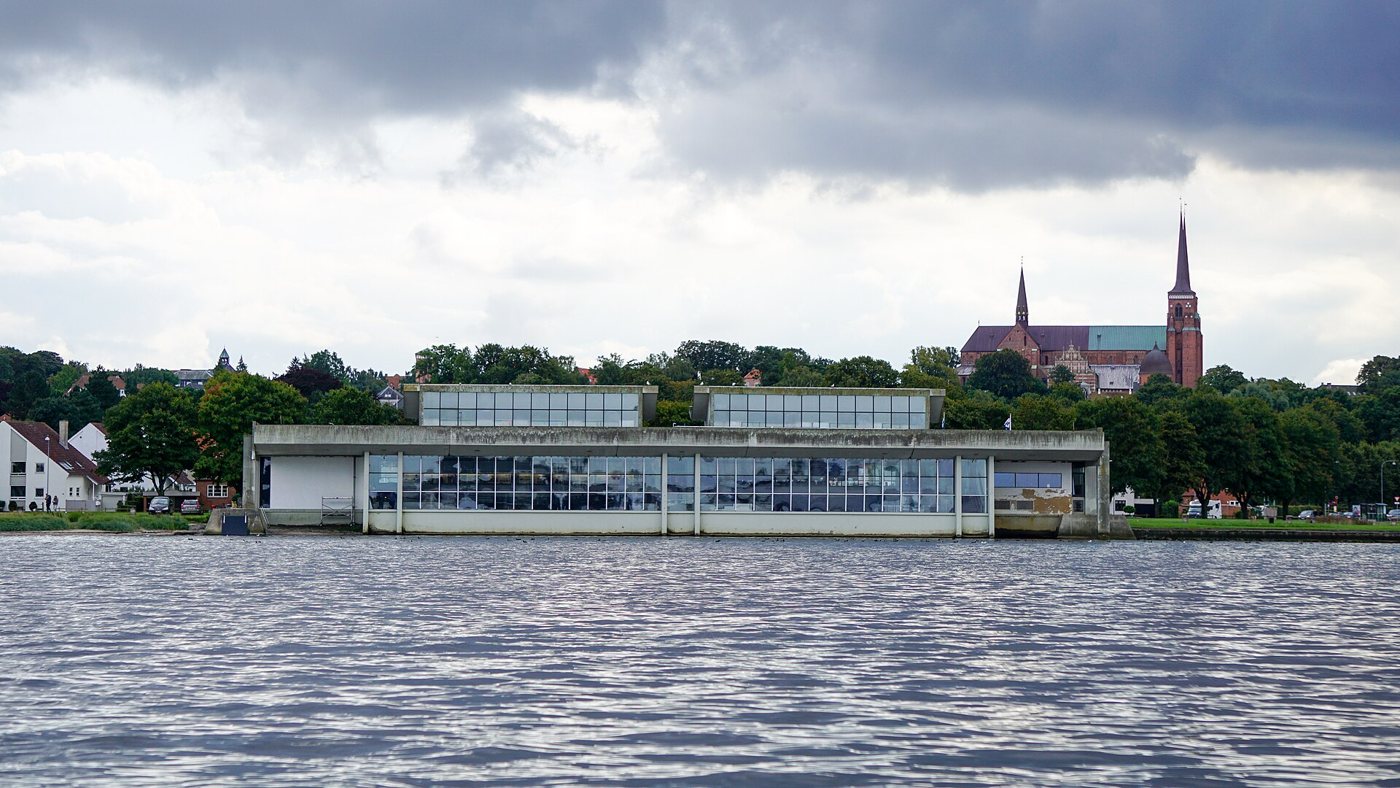
The Viking Ship Museum in Roskilde is open all year and, while Oslo is closed, the top stop for ship lovers. The story starts with a blockade. Late in the Viking Age, people filled three worn-out ships with stones and sank them in the Peberrenden channel to bar the way to Roskilde. About twenty years later two more joined them. The excavation began on 5 July 1962. A cofferdam turned the site into an artificial island of about 2,500 square metres.
At first the team counted six ships. Later it turned out that the parts labelled number 2 and number 4 belonged to the same vessel. That is why there are five Skuldelev ships but no Skuldelev 4. Each one represents a different type:
A warship from Ireland, two boats from Norway, Danish craft alongside: the Viking world was a network, not a nation state. Replicas of all five types are moored in the museum harbour. The most famous is the Sea Stallion from Glendalough, the copy of Skuldelev 2: built between 2000 and 2004, 30 metres long, rowed by 60. In 2007 and 2008 she sailed from Roskilde to Dublin and back, to the very place her original was built.
From 1 May to 30 September boats with oars and sail go out on the fjord every day, and you can pull an oar yourself. For children, 2026 brings a children's village, a digital museum mystery game and a hands-on exhibition for climbing aboard.
The National Museum of Denmark in Copenhagen holds the country's great cultural-history collection. According to its website it is open daily from 10 am to 5 pm from April to October, and Tuesday to Sunday from November to March. It has a children's museum; only the coin and medal galleries are closed for renovation.
In the prehistory galleries you will find the object that gave an entire art style its name: the Mammen axe. An iron axe inlaid with silver, from a grave near Viborg whose timbers were felled in the winter of 970/71. Its tendrils and animal heads define the Mammen style.
And Roskilde 6? At about 37 metres the longest Viking ship known, it was found in 1997 during building work to extend the Viking Ship Museum's harbour in Roskilde. The National Museum showed it in a major exhibition that later travelled to the British Museum and, in 2014/15, to Berlin. We could not reliably establish whether it is on permanent display today, so ask before you travel for it.
About seven kilometres from Roskilde lies Sagnlandet Lejre (Lejre Land of Legends), an open-air site with what it calls Denmark's largest Viking hall. It is a reconstruction inspired by the great halls excavated at Lejre, the place later tradition names as the seat of the Skjöldung kings. In the 2026 season it was open daily from 27 June to 30 August, with selected days in September and early October. The small silver figure that may show Odin on his high seat was found at Gammel Lejre in 2009.
The Moesgaard Museum, with its sloping grass roof at the edge of the woods south of Aarhus, is one of the most striking museum buildings in the north. At the entrance to its Viking exhibition stands the Aarhus mask stone, which the museum dates to roughly 970 to 1020. Four men raised it for a comrade who fell in a fight between kings. Perhaps, the museum suggests, the sea battle of Svold in the year 1000 is meant.
Plenty of visitors come for the Grauballe Man, in the museum's words the best-preserved bog body in the world. But he belongs to the Iron Age, centuries before the Vikings, and he lies in the Iron Age gallery. In summer, Viking days are held on the beach below the museum, and in 2026 Moesgaard excavated a large textile workshop at Søften, north of the city.
Trelleborg near Slagelse is one of Harald Bluetooth's ring fortresses, built around 980, with a circular rampart and four gates aligned to the points of the compass. According to the National Museum it is closed from January to March, open Tuesday to Sunday from April to October, and in November and December only the outdoor area is open. Under-18s get in free, except during the Viking festival in week 29. The museum says wheelchair users can reach the longhouse and village on firm gravel paths, but steps lead up the rampart and the grass inside is hard going. Background on the geometry of these fortresses is in our article on Trelleborg and the ring fortresses.
Fyrkat near Hobro in North Jutland is the little sister. Since September 2023 it has been part of the UNESCO World Heritage listing of the Viking-Age ring fortresses. Beside the rampart stands a full-size longhouse, and on a reconstructed chieftain's farm with nine buildings, costumed volunteers demonstrate crafts and daily life. According to VisitDenmark it is busiest in summer and the school holidays.
Ribe gives you two destinations in one town. The museum Ribes Vikinger in the centre shows more than 14,000 finds from early Ribe, one of the oldest towns in Scandinavia. It opens daily from 10 am to 5 pm and has a children's Viking town, Riberødder. Ribe VikingeCenter, just outside, is an open-air museum with the reconstructed town of Ripa: market place, harbour, boats, town houses, church, farmstead and fortress. The season runs into the October half-term. More on the early town in our article on the coins of Ribe.
Kongernes Jelling lets you see almost the whole founding of the Danish state in an hour. Inside a vast palisade, whose line is marked on the ground today, stand the church, two great mounds, the remains of a ship setting and the two runestones. The smaller one, known to scholars as DR 41, was raised by King Gorm for his wife Thyra. The great stone, DR 42, comes from their son Harald Bluetooth, who boasts on it that he won all of Denmark and Norway and made the Danes Christian. Hence "Denmark's baptismal certificate". Both stones now stand in protective glass cases on their original spot. According to VisitDenmark, adults pay 60 to 120 kroner at the visitor centre depending on the season, and under-18s go free. More in our article on Jelling.
On the edge of Aalborg lies Lindholm Høje, one of the most atmospheric cemeteries in the north. Excavations between 1952 and 1958 uncovered nearly 700 graves, most of them cremations, many marked by stones set in circles, ovals or ship shapes. According to SNL, no site in Scandinavia has more surviving ship settings. The oldest graves go back to around 500, most date from between 700 and 1000. The museum at the site is open daily in July and August and otherwise Tuesday to Sunday, according to Nordjyske Museer, with a winter break from mid-December 2026 to early January 2027. Under-18s enter free.
On Funen, near Kerteminde, the Viking Museum Ladby preserves a Viking-Age ship burial in place under a protective building. Around 925 a man was laid to rest here in a ship almost 22 metres long and about 3 metres wide. With him lay eleven horses and probably four or five dogs. It was found in 1935 together with eleven smaller graves. At the prow the anchor and anchor chain survive in remarkable condition. The wood itself has gone, leaving only its imprint in the soil and the iron rivets. You are looking at the shadow of a ship.
Birka, on the island of Björkö in Lake Mälaren, was Sweden's most important trading place in the 9th and 10th centuries and has been a UNESCO World Heritage Site since 1993. The excursion boat from Klara Mälarstrand in Stockholm takes about two hours each way. According to the operator Strömma, the whole trip lasts about seven and a half hours, and includes museum admission and a guided walk over the cemetery and hillfort. Among the thousands of mounds lay chamber grave Bj 581, excavated by Hjalmar Stolpe in the 19th century and debated since the DNA analysis of 2017 as the grave of a woman buried with a warrior's kit. More in our article on Birka.
Many of the Birka finds are now in the Swedish History Museum (Historiska museet) in Stockholm. The museum calls its Viking exhibition, opened in 2021, one of the largest in the world, with genuine artefacts. It holds the small bronze figure from Rällinge, perhaps the best-known face of the Viking Age. Do not skip the Gold Room: Sweden's greatest gold and silver treasures, some of them from the Viking period.
Gotland is a chapter of its own. At Fornsalen in Visby, the historic building of Gotland Museum, the island's unique picture stones have their own hall, and the Spillings hoard is on show, according to the museum the largest Viking-Age silver hoard in the world. Fornsalen opens daily from 9 am to 5 pm from May to September and from 11 am to 4 pm from October to April.
Oslo: the Viking Ship Museum is closed. The famous building on Bygdøy with the Oseberg, Gokstad and Tune ships has been closed for rebuilding since 2021 and is becoming the new Museum of the Viking Age (Vikingtidsmuseet). According to the Norwegian encyclopedia (SNL) it is scheduled to open in 2027, and VisitNorway also gives 2027. We found no official opening date anywhere as of October 2026. If you go to Oslo now, you will not see the ships. The Historical Museum in the city centre does show Viking-Age finds.
Lofotr Viking Museum, Borg. At the chieftain's seat of Borg in Lofoten, archaeologists found a longhouse more than 80 metres long, one of the largest known buildings of the Viking Age. Today the museum describes its reconstruction as the longest reconstructed longhouse in the world, a place to experience the fire, smoke and half-light of a chieftain's hall. In autumn and winter 2026 it opens only on certain weekdays. In December 2026 a new exhibition opens, replacing the one in place since 2011.
Kaupang in Vestfold and Avaldsnes on the west coast are historically first-rate, but we could not confirm their current visitor facilities from official websites.
Between 1976 and 1981 archaeologists from York Archaeological Trust excavated part of the Viking town of Jórvík on Coppergate in York. The waterlogged ground preserved wood, leather and textiles unusually well. The Jorvik Viking Centre stands on exactly that spot. You ride in small cars through a reconstructed 10th-century street and then see original finds from the very same plot in the gallery. In February York hosts a large Viking festival. More on Jórvík.
Far to the north, at the southern tip of Shetland, lies Jarlshof, a site cared for by Historic Environment Scotland. Its remains include Norse longhouses. In winter, combine it with the fire festival Up Helly Aa in Lerwick.
| Museum | Place | Highlight | Season (as of Oct 2026) |
|---|---|---|---|
| Viking Museum Haithabu | Busdorf/Schleswig (DE) | Hedeby 1 wreck, boat-chamber grave, 7 houses | daily 9–17 |
| Danevirke Museum | Dannewerk (DE) | rampart, Valdemar Wall | museum closed, reopening planned spring 2027 |
| Viking Ship Museum | Roskilde (DK) | Skuldelev 1, 2, 3, 5, 6; Sea Stallion | all year; boat trips 1 May–30 Sept |
| National Museum | Copenhagen (DK) | Mammen axe | Apr–Oct daily, otherwise Tue–Sun |
| Sagnlandet Lejre | Lejre (DK) | reconstructed royal hall | summer daily, late summer selected days |
| Moesgaard Museum | Aarhus (DK) | mask stone, Grauballe Man (Iron Age) | all year, check times |
| Trelleborg | Slagelse (DK) | ring fortress c. 980 | Apr–Oct Tue–Sun; Nov/Dec grounds only |
| Fyrkat | Hobro (DK) | ring fortress, chieftain's farm | mainly summer and school holidays |
| Ribes Vikinger / Ribe VikingeCenter | Ribe (DK) | 14,000 finds; town of Ripa | museum daily 10–17; centre into October |
| Kongernes Jelling | Jelling (DK) | runestones DR 41 and DR 42 | all year |
| Lindholm Høje | Aalborg (DK) | nearly 700 graves, ship settings | Jul/Aug daily, otherwise Tue–Sun |
| Viking Museum Ladby | Kerteminde (DK) | ship burial c. 925 | not checked |
| Birka | Björkö, Lake Mälaren (SE) | cemetery, Bj 581 | boat trips in summer |
| Historiska museet | Stockholm (SE) | Rällinge figure, Gold Room | all year, check times |
| Gotland Museum Fornsalen | Visby (SE) | picture stones, Spillings hoard | daily, May–Sept 9–17 |
| Vikingtidsmuseet | Oslo (NO) | Oseberg, Gokstad, Tune | closed, opening planned 2027 |
| Lofotr Viking Museum | Borg, Lofoten (NO) | reconstructed chieftain's hall | reduced hours in winter |
| Jorvik Viking Centre | York (UK) | Coppergate finds, ride | all year, check times |
The long weekend on the Schlei: Hedeby on day one, the Danevirke park with the Valdemar Wall on day two, then on to Ribe.
The Jutland loop: Ribe with its museum and VikingeCenter, Jelling, then Aarhus and Moesgaard. From there head north to Fyrkat and on to Lindholm Høje at Aalborg.
The Zealand week: Cross Funen with a detour to Ladby, then over the Great Belt to Trelleborg, on to Roskilde and Lejre, and finish in Copenhagen at the National Museum. In July, the Trelleborg festival is a bonus.
The Swedish summer: Stockholm and the History Museum, a day on Birka, then the ferry to Gotland and half a day at Fornsalen.
The Baltic variant: Hedeby, then via Rügen, where a Viking-Age trading site lay at Ralswiek, to the mouth of the Oder and Wolin. The Centre of Slavs and Vikings there is open from April to October according to its website, and in summer it hosts the Festival of Slavs and Vikings. Which events suit which trip is set out in our overview of Viking festivals 2027.
Is the Viking Ship Museum in Oslo open? No. The building on Bygdøy has been closed for rebuilding since 2021 and, according to the Norwegian encyclopedia, is due to reopen in 2027 as the Museum of the Viking Age. No exact date had been officially announced as of October 2026.
What is the best Viking museum in Germany? The Viking Museum Haithabu near Schleswig, with a warship wreck, the boat-chamber grave and seven reconstructed houses on the original site.
Where can I see real Viking ships? While Oslo is closed, above all at the Viking Ship Museum in Roskilde with five original ships, and at Hedeby with the Hedeby 1 wreck.
Which Viking museums are good for kids? According to the museums themselves, Roskilde, Ribe, Trelleborg, Hedeby and the National Museum all have children's programmes. At Trelleborg and Lindholm Høje under-18s get in free.
When is the best time to visit Viking sites? May to September, when the open-air sites, the Roskilde boat trips and the boats to Birka are running.
For courage. For remembrance. For legends that live on.

Viking festivals 2027 · Hedeby · The Skuldelev ships · Birka – the trading hub · The Jelling stones · Trelleborg – Harald's ring fortresses.
Anyone exploring the Viking Age soon trips over strange words: blót, seiðr, ørlög, drengr, kenning. Many are misspelled …
Read more →The little blue symbol on your phone is over a thousand years old: two interlocking runes – the initials of the Viking …
Read more →Few questions reach us in the workshop as often as this one: „Which material actually suits my motif best?" Whether …
Read more →A dark slate plate, a brief beam of light, and where there was deep anthracite a moment ago, a bright, silvery-white …
Read more →
