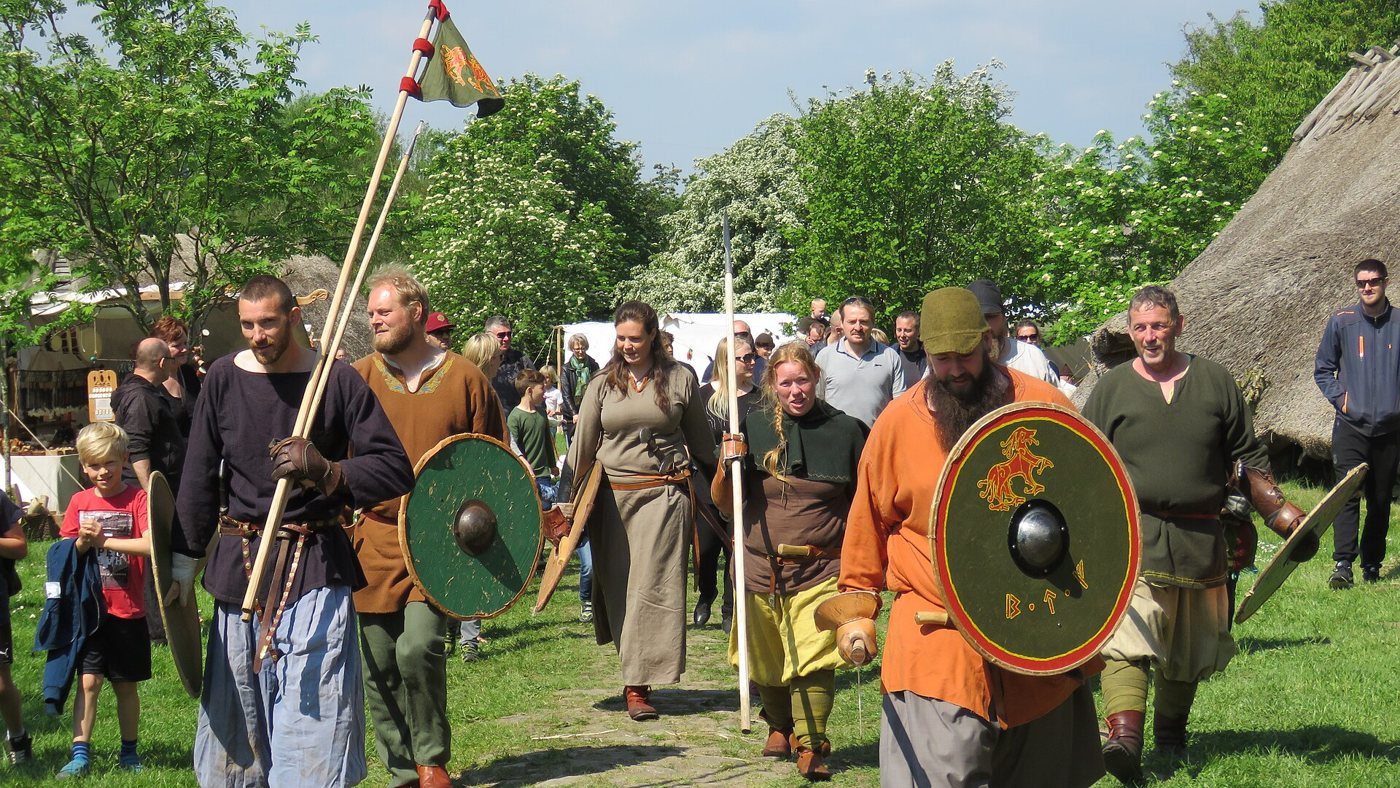
Three big Viking festivals have fixed their 2027 dates so far: Up Helly Aa in Lerwick on 26 January, the Jorvik Viking Festival in York from 8 to 14 February and the Schleswig Viking Days from 6 to 8 August. Everything else, from Ribe and Trelleborg to Wolin, is still unannounced. We show you when each festival last took place, what the sites have to offer historically, how to spot good reenactment and how to get through the day with children, camera and North Sea weather.
Pick almost any month and somewhere in the North a campfire is burning and shields are clashing. Here are the most important Viking festivals and markets for 2027, from Shetland to Wolin, each marked as officially confirmed or not yet.
As of October 2026, only three of the big organisers have published their dates for 2027: Up Helly Aa on Shetland, the Jorvik Viking Festival in York and the Wikingertage (Viking Days) in Schleswig. All the other festivals take place at roughly the same time every year, but "roughly" is not a date. For those events we give the usual season and the 2026 date as a guide. If you are booking leave, a ferry or a room, please check the organiser's official site first.
We will update this page as new dates are announced. Medieval fairs and festivals without a Viking focus are listed in our regularly updated events calendar.
"Confirmed" means the organiser has published the 2027 date. Everything else is the 2026 picture and is meant only as a guide.
| Month | Festival | Place | Status 2027 |
|---|---|---|---|
| January | Up Helly Aa | Lerwick, Shetland (UK) | confirmed: 26 Jan 2027 |
| February | Jorvik Viking Festival | York (UK) | confirmed: 8–14 Feb 2027 |
| April/May | International Viking Market | Ribe VikingeCenter (DK) | open; 2026: 27 Apr–3 May |
| June | Foteviken Viking Market | Höllviken (SE) | open; 2026 late June |
| June/July | Vikingespil | Frederikssund (DK) | open |
| July | Summer market, Haithabu | Busdorf near Schleswig (DE) | open; 2026: 9–12 Jul |
| July | Wikingerfest Eckernförde | Eckernförde (DE) | open; 2026: 10–12 Jul |
| July | Battle for Svantevit | Cape Arkona, Rügen (DE) | open; 2026: 10–12 Jul |
| July | Trelleborg Viking Festival | Slagelse (DK) | open; 2026: 11–19 Jul |
| July | Moesgaard Viking Days | Aarhus (DK) | open; 2026: 23–26 Jul |
| July/August | Festival of Slavs and Vikings | Wolin (PL) | open; 2026: 30 Jul–2 Aug |
| August | Wikingertage Schleswig | Schleswig (DE) | confirmed: 6–8 Aug 2027 |
| August | Lofotr Viking Festival | Borg, Lofoten (NO) | open; 2025: 7–10 Aug |
| September | Die Wikinger kommen! | Xanten (DE) | 18–19 Sep 2027 per our database, please verify |
| October | Boat-builders' meeting | Viking Museum Haithabu (DE) | open; 2026: 10–11 Oct |
Date 2027: Tuesday, 26 January 2027 (confirmed). Up Helly Aa always takes place on the last Tuesday of January, in the darkest part of the North Sea winter. All day the Guizer Jarl and his Jarl Squad march through Lerwick in armour, and at midday the Proclamation is read at the Market Cross. The evening brings the climax: hundreds of torchbearers escort a replica longship through the town and hurl their torches into it until the galley is ablaze.
One honest remark belongs here. Up Helly Aa is not an ancient Viking tradition but a festival of the 19th century. It grew out of rowdy New Year customs with burning tar barrels and only acquired its Viking dress in the Victorian era. The first galley was burned in the late 1880s, according to the usual accounts. Since 2022 women and girls have been allowed to march in the squads of the Lerwick festival.
That Shetland really was Scandinavian for centuries, on the other hand, is well documented: the islands belonged to the Norwegian, later Dano-Norwegian crown until 1469. If you want to pair the fire with a day of archaeology, head to the south of Mainland to Jarlshof, where Norse longhouses sit on top of much older settlement layers. Schedule, history and travel tips are in our in-depth guide to Up Helly Aa 2027.
Date 2027: 8 to 14 February 2027 (confirmed, programme to follow). From 866, after the Great Army had taken the city, York – Jórvík – was the centre of Scandinavian northern England. The Jorvik Viking Centre's festival takes place every year during the English February half-term and lasts about a week: marches through the old town, talks, crafts, encampments and a big battle display to finish.
The Jorvik Viking Centre stands on a spot where Viking history literally came out of the ground. During the Coppergate excavations between 1976 and 1981, archaeologists from York Archaeological Trust uncovered house remains, workshops, shoes, combs and thousands of everyday objects that had survived remarkably well in the waterlogged soil. The centre opened in 1984 right above the dig. Visit the exhibition too: the camps make more sense once you have seen the finds. For the historical background, read our article on Jórvík.
International Viking Market, Ribe (Denmark). The market at Ribe VikingeCenter is one of the big trading markets of the scene, and it opens the season early: in 2026 it ran from 27 April to 3 May. Hundreds of reenactors and traders gather; the weekend brings riding displays, falconry and a battle show. Traders take cash only, in kroner or euros. And the trading happens in a fitting place: Ribe was one of the oldest trading sites in Scandinavia, founded in the early 8th century. We could not yet find a confirmed date for 2027. More on the town in our article on the coins of Ribe.
Foteviken (Höllviken, Sweden). The open-air museum in Scania is a reconstructed Viking town by the water. It opened in 1995 and grew out of the investigation of shipwrecks in Foteviken Bay. Its buildings portray a late Viking-Age settlement, the decades of transition into the Christian Middle Ages. Fittingly, on 4 June 1134 a battle in the Danish succession wars was fought at Foteviken. The Viking market has been held since 1997, traditionally on the last weekend of June. In 2025 it took place on 28 and 29 June, and market listings again gave the last weekend of June for 2026. 2027 is open.
Vikingespil Frederikssund (Denmark). Something different: open-air theatre on Roskilde Fjord, performed by local amateurs every summer since 1952. The stage is the Viking settlement on the Kalvøen peninsula. Between late June and early July a new play based on saga material is staged, in Danish. There is also a Viking market. The play and dates for 2027 have not yet been announced.
July is high summer on the Viking scene. On some weekends you have to choose between three festivals, and in 2026 Hedeby, Eckernförde and Cape Arkona really did fall on the same weekend.
Summer market at the Viking Museum Haithabu (Busdorf near Schleswig). If you want to know what a real Viking-Age trading place felt like, there is no way around Hedeby. The summer market takes place every July among the reconstructed houses, with craftspeople, traders and reenactors. In 2026 it ran from 9 to 12 July. The houses stand inside the original semicircular rampart, and since 2018 Hedeby and the Danevirke have been a UNESCO World Heritage Site. The museum also holds markets in spring and autumn and an international boat-builders' meeting in October, in 2026 on 10 and 11 October. The 2027 dates are still to come. What Hedeby was in the Viking Age is told in our article on Hedeby, which also covers how an Arab traveller experienced the place around 965.
Wikingerfest Eckernförde. In mid-July on the beach by the Ostsee-Info-Center: warrior camps, a market street and fight displays, with free admission. In 2026 the festival ran from 10 to 12 July. There is no date for 2027 yet. Hedeby is about 30 kilometres away.
Viking festival at Cape Arkona (Rügen). "The Battle for Svantevit" brings Vikings and Slavs together at a place with real history: on Cape Arkona stood the Jaromarsburg of the Rani, a West Slavic tribe, with the temple of the god Svantevit. In 1168 the Danes under King Valdemar I took the stronghold and destroyed the sanctuary. The Danish chronicler Saxo Grammaticus described it in detail around 1200, from the winners' point of view. Part of the rampart survives; the cliffs have taken the rest into the sea over the centuries. The festival is held every July, in 2026 from 10 to 12 July, with a small admission fee. You park in Putgarten and walk for about 20 minutes.
Trelleborg Viking Festival (Slagelse, Denmark). Denmark's largest Viking festival takes place at the ring fortress of Trelleborg, built on the orders of King Harald Bluetooth around 980. More than a thousand reenactors pitch their tents, and the highlight is the Battle of Trelleborg with over two hundred warriors. In 2026 the festival ran from 11 to 19 July, with the battle on the last four days and around 250 fighters from more than twelve countries. The scenario is a power struggle of the 980s between the followers of Harald and his son Sweyn Forkbeard, and the winner is not decided in advance. Since 2023 Trelleborg and the other Viking-Age ring fortresses have been a UNESCO World Heritage Site. Background on the fortress in our article on Trelleborg and the ring fortresses.
Moesgaard Viking Days (Aarhus, Denmark). Formerly known as the Viking Moot, now called Vikingedage: market, ships, horses and fight displays on the grounds by the beach below Moesgaard Museum, at the end of July. In 2026 the days ran from 23 to 26 July, daily from 10 am to 5 pm. That year the programme was organised into five hands-on zones, from the world of the gods through wisdom and craft to hunters and warriors: rune puzzles, blacksmithing, longbow shooting, falconry and horse shows. The museum itself is worth a visit, not least for the Iron Age bog body known as the Grauballe Man.
Festiwal Słowian i Wikingów, Wolin (Poland). The Festival of Slavs and Vikings on the island of Wolin is one of the biggest gatherings of the scene anywhere. Around two thousand reenactors from all over Europe fill the reconstructed early medieval settlement, joined by a large field battle and a market. The organisers speak of a tradition going back to 1993, and according to the Polish Press Agency the 2025 edition was the 30th, with some 30,000 visitors. The festival takes place every year over a long weekend at the end of July or start of August, in 2026 from 30 July to 2 August. The 2027 date has not yet been published.
The location carries weight. At the mouth of the Oder lay one of the most important trading centres of the Baltic, which Adam of Bremen described in the 11th century as "Jumne" and which later sagas link with Jomsborg. Programme, tickets and travel are covered in our dedicated guide to the Festival of Slavs and Vikings in Wolin.
Wikingertage Schleswig. Date 2027: 6 to 8 August 2027 (confirmed). In the Königswiesen park right on the Schlei, a Viking village rises for one weekend, with a thing site, combat arena, archery, ships on the water and a children's village. The location is hard to beat: on the other side of the Schlei, less than five kilometres away, lay Hedeby. With a long weekend you can combine the festival with the museum and the Danevirke earthworks; our guide to the Schleswig Viking Days 2027 shows how.
Lofotr Viking Festival (Borg, Lofoten, Norway). At the chieftain's farm of Borg, where archaeologists found one of the largest known longhouses of the Viking Age, a festival with a market, combat training, rowing and theatre is held every summer. The house was discovered in 1983 and excavated between 1986 and 1989 in a joint Scandinavian research project. Its footprint measures 83 by 9.5 metres, the largest Viking-period building found in Norway. It was probably built around 500, enlarged in the 8th century and abandoned around 950. The full-scale reconstruction next to it has stood since 1995. In 2025 the festival ran from 7 to 10 August; we found no date for 2026 or 2027 on the museum's pages.
"Die Wikinger kommen!" (The Vikings are coming!) in Xanten. According to the organiser details in our database, this event is set for 18 and 19 September 2027. We could not find an official confirmation online at the time of writing, so please check before you travel. Xanten rewards the trip anyway, with the Roman city of Colonia Ulpia Traiana and its role as Siegfried's home in the Nibelungenlied. More on Xanten and the fairs along the Rhine in our guide to medieval markets in North Rhine-Westphalia.
At Archeon in Alphen aan den Rijn (Netherlands) an international Viking festival has been held in August for many years. We found no recent dates. The Mühlenhof open-air museum in Münster hosts an Early Medieval and Viking market. For both: check the organiser's site first.
The Viking market in the Viking village of Njardarheimr in Gudvangen on the Nærøyfjord is also often mentioned. The last market we could date with certainty was in 2020; we found no later dates. We cannot currently confirm whether the market still takes place in that form. The village itself is open to visitors.
Reenactment means recreating a period as closely as current knowledge allows. You will also hear living history, usually when the focus is everyday life rather than battles. At a festival you meet both, and a wide range of standards in between.
Quality of portrayal. The best groups work from finds. A reenactor will then wear not "a Viking dress" but an apron dress with oval brooches based on a particular grave, in hand-woven wool coloured with dyes that existed at the time. Many groups commit to one region and one century: Hedeby around 900 looks different from Birka or Jórvík. Do ask. A good reenactor knows whether her brooches are based on a find from Birka or from Hedeby, and she will be glad to tell you. What people really wore is covered in Viking clothing: wool, linen and bright colours.
Camp life. The camp is the heart of every good festival. People cook, sleep, mend and argue there all weekend. In good camps, tents, chests and cooking gear follow models from graves and settlements. Modern things such as cool boxes and sleeping mats disappear under furs and blankets during opening hours.
Crafts. For us as a workshop this is the best part: smiths at an open fire, weavers at the warp-weighted loom, comb makers sawing teeth from antler, bronze casters, tablet weavers, leatherworkers. Many sell their work, so look closely at whether a knife was hand-forged or merely made to look old.
Combat. The best groups fight with blunted weapons in shield-wall formation, as the sources suggest, instead of in wild one-on-one duels after the television model. How a shield wall worked is explained in its own article.
Sometimes only a fence separates a festival that takes you into the Viking Age from a funfair with plastic horns. The organiser is a good first clue: museums such as Hedeby, Moesgaard, Trelleborg, Ribe, Foteviken or Lofotr have a scholarly reputation to lose and choose their guests accordingly. Commercial events vary more.
Horned helmets are the most reliable warning sign. Not a single Viking-Age helmet had horns, as we show in our myth check on the horned helmet. Where they are on sale, the event is about fancy dress rather than history.
Symbols are worth a second look too. Much of what markets sell as an "ancient Viking symbol" is far younger. The Vegvísir, for instance, comes from a 19th-century Icelandic book of magic. We have sorted out what is genuine and what is not in Norse symbols: genuine or invented?
Clothing. Weatherproof clothing and sturdy shoes are a must at every festival, even in August. The Vikings knew this best: wool keeps you warm even when wet. On the coast, at Ribe, Cape Arkona or Eckernförde, the wind bites even in summer. Period dress (Germans call it Gewandung) is never required for visitors, though some markets give a discount if you wear it.
Children. Most festivals are very family-friendly. Schleswig has its own children's village, Ribe offers warrior training for 7- to 13-year-olds and Lofotr a fighting school. Children under three get in free at many venues. To help younger visitors know what to expect, we have written Vikings explained for kids.
Photos and respect. Reenactors are not extras but people who put a lot of time and money into their hobby. Ask before taking a portrait; the answer is almost always yes. Tents are private space, even when the flap is open. Only touch weapons and kit when invited. And please, no flash near horses or birds of prey.
Travel and money. Many of the big festivals are in Denmark and Poland, so getting there from Germany or the Netherlands is manageable. If you are planning Shetland, bear in mind that ferries and flights at the end of January depend on the weather and that rooms in Lerwick are booked out early. Bring cash, since the smaller craftspeople at the markets do not always have a card reader, and at Ribe the traders take cash only.
What is the biggest Viking festival in Europe? There is no official ranking. Among the largest are the Festival of Slavs and Vikings in Wolin, with around two thousand reenactors, and the Trelleborg Viking Festival, with more than a thousand participants.
When is Up Helly Aa 2027? On Tuesday, 26 January 2027, as always the last Tuesday of January, in Lerwick on Shetland.
When is the Jorvik Viking Festival 2027? From 8 to 14 February 2027 in York. The dates are confirmed; the programme will follow.
Are there Viking festivals in Germany? Yes, mainly in the north: Hedeby, Schleswig (6–8 August 2027), Eckernförde and Cape Arkona. In the west, "Die Wikinger kommen!" in Xanten is listed for September 2027, but the date still needs checking.
Do I need a costume for a Viking market? No. Visitors come in ordinary clothes. A waterproof jacket and sturdy shoes matter more than any costume.
Can I photograph reenactors? Usually yes, but ask before portraits and do not enter tents without an invitation.
For courage. For remembrance. For legends that live on.
Viking museums · Hedeby · Wolin & Jomsborg · Trelleborg – Harald's ring fortresses · The Norse of Jórvík · Typically Viking?.
The Norse world is full of strong women: Freyja, who rules over love and battle alike, the Norns who weave fate, Idun …
Read more →A tie, another shower-gel set, one more mug with a slogan — for birthdays and Christmas, men often get exactly what …
Read more →The best Viking museums are in Hedeby, Roskilde, Copenhagen, Ribe, Jelling, Stockholm, Visby and York, but two big …
Read more →Anyone exploring the Viking Age soon trips over strange words: blót, seiðr, ørlög, drengr, kenning. Many are misspelled …
Read more →
