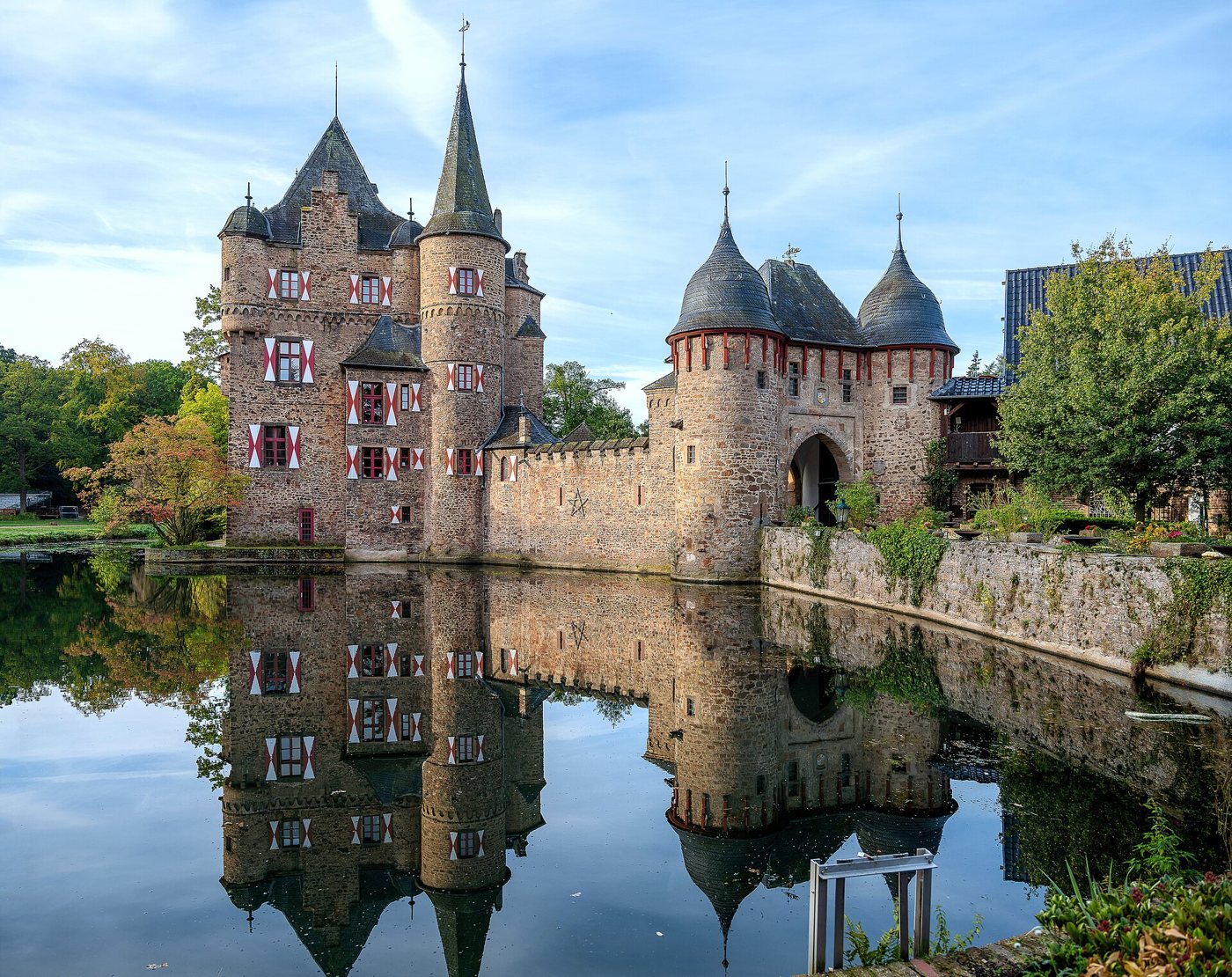
North Rhine-Westphalia has a medieval market almost every weekend: at the moated castle of Satzvey in the Eifel, in Xanten, the town the Nibelungenlied names as Siegfried's home, in the old Hanseatic towns of Soest and Dortmund, and at the Christmas markets of Siegburg, Essen and Herne. Below you will find every date we have collected for 2026 and 2027, in chronological order. We also tell you what really happened at these places, how to tell a well-researched fair from a fantasy backdrop, and which markets are an easy trip from Aachen or Cologne.
Woodsmoke, roasted almonds, a hammer ringing on an anvil, a drum somewhere beyond the moat. In Germany's most populous state you do not have to travel far for that. Between the Eifel hills and the Münsterland plain, between the Lower Rhine and the Sauerland, there are so many medieval fairs that on some autumn weekends you will have to choose. That is no accident. The region has the stage sets, and it has the history to go with them.
Start with the walls. The Rhineland and Westphalia are dotted with castles of a particular kind: the Wasserburg, or moated castle, which sits not on a hilltop but behind ditches and ponds. In the flat country between the Rhine, the Erft and the Lippe, water was the obvious defence. Many are still privately owned, and anyone who has to maintain a fourteenth-century castle is glad of a few thousand paying visitors.
Then come the towns. Dortmund, Soest, Wesel, Telgte and many others belonged to the Hanseatic League, the loose network of north German merchants and cities that shaped trade between London, Bruges, Lübeck and Novgorod from the thirteenth to the sixteenth century. Markets here are not an invention of the events industry. They are the reason these towns grew rich in the first place. And the Rhineland has always been a corridor: Romans, Franks, Carolingians, Norsemen, prince-archbishops and dukes of Cleves all left traces you can still touch.
The calendar below comes from the events database that also powers our events page. It covers the medieval markets and spectacles in North Rhine-Westphalia we know of for autumn 2026 and the whole of 2027, sorted by date. Three things are worth knowing before you plan a trip.
First, all dates are without guarantee. Organisers move events, cancel them because of weather or permits, or change venues. Always check the organiser's own website before you travel, especially for ticket prices and opening times. Most are in German only.
Second, some 2027 dates are provisional. Many fairs traditionally fall on the same weekend every year, around Easter, Whitsun (Pentecost) or Advent. Until an organiser confirms, we enter the expected date and mark it as provisional.
Third, "medieval market" is not a protected term. You will find everything from carefully researched living history to a Christmas market with fur hats. Further down we explain how to spot quality. If you are mainly interested in the Norse side of things, take a look at our overview of Viking festivals and Viking markets in 2027 as well.
50 events from 8 Oct 2026 onwards, as of our database update on 5 Oct 2026. All dates without guarantee – please check with the organiser before you set off.
October 2026
| Date | Event | Place |
|---|---|---|
| 9–11 Oct 2026 | Mittelaltermarkt an der Drachenbrücke Recklinghausen Medieval market | 45661 Recklinghausen |
| 9–11 Oct 2026 | Mittelaltermarkt mit großem Ritterturnier Düsseldorf-Eller Tournament | 40229 Düsseldorf |
| 17–18 Oct 2026 | 20. Mittelaltermarkt Freudenberg Medieval market | 57258 Freudenberg |
| 17–18 Oct 2026 | 5. Mittelalter-Markttage Castrop-Rauxel Medieval market | 44575 Castrop-Rauxel |
| 23–25 Oct 2026 | Historisches Hansefest Wesel Medieval festival | 46483 Wesel |
| 23–25 Oct 2026 | Hubertusmarkt Brühl Medieval market | 50321 Brühl |
| 24 Oct 2026 | Halloween auf Burg Satzvey Medieval spectacle | 53894 Mechernich-Satzvey |
| 30 Oct – 1 Nov 2026 | ANNO Halloween Samhain – Tierpark Nadermann Medieval festival | 33129 Delbrück-Schöning |
| 31 Oct 2026 | Halloween auf Burg Satzvey (31. Oktober) Medieval festival | 53894 Mechernich-Satzvey |
November 2026
| Date | Event | Place |
|---|---|---|
| 4–8 Nov 2026 | Hansemarkt Dortmund Medieval market | 44137 Dortmund |
| 7 Nov 2026 | Martinsmarkt auf Burg Satzvey Medieval market | 53894 Mechernich-Satzvey |
| 8 Nov 2026 | Dunkelbunter Szenemarkt Burg Satzvey Medieval market | 53894 Mechernich-Satzvey |
| 13 Nov – 23 Dec 2026 | Mittelalterlicher Weihnachtsmarkt auf dem Flachsmarkt Essen Medieval market | 45127 Essen |
| 20 Nov – 22 Dec 2026 | Mittelalterlicher Markt zur Weihnachtszeit Siegburg Medieval Christmas market | 53721 Siegburg |
| 27–29 Nov 2026 | Mittelalter-Advent Schloss Strünkede Herne Medieval market | 44629 Herne |
| 27 Nov – 13 Dec 2026 | Mittelalterlicher Weihnachtsmarkt Kloster Graefenthal Medieval Christmas market | 47574 Goch-Asperden |
| 28–29 Nov 2026 | 12. Mittelalterlicher Weihnachtsmarkt Velbert Medieval market | 42553 Velbert |
| 28–29 Nov 2026 | Adventsmarkt auf Burg Satzvey Medieval Christmas market | 53894 Mechernich-Satzvey |
December 2026
| Date | Event | Place |
|---|---|---|
| 4–6 Dec 2026 | Mittelalter-Advent Schloss Strünkede Herne (2. Wochenende) Medieval market | 44629 Herne |
| 5–6 Dec 2026 | Broicher Schlossweihnacht (1. Wochenende) Medieval Christmas market | 45479 Mülheim an der Ruhr |
| 5–6 Dec 2026 | Weihnachtsmarkt auf Burg Satzvey (2. Wochenende) Medieval market | 53894 Mechernich-Satzvey |
| 11–13 Dec 2026 | ANNO 1280 Wyhnacht – Gütersloh-Isselhorst Medieval market | 33334 Gütersloh |
| 11–13 Dec 2026 | Mittelalter-Advent Schloss Strünkede Herne (3. Wochenende) Medieval market | 44629 Herne |
| 12–13 Dec 2026 | Broicher Schlossweihnacht (2. Wochenende) Medieval Christmas market | 45479 Mülheim an der Ruhr |
| 12–13 Dec 2026 | Weihnachtsmarkt auf Burg Satzvey (3. Wochenende) Medieval market | 53894 Mechernich-Satzvey |
| 18–20 Dec 2026 | Mittelalter-Advent Schloss Strünkede Herne (4. Wochenende) Medieval market | 44629 Herne |
| 18–20 Dec 2026 | Mittelalterlicher Weihnachtsmarkt Lengerich Medieval market | 49525 Lengerich |
| 19–20 Dec 2026 | 4. Weyhnacht zu Warburgum Medieval market | 34414 Warburg |
| 19–20 Dec 2026 | Broicher Schlossweihnacht (3. Wochenende) Medieval Christmas market | 45479 Mülheim an der Ruhr |
| 19–20 Dec 2026 | Weihnachtsmarkt auf Burg Satzvey (4. Wochenende) Medieval market | 53894 Mechernich-Satzvey |
March 2027
| Date | Event | Place |
|---|---|---|
| 27–29 Mar 2027 | Oster-Ritterturnier Schloss Lembeck Knights' festival | 46286 Dorsten |
| 28–29 Mar 2027 | Ostermarkt Burg Satzvey Medieval market | 53894 Mechernich-Satzvey |
April 2027
| Date | Event | Place |
|---|---|---|
| 16–18 Apr 2027 | ANNO 1425 Laer Medieval market | 48366 Laer |
| 17–18 Apr 2027 | Mittelalterspektakel Schloss Tüschenbroich Medieval spectacle | 41844 Wegberg |
| 23–25 Apr 2027 | Mysterland – Mittelalter- & Fantasyfestival Legden Medieval spectacle | 48739 Legden |
| 30 Apr – 1 May 2027 | Hexennacht & Hexenmarkt Burg Satzvey Medieval festival | 53894 Mechernich-Satzvey |
May 2027
| Date | Event | Place |
|---|---|---|
| 1–2 May 2027 | Ritterturnier Schloss Lauersfort Knights' festival | 47447 Moers |
| 6–9 May 2027 | 23. Siegfriedspektakel Xanten Medieval spectacle | 46509 Xanten |
| 8–9 May 2027 | Kinderritter Burg Satzvey Knights' festival | 53894 Mechernich-Satzvey |
| 15–17 May 2027 | Ritterfestspiele Burg Satzvey – Frühjahr (Pfingsten) Tournament | 53894 Mechernich-Satzvey |
| 22–23 May 2027 | Mittelalterspektakel Kemnader See Medieval spectacle | 58455 Witten |
| 27–30 May 2027 | Annotopia 2027 Paderborn Fantasy festival | 33104 Paderborn |
June 2027
| Date | Event | Place |
|---|---|---|
| 11–13 Jun 2027 | Annamarkt und Stadtfest Düren Medieval market | 52349 Düren |
August 2027
| Date | Event | Place |
|---|---|---|
| 6–8 Aug 2027 | ANNO 1238 Telgte Medieval market | 48291 Telgte |
| 6–8 Aug 2027 | Soester Fehde Medieval festival | 59494 Soest |
| 21–22 Aug 2027 | Festival der Kulturen & Mittelaltermarkt Troisdorf Medieval market | 53840 Troisdorf |
September 2027
| Date | Event | Place |
|---|---|---|
| 3–5 Sep 2027 | Mittelalterspektakel Schloss Strünkede Herne Medieval spectacle | 44629 Herne |
| 18–19 Sep 2027 | Die Wikinger kommen! Xanten Viking festival | 46509 Xanten |
| 25–26 Sep 2027 | Retro MPS Borken Medieval spectacle | 46325 Borken |
October 2027
| Date | Event | Place |
|---|---|---|
| 29–31 Oct 2027 | ANNO Halloween Samhain – Tierpark Nadermann Fantasy festival | 33129 Delbrück-Schöning |
Events outside NRW, in Germany, Austria, Switzerland and the Netherlands, are in our events calendar with map.
If one venue in the state stands for medieval fairs, it is Burg Satzvey near Mechernich, south-west of Cologne. Hardly any other place hosts so many events a year: Halloween, St Martin's market, a "scene market" for the reenactment and medieval-music crowd, Advent and Christmas markets, an Easter market, a Walpurgis-style witches' night, a children's knights' day and, as the high point, the knights' tournament at Whitsun. The setting is genuine. Satzvey counts among the best-preserved moated castles in the Rhineland.
It began as a fortified farmstead on two islands, probably in the twelfth century. Otto von Vey is recorded as steward (Vogt) in 1368; his family managed estates of the Dietkirchen convent and held the house as a fief from the Archbishop of Cologne. Through Otto's granddaughter it passed in 1391 to Heinrich von Krauthausen, who built the first Gothic residence in 1396. The gatehouse with its twin towers and the Zwinger, the strip of ground between inner and outer wall, followed in the fifteenth century. After several changes of ownership the castle came to the Beissel von Gymnich family in 1944. Count Franz Josef Beissel von Gymnich opened it to visitors in the late 1970s and brought jousting to the meadow in front of the moat.
Xanten is the only municipality in Germany whose name begins with an X, and it carries more history than many cities. Around 13/12 BC the Romans built the legionary fortress of Vetera on the Fürstenberg hill near Birten. Under Emperor Trajan the civilian town next to it was raised, around AD 100/110, to the rank of Colonia Ulpia Traiana, a city under Roman law with walls, an amphitheatre and a harbour temple. Its site is now the LVR Archaeological Park, opened in 1977. If you want to meet the Germanic people who lived around it, read our piece on the Cugerni near Xanten.
The second story is a literary one. In the Nibelungenlied, written down around 1200, Siegfried grows up as a king's son in the Netherlands, in a castle "nidene bî dem Rîne: diu was ze Santen genant", down by the Rhine, called Santen. That is Xanten. Siegfried himself cannot be pinned to any historical person, but the core of the tale goes back to the Burgundians on the Rhine, whose kingdom was destroyed in 436. We untangle legend and history in The Burgundians and, for the Norse version, in Sigurd, Brynhild and the Nibelungs. Xanten has made the hero its trademark, which explains the name of the Siegfried spectacle. Viking fans should note September 2027: "Die Wikinger kommen!" ("The Vikings are coming!") is announced for Xanten.
The Soest Feud is one of the rare cases where a market's name points to a real, well-documented event. Soest, a wealthy Hanseatic town on the Hellweg trade road, belonged to the territory of the Archbishop of Cologne. In 1444 the town had had enough of Archbishop Dietrich II von Moers and his tax demands. On 5 June 1444 it accepted Duke John I of Cleves-Mark as its new lord, and days later the duke declared a feud on the archbishop. A feud was a formal declaration of hostilities between lords or towns.
The crisis came in 1447. Dietrich brought in a mercenary army that included Bohemian troops; the figure of around 12,000 men comes from contemporary reports and should be taken with caution. The army failed first at Lippstadt, then at Soest. Duke John led the defence in person. The town was bombarded and stormed several times but never taken, and the unpaid, hungry army finally withdrew. In 1449 Duke Philip of Burgundy and papal legates, among them Nicholas of Cusa, brokered peace at Maastricht. Soest stayed with Cleves, and the archbishop was left with crushing debts.
Dortmund first appears in the rent roll of Werden Abbey, dated 880 to 884. On the Hellweg, the old long-distance road from the Rhine to Paderborn, a royal estate grew into a palace where Henry I and Otto I stayed. As the only free imperial city in Westphalia, Dortmund answered to the king alone. At the height of the Hanse in the fourteenth century it was the leading town of the Westphalian Hanseatic cities. Its merchants dealt in English wool and lent money to the English crown. The Hanseatic market in Advent draws on exactly that tradition.
Wesel received its town charter from the Counts of Cleves in 1241 and joined the Hanse in 1407. It lived on the cloth trade and became the most important transhipment point between the Netherlands and Westphalia after Cologne. And the Lower Rhine was a trading region long before the Hanse, as Dorestad, the great Frisian-Frankish market of the Carolingian age, shows.
Siegburg lies beneath the Michaelsberg, where Archbishop Anno II of Cologne founded a Benedictine abbey in 1064. Anno was buried there after his death in 1075 and canonised in 1183; his bones rest in the splendid Anno shrine. Monks lived on the hill for almost 950 years until the Benedictines left in 2011. The medieval Christmas market on the square below is one of the best known of its kind in the Rhineland.
Düren owes its biggest festival to a theft. On 29 November 1500 a stonemason named Leonhard stole the head relic of St Anne from the church of St Stephan in Mainz. The relic reached Düren, the town council secured it for the Duke of Jülich, and in 1506 Pope Julius II ruled that it could stay. From the pilgrimage grew the Annakirmes, one of the largest funfairs in western Germany. The Annamarkt picks up that origin.
Telgte near Münster received its town charter in 1238, hence the name of the ANNO 1238 market. The small town on the Ems belonged to the Hanse and is still a pilgrimage site. Pilgrims come to a Pietà, a sculpture of Mary holding the dead Christ, in a baroque chapel from the mid-seventeenth century.
Brühl was granted its charter on 27 April 1285 by Archbishop Siegfried von Westerburg of Cologne and later became a residence of the prince-electors. Clemens August laid the foundation stone of Augustusburg Palace in 1725; together with the Falkenlust hunting lodge it has been a UNESCO World Heritage Site since 1984. The Hubertusmarkt carries the name of St Hubert, patron saint of hunters, which suits a town with a falconry lodge.
Schloss Strünkede in Herne is a moated manor with a long pedigree. The lords of Strünkede appear in charters in 1142, the castle itself in 1243 as "castro nostro Strunkede". From 1591 it was rebuilt as a Renaissance residence. Its Gothic chapel is considered the oldest building in Herne, and the castle has housed the Emschertal Museum since 1938. It hosts an Advent market and a spectacle in September.
Our workshop is in Alsdorf near Aachen, so here is some honest advice for anyone in the border region. Most of the big markets are one to two hours away. The obvious choice is Burg Satzvey: about an hour by car from Aachen, and with so many events a year there is nearly always one on. Düren and its Annamarkt are closer still, as is Schloss Tüschenbroich in Wegberg, a baroque house that grew out of a medieval moated castle, with a mill pond and the octagonal St Ulrich's chapel.
And Aachen itself? It has no regular medieval market in our list, but history enough for ten. Charlemagne made the palace at Aachen his favourite seat, built the Palatine Chapel that forms the core of today's cathedral, and was buried there after his death in January 814. Some sixty years later came uninvited guests. In the winter of 881/882 Norsemen rode out from their camp on the Meuse, reached Aachen and plundered the palace; contemporary Frankish annals report that they used the king's chapel as a stable for their horses. We tell the full story in 881 – when the Vikings stood before Aachen, and the camp itself in Winter camps on the Rhine.
A medieval market usually tells the story of the High and Late Middle Ages: knights, guilds, jugglers and the German mercenaries known as Landsknechte, roughly the twelfth to sixteenth centuries. A Viking market is about the Viking Age, about 793 to 1066, a completely different world of longhouses, oval brooches, leg wraps and round shields. Many fairs mix the two, some well, some less so. These are the signs we look for.
Kit based on finds. Good groups can tell you what their equipment is based on: a helmet after Gjermundbu, clothing after Hedeby or Birka, a sword after a specific type. Ask, most reenactors love that question. If horned helmets, black faux leather and studded wristbands dominate, you are at a fantasy event. Fun, but not history. Why horns never belonged on a Viking helmet is explained in Did Vikings really wear horned helmets?; what people actually wore, in Viking clothing.
A camp that is lived in. In a good camp people cook over open fire, spin wool, weave on tablets, mend shoes. Plastic boxes vanish under blankets, and tents are cut after historical models.
Craft you can watch. The smith who really forges, the weaver at the warp-weighted loom, the comb maker working antler: these are the stalls where you learn the most. For background, read Viking blacksmithing and Viking weaving and textile craft. A trader selling mass-produced goods is not a craftsman, chain mail or not.
Honest labels. Good traders tell you whether a piece is a replica of a specific find or a free interpretation. Both are fine, as long as not everything is sold as "genuine Viking".
We are a small family business in Alsdorf, engraving slate, wood and glass, often with Norse motifs and runes based on real originals. We do not run a shop with opening hours; we sell online. If you live nearby, though, you can arrange to drop by, collect an order or bring an item of your own to be engraved and talk your idea through with us in person. More on our page about engraving in Aachen and the region.
What is the biggest medieval market in North Rhine-Westphalia? There is no official ranking. Among the best known are the knights' tournament at Burg Satzvey, the medieval Christmas market in Siegburg, the Siegfried spectacle in Xanten and the Soester Fehde.
When are the Burg Satzvey events in 2027? Satzvey has events throughout the year, from the Easter market and witches' night to the Whitsun tournament, Halloween and the Advent markets. Current dates are in the list above; confirm them with the organiser before you go.
Are there Viking markets in North Rhine-Westphalia? Yes, though fewer than in northern Germany. "Die Wikinger kommen!" is announced for Xanten in September 2027, and many medieval fairs include Viking camps. For a nationwide overview, see our guide to Viking festivals in 2027.
Do I need to speak German? Not really. Many reenactors and traders speak some English, and the experience is mostly visual. Signs and websites, however, are usually German only.
Do medieval markets charge admission? Usually yes, especially at castles. Many offer reduced tickets for children or for visitors in garb, meaning historical costume. Town Christmas markets are often free.
For courage. For remembrance. For legends that live on.
Viking festivals 2027 · The Vikings before Aachen · Viking traces in Germany · Typically Viking? · Mead – the drink of gods · Viking museums.
The great milestones of life deserve more than an off-the-shelf present. A Norse gift bearing a name, a date and an old …
Read more →A word of love engraved in stone or glass outlasts any card and any bouquet. But how did „I love you" actually sound in …
Read more →Ragnar, Astrid, Björn, Sigrid – Norse names ring of fjord, fire and distant saga. But what really lies behind them? …
Read more →Natural slate is a rewarding material: sturdy, millions of years old and genuinely low-maintenance. Still, there are a …
Read more →
