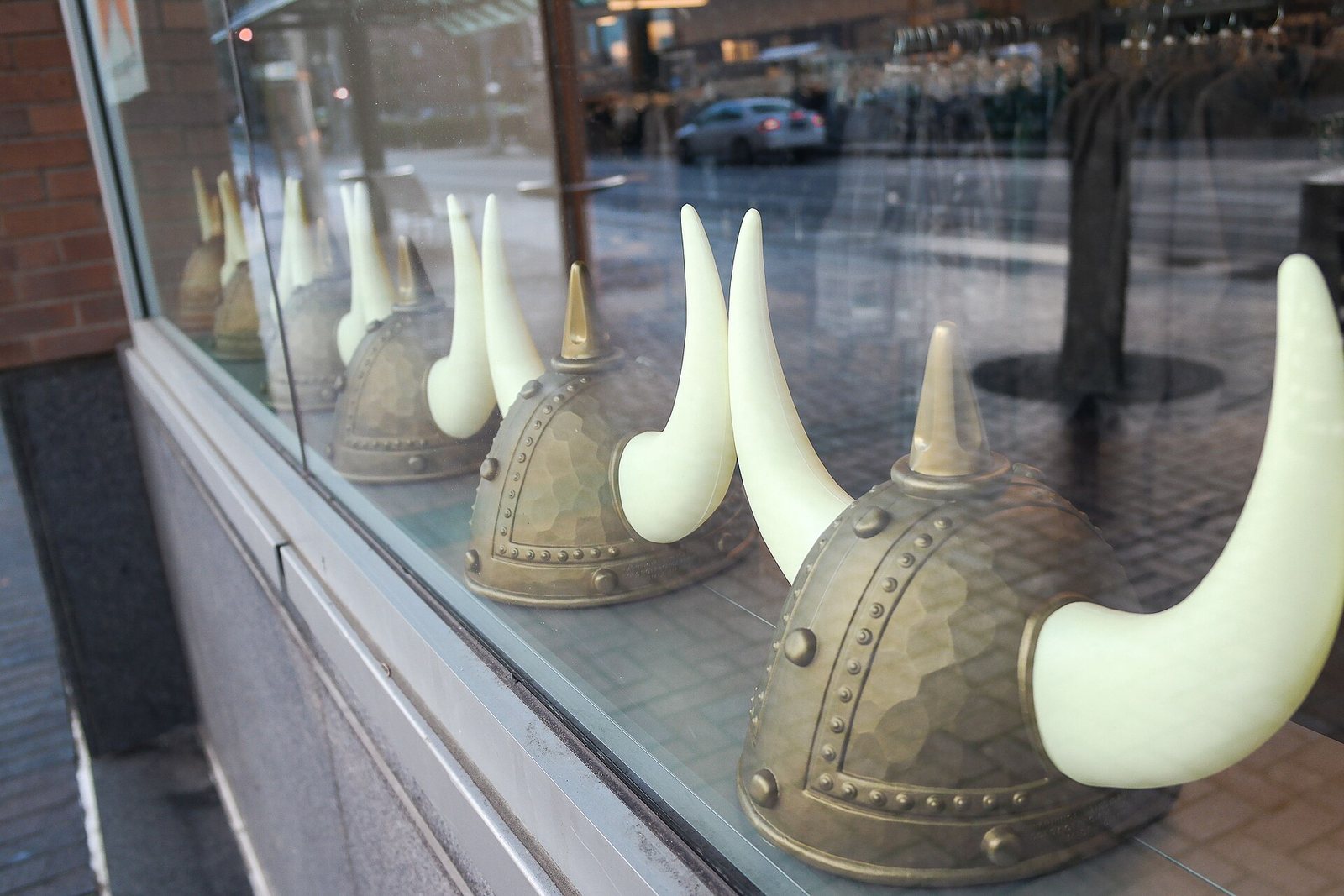
The typical Viking was, above all, a farmer, trader or craftsperson in the North – comb on the belt, ale in the cup, and now and then a voyage across the sea. Horned helmets, skull cups and unwashed blond giants do not belong to the Vikings at all; they belong to the 17th to 20th centuries. We take the best-known clichés apart one by one and keep the evidence strictly separate: what the ground shows, what contemporaries wrote, and what the sagas only told generations later.
When someone in our workshop asks for “something really Viking” to be engraved, the same picture comes up again and again: a bearded giant with horns on his helmet, a drinking horn in his fist, a dragon ship behind him. We get it. It is a powerful image. The trouble is that much of it was invented by scholars, painters, opera costume designers and film studios – and it hides how fascinating the real people of the 8th to 11th centuries were.
Before we dismantle the clichés, here is a tool you will need for every Viking question: three drawers. The first holds archaeological evidence – graves, settlements, ships, skeletons, combs. It does not lie, but it is often silent. The second holds contemporary written sources: Frankish annals, English chronicles, letters, Arabic travel accounts, runic inscriptions. They date from the period itself, but were almost always written by outsiders or victims. The third holds later tradition – the Icelandic sagas, the Edda, Saxo Grammaticus, chronicles of the 12th and 13th centuries. They are vivid and detailed, but they were written two or three centuries after the events and look back through Christian eyes. Almost every cliché is born when those drawers get mixed up.
Even the word trips us up. In Old Norse, a víkingr is a person who goes on víking – a raiding voyage by sea. You “went a-viking” the way you might go to war. Where the word comes from is still debated: from vík (bay), from the Viken region around the Oslo fjord, or from a verb meaning “to move aside, depart”. None of these explanations has won the argument.
More telling is what contemporaries called the people from the North. Frankish annals write of Nordmanni and Dani, the Anglo-Saxon Chronicle of Danes and the “heathen army”, Arabic authors of the Rūs, and Byzantium later of Varangians. Using “Vikings” as a blanket term for all Scandinavians of the period is a modern habit that only took hold in the 19th century. If you want to keep the labels straight, our article Vikings, Normans, Northmen, Varangians, Rus sorts them out.
This has a big consequence: the vast majority of people in Scandinavia were never “Vikings” in the literal sense. They lived on farms, sowed barley, kept cattle, wove, forged and traded. In the sagas, víkingr is often not a badge of honour at all but a word for a pirate – including the kind who plundered his own coasts.
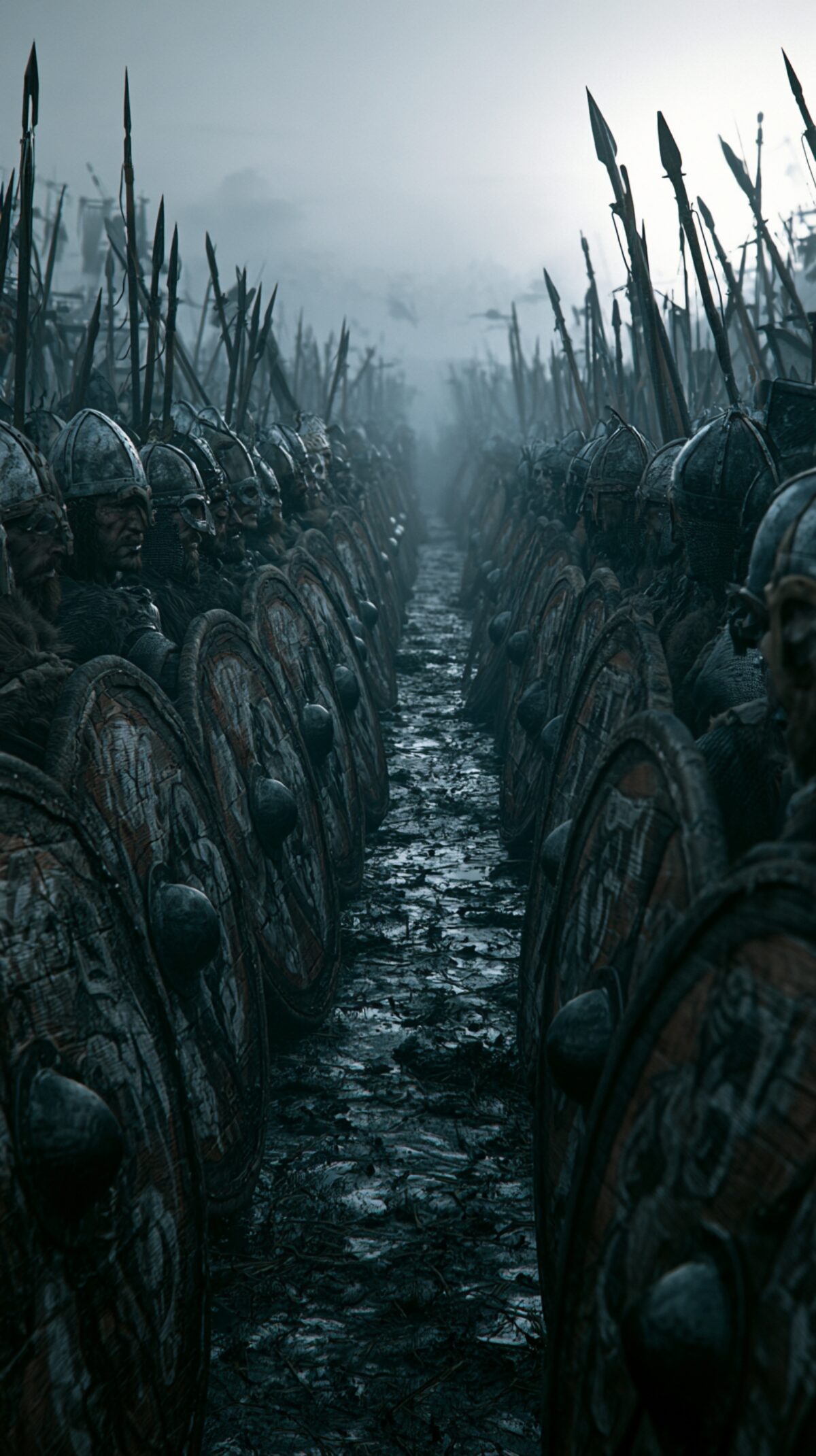
We can deal with the most stubborn cliché quickly, because it has its own article: Did Vikings really wear horned helmets? In short: not a single horned helmet is known from the Viking Age. The only largely intact helmet from Scandinavia, the 10th-century Gjermundbu helmet, has a rounded cap and a spectacle-like face guard – and no horns. Horned helmets do exist, such as the Veksø helmets from Denmark, but they date from the Bronze Age, roughly 1,800 years before the Vikings. Horned figures in Vendel- and Viking-period imagery probably show ritual or mythical beings, not battle gear.
How the horns ended up on Viking heads anyway is a story we tell further down, when we get to the people who invented the clichés.
Few objects turn up in Viking-Age graves and settlements as often as the comb. Carved from deer antler, riveted together with iron, often decorated – they have been found in large numbers at Hedeby, Birka, Ribe and York, along with the workshop waste. We describe the craft behind them in our piece on comb makers and bone carvers. Add to that tweezers, small ear-spoons and razors. People who carry such things on their belts and take them into the grave cared about how they looked.
The language gives even more away. Saturday in Old Norse is laugardagr, “washing day”, from laug, a bath. Icelandic laugardagur and Scandinavian lørdag/lördag still carry the word today.
A favourite quotation here comes from an English chronicle usually attributed to “John of Wallingford” after a later owner of the manuscript: the Danes, it claims, combed their hair every day, bathed on Saturdays and changed their clothes often – and turned the heads of English wives that way. This is where the drawer test pays off. The text was written in an English monastery in the 13th century, more than 200 years after the events around 1002 it describes, and historians regard it as unreliable. It is no eyewitness report – but it does reflect a reputation the Danes kept in England for a long time: vain rather than dirty.
A genuinely contemporary letter tells a similar story. In 793, after the raid on Lindisfarne, the scholar Alcuin wrote to the king of Northumbria and scolded the nobility for trimming their beards and hair in imitation of the pagans. He very probably meant Scandinavians. Northern hairstyles were evidently fashionable – right in the years of the first raids.
And then there is Ibn Faḍlān. The envoy from Baghdad met the Rūs on the Volga in 921/922 and called them the filthiest of God’s creatures: they did not wash their hands after eating, and each morning all the men washed face and hair one after another in the same basin, spitting and blowing their noses into it as well. That is real eyewitness testimony – but measured against strict Islamic purity rules that demand running water. More on this text in our article on Ibn Faḍlān. Another traveller from al-Andalus, Ibrāhīm ibn Yaʿqūb, even reports from 10th-century Hedeby that both men and women there wore eye make-up.
One more find refuses to fit the barbarian picture: on skulls from Sweden, especially Gotland, men had carefully filed horizontal grooves in their front teeth. What they meant – belonging, status, decoration – remains an open question. As for tattoos, we have checked the evidence in Were the Vikings tattooed?
Their clothes were not sack-grey either. Textile finds show wool and linen dyed with woad, madder and other plant dyes, with woven bands and, on wealthy garments, silk from the East. Details in Viking clothing.
The image of the six-and-a-half-foot, flaxen-haired Norseman does not survive a look into a museum store room. Skeletal studies give average heights for Viking-Age men of around 1.70 metres (about 5 ft 7 in), somewhat more in some Norwegian samples, and for women around 1.60 metres (about 5 ft 3 in). The Viking Ship Museum in Roskilde puts it plainly: on average some eight to ten centimetres shorter than people today. Respectable for their time – not giants.
On hair colour, we have had a large data set since 2020. An international team led by Ashot Margaryan and Eske Willerslev published the genomes of 442 people from the Viking Age and its surroundings in Nature, from Greenland to Ukraine. The study found gene flow into Scandinavia from southern and eastern Europe both before and during the Viking Age. Trait predictions suggest that brown hair was widespread – blond was by no means the norm. There is a lovely detail from Orkney, too: two men buried with swords in typically Scandinavian fashion had no Scandinavian genetic ancestry at all but resembled Irish and Scottish people. Being a “Viking”, it seems, was a way of life you could adopt.
And Ibn Faḍlān? He described the Rus as tall “like palm trees” and fair and reddish in complexion. An eyewitness picture – but of one group of traders, not of all Scandinavia.
The raids are well documented. Frankish, English and Irish chronicles list plundering, ransoms and burnings year after year. The slave trade belongs to the truth as well: captives were merchandise, as we show in Slavery among the Vikings. We have no intention of glossing over any of it.
Yet even those who did go raiding usually did so for a season or a few years and then returned to a farm. The backbone of society was agriculture: barley, oats, rye, cattle, sheep, pigs. Alongside it came fishing, iron production, carpentry and far-reaching trade in silver, furs, walrus ivory and amber. Places like Hedeby and Birka were market towns, not pirate dens. What a year on such a farm looked like is the subject of How the Vikings really lived.
The picture of a lawless mob does not hold up either. Free men gathered at the Thing, where disputes were heard and law was spoken. In battle, discipline counted for more than frenzy – the shield wall only worked if everyone held his place. The raging berserkers come mostly from sagas and skaldic poetry, and even there they are exceptional figures.
This cliché comes in two flavours, and both miss. One casts women as powerless drudges, the other turns every second one into a shieldmaiden.
What the evidence supports is a middle position with real weight. Women ran the household and with it a large share of the economy; keys in women’s graves are often read as a sign of that responsibility. Rune stones show women as patrons and heirs: they raised stones for husbands and sons, paid for bridges and roads, and some inscriptions record chains of inheritance in which land passed to women. The most splendid burial of the entire era, the Oseberg ship, belonged to two women. And in the North Atlantic, according to tradition, a woman like Aud the Deep-Minded led her own settlement voyage.
Be careful with the sweeping claims about women’s rights, though. What we know about inheritance, dowry and divorce comes mainly from law books written down in the 12th and 13th centuries, such as the Icelandic Grágás. They allow women to divorce under certain conditions and regulate their property. A seat at the Thing or a political office was not envisaged for women, and marriages were generally negotiated by families. More in Women in the Viking Age.
And the warrior women? Grave Bj 581 at Birka, a rich burial with weapons and two horses, was identified genetically as female in 2017. Whether it held a warrior, a leader or a woman with symbolic grave goods is hotly debated. The shieldmaidens of the sagas and Saxo’s Lagertha, on the other hand, belong in the third drawer.
The idea that Vikings drank from their enemies’ skulls demonstrably rests on a translation error. In the poem Krákumál, probably composed in the 12th century and put into the mouth of the dying Ragnar Lodbrok, the hero looks forward to drinking ale in Odin’s hall ór bjúgviðum hausa – “from the curved branches of skulls”. That is a kenning, a poetic circumlocution: the curved branches that grow from skulls are animal horns. The Danish scholar Ole Worm rendered the line into Latin in his 17th-century work on runes as drinking from the skulls of the slain – and Europe believed it for nearly 300 years. The full story is in Did Vikings really drink from skulls?, and why “skål” has nothing to do with skulls is explained in Skål! Meaning and origin.
There is one real skull cup in Norse tradition, mind you: in the Edda, Völund the smith turns the skulls of the murdered princes into silver-mounted drinking bowls for their father. That is told deliberately as monstrous revenge – horror, not table manners.
And the drinking horn? That one is real. Drinking-horn mounts occur in graves, figurines of women holding a horn are known from several sites, and Gotlandic picture stones show riders being offered a horn – often interpreted as a welcome into the hall of the dead. But the horn was a vessel for special occasions. Everyday drinking happened from wooden cups and pottery, and in wealthy households from imported glass beakers like those found at Birka. And what was in the cup was usually not mead but ale. Honey was precious, so mead was a drink for feasts and lords – and in mythology the drink of gods and poets.
The ships are no exaggeration – they really were the high technology of their age, as we show in Dragon Ships – Masterpieces in Oak. What is questionable is the dragon head on the prow. The two most famous finds, Oseberg and the Gokstad ship, have no dragon head: the Oseberg stem ends in a coiled serpent. At the Ladby ship burial on Funen, around 925, however, iron curls were found that are interpreted as the mane of a dragon head at the bow.
Written evidence does favour animal heads. The Encomium Emmae Reginae, composed around 1041/42 for Queen Emma, raves about Cnut’s fleet with lions, dragons and bulls gleaming with gold on the ships. The Bayeux Tapestry also shows animal heads on Norman stems. Skaldic poetry calls large ships dreki, “dragon” – a poetic name, not a ship type. The most famous of them is Olaf Tryggvason’s “Long Serpent”, though we know it only from the kings’ sagas of the 13th century. The word “drakkar”, incidentally, is not an Old Norse term but a modern coinage.
A charming detail comes from the Icelandic settlement tradition: an old heathen law supposedly required ships’ heads to be removed before land came into sight, so as not to frighten the land spirits. It is found in a version of Landnámabók from the late 13th century – late evidence, but a hint that prow heads were detachable and not carried all the time.
In the blood eagle, a captive’s back is said to have been cut open, the ribs severed from the spine and the lungs drawn out so that they looked like wings. Anyone who thinks of this as typically Viking should know what the sources actually say.
The oldest trace is a single stanza by the skald Sigvatr Þórðarson from Cnut’s time, early 11th century. In paraphrase, Ívarr had the back of the Northumbrian king Ælla “cut with the eagle”. That might mean a ritual – or a stock poetic image in which the defeated is left for the eagles to feed on. In 1984 the medievalist Roberta Frank showed that the detailed descriptions only appear from the late 12th century onwards and grow more gruesome and more pagan with each generation – in Orkneyinga saga, in the tale of the sons of Ragnar Lodbrok and in Saxo. Her conclusion: the blood eagle may have grown out of misunderstood poetry.
In 2022 a team led by Luke John Murphy tested in the journal Speculum whether the procedure was anatomically possible at all. The result: feasible in principle, but the victim would have died very quickly. Whether it ever happened is a question the study explicitly leaves open. Our detailed weighing of the evidence is in The blood eagle: execution or mistranslation?
Nearly every image on our list has a birth certificate – and hardly any of them dates from the Viking Age.
17th-century scholars. Antiquarians like Ole Worm in Denmark rediscovered Old Norse tradition, translated it into Latin and made it known across Europe. With them, the skull cup entered the world.
Romanticism. Around 1800, Scandinavia and Germany were looking for a past of their own, one not shaped by Rome. In 1811 the “Gothic League” was founded in Stockholm, and one of its members, Erik Gustaf Geijer, published his poem Vikingen that same year. Esaias Tegnér’s Frithiof’s Saga of 1825 became a Europe-wide bestseller, translated into many languages. The sea-raider turned into a noble, freedom-loving hero. Painters gave him winged helmets, bearskins and flowing manes. In English, too, the word “Viking” only became popular during the 19th century.
Wagner and the stage. In 1876 Carl Emil Doepler designed the costumes for the first performance of Richard Wagner’s Ring of the Nibelung at Bayreuth – with horns and wings on the helmets. Wagner’s material was Germanic myth rather than Viking history, but the image jumped across anyway.
Film and television. Hollywood adopted the operatic look, most prominently in The Vikings of 1958 starring Kirk Douglas. More recent productions have mostly dropped the horns but created new clichés: leather armour, undercut hairstyles, war paint, warrior women as the norm. How much history there is in “Vikings” or in games like Assassin’s Creed Valhalla is something we have checked separately.
Once the drawers are properly sorted, what remains is a picture we honestly like better than the horned helmet: people who crossed the Atlantic with oak planks and woollen sails, maintained a legal system built on assemblies, traded silver from Baghdad for furs from the North, combed their hair, brewed ale and honoured their dead with ships. The dark sides belong to it too – raiding, slavery, violence. They are part of the picture, just not the whole of it.
That real picture is what we try to capture in our engravings: motifs based on finds, not on film posters. No horns – we promise.
Did Vikings wear horned helmets? No. No horned helmet is known from the Viking Age, and the only largely intact helmet, from Gjermundbu, has no horns. The image comes from the 19th century, above all from Doepler’s Bayreuth costumes of 1876.
Were the Vikings dirty? No. Combs, tweezers and ear-spoons have been found in huge numbers, and Saturday was called “washing day”. Ibn Faḍlān’s criticism of the Rus measured them by Islamic purity rules.
Were all Vikings tall and blond? No. Men averaged about 1.70 m and women about 1.60 m. A 2020 genome study suggests that brown hair was widespread.
Did Vikings drink from skulls? No. The myth goes back to Ole Worm’s mistranslation of a kenning in the poem Krákumál; drinking horns were meant.
Was the blood eagle real? It is unproven. There is only an ambiguous skaldic stanza and later sagas, and no archaeological evidence.
Were the Vikings a people? No. Old Norse víkingr means someone who goes raiding by sea. Contemporaries spoke of Northmen, Danes or Rus.
For courage. For remembrance. For legends that live on.
The horned helmet myth · Everyday Viking life · Women among the Vikings · Skull cup myth.
All History & Finds articles →
Without their ships the Vikings would never have become Vikings. The longship was the high technology of its time …
Read more →