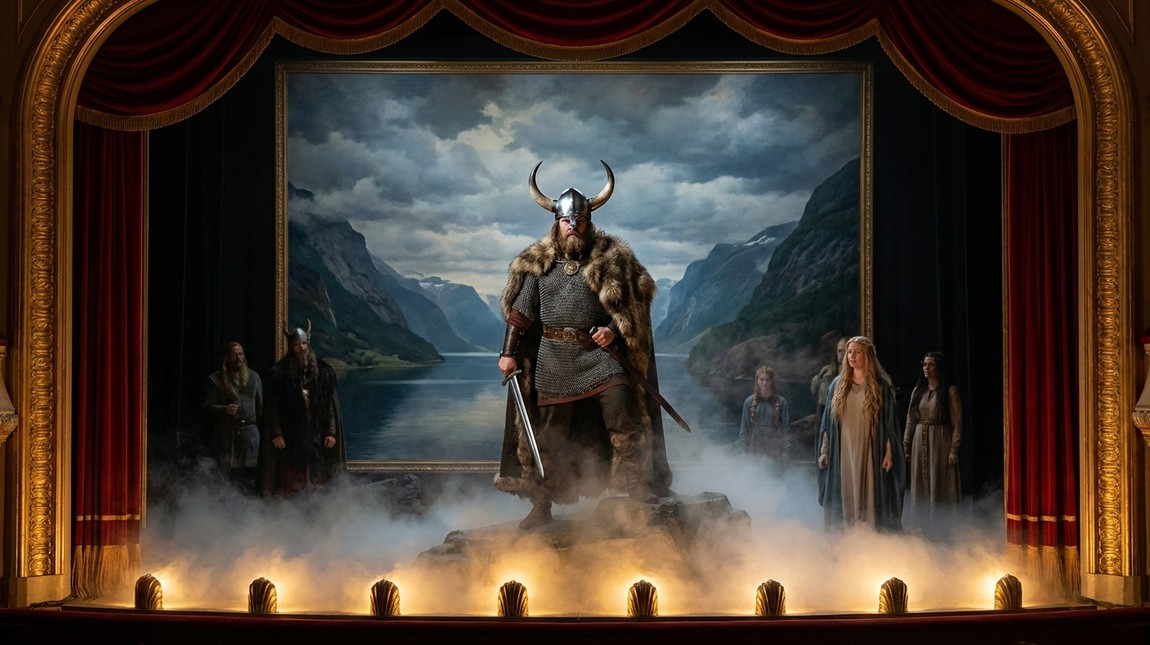
No – there is no evidence that any Viking ever wore a horned helmet in battle, neither in the ground nor in any contemporary text. The only near-complete helmet of the Viking Age, found in 1943 at Gjermundbu in Norway, is a rounded iron cap with a spectacle guard and not a trace of horns. Real horned helmets do exist, but they come from the Bronze Age, roughly 1,700 years earlier. The horned Viking was invented by scholars, painters and the Bayreuth stage of the nineteenth century. Here is how it happened.
Ask ten people to sketch a Viking and nine will hand you the same head: beard, scowl, iron helmet, two sweeping horns. The image is so familiar that challenging it feels almost impolite. We are going to challenge it anyway, because on this point the archaeology is refreshingly blunt. From the Viking Age, roughly 793 to 1066, we do not have a single helmet with horns. Not a grave good, not a bog find, not even a fitting where a horn might once have been attached.
The written sources are no help to the myth either. Frankish annals, Anglo-Saxon chronicles, Irish monastic records and Arab travellers all describe the Northmen, often and rarely kindly. Christian chroniclers in particular would have seized on any barbaric detail. None of them mentions horns. Old Norse poetry knows the word hjálmr, helmet, perfectly well, but it decorates helmets with gold, not with horns.
The interesting question is where the picture came from instead. The trail runs from Danish Bronze Age bogs all the way to the Bayreuth stage in 1876.
On 29 March 1943 a farmer named Gunnar Gjermundbo was levelling ground for a house on his farm near Haugsbygd in Ringerike, north-west of Oslo. He struck a burial mound, and inside it a tenth-century man's grave. Archaeologists recovered a sword, two spears, two axes, four shield bosses, spurs, horse gear, fragments of a mail shirt and nine pieces of iron from which a helmet could be reconstructed. The grave is dated to the second half of the tenth century.
The helmet has a rounded skull, or dome, built from four iron plates held together by bands, with a small spike on top. In front sits a so-called spectacle guard: an iron frame around the eyes and down the nose, rather like a pair of glasses with a nose bridge. Traces of rings along the rim suggest a mail curtain protecting the neck. Horns? None. No stub, no rivet, no hole where one might have been fixed.
If you want the full story of the find, its construction and the many replicas, read our feature on the Gjermundbu helmet. For our question the essence is enough: the one well-preserved original looks like a sober piece of iron equipment, not an opera costume.
Beyond Gjermundbu, research knows only a handful of other helmet remains that certainly or probably belong to the Viking Age. What matters is what they share, and what they lack.
Tjele, Denmark. In 1850 a farmer planting trees near Tjele manor, between Viborg and Randers, turned up a set of smith's tools: anvils, hammers, tongs, files. A decorated piece of iron among them was catalogued as a saddle fitting and stayed that way for over 130 years. Only in 1984 did the archaeologist Elisabeth Munksgaard at the National Museum in Copenhagen recognise it as the brows and nose guard of a helmet mask very like the one from Gjermundbu. The find is dated to around 950 to 970.
Yarm, England. In the 1950s workmen digging pipe trenches in Yarm on the River Tees, North Yorkshire, found an iron helmet made of riveted bands and plates, with a small knob on top and a spectacle guard. A study led by Chris Caple of Durham University placed it in 2020 in the tenth century and in the Anglo-Scandinavian world of northern England. It is the second largely complete helmet of the period and is now on display at Preston Park Museum in Stockton-on-Tees.
Kyiv and Lokrume. From Kyiv comes a richly decorated helmet mask found at the site of the Church of the Tithes; from Lokrume on Gotland, another mask fragment. Both are also dated to the second half of the tenth century. Add a few scraps, for instance from Birka, whose identification is uncertain.
The pattern is clear. What survives are caps with spectacle or nose guards, some inlaid with silver and bronze, so genuine prestige objects. Not one carries horns, and not one has fittings for them. For a full survey of the known finds, back to the older parade helmets, see our article Helmets of the North.
If some 270 years of Viking Age have left us so few helmets, a second question follows: how many warriors owned one at all? The honest answer is probably not many. Iron had to be smelted from bog ore, refined and then hammered into shape over many hours of skilled work. A helmet was an expensive item, in the same league as a sword or a mail shirt. Most researchers therefore assume that metal helmets belonged mainly to wealthy men and to the retinues of kings and jarls.
An observation from much earlier, about the Germanic peoples of the first century, shows how scarce metal had long been in the north. Tacitus writes in his Germania (chapter 6):
Paucis loricae, vix uni alterive cassis aut galea.
"Few have a breastplate; scarcely one or two have a helmet of metal or of leather."Tacitus, Germania 6 (AD 98); our own translation
Eight centuries later circumstances had changed, but the principle held. The bulk of the fighters in a shield wall relied on shield, spear and perhaps an axe. Caps of leather or cloth are plausible but almost impossible to prove, so treat them as a guess.
There is another reason for the scarcity of finds. With conversion to Christianity, the custom of burying the dead with weapons came to an end in the north. Even in pagan times a helmet seems rarely to have gone into the grave; it was more likely an heirloom than a burial gift. So the small number of finds does not mean there were no helmets. But it does not mean a stash of horned ones is waiting somewhere either. For what Vikings really looked like according to skeletons, DNA and eyewitnesses, read What did Vikings look like?
Alongside the finds there is a practical argument that arms historians like to make. A smooth, rounded helmet makes blows glance off. Horns do the opposite: they give a blade or an axe a point to catch on, and they act as levers, passing the force straight into the wearer's head and neck. In the crush of a shield wall or on the cramped rowing benches of a longship they would snag constantly.
To be fair, the argument is not watertight: parade helmets with crests or animal figures existed in many cultures. The decisive argument remains the evidence in the ground.
Now the twist that makes the myth so stubborn: horned helmets are real, and some of the finest come from Denmark. In 1942 a peat cutter in the bog of Brøns Mose near Veksø (often spelled Viksø), a few kilometres north-west of Copenhagen, found two splendid bronze helmets. Each has a pair of strongly curved horns, plus stylised eyes and a beak suggesting a bird of prey. Originally each probably carried a crest, perhaps of horsehair, and possibly feathers on the horn tips.
For a long time the helmets were dated only by style, loosely to the Bronze Age. In 2019 specialists at the National Museum of Denmark, preparing new photographs, noticed birch tar on one of the horns. This organic adhesive could be radiocarbon dated directly. The result, published online at the end of 2021 in the Praehistorische Zeitschrift by Helle Vandkilde of Aarhus University and colleagues: the helmets went into the bog around 900 BC, in the later Nordic Bronze Age. The team also sees links to horned figures from Sardinia and the Iberian Peninsula of the same period, a long-distance connection that not every specialist accepts.
The Veksø helmets were not combat gear. Their thin bronze sheet would not have survived a serious blow, and the pair was deliberately placed in the bog, most likely as an offering. Vandkilde put it this way in a Danish interview, in paraphrase: in some popular stories Vikings wear horned helmets, but that is a Bronze Age phenomenon. Some 1,700 years separate the deposit from the raid on Lindisfarne in 793.
Horned figures appear in other Bronze Age finds too, such as small bronze statuettes from the Grevensvænge hoard on Zealand, now only partly preserved, and countless Scandinavian rock carvings. Outside the north there is the Waterloo Helmet from the Thames in London, an Iron Age ceremonial helmet with conical horns from the British Celtic world. Our article Horned helmets – yes, but not among the Vikings looks at these pieces, their purpose and their dating in detail.
Between the Bronze Age and the Viking Age lies a period in which horns surface once more, but in pictures, not on combat helmets. Early in 1870, four cast bronze plates were found in a cairn at Torslunda on the Swedish island of Öland. They are not ornaments but dies: thin sheet metal was pressed onto them to produce picture strips that covered the parade helmets of the Vendel period (roughly 550 to 790). They are now in the Swedish History Museum in Stockholm.
One plate shows a dancing figure holding spears, wearing headgear of two curved horns that end in birds' heads. The dancer is missing an eye: laser scanning showed that it was apparently removed deliberately from the model. That is why many scholars read the figure as Odin, or as a man taking on the role of the one-eyed god in a ritual. We explore the plate and its interpretation in The Torslunda Plates.
Very similar dancers with bird-horned helmets appear on the stamped panels of the helmet from the ship burial at Sutton Hoo in England, around AD 600. These are images of gods, rituals or cult roles, not snapshots of everyday war gear. The helmets that carried these images were themselves smooth caps with crests and animal figures. Instead of horns they bore boars, which promised protection; our piece on the boar in the Norse world tells that story. The Old English epic Beowulf knows such helmets too:
Eoforlic scionon ofer hleorberan gehroden golde, fah ond fyrheard; ferhwearde heold.
"Boar-shapes shone above the cheek-guards, adorned with gold, gleaming and fire-hardened; they kept watch over life."Beowulf, lines 303–306; our own translation
Not a word about horns.
One find from the Viking Age itself is regularly cited as a counter-example. The Oseberg ship burial on the Oslofjord, closed in 834, contained remains of a narrow woven tapestry. It shows a procession of wagons, horses and people, and one figure wears headgear that looks like a pair of horns.
What does it show? The context is clearly not a battle. The scene looks like a procession or a cult event, and many researchers see the horned figure as a ritual character, a god or a person in a divine role, very much in the tradition of the Torslunda dancers. Whether people actually wore horned headdresses on such occasions, or whether the weaver was depicting a figure from myth and memory, cannot be settled. A horned combat helmet certainly cannot be derived from it.
The most thorough investigation comes from the medievalist Roberta Frank, who in 2000 published an essay with the splendid title "The Invention of the Viking Horned Helmet". Her conclusion: the horned Viking is a child of the late nineteenth century, but one with a long ancestry.
That ancestry begins in antiquity. Greek and Roman writers such as Diodorus and Plutarch described Gauls and Cimbri wearing helmets with horns or animal figures. Renaissance humanists happily lumped Celts and Germanic peoples together, and so the geographer Philipp Clüver, in his Germania antiqua of 1616, gave the ancient Germans horned helmets. Germans, mind you, not Vikings. But the horned "barbarian from the north" was now in circulation.
Then came finds that were misassigned. The famous golden horns of Gallehus with their horned figures, the Grevensvænge hoard found in 1799, the Torslunda plates of 1870 and the Waterloo Helmet pulled from the Thames in 1868 were all, at times, credited to the "ancient Northmen" in the nineteenth century. Ironically, the Swedish archaeologist Oscar Montelius described the Torslunda figure's headgear as early as 1872 as birds' necks, not horns. His caution did not win. Tellingly, the term "Viking Age" first appears in scholarly articles in 1873, just before the period acquired its false costume.
In the early nineteenth century Scandinavia rediscovered its distant past. In Sweden the Götiska förbundet, the "Gothic League", founded in 1811, brought together poets and scholars eager to celebrate a heroic past. Its greatest success was Esaias Tegnér's Frithiof's Saga, a verse epic based on an Icelandic saga, completed in 1825 and translated into many languages. Frithiof, the hero, wears no horned helmet in the poem. According to Roberta Frank, illustrators gave him an eagle helmet for most of the century.
Here we need to correct a widely repeated claim, one that also appeared in the earlier version of this article. You often read that the Swedish painter Gustav (properly Johan August) Malmström drew horned Vikings as early as the 1820s. That cannot be right: Malmström was born in 1829. His well-known illustrations for Frithiof's Saga came decades later, first as wood engravings for an edition of the 1870s and then for the grand Stockholm edition of 1888. In these pictures, according to common descriptions, some kings and warriors wear helmets with small lateral horns or wings. Malmström helped spread the motif, but he did not invent it in the 1820s.
Scandinavian artists, Frank found, stayed cautious for a long time. Louis Moe's drawings for Saxo (1898), for example, give horns to gods, giants and foreigners, not to the Vikings themselves. The real push came from the German-speaking world.
In 1876 Richard Wagner opened his Festspielhaus in Bayreuth with the first complete performance of his cycle "Der Ring des Nibelungen". The costumes were designed by the painter and illustrator Carl Emil Doepler (1824–1905). Lacking archaeological models for Germanic gods, he drew on ancient barbarian imagery, finds from all sorts of periods and plenty of imagination. The result was winged helmets, helmets with cow horns, furs and heavy jewellery. Cosima Wagner, Frank reports, thought the costumes recalled "Red Indian chiefs", and she did not mean it kindly.
One distinction matters. Wagner's "Ring" is not set in the Viking Age but in a mythic world of gods, giants and the Völsung and Nibelung legends. Strictly speaking, Doepler was not dressing Vikings at all. But Bayreuth became an international cultural event, pictures of the productions travelled the world, and to the public the line between "Germanic", "Norse" and "Viking" was blurry anyway. For the legends behind the operas, see our article on Sigurd, Brynhild and the Nibelungs.
Within a few years the horned Northman was everywhere. Frank lists the evidence: Wilhelm Wagner's book of legends "Unsere Vorzeit" gave Frithiof a horned helmet in its 1878 edition, and an American translation of Frithiof's Saga from the same year did likewise. In 1894 Kaiser Wilhelm II had his "Song to Aegir" illustrated with cow-horn helmets, drawn by Doepler's son Emil Doepler the Younger. By 1900 the horned helmet had become the badge of anything meant to look pagan, warlike and Nordic.
In the twentieth century advertising, comics and film took over the finished image. It had one unbeatable advantage: you recognise it by its silhouette. Two horns, and everyone thinks "Viking" without reading a word.
Examples are legion. The Minnesota Vikings football team has worn a horn on its helmets since the 1960s. Dik Browne's comic-strip hero Hägar the Horrible, syndicated worldwide since 1973, is unthinkable without his horned helmet. Halvar, the father of Vicky the Viking from Runer Jonsson's children's books and the famous 1970s cartoon series, wears horns too.
Today's series mostly show rounded helmets with nose guards, if anything too many. Other stubborn clichés are collected in Typically Viking?
The horned helmet's little brother is the winged helmet you know from Valkyries on opera posters or from Asterix. It has nothing to do with the Viking Age either. Winged heads are familiar from Roman images of the god Mercury, and ancient writers describe Celtic helmets with bird and animal figures. The Celtic iron helmet from Ciumeşti in Romania actually carries a raven with movable wings. In the nineteenth century the novelist Felix Dahn gave a Scandinavian chieftain sea-eagle wings on his helmet in 1876, and Doepler put wings on the heads of his Valkyries and gods in Bayreuth.
Roberta Frank tells a lovely anecdote. Around 1905 a reader asked in the journal of the Viking Society in London what lay behind the Vikings' winged helmets. The scholar Karl Blind replied that he knew of no evidence. The society's secretary, by contrast, reported plenty of evidence for the horned helmet. He was wrong, but the image was already firmly in place.
The horned helmet is a case study in how images of history are made: genuine finds from other eras, ancient clichés about barbarians, nineteenth-century longings and a lavish opera stage merged into a costume more powerful than any catalogue of finds.
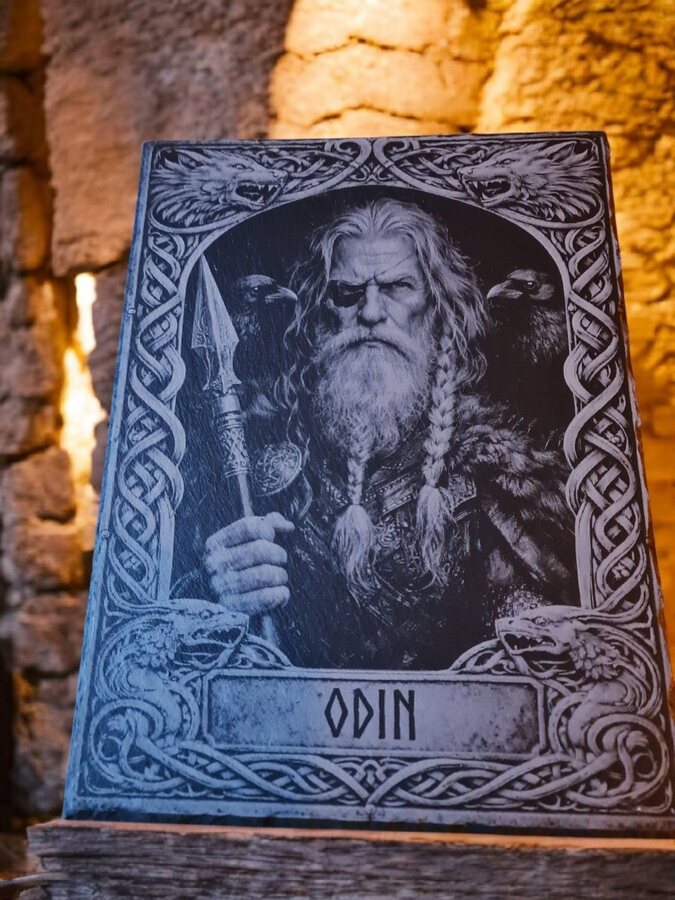
We have chosen the second. When we engrave Norse motifs into slate, wood or glass in our workshop in Alsdorf, we work from real models: rune stones, animal-style ornament, helmets like the one from Gjermundbu. Horns appear in our work only where they belong, on a Bronze Age ritual helmet or a dancing god from Torslunda. For the Viking in the shield wall we leave them off. He did not need them then either.
Did Vikings wear horned helmets? No. There is not a single archaeological find and no contemporary written source showing a Viking Age combat helmet with horns. The only near-complete Viking helmet, from Gjermundbu in Norway (tenth century), has no horns.
Where does the Viking horned helmet myth come from? From the nineteenth century. Ancient descriptions of horned Gauls, misattributed finds and Romantic illustrations prepared the ground; the breakthrough came in 1876 with Carl Emil Doepler's costumes for Wagner's "Ring of the Nibelung" at Bayreuth.
Were there ever horned helmets in Scandinavia? Yes, in the Bronze Age. The two Veksø helmets from a Danish bog were deposited around 900 BC, some 1,700 years before the Viking Age, and were ritual objects, not battle helmets.
Which Viking helmets survive? Near-complete examples are the Gjermundbu helmet and, from England, the Yarm helmet. There are also mask fragments from Tjele (Denmark), Kyiv and Lokrume (Gotland), all from the tenth century.
Did all Vikings wear helmets? Probably not. Iron helmets were expensive and very rare in graves, so they were most likely worn by wealthy warriors and the retinues of rulers.
What do the horns on the Torslunda plates show? A dancing figure with bird-headed horns, probably Odin or a person in his role. The plates date from the Vendel period (6th–7th century) and depict ritual and divine scenes, not everyday equipment.
For courage. For remembrance. For legends that live on.
Berserkers · The shield wall · The Great Heathen Army · The longships · Vegvísir & Ægishjálmr.
A heavy grey slab covered in a long line of runes, dug out from under the roots of an aspen tree in Minnesota. The …
Read more →Two short stanzas, scribbled onto a blank page of a church book – and yet the most precious record we have of the …
Read more →The market is full of "Norse" symbols: on pendants, T-shirts, tattoos and wall art. Many are sold as ancient and …
Read more →Every Easter she makes the rounds again: „Ostara, the Germanic spring goddess". Only – she is largely an invention of …
Read more →