 Before the Vikings sailed the seas, an age of astonishing splendour flourished in Swedish Uppland: the Vendel Period. In its boat graves lay gilded helmets with stern eyebrows and striding warriors, ring-pommel swords and shields with bird mounts. Its art – finely stamped image foils and interlacing animals – is the direct root of what we today call "Viking art". A look at the forgotten golden age before the dragon ships.
When the Norse past is spoken of, most people think at once of the Vikings: of longships, runestones and mead in the hall. But the Viking Age did not fall from the sky. It was preceded by an epoch that Scandinavia calls the Vendel Period – and one must know it to understand where the famous art styles, helmets and warrior images of the Vikings actually come from. It is the workshop in which much was forged that is later held to be "typically Viking".
The Vendel Period is a section of the Swedish (more precisely, central Swedish) Iron Age, dated roughly to the years between about 550 and 790 AD. It thus lies exactly between two better-known epochs: the Migration Period before it (with its gold hoards and the great crisis around 536) and the Viking Age after it, usually begun with the raid on Lindisfarne in 793. The name comes from a place: the parish of Vendel in the region of Uppland north of Uppsala, where the first and name-giving splendid graves were found.
It is important to know that "Vendel Period" is above all an archaeological term for the Swedish area. In Norway the same time is often called the "Merovingian Period", and Denmark and the Continent have their own designations. Everywhere, however, the same exciting transitional phase is meant: the centuries in which, out of the rubble of the Migration Period, new centres of power, new art forms and a new warrior aristocracy took shape in the north.
The Vendel Period became famous through its spectacular boat graves. In Uppland an upper class buried its dead in boats over generations – long before the Vikings did the same at Oseberg and Gokstad. The two most important cemeteries lie only a few kilometres apart: Vendel itself, excavated from the 1880s, and Valsgärde, systematically investigated in the 20th century, which yielded some fifteen boat graves.
What is astonishing about Valsgärde is the continuity: over about three hundred years – from the Vendel Period into the Viking Age – a man of the leading family was again and again laid to rest here in a boat, equipped with helmet, sword, shield, spears, horses and gear. These graves are like an open picture-book of the Norse warrior aristocracy: they show how equipment, art and self-presentation slowly changed over the centuries – and that boat burial was no Viking-Age invention, but a long tradition with deep roots.
The most impressive thing the Vendel Period left behind are its splendid helmets. Several of these head-pieces come from Vendel and Valsgärde, and they have nothing to do with the cliché "Viking helmet" – no one here wore horns anyway. They are artful objects made of an iron cap, often with a crest over the crown, with cheek guards, a neck guard of mail, and – most striking – a fixed eyebrow and nose piece that gave the wearer a stern, mask-like face.
These helmets do not stand alone. Their closest relatives lie in England: the famous helmet of Sutton Hoo and the helmet parts from the Staffordshire Hoard belong to the same craft and image tradition. This shows how closely the elites of the North Sea and Baltic world were linked at this time: a prince in Uppland and a king in East Anglia wore helmets similar in form and pictorial decoration. Art and prestige knew no borders.
Boar-images shone above the cheek-guards, adorned with gold; bright and fire-hardened, the swine kept watch over the war-ready men.Beowulf, Old English epic (paraphrased from the public-domain translation; on the boar-crested helmet)
The Old English heroic epic Beowulf describes exactly such helmets: with a boar as a crest, promising protection and divine aid. And indeed archaeology knows boar-crested helmets of this time, such as the helmet from Benty Grange in England. Text and find confirm one another – a rare stroke of luck.
The helmets and many other objects bear their famous pictorial decoration in a special technique: pressblech (stamped foil). A thin sheet of bronze, silver or gilded metal is hammered over an engraved bronze die, so that the image stands out as a fine relief. In this way figural scenes could be produced in series and applied to helmets, mounts and showpieces. It is an art of patient fine work – no accident that it remained reserved for the princely courts.
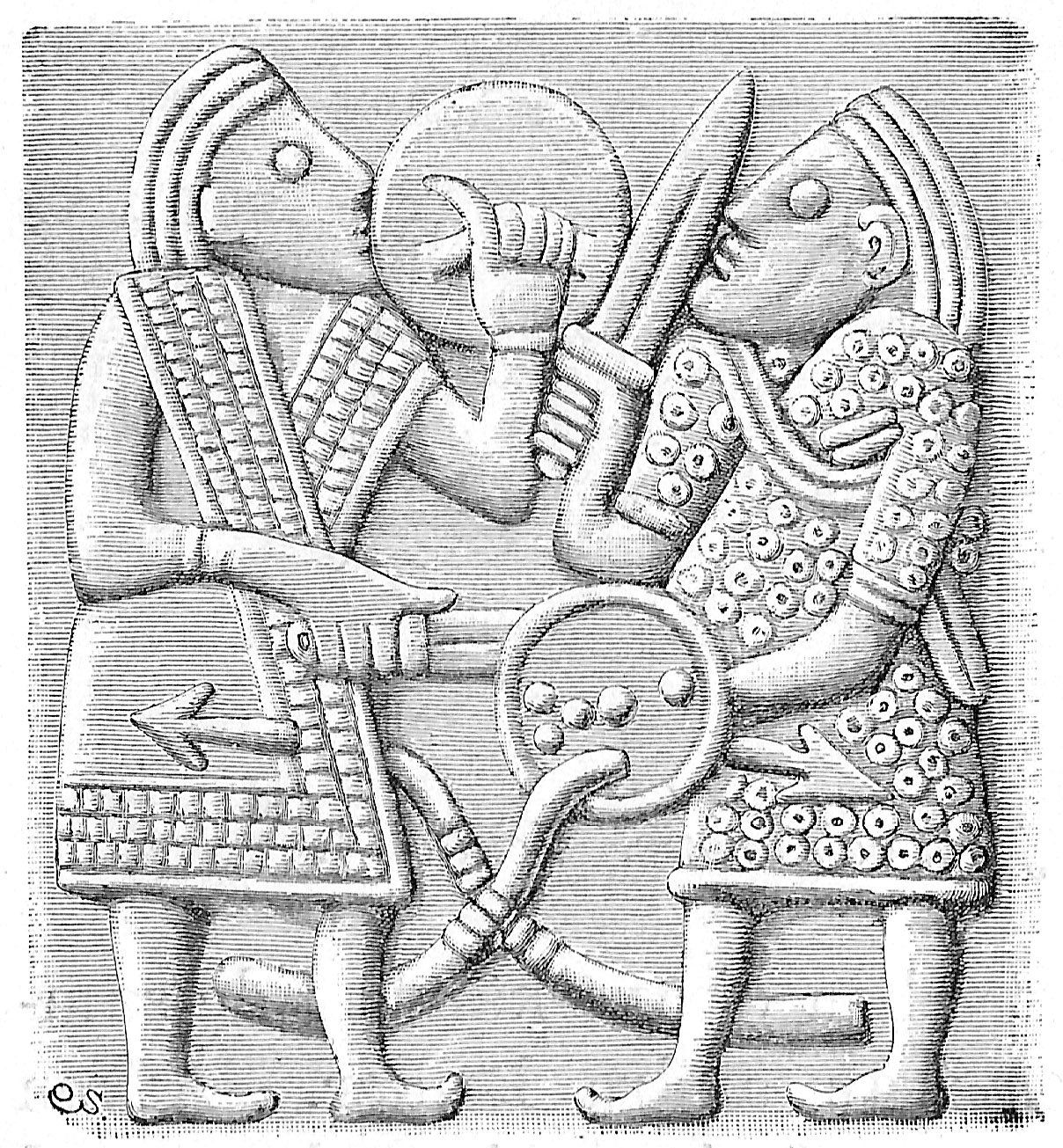
A unique find makes this technique tangible: the dies of Torslunda on the island of Öland. They are four bronze models – engraved stamps with which exactly such image foils were struck. They show the typical motifs of Vendel art and are at the same time a workshop find: direct proof of how these images were made. To look at the Torslunda dies is to look over the shoulder of the Vendel Period itself.
What do these image foils show? Again and again the same, highly condensed scenes of a warrior world: a rider, often accompanied by small helper figures, riding down an enemy; dancing or striding warriors with crossed spears; and – most famously – figures in animal disguise, such as a man in a wolf-skin beside a spear-bearer whose helmet carries two bird-crowned horns.
These images have occupied scholarship for over a hundred years. Many interpret the rider or the dancer as Odin and the animal warriors as forerunners of the berserkers and ulfhednar – the "bear-" and "wolf-shirts" – named later in texts. That is a fascinating and not implausible reading. But it is a reading, and one should remain cautious (more on that in the myth check at the end). Certain is: these images were no mere decoration. They showed a worldview – rule, battle, the aid of higher powers – and thereby adorned precisely those who claimed that power.
Beside the pictorial scenes stands the other great art form of the Vendel Period: the Germanic animal style. The Swedish scholar Bernhard Salin arranged these interlacing animal ornaments into stylistic stages around 1900, and the Vendel Period is the flowering of "Style II" and the emergence of "Style III". Out of still-recognisable animal bodies come ever more abstract, interwoven ribbons – bodies, legs and jaws weave into an endless tangle in which the eye can barely find beginning or end.
This animal style is the direct legacy the Vendel Period passed to the Vikings. Out of it developed the famous Viking art styles, named after their find-spots: Oseberg, Borre, Jelling, Mammen, Ringerike and finally Urnes. Anyone who looks at a gripping beast on a Borre mount or the interlacing ribbons of an Urnes portal sees an art whose grammar was written in the Vendel Period. That is precisely why this epoch is indispensable for anyone who takes Norse ornament seriously.
The Vendel Period was a pronounced warrior aristocracy, and its graves reflect this. Beside the helmets are magnificent swords, some with a ring-pommel – a small ring on the hilt, probably a sign of retainer loyalty and oath-binding. To this come shields with artful mounts, spears, and again and again horses with gilded harness. The dead were equipped for a life as a mounted warrior and lord.
This cavalry and weapon culture shows a society in which a small upper class commanded land, following and long-distance ties. The fine imports – Byzantine glass, Frankish blades, oriental material – prove that Uppland was no remote corner but a hub of far-reaching networks. Precisely these connections and this wealth prepared the ground from which the trading places of the Viking Age, such as Birka, later grew.
The Vendel Period ends not with a break but flows smoothly into the Viking Age. The boat burials continue, the animal style develops step by step, the warrior aristocracy remains. What changes is the range of action: the princes who wore their helmets in Uppland in the 7th century become, in the 8th and 9th centuries, the seafarers, traders and warriors who reach half of Europe. The Viking Age is in many respects the Vendel Period putting out to sea.
That is why it is a little unfair that the Vendel Period stands in the shadow of the Vikings. Its art is at least as fine, its helmets are more impressive than anything the actual Viking Age left in the way of headgear (of which, with the helmet from Gjermundbu, practically only a single one survives), and its imagery is the source of many motifs we associate with the north today.
Precisely because Vendel art is so fascinating, an honest look at what we really know is worthwhile. The helmets, foils, dies and boat graves are solid finds. The meaning of the images, however, is interpretation. Whether the one-eyed dancer is really Odin, whether the animal warriors were already "berserkers" in the later sense, whether the scenes tell concrete myths – all of these are well-founded but unproven readings. The written sources that tell of Odin and ulfhednar are centuries younger than these images.
Precisely this separation of find and interpretation is the thread we follow at GLANZ & GRAVUR with our Norse motifs. When we take up a Vendel motif, a splendid helmet or an animal-style ornament, we do so with respect for what the finds really yield – and with the honesty to say where scholarship ends and conjecture begins. The Vendel Period deserves to be shown not transfigured into fantasy, but in its real, wondrous splendour: as the shining workshop in which the art of the Vikings was born.
The Torslunda Dies · The Oseberg ship & the two women · The Urnes portal – the last animal style · The Saxons.
All History & Finds articles →
In December 2020 a metal detector beeped in a field near Vindelev, only a few kilometres from Jelling. What came to …
Read more →A rare genetic trace in Iceland tells a story that sounds almost unbelievable: some Icelanders carry a maternal DNA …
Read more →