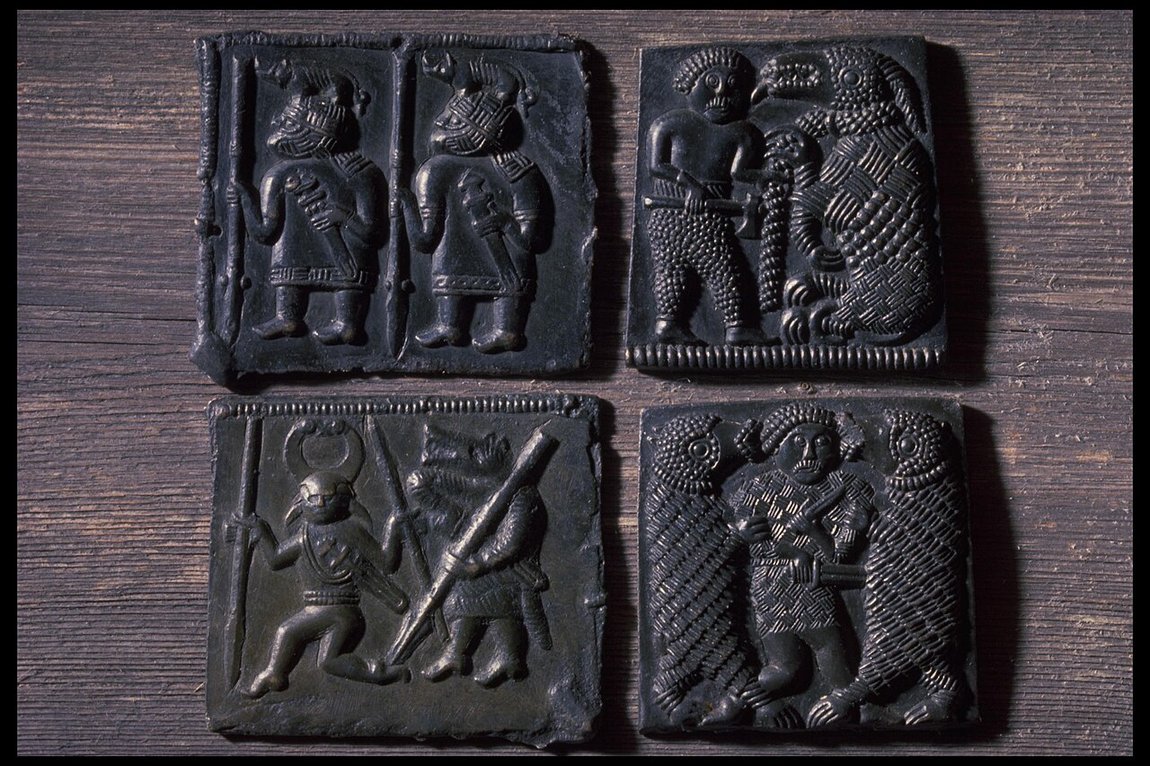
The Torslunda plates are four cast bronze dies from the 6th to 7th century, found in 1870 at Björnhovda in Torslunda parish on the Swedish island of Öland. Craftsmen used them to stamp figural foils for the decorated helmets known from Vendel, Valsgärde and Sutton Hoo. Their four scenes – a man between two bears, an axe-wielding man with a roped beast, a horned dancer beside a wolf warrior, and two warriors in boar-crested helmets – rank among the key images of pre-Christian Scandinavian religion. They are Vendel Period, not Viking Age.
Somewhere on Öland in 1870, a farmer cleared a heap of stones from his field. Among the rubble lay four small bronze plates, green with corrosion, roughly palm-sized. Nobody at the time could have guessed that they were the printing blocks of an entire visual world – one that would later be recognised on royal helmets from central Sweden to the coast of Suffolk. On one plate a man in a horned helmet dances beside a warrior wrapped in a wolf's hide. More than a century later, a laser scan revealed something nobody had noticed: the dancer has only one eye.
This is the story of those four images. We look at how they were used, what they show, how scholars read them – and where careful interpretation ends and wishful thinking begins. Because the Torslunda plates carry no runes, no names, no captions. Everything we say about their meaning comes from reading pictures.
The find spot lies in the parish of Torslunda on Öland, the long limestone island off Sweden's Baltic coast, near the farm of Björnhovda. The plates came to light in 1870 when a cairn or field clearance heap (Swedish röse) was removed. There was no excavation, so the exact context is lost. It was only in 1976 that the Swedish archaeologist Ulf Erik Hagberg reinvestigated the site and its surroundings, publishing his results under the title "Fundort und Fundgebiet der Modeln aus Torslunda" (find spot and find area of the Torslunda dies). Iron Age settlement remains were later found nearby, and one of the island's richest finds of Roman gold coins (solidi) came from neighbouring fields.
Öland was a wealthy place in the Migration and Vendel Periods, with ring forts such as Eketorp and Ismantorp and a striking amount of gold. Björnhovda has been suggested as a leading estate of the island in that era. Whether the dies were actually used in a workshop there, or ended up in the ground for another reason, is still unclear.
Today all four plates belong to the Swedish History Museum (Statens historiska museum, Historiska museet) in Stockholm, where each has its own object number. In 1966 they travelled to London for the British Museum's exhibition "Swedish Gold" – not far from the place where their English cousins had been found a generation earlier, the ship burial at Sutton Hoo.
These plates are neither jewellery nor amulets. They are tools. Specialists call them dies, moulds or – strictly speaking – patrices: the image stands out in relief on the bronze. A craftsman laid a paper-thin sheet of bronze, silver or gilded copper over the die and pressed or tapped it into every hollow, using a soft pad of leather or lead and fine punches. The result was a pressblech (German for "pressed sheet"), a foil relief that could be trimmed and riveted onto a helmet, a scabbard or a small box.
The clever part: a single die produced the same picture again and again. A helmet needed many identical panels, and on surviving helmets the same motifs do repeat. This is mass production in the literal sense. In 1987 the Danish archaeologist Morten Axboe published a paper called "Copying in Antiquity: The Torslunda Plates", arguing that two of the four plates are probably themselves casts taken from finished foils. People were not only copying with the dies – they were copying the dies. That is one way images could travel from workshop to workshop, and one reason the same scenes appear in Sweden and England.
One crucial point before we turn to the pictures: the Torslunda plates are not Viking finds. They belong to the Vendel Period, which in Sweden runs from roughly 550 to around 800 and takes its name from the rich boat graves at Vendel in Uppland. The plates themselves are usually placed in the 6th to 7th century. The Viking Age, by the conventional reckoning, begins only around 793 with the raid on Lindisfarne.
The people who used these dies were, so to speak, the great-grandparents of the Vikings. Between them and Snorri Sturluson, who wrote down the Norse myths in 13th-century Iceland, lie some six hundred years. Whenever we link these images to Odin, berserkers or Fenrir, we are building a bridge across six centuries. That bridge may hold. It may not.
The first image shows a human figure standing between two large, upright animals. They are usually read as bears; some scholars prefer the more neutral "monsters". The beasts turn towards the man. Whether he is wrestling them, taming them or being attacked by them is hard to decide from the image alone.
The composition is ancient. Art historians call it the "Master of Animals": a hero or god flanked by two symmetrical beasts, a scheme that goes back to the art of the ancient Near East. Very close to the Torslunda image in time and spirit is the purse lid from Sutton Hoo, which shows a man between two animals twice over. The motif was clearly widespread and understood among the elites around the North Sea and the Baltic.
Who is meant remains open. Scholars have thought of legendary heroes connected with bears, such as Bǫðvarr Bjarki – "Battle Bear" – from the saga of King Hrólfr Kraki. No such identification can be proven; the saga is centuries younger. What we can say is that the bear was the animal of raw strength in the North and a model for warriors. Read more in our article on the bear in Norse tradition.
The second plate shows a man with an axe. In front of him stands a large, predatory creature that seems to be held on a rope or line. It does not look like livestock. It looks like a monster brought under control. The man holds the rope; the axe is ready.
The temptation is obvious. A bound monster and a god – surely this is the wolf Fenrir, whom the gods bind with the magical fetter Gleipnir in Snorri's account, at the cost of Týr's hand? That reading has indeed been proposed more than once. But Týr does not fight with an axe in Snorri, and nobody in the picture is losing a hand. The scene could just as well illustrate a heroic legend that has not survived, or a general image of order subduing chaos.
In 1968 the German philologist Heinrich Beck published a detailed comparison of the images with the written sources, "Die Stanzen von Torslunda und die literarische Überlieferung" (the Torslunda dies and the literary tradition). The comparison is rewarding, but it also shows that the texts and the pictures come from different centuries and do not fit together like an illustration and its caption.
The most famous plate shows two figures side by side. On the left, a man dances with one leg raised, armed with spears, wearing a helmet from which two curving horns rise. The horns end in birds' heads, which is why specialists speak of "bird-headed horns". Otherwise the dancer wears very little; a belt is the most noticeable item.
Beside him stands a figure with an animal head and a pelt, carrying a spear and a sword. The head is generally read as a wolf's, so the man wears a wolfskin or wolf mask. He immediately recalls the úlfheðnar, the "wolf-skins" of Old Norse poetry – warriors who dressed in animal hides and were feared for their ferocity.
The dancer, for his part, matches figures found across the period: on helmet foils from Sutton Hoo and Valsgärde, on a pendant from Ekhammar in Uppland, on an engraved belt buckle from a grave at Finglesham in Kent, and on small figurines from Uppåkra in Scania. It is always the same type: a man in horned headgear, often with spears, often in motion. This was a fixed visual formula that its audience understood at a glance.
For decades people simply saw a dancer. Then came the laser. In 1992 Birgit Arrhenius and Henry Freij of Stockholm University published a study in which they had analysed pressblech fragments from the East Mound at Old Uppsala with a laser scanner. As part of that work the Torslunda plate was also examined closely – with a surprising result. The dancer has only one eye. The right eye is missing, and not because the bronze is worn. It appears to have been deliberately removed, probably already on the original from which the die was cast.
A one-eyed man with a spear, in the company of a wolf warrior: that summons one name. According to the Eddic poem Völuspá and to Snorri, Odin gave one of his eyes as a pledge at the well of Mímir in exchange for wisdom. Spears, war dances, ecstasy and wolves all belong to his world. Many scholars therefore read the scene as Odin leading his wolf warriors in an ecstatic dance. We tell the full story of the sacrifice in Odin's eye.
The Torslunda find does not stand alone. A small horned figure from Uppåkra also has an altered eye, and a figurine from Levide on Gotland appears to have lost an eye after it was finished. Most elegant of all is an observation on the Sutton Hoo helmet. Both eyebrows are set with garnets, but only on one side is there a reflective gold foil behind the stones. In their 2014 paper "An Eye for Odin? Divine Role-Playing in the Age of Sutton Hoo", Neil Price and Paul Mortimer suggested that in the dim, firelit hall the helmet would have shown just one glittering eye. Its wearer, in other words, would have played the part of the one-eyed god.
What do the texts tell us about wolf warriors? The earliest Norse references come from skaldic verse composed around 900. In Þorbjǫrn Hornklofi's poem in praise of King Harald Fairhair, the Haraldskvæði, berserkir and úlfheðnar appear as the king's elite fighters, roaring and howling as battle begins. That is around 250 years later than the Torslunda dies, but it shows how deeply rooted the idea of animal-skinned warriors was in the North.
In the 13th century Snorri Sturluson describes Odin's warriors in Ynglinga saga. In Samuel Laing's 1844 translation:
His men rushed forwards without armour, were as mad as dogs or wolves, bit their shields, and were strong as bears or wild bulls, and killed people at a blow, but neither fire nor iron told upon them. These were called Berserkers. Snorri Sturluson, Ynglinga saga, ch. 6 (tr. Samuel Laing, 1844)
Here Odin and the animal warriors are linked directly – but by a Christian author writing at a great distance in time. For a closer look at what berserkers really were, and what later sagas turned them into, see our dedicated article.
On the image side, there is a fine parallel from southern Germany. In 1887 a silver scabbard was found in a 7th-century Alamannic warrior's grave at Gutenstein near Sigmaringen. Its upper panel shows a warrior striding to the right in a wolf mask, holding a lance and a ring-sword. The original went to Berlin, was removed by a Soviet trophy commission in 1945 and is now in the Pushkin Museum in Moscow; replicas are held by, among others, the Landesmuseum Württemberg in Stuttgart and the Roman-Germanic Central Museum in Mainz. A similar image is known from Obrigheim in the Palatinate. The wolf warrior was therefore not a purely Scandinavian motif but part of a visual language that reached the Upper Rhine.
And the dance? As early as the late 1st century, Tacitus wrote of the Germanic peoples:
Naked youths who practise the sport bound in the dance amid swords and lances that threaten their lives. Tacitus, Germania 24 (tr. Church and Brodribb, 1876)
Half a millennium separates Tacitus from Torslunda, yet the weapon dance is old and well attested. Scholars such as Priscilla Kershaw, in her study of the one-eyed god and the Germanic warrior bands (Männerbünde), have gathered such traces and connected them with bands of young warriors bound to a god of war.
The fourth image is the most "realistic". Two warriors stride one behind the other, in decorated tunics, with spears and swords. On their helmets sit large boar figures as crests. There is no animal skin here and no ecstasy – more the impression of a retinue on the march.
Boar helmets are not just pictures; they are finds. England has the Benty Grange helmet from Derbyshire, a 7th-century helmet topped by a small boar, and the Wollaston (Pioneer) helmet from Northamptonshire, also with a boar crest. The Old English epic Beowulf mentions boar-adorned helmets several times. Of the warriors marching to the Danish king's hall it says, in our own rendering:
Boar-shapes shone above the cheek-guards, adorned with gold, bright and fire-hardened; they kept watch over life. Beowulf, lines 303–306 (own translation)
The boar, then, was a protective sign. In the 1st century Tacitus (Germania 45) reports that the Aestii on the Baltic wore boar figures as the emblem of their goddess, believing they would keep them safe even among enemies. In Norse tradition the boar belongs to the Vanir. According to Snorri, Freyr rides the golden-bristled Gullinbursti, forged by the dwarves Brokkr and Sindri, and in the Eddic poem Hyndluljóð Freyja rides the boar Hildisvíni. Snorri also knows two famous helmets of the Swedish king Aðils named Hildisvín and Hildigǫltr – "battle swine" and "battle boar". More on the animal in our article on the boar in the North.
Whether the two warriors stand under Freyr's protection, we cannot say. What is certain: a man who wore a boar on his helmet wanted to be seen.
The Torslunda plates are the tools; the helmets are the products. The Vendel-period crested helmets from the boat graves of Vendel and Valsgärde in Uppland, the fragments from the East Mound at Old Uppsala and the Sutton Hoo helmet from Suffolk all belong to the same family. Typical features are a crest running over the skull and ending in animal heads, metal eyebrows, and a surface covered in pressblech panels. For an overview of helmet types from the Vendel Period to the Viking Age, see our article on Viking helmets.
The Sutton Hoo helmet, found in 1939 in a ship burial usually dated to around 620–625 and often associated with King Rædwald of East Anglia, carries five different pressblech designs. One of them shows two dancing warriors in horned helmets with spears and swords – almost the same scene as on a helmet from Valsgärde, and closely related to the Torslunda dancer. A tiny foil fragment from Old Uppsala resembles the Sutton Hoo dancer so strongly that scholars have suggested the same circle of craftsmen.
These correspondences are strong evidence of close ties between the elites of East Anglia and central Sweden in the 7th century. Whether craftsmen travelled, helmets were exchanged as gifts, or dies and models changed hands is still debated. Rupert Bruce-Mitford, the great excavator-scholar of Sutton Hoo, re-examined the Torslunda plates in 1968 for exactly this comparison.
Here lies a trap. Look at the Torslunda dancer and you might shout: there it is, the horned helmet! And indeed it is one of the few genuine horned helmets in early Scandinavian art. But three things argue firmly against the Hollywood Viking.
First, the plate is Vendel Period, not Viking Age. Second, the horned helmet is worn by an almost naked, dancing man – not by an armoured warrior in battle. The fully equipped fighters on plate four wear boar crests, not horns. Third, not a single surviving Viking Age combat helmet has horns – not the helmet from Gjermundbu, nor the fragments from other sites. The bird-headed horns were most likely ritual or cultic headgear, perhaps simply a visual sign marking a god or someone playing one. Since horned figures from Uppåkra and Levide are also missing an eye, the horns may even have served as the identifying attribute of a specific mythic figure.
Actual metal horned helmets in the North come from an entirely different age: the two bronze helmets from Veksø in Denmark, dating to the Bronze Age, some two thousand years before the Vikings. The horned helmet as a Viking trademark is an invention of the 19th century, with opera stages and history painting doing the heavy lifting. We tell the full story in The horned helmet myth and in our piece on Bronze Age horned helmets.
As powerful as these images are, it pays to know their limits. The plates carry no inscription. We do not know which helmet they were made for, and no helmet from Öland survives bearing any of the four scenes. Some scholars have proposed reading the four images as one connected programme – scenes from a single myth, perhaps, or stages in a warrior's initiation. Others see them rather as a workshop's stock of popular motifs.
The names are interpretations too. "Odin" for the dancer is well supported by the missing eye. "Úlfheðinn" for the wolf man is plausible. "Fenrir" for the roped beast is one possibility among several. "Bǫðvarr Bjarki" for the man between the bears is speculation. These pictures tell stories whose words we have lost – and that is exactly where their pull comes from.
For us at Glanz & Gravur, the Torslunda plates feel almost like distant colleagues. Some 1,400 years ago a craftsman set an image in bronze so that it would reach thin metal cleanly, time after time. We set images into natural slate, wood and glass with a laser. The principle is closer than you might think: a good template, a durable material, a repeatable process.
If you would like a Torslunda motif, we are happy to advise you on how to realise it. The originals have a high, finely detailed relief. For an engraving we translate that into clear lines and surfaces so that the dancer and the wolf warrior stay legible on slate. In our experience it works best to show a single figure large rather than squeezing all four plates onto one panel – or to set the four scenes in a row on a long board, the way they sat side by side in panels on a helmet. We engrave the dancer deliberately one-eyed; that is not a flaw, it is the point of the image. How slate behaves with motifs like these is explained on our page about slate engraving.
And because it matters to us: a Torslunda motif is a Vendel-period image. We label it that way – never as a "Viking helmet plate".
What are the Torslunda plates? Four cast bronze dies from the Vendel Period (6th–7th century) used to make figural pressblech foils for decorated helmets. They were found in 1870 at Björnhovda in Torslunda parish on Öland, Sweden.
Where are the Torslunda plates kept? They belong to the Swedish History Museum (Historiska museet) in Stockholm. Check with the museum before visiting whether they are currently on display.
Does the Torslunda plate show Odin? Many scholars identify the horned dancer as Odin because a laser examination showed that one of his eyes was deliberately removed. It is a well-founded interpretation, but it cannot be proven, since the plate has no inscription.
Are the Torslunda plates Viking? No. They date from the Vendel Period and are clearly older than the Viking Age, which begins around 793.
Do the Torslunda plates prove Vikings wore horned helmets? No. The horned helmet is worn by a dancing, almost naked figure and is regarded as ritual headgear. No surviving Viking Age battle helmet has horns.
How are the Torslunda plates related to the Sutton Hoo helmet? The Sutton Hoo helmet carries foils with dancing horned warriors closely related to the Torslunda dancer. Both belong to a shared visual language of the English and Scandinavian elites in the 7th century.
For courage. For remembrance. For legends that live on.
Odin · Berserkers & Úlfheðnar · Runes · The Sacrificed Army in the Bog.
All History & Finds articles →
From above they look as if drawn with a compass: perfectly circular ramparts, divided into exact quarters, with four …
Read more →On a field south of Lund, where today only a small church stands, lay for almost a thousand years one of the largest …
Read more →No place stands more for the pagan cult of the North than Gamla Uppsala: the golden temple, the great sacrifice every …
Read more →In December 2020 a metal detector beeped in a field near Vindelev, only a few kilometres from Jelling. What came to …
Read more →