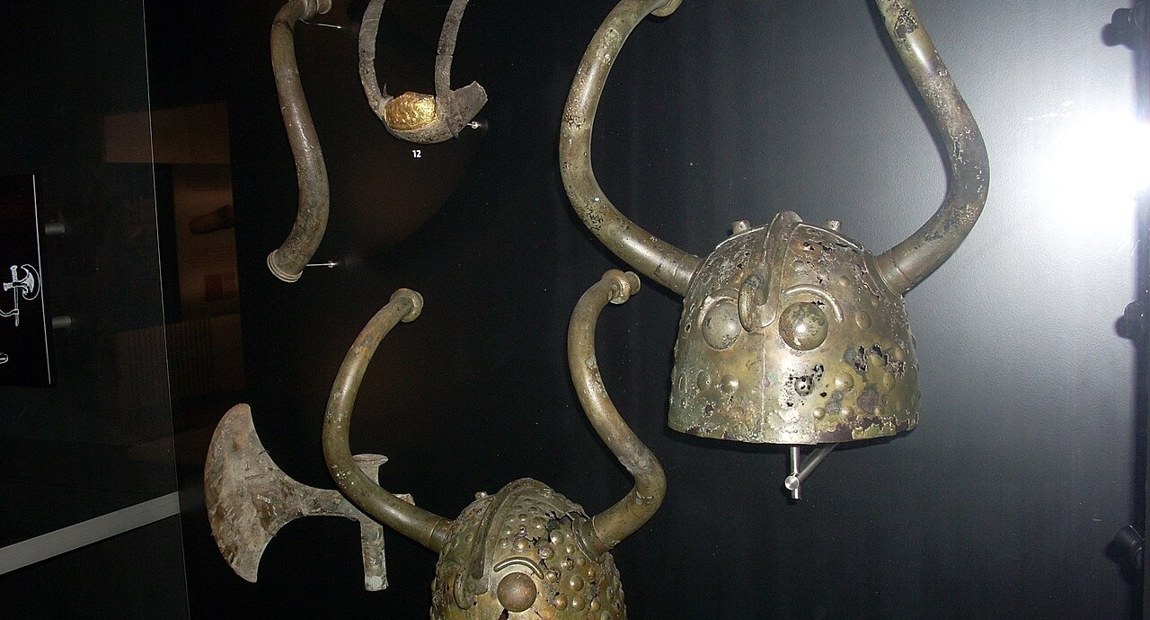
Yes, Scandinavia really had horned helmets – but in the Bronze Age, not the Viking Age. The two bronze helmets from Veksø on the Danish island of Zealand were found in a bog in 1942, and radiocarbon dating places their deposition around 900 BC, some 1,700 years before the first Viking raids. They were never battle gear; they were ritual equipment. Small bronze figurines from Grevensvænge and the rock carvings of Tanum show how such helmets were worn in ceremonies. Here is what we know about the find, its date, its meaning, and the surprising trail that leads to Sardinia and Spain.
Two bronze faces stare back at you. Round, bulging eyes, arched brows, a ridge down the middle that ends in a hooked raptor's beak. And sweeping out from the sides, two huge horns twisted into an S. Stand in front of the Veksø helmets in Copenhagen and the first thought is almost unavoidable: so that is what a Viking helmet looked like. Except it isn't – by nearly two thousand years.
These helmets demolish two myths at once. Myth one: Vikings wore horned helmets. Myth two, just as sweeping: there were never any horned helmets in the North at all. Both are wrong. The real story is older and stranger, and frankly a good deal more beautiful than any fancy-dress costume.
Let us get this out of the way. From the entire Viking Age, roughly 793 to 1066, archaeology has not produced a single horned helmet. The only near-complete Viking helmet is the Gjermundbu helmet from Norway, a rounded iron cap with a spectacle guard, made in the 10th century. Other helmet finds and fragments are gathered in our overview Helmets of the North. Not one of them has horns.
Where the horned Norseman came from is well understood too: the 19th century – painting, National Romanticism and, above all, the costume designs Carl Emil Doepler created for Richard Wagner's Ring cycle at Bayreuth in 1876. We tell that story in full in Did Vikings really wear horned helmets?, so we will not repeat it here. This article is about the other side of the coin: the genuine horned helmets that the North really did produce.
Denmark, 1942. The country is occupied, fuel is scarce, and peat is being cut wherever it can be found – including Brøns Mose, a bog near the village of Veksø (then spelled Viksø) in northern Zealand, a few kilometres north-west of Copenhagen. A peat cutter's spade hits something hard. Bogs are full of rubbish, so the workers put the pieces aside – until the foreman takes a closer look and realises they are decorated bronze. Word eventually reaches the National Museum.
Museum inspector Hans Norling-Christensen has the site examined. A rescue excavation recovers more fragments, and according to the Danish encyclopaedia lex.dk around two tonnes of peat were sieved in October 1942. In the end two almost complete, nearly identical helmets could be reconstructed. Pieces of wood were also found and interpreted as a stand or tray the helmets may have rested on. Norling-Christensen published the find in Acta Archaeologica in 1946, and his report is still the foundation for everything written since.
The landscape matters here. In the Bronze Age the bog was open water, an arm of the nearby lake Løged Sø. So the helmets did not come from a grave or a settlement: they were placed in a lake. That is no accident. Throughout the Nordic Bronze Age, precious objects were deliberately deposited in lakes, bogs and springs. How that tradition of offering worked over the millennia is the subject of our article on sacrificial bogs and bog finds.
Look closely, because every detail has something to say. The cap is made of two hammered sheets of bronze, riveted together along a seam running from front to back. On top sits a heavy crest, and at forehead and nape it ends in a downward hook that looks unmistakably like the beak of a bird of prey. The alloy is rich in tin – analyses gave a tin content of just under 17 per cent, plus small amounts of lead, arsenic, antimony and nickel and a trace of silver. More tin makes bronze look more golden but also more brittle: perfect for a showpiece, poor for a helmet meant to take a blow.
On the front are two large raised bosses that read as eyes, with applied brows above them. Together with the beak they create a face – half human, half bird. Along the lower edge runs a line of small bosses that curl into S- and Z-shaped flourishes. Many scholars read these as stylised ships with high, curving prows, one of the defining motifs of Bronze Age art in the North.
Then the horns. They were made separately, riveted onto round base plates and fixed to the helmet with side fittings. Their curve recalls a bull's horns, but also the great bronze lurs, the twisting wind instruments of the period. Between horns and crest sit small tubular holders. Norling-Christensen already suspected they once held feathers. More recent work suggests that the horn tips were tufted with feathers too, and that the crest may have carried a mane of horsehair. Gleaming bronze, nodding plumes, a staring bird face: this was not a helmet for fighting. It was a helmet for making an entrance.
For decades the helmets were dated by style alone. They were assigned to the later Nordic Bronze Age, roughly periods IV and V in the scheme devised by the Swedish archaeologist Oscar Montelius – somewhere between the 11th and 8th centuries BC. An early radiocarbon attempt in the 1970s produced an absurd result several thousand years too old and was rightly set aside. The wooden pieces from the site, when dated, turned out to be older than the helmets themselves.
Then, in 2019, came a lucky break. While National Museum staff were preparing the helmets for new photography, they spotted organic residue on one of the horns: birch tar. Birch tar was prehistory's all-purpose glue, made by heating birch bark, and here it had evidently been used to fix decoration – most likely feathers – into the tip of the horn. Samples were taken from the horn of the less well-preserved helmet, inventory number B13552, for trace-element analysis, lead isotopes and a fresh radiocarbon date.
The result: 1006 to 857 BC at 95.4 per cent probability, narrowing to 976–907 BC at 68.2 per cent. That puts the helmets at the end of period IV or the transition to period V. The familiar round figure of "around 900 BC" is therefore well founded – as the middle of a range, not as a birthday. Note also what exactly was dated: the glue in the horn, which tells us when the helmets were last decorated. They may have been made somewhat earlier and used for a while before they went into the water.
The study was published by a team led by archaeologist Helle Vandkilde of Aarhus University, with Valentina Matta, Laura Ahlqvist and Heide Wrobel Nørgaard. It appeared online in December 2021 and in print in 2022 in Praehistorische Zeitschrift. If you come across references to a "2019 study", that is a mix-up: 2019 is when the samples were taken, not when the results came out.
For scale: between the deposition of the helmets and the raid on Lindisfarne in 793 lie about 1,700 years – roughly the distance between us and the emperor Constantine.
A helmet on its own does not tell us how it was worn. For that we need pictures, and the Nordic Bronze Age left some. The most important comes from Zealand too, from Grevensvænge near Næstved, where a small hoard of bronze figurines turned up in the 18th century. Marcus Schnabel, the parish priest of Herlufmagle, described it in a letter dated 2 January 1779 as found "a few years ago" and enclosed a drawing of every figure.
According to that drawing the hoard held six figures. Two kneeling men in horned helmets, mirror images of each other, set side by side on a small bronze bar, each with one hand on his chest and a large ceremonial axe in the other. Several acrobats caught in mid-leap. And a standing woman. Comparison with rock carvings suggests the figures were originally mounted on a model ship or a ship-like base – a cult scene in miniature.
What happened to them afterwards is a small tragedy. The historian Peter Frederik Suhm acquired the group around 1780; after his death it was split up and auctioned in 1800. One of the two kneeling axemen was lost in the British bombardment of Copenhagen in 1807. The other reached the museum in 1823, by then missing his right arm and his axe. One acrobat was bought in 1839; the rest have vanished. What you see in Copenhagen today is a fragment of an ensemble we know complete only from an 18th-century sketch.
The Grevensvænge figures are less precisely dated than the Veksø helmets and are usually placed in the late Bronze Age, roughly the 8th to 6th centuries BC. But their helmets have exactly the same sweeping horns – and they show what such helmets were for: men who kneel, hold ceremonial axes and take part in a rite, not men who charge.
The pairing is striking. Two matching helmets at Veksø, two mirror-image helmet wearers at Grevensvænge, horned twin figures on the bronze horse yoke from Fogdarp in Scania. Many scholars link this to the idea of divine twins, familiar from several Indo-European traditions, from the Indian Aśvins to the Greek Dioscuri. Much later, Tacitus mentions a pair of Germanic twin gods called the Alcis, worshipped among the Naharvali. Whether there is a real line from Bronze Age twin helmets to the Alcis is an attractive hypothesis, but it cannot be proven – around a thousand years separate them.
If you want to see the cult behind the helmets, go to Bohuslän on Sweden's west coast. In the municipality of Tanum, smooth granite outcrops carry the densest concentration of rock art in northern Europe. UNESCO listed the Rock Carvings in Tanum as a World Heritage Site in 1994, and more than 600 carving sites are known within the protected area. Most of the images were pecked into the rock during the Nordic Bronze Age.
The motifs: ships above all, plus people, animals, weapons, wagons and sun signs. And among the people there are a striking number of men wearing horned helmets. They carry axes and swords, blow lurs, stand in boats or leap through the air. The National Museum of Denmark points in particular to a carving at Sotetorp in Tanum: helmeted warriors with axes and swords at their hips, one holding a round object that may be a sun image, while a third figure vaults acrobatically over the boat. It is exactly the kind of scene the Grevensvænge figures seem to recreate in bronze.
Denmark has comparable images. A bronze razor from Vestrup in southern Zealand is engraved with kneeling men in a boat, wearing helmets and holding axes. Late Bronze Age razors are one of the richest picture sources of the period – ships, suns and ritual scenes in hair-fine lines. As engravers, we find that level of precision quietly humbling.
That the Veksø helmets were not war gear is close to undisputed. The arguments pile up: thin sheet metal; horns that would hand any opponent a convenient lever; feathers and horsehair; deposition in water; and pictures that always show helmet wearers in ceremonial poses. Flemming Kaul of the National Museum, speaking to videnskab.dk, called them "religious power hats" with a link to cosmic forces – our paraphrase of his Danish.
Which forces? Most scholars today see the sun at the heart of Nordic Bronze Age religion, its daily and nightly journey told through ships, horses, fish and snakes – an image system Kaul worked out above all from decorated razors. Its most famous witness is the Trundholm sun chariot, a horse pulling a gilded sun disc – considerably older than the helmets but part of the same religious world. Birds of prey and bull horns are both considered possible sun symbols in this context. A helmet combining eyes, beak and horns might then have turned its wearer into a being that shared in those powers.
Several readings sit side by side, and none is proven:
These readings do not exclude one another: in prehistory, religious and political power often sat in the same hands. For how cult practice looked in the North in later centuries, see our guide to Norse ritual.
The real headline of the 2021/22 paper was not the date but the comparison. Vandkilde and her team set images of horned warriors from three regions side by side, all from roughly 1000 to 750 BC: a southern zone of Sardinia and parts of Corsica, a middle zone in south-western Iberia, and a northern zone in southern Scandinavia.
On Sardinia the evidence is the bronzetti, small bronze figures of the Nuragic culture that include many warriors in horned helmets, as well as the larger-than-life stone statues of Mont'e Prama. In south-western Spain and Portugal it is the so-called warrior stelae: stone slabs carved with weapons, shields, chariots and human figures, some with horned headgear. Aarhus University's press release cites a stone from Jerez de los Caballeros in the province of Badajoz. And in the North: Veksø, Grevensvænge and the rock art of Tanum.
The images are not identical. Sardinia has bronze sculpture, Iberia has incised stone, Scandinavia has real helmets plus rock art and figurines. Yet the core motif is remarkably close: an armed man whose helmet is crowned with horns. The authors read the horns as a sign of the wearer's special potency – the warrior par excellence. They trace the roots to the Late Bronze Age Levant, where horned divine images had a long history; on Cyprus, two celebrated bronze statuettes from Enkomi, the "Horned God" and the "Ingot God", wear horned helmets. The route north, in their view, ran by sea, from the Mediterranean up the Atlantic coast, linked to the westward expansion of Phoenician traders from around 1000 BC.
Vandkilde described it in interviews as an early form of globalisation, driven by long-distance trade in metals, ideas and luxuries. That Scandinavian elites did not mine their own copper and tin but obtained them through far-flung networks has long been known; for the early Bronze Age the Nebra sky disc, whose metals came from several parts of Europe, makes the point.
When the Bronze Age ends, horned helmets disappear from the North. The horned being lives on, though, in other forms. A fine example comes from Jutland: the Brå cauldron. It was discovered in 1952 at Brå, south of Horsens, smashed and buried in a hillside. Reconstructed, it measures over a metre across and about 70 centimetres high, and it held roughly 600 litres. Its rim carries bull heads and owl heads amid Celtic tendril ornament. It was made around 200 BC in Central Europe and is now displayed at Moesgaard Museum near Aarhus. Ole Klindt-Jensen published it as early evidence of Celtic influence in Denmark.
The Brå cauldron is not a helmet and has no direct link to Veksø – some 700 years lie between them. But it shows that horns remained part of the imagery of the pre-Roman Iron Age, now as bull heads on a giant feasting vessel that was evidently also disposed of in a ritual way. Better known still is the Gundestrup cauldron, which shows, among much else, an antlered figure and a figure in a horned helmet. The Celtic Waterloo helmet from the Thames, with its short straight horns, is likewise a parade piece, not a battle helmet. The pattern holds: wherever horns turn up on helmets, we are almost always in the realm of cult and display.
Some 1,500 years after Veksø, horned helmets return to the North – not as real helmets, but as images. In 1870, four bronze dies were found in a cairn in Torslunda parish on the island of Öland: the Torslunda plates. They were used to press the thin foils that decorated the splendid helmets of the Vendel period in the 6th and 7th centuries AD. One die shows two figures: a man in wolf form with a spear, and beside him a dancer wearing a helmet whose horns end in birds' heads. Both are armed.
Here is the twist: the dancer has only one eye. A laser scan suggested that the eye was deliberately removed from the original used to make the die. A one-eyed man with weapons, next to a wolf-warrior – many scholars see Odin here, or a ritual performer playing Odin, alongside the kind of warrior later sources call an úlfheðinn. Very similar dancers in bird-horned helmets appear on the foils of the Sutton Hoo helmet in England, on a 7th-century belt buckle from Finglesham in Kent, and on further small objects from Sweden.
Two points matter. First, the helmets that carried these images had no horns themselves; the horned figures are a motif, not equipment. Second, there is no demonstrable line from Veksø to Torslunda. More than a thousand years without horned helmet finds separate them. What the two eras share is only that the horned helmet belongs to the world of gods and ritual.
Which brings us back to the opening question, and now we can answer it precisely. The Bronze Age had real horned helmets as cult objects. The Vendel period had horned figures as decoration on helmets. The Viking Age, as far as finds and texts allow us to judge, had no horned helmets in battle – no text and no helmet find from the period mentions or shows them.
You will occasionally read that the Veksø helmets, found in 1942, inspired the image of the horned Viking. That cannot be true, at least not as its origin: Doepler's Bayreuth costumes date from 1876, when the helmets were still lying undiscovered in the bog. At most they reinforced the misconception in the 20th century. How the myth was born and why it refuses to die is covered in our article on the horned helmet myth.
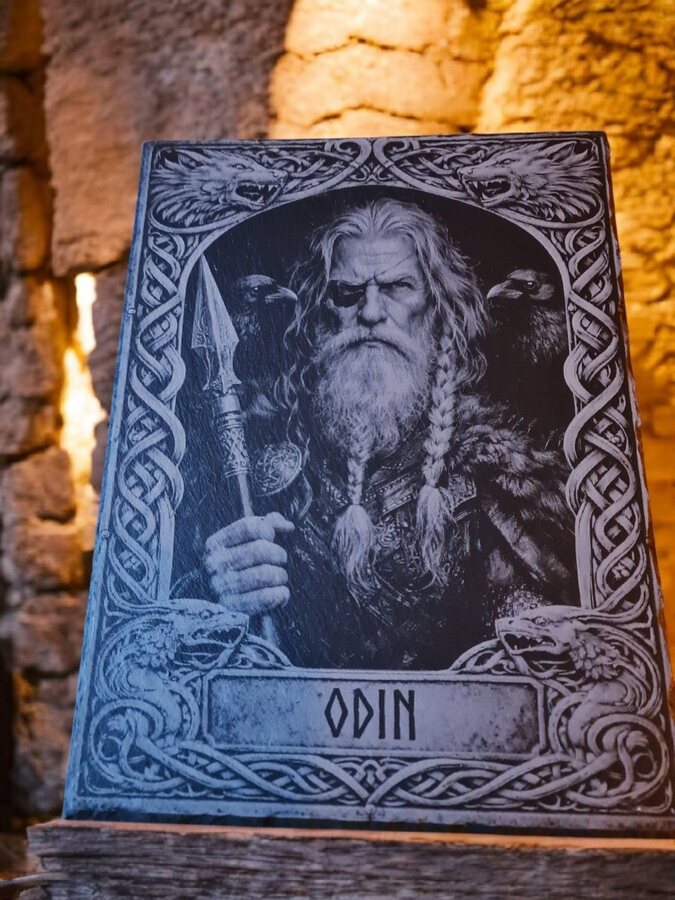
For a family workshop that engraves Norse motifs into slate, wood and glass, the Veksø helmets are an object lesson. The real evidence is more exotic than the cliché: a bronze bird face, feathers glued into horn tips with birch tar, a world of images that stretches from Zealand to Sardinia. That is why, when we design a motif, we name its period and its findspot instead of throwing the Bronze Age, the Vendel period and the Viking Age into one pot.
They also remind us how much we owe to chance. A peat cutter who does not throw everything away. A foreman who looks twice. Museum staff who, in 2019, examine a horn more closely before a photo shoot and find birch tar. Without those moments we would know less about a religion whose prayers we will never hear, but whose images still look down at us from the granite of Bohuslän.
Were there ever real horned helmets in Scandinavia? Yes. The two bronze helmets from Veksø on Zealand are genuine horned helmets, found in 1942 and deposited in what was then a lake around 900 BC. They are Bronze Age, not Viking Age.
How old are the Veksø helmets? Radiocarbon dating of birch tar from one horn gave 1006–857 BC (95.4 % probability). The results were published in 2021/22 by Helle Vandkilde and colleagues in Praehistorische Zeitschrift.
Were horned helmets worn in battle? As far as we can tell, no. Thin sheet metal, feather decoration, deposition in water and images such as Grevensvænge and Tanum all point to procession and ritual.
Where can I see the Veksø helmets? Both helmets are on display at the National Museum of Denmark in Copenhagen, together with the surviving Grevensvænge figurines.
What do the horned helmets have to do with Sardinia? Sardinia and south-western Iberia have very similar images of horned warriors from the same period. Researchers see a shared network of images spread along sea routes – not proof that the helmets themselves came from Sardinia.
Did Vikings wear horned helmets? No. Not a single horned helmet is known from the Viking Age; the image arose in the 19th century, largely through Wagner productions from 1876 onward.
For courage. For remembrance. For legends that live on.
The horned-helmet myth · Vegvísir & Ægishjálmr · Norse symbols: real or invented? · Berserkers.
All History & Finds articles →
Sometimes a war is won not with the sword but with the purse. In 991 the English ealdorman Byrhtnoth faced a Viking …
Read more →In 723 an Anglo-Saxon missionary stood axe in hand before the holiest tree of the Hessians – the oak sacred to the …
Read more →Vikings were not only raiders. In the Rhine-Meuse delta they sat in the very middle of the greatest trading centre of …
Read more →Some 1,700 years ago a man from the Near East settled in a Germanic village in present-day Thuringia – and rose into …
Read more →