There is one number that sobers up everyone approaching Norse arms and armour for the first time: from roughly two and a half centuries of the Viking Age we know four to five helmets. Not four to five types. Four to five objects – and most of them are fragments you could hold in your palm. Anyone who wants to know how a head was protected in the North therefore has to cast the net wider: back into the Vendel Period, across to England, down to the Rhine and east as far as Kyiv. This article takes stock.
Let us begin with the uncomfortable truth. For the period from roughly 800 to 1066, the whole of Scandinavia and its orbit has yielded a handful of convincing helmet finds: the Gjermundbu helmet from Norway, the Tjele mask fragment from Denmark, a decorated eyebrow from Lokrume on Gotland, a mask fragment from Kyiv – and, since 2016, a tiny piece from Mindegård on Funen whose identification is still open. Add to that the disputed helmet from Yarm in northern England, over whose age the field is currently arguing.
For comparison: for the second half of the sixth to the eighth century alone, scholarship counts more than seventy helmets and helmet fragments across western and northern Europe. The Viking Age in the narrow sense is therefore not merely poor in helmets – it is poorer than the centuries before it. And those few pieces are not evenly spread: practically everything we have belongs to the second half of the tenth century. For the roughly two hundred years before that, the classic era of the great voyages, we own next to nothing.
The helmet from the burial mound at Gjermundbu near Ringerike was reported in spring 1943 and published by Sigurd Grieg in 1947. It is now in the Museum of Cultural History in Oslo under the number C27317. Do not be fooled by the familiar photographs: the helmet came out of the ground in nine fragments, and roughly a quarter to a third of the original substance survives. What you see in the museum is a reconstruction built around a genuine core.
Even so, Gjermundbu is the backbone of the entire discussion, because it is the only piece that shows how bowl, crest and spectacle mask belong together. The recent study by Stylegar and Børsheim (2021) places it in the last three decades of the tenth century. Everything else – construction, mask, mail, the warrior grave around it – we have set out in a separate piece: the Gjermundbu helmet in detail. What matters here is that it is a one-off, and that the entire popular idea of the "Viking helmet" rests on this single grave find.
In the 1950s, workmen digging sewer trenches at Chapel Yard in Yarm, North Yorkshire, struck an iron helmet. There was no archaeological supervision, no find report, only a single photograph taken shortly after recovery. For decades the piece stood in the town hall labelled a "Norman helmet". Only when it reached the Preston Park Museum did Chris Caple of Durham University take it in hand. His study appeared in Medieval Archaeology in 2020 and concluded: not a later copy, but a genuine helmet of the ninth to eleventh century, comparable to Gjermundbu. The news travelled the world – Britain's first Viking helmet.
At the end of 2021 Tomáš Vlasatý published a detailed rebuttal. His argument does not target authenticity – he explicitly does not dispute that – but the construction of the bowl. Yarm is a classic banded helmet: a circumferential brow band, crossing bands, four triangular infill plates. That construction belongs to the sixth to eighth century, and its latest securely dated representative is the Coppergate helmet of the third quarter of the eighth century. Then there is the outward-bent, perforated lower edge, which Yarm shares with two helmets from Bremen and Groningen now placed around 650 to 800. Vlasatý's date: 550 to 800, most probably the seventh or eighth century. Yarm would then not be Gjermundbu's cousin but its great-grandfather.
The matter is unresolved. Caple's dating has been adopted by several authors; Vlasatý's objection is technically well grounded and has been widely received in both scholarly and reenactment circles. The honest position at present is: Yarm is genuine, Yarm has a spectacle mask, and nobody knows for certain which century it belongs to.
The finest museum story in the whole subject comes from Jutland. In 1850 a farmer planting saplings on the Tjele estate between Viborg and Randers dug up a hoard of smith's tools: two anvils, five hammers, three pairs of tongs, plate shears, files, drawplates, a balance with ten weights – and a wing-shaped piece of iron with bronze facing. The find was published in 1858 and the iron piece written off as a saddle mount.
Only in 1984 did Elisabeth Munksgaard, then assistant keeper at the National Museum in Copenhagen, recognise what had been sitting in the case for over a hundred and thirty years: the eyebrows and nasal of a helmet mask, roughly 12 by 7 centimetres. Her dry remark in the publication has become proverbial among archaeologists – the best finds are often made not in the field but in the museum. The piece is dated by the accompanying sheets in Jelling and Mammen style to around 950 to 975. Of the rest of the helmet there is no trace: no mail, no bowl plates, only eight narrow iron strips that may have joined the plates.
From Lokrume on Gotland comes the most richly decorated Scandinavian fragment: an eyebrow with the start of a nasal, 13.2 centimetres wide, an iron core plated with silver and carrying an interlace pattern in niello or inlaid wire. Nothing is known of the find circumstances. Two sentences and a drawing in the journal Fornvännen of 1907 – that is the whole of the first publication. It is now in the Gotland Museum as GF B 1683, dated by its interlace to the tenth, possibly early eleventh century.
Gotland is a special case altogether. The island has produced up to twenty helmet attestations – but nearly all from cremation graves, and nearly all only one or two fragments in size. The eyebrow from Hellvi, around 550 to 600, consists of two pieces four centimetres long each, iron with silver strips and a cast-on bronze animal head at the end. Single eyebrows of this kind led Neil Price and Paul Mortimer in 2014 to ask whether the deliberate deposition of a single eye piece might allude to Odin. It is an attractive reading – and that is exactly what it remains.
Near the Church of the Tithes in Kyiv, a mask fragment came to light at the end of the nineteenth century, though it drew scholarly attention only in the 1950s. It is held by the National Museum of the History of Ukraine (inventory number ДРА 1065): a nasal of roughly 112 by 10 millimetres, side lugs, a remnant of the helmet rim, total weight 24 grams. It is decorated with inlay and overlay of twisted silver wire, plus a fork-ended cross in silver of a different fineness.
The Church of the Tithes was built between 989 and 996. Whether the fragment comes from the older cemetery covered by the building site or from the church-period burials is open; either way one lands in the second half of the tenth or the beginning of the eleventh century. Not even the orientation is settled: part of the literature reads the curved elements as eyebrows, another part as spectacle rings. Anyone looking at a drawing of this helmet is already looking at a decision.
In 2016 the detectorist Jan Hein found, in a field by the Mindegård farm in north-eastern Funen, a six-centimetre sickle-shaped piece of gilded bronze with six grooves filled alternately with silver and tin bands. Three of those bands carry engraved stepped and lozenge patterns. Tomáš Vlasatý presented the piece at length in 2024 and reads it as the eyebrow of a divided helmet mask. The engraving leads him, via comparison with oval brooches of Petersen types P 37 and P 51, to the ninth or first half of the tenth century – straight into the gap that otherwise defeats us.
What is remarkable is how openly the author handles his own thesis: the fragment could equally be read as the edge fitting of a knife sheath, and the text is "a proposal that must be supported by further research". That is how it should be treated. Two fragments from Birka are similarly uncertain – tentatively placed around 950 to 975, but of unknown type – as is an eyebrow from the Ternopil region that resembles the Coppergate helmet and has not yet been published in detail. Any one of these pieces could tip the balance: with a find group of five objects, a single new discovery changes the statistics dramatically.
On 12 May 1982, on the building site at 16–22 Coppergate in York, a mechanical digger met resistance in the clay. The foreman took it for a stone, brushed off the dust, saw a gold-coloured band – and called the archaeologists. The result is the best-preserved early medieval helmet in England: a bowl of eight riveted iron pieces, two hinged cheek pieces with brass edging, and a neck guard of genuine mail that had been stowed inside the helmet when it was found. The helmet lay upside down in a timber-lined pit – somebody had hidden it and evidently meant to come back.
The mail curtain is the only complete one of its kind: 1,947 rings in 28 horizontal rows, the longest now 81 rings long, suspended from slotted brass strips with silver rivets. On the brass crest strips runs a Latin inscription which, together with the transverse strip, forms a cross: IN NOMINE DNI NOSTRI IHV SCS SPS DI ET OMNIBVS DECEMVS AMEN OSHERE XPI. Its resolution is still argued over – Dominic Tweddle read it in 1984 as an intercession ("in the name of our Lord Jesus, the Holy Spirit, God, and with all we pray. Amen"), while Binns, Norton and Palliser objected in 1990 that "we pray" does not appear in the Latin at all, and read instead a dedication of the wearer Oshere to All Saints.
The helmet is dated purely on stylistic and epigraphic grounds, usually to the third quarter of the eighth century. It is therefore Anglo-Saxon, not Norse – and yet it sits exactly where the Scandinavian finds run out. That makes it the single most important comparative piece we have. One detail for the workshop: the sheet thickness of the lateral band was measured at 1.3 to 1.9 millimetres. A published weight, by contrast, does not exist – every figure circulating online comes from replica sellers.
Anyone who wants to know what a Norse helmet looked like inevitably ends up two centuries before the Vikings. The boat graves of Vendel and Valsgärde in Uppland produced the famous parade helmets: Vendel XIV, roughly 560 to 620, Vendel XII around 650, Vendel I around 675 to 700, plus the pieces from Valsgärde 5, 6, 7 and 8 and the helmet from Ultuna. The helmet from Broe on Gotland, recovered from a cremation grave around 1904, is by contrast so decayed that only a speculative reconstruction exists.
These helmets are not mass-produced kit but badges of rank – Heiko Steuer described them in 1987, together with the ring-sword, as insignia of a warrior elite. They carry pressed foil panels with riders, dancers and animal-warriors; they have cheek pieces, neck guards and sometimes full face masks. What crosses over into the Viking Age is a selection: cheek pieces disappear after 800, and so do the figural panels. What remains is bowl, crest and spectacle mask. For a deeper dive: the Vendel Period as an era of its own.
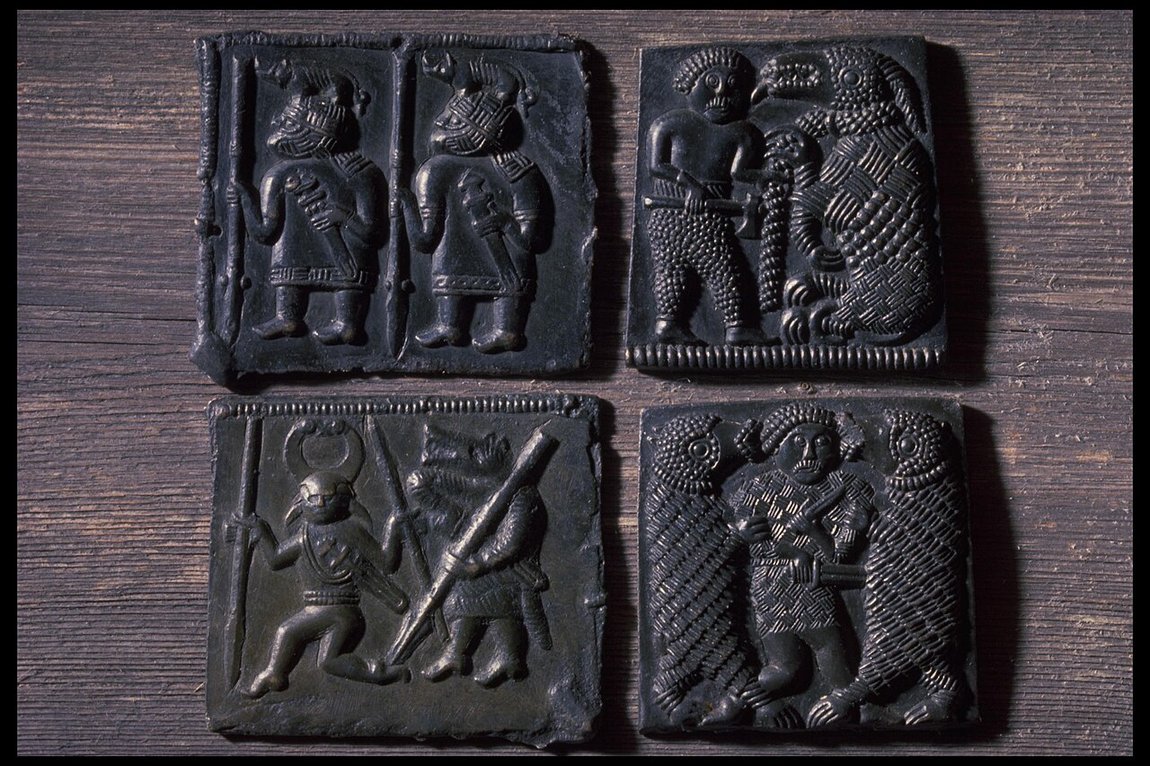
How those panels were made is shown by a find from Öland. In early 1870 four cast bronze dies came to light in a cairn in Torslunda parish; they are now in the Swedish History Museum in Stockholm. They are not ornaments but tools: thin bronze or silver foil was laid over the die and hammered in from behind so that the motif came out in relief – serial production of figural decoration. The four motifs show two striding spearmen in boar-crested helmets, a horned dancer beside a spear-bearer in a wolf pelt, a man with an axe leading a bound beast, and a man between two bears.
A good part of the popular Odin reading hangs on precisely these plates. In 1992 Arrhenius and Freij showed by laser scan that the right eye of one figure had been struck out – ever since, many have taken the dancer for Odin with a wolf-warrior. In 2023 Schulz and Jepsen disagreed: under the microscope the damage looks like an unintended hammer blow during manufacture, and the nearest pictorial parallel for the whole motif group is the Vinica terracotta plaques in North Macedonia showing the dog-headed St Christopher and St George. A minority position, but one to be taken seriously. More in our piece on the Torslunda matrices.
The Anglo-Saxon balance sheet is almost as thin as the Scandinavian one. From several thousand excavated graves, seven helmets are known. The Benty Grange helmet in Derbyshire, recovered by Thomas Bateman in 1848, is an iron frame originally faced with horn plates, with a boar on the crown and a silver cross on the nasal – paganism and Christianity on one head. The Pioneer or Wollaston helmet, found in a Northamptonshire gravel pit in 1997, also carries a boar crest. The Shorwell helmet from the Isle of Wight, discovered in 2004 by metal detector and broken into some four hundred fragments, is the only continental type on the island. The Staffordshire Hoard of 2009 yielded over a thousand silver sheet fragments from a single helmet, from which two reconstructions were produced in 2018.
And then of course there is the helmet from Sutton Hoo, Mound 1, recovered in 1939 in more than five hundred fragments amounting to less than half the original surface. Its present shape goes back to a second reconstruction by Nigel Williams in 1970/71; the first, by Herbert Maryon in 1945 to 1947, looked distinctly different. That is a useful reminder that many famous helmet images are really drawings that have been executed in metal. On the site itself: Sutton Hoo.
South of the North Sea the world looks different. There the fifth to seventh centuries are dominated by the Spangenhelm of Baldenheim type: a framework of bronze ribs with iron plates set into it, often with cheek pieces and a neck guard. Mahand Vogt produced the standard monograph on this group in 2006. The Shorwell helmet belongs to this continental tradition rather than the Nordic one – which is why it stands out in England.
What matters for our subject is the difference in structure. The Spangenhelm carries its frame as ribs running down from the apex. The banded helmet, out of which the Nordic crested helmets develop, works with a circumferential brow band and bands laid over it from brow to nape and from ear to ear, with triangular plates filling the gaps. Both solve the same problem: with the means of the time, a single large sheet is hard to raise evenly to that depth, so the helmet is assembled from small parts. Only with the conical nasal helmets around 1000 does manufacture from a few large pieces take over.
Reenactment has for years circulated a pointed, four-plate helmet with gilded copper sheet and a socket as "the eastern type of Viking helmet". The prototype comes from the great mound of Chernaya Mogila near Chernihiv, investigated by Samokvasov in 1872/73: a cremation grave of two men with two helmets, two mail shirts, swords, sabres and drinking horns. Recent radiocarbon dates place the burial at roughly 980 to 1025. Only one of the two helmets has ever been described; the second is considered lost.
This helmet type – "type II" in the Russian-language literature – is now represented by roughly seventy examples and fragments from Poland to the Urals, and most scholars trace it to steppe nomadic models; the earliest piece lies in a Magyar grave of the ninth century. It is an eastern European elite helmet, not a Scandinavian one. Two helmets are known from Gnezdovo near Smolensk as well, but neither belongs to this group; one is a conical nasal helmet whose nasal was cut off before deposition and which probably originated in the present-day Czech lands. The trade term "Gnezdovo type II" is a modern invention with no archaeological basis.
In the treasury of St Vitus in Prague, under the number K 168, lies a helmet traditionally attributed to St Wenceslas. The major re-examination by Bravermanová and colleagues (2019) exposed it as a composite object: the bowl is raised from a single piece of very pure iron, probably Bohemian and of the tenth century; the nasal with its figural decoration and the rim band are of chemically different iron and were riveted on later, presumably towards the end of the same century.
The most telling evidence is physical. At the brow the sheet is thickened over a length of about 4.2 centimetres and bounded by incisions – an integral nasal once sat there and was cut away. The present nasal, with its interlace in overlay technique, points stylistically to Scandinavia or Gotland, its closest analogies being Lokrume and Kyiv. Whether the figure on it shows a crucified Christ or Odin has been debated for decades and is not settled. The object is not a Viking helmet – but it is evidence that Norse craftsmanship could end up on the head of a central European ruler.
The Nordic basic pattern is what scholarship calls the crested helmet. It consists of a circumferential brow band, a band running from brow to nape, lateral bands from ear to ear, triangular plates filling the gaps, and an applied crest. Everything is riveted, nothing welded. The crest is not mere ornament: a raised ridge deflects a glancing blow before it reaches the surface.
Gjermundbu departs from this. There the infill plates are not riveted with overlapping surfaces but joined through slots to inner bands with outer ridges laid over them. Yarm in turn works with four infill plates, a mushroom-shaped knob on the crown and an outward-bent, perforated lower edge – the last being the only direct evidence for a lining attachment on any of these helmets. Sheet thicknesses there run from 1 to 2 millimetres, mostly between 1.2 and 1.4. That is thinner than most people expect, and it suits a device you have to wear for hours.
The spectacle mask is the hallmark of the late Nordic form. It protects the eye region and the nose while leaving cheeks and chin free. Technically there are two tenth-century solutions. On Gjermundbu an iron blank is split at one end and bent apart to form the eyebrows; the spectacle rings were welded on across it. On Tjele, Lokrume and Kyiv the same Y-shaped base occurs, but the rings are riveted rather than welded. From the developed tenth century we know no example in which the eyebrows are separate from the nasal.
Earlier it was different. In the Vendel Period the eyebrows regularly sit on the rim as separate castings in copper alloy, often with an animal head or decorative curl at the end, and the gap between them is filled by the end of the crest. That is precisely why the Mindegård fragment is so interesting: if the reading holds, separate cast eyebrows were still in use in the ninth century – only without the old animal-head terminals. The transition would then be more gradual than the two endpoints Coppergate and Gjermundbu suggest.
This is the point at which to read slowly, because it is where reconstructions stray furthest from the evidence. A genuine mail curtain hanging from the helmet is attested exactly once: at Coppergate. At Gjermundbu mail did lie in the same grave, in over eighty fragments, but whether it ever hung from the helmet is not secure; the rings on the helmet itself are thicker than ordinary mail rings and are read rather as a suspension system. The familiar drawings with a long mail veil are modern additions, not findings. On none of the known Viking Age masks is there a fitting to which mail could have been attached.
With lining the situation is thinner still. The best evidence comes not from Scandinavia but from Benty Grange, where a lining of cloth or leather is documented. At Sutton Hoo leather is inferred from dark discolouration. At Coppergate the interior was excavated in ten-millimetre steps – no organic inner cap was found. What we have are rows of holes and a turned-out edge, that is, the mounting for a lining rather than the lining itself. And to this day there is not a single archaeological attestation of a purely leather helmet from the Viking Age. That does not mean none existed – leather perishes. It means only that any statement about it is an argument from silence.
Because the objects are so scarce, people reach for images. That works, but only with care. The Gotlandic picture stones show helmeted warriors, but in a visual idiom rarely precise enough for a spectacle mask to be identified with confidence. The Oseberg tapestry shows horned figures – in a processional and ritual context, one of them wearing an animal-head mask. These are cult and masking costumes, not combat equipment.
Things become more reliable only at the end of the era. Coins of Cnut the Great and Anund Jacob from the 1020s and 1030s show conical helmets with a nasal, as does the Ledberg stone in Östergötland. The Bayeux Tapestry of the 1070s shows the same form in series – but it is Norman, was made after the Viking Age and was restored and supplemented in the nineteenth century. As a source for the ninth or tenth century it will not do. And the famous valkyrie from Hårby, found on Funen in 2012 and all of 3.4 centimetres tall, wears no helmet at all but a ponytail. An image is a statement about images, not about equipment.
Four reasons stand side by side, and none suffices alone. First, iron was valuable and was melted down; a damaged helmet was raw material. Second, a helmet is an elite object – the estimate that less than one per cent of the population could afford one is rough, but the order of magnitude holds. Third, burial customs change: almost every helmet we have is a grave find, and with Christianisation weapon burial ends. In western Europe the last grave helmets lie in the seventh century, in Scandinavia at the end of the tenth – exactly where our record stops. Fourth, iron objects survive cremations and acid soils badly.
From this follows a practical consequence formulated by Vlasatý: new Scandinavian helmets of the ninth and tenth century will not be found in graves but in waters, hoards and settlements – or, as Mindegård and Tjele show, in ploughed fields and museum drawers. From the same scarcity the neurosurgeon Knut Wester built a broader thesis in 2000: that metal helmets were extremely rare among the Vikings and that archaeology had failed to correct the popular counter-image. His figure of exactly one helmet is now out of date; the underlying observation is not. For how the picture of the Norse warrior is assembled from a handful of objects, see our guide to arms and armour.
ac se hwita helm hafelan werede, / se þe meregrundas mengan scolde, / secan sundgebland since geweorðad, / befongen freawrasnum, swa hine fyrndagum / worhte wæpna smið, wundrum teode, / besette swinlicum, þæt hine syðþan no / brond ne beadomecas bitan ne meahton.
“But the bright helmet guarded his head, that was to stir the depths of the mere, to seek the surging water, adorned with treasure, encircled with lordly bands, just as a weapon-smith had wrought it in days long gone, wondrously fashioned it and set it about with boar-figures, so that afterwards no brand and no battle-blade could bite it.”Beowulf, lines 1448–1454, Old English text after the Nowell Codex; translation: Glanz & Gravur
From the Viking Age in the narrow sense, four to five helmet finds are known: Gjermundbu (1943, Oslo C27317, recovered in nine fragments, last third of the tenth century), the Tjele mask fragment (found 1850, recognised as part of a helmet by Elisabeth Munksgaard in 1984, around 950 to 975), the Lokrume eyebrow from Gotland (13.2 cm, first published 1907, tenth century), the Kyiv mask fragment (Church of the Tithes, 24 g, tenth or early eleventh century) and – as a proposal – the bronze fragment from Mindegård (Funen, detector find 2016, 6 cm). The Yarm helmet is genuine, but its date is contested: Chris Caple (Medieval Archaeology 64, 2020) places it in the tenth century, Tomáš Vlasatý (2021) between 550 and 800 on account of its banded construction. The Coppergate helmet from York (found 1982, third quarter of the eighth century) is Anglo-Saxon and carries the only completely preserved mail curtain, of 1,947 rings. More than seventy helmets and fragments are known from the Vendel Period, and seven from Anglo-Saxon England.
Not one of these helmets has horns, and no Viking Age depiction shows a horned warrior in battle; the horned figures from Torslunda and Oseberg belong to a cult and masking context, and the genuine horned helmets from Veksø date to around 900 BC – details in the horned helmet myth. The leather helmet is archaeologically unattested: it may have existed, but anyone asserting it argues from the silence of the sources, not from a find. The spectacle mask is not a Norse standard form but simply what happens to survive from a few elite graves – it says nothing about the kit of an ordinary fighter. The plain, undecorated iron helmets sold today likewise have no basis in the finds: every published Scandinavian piece of the tenth century is decorated. The nasal helmet of the Bayeux Tapestry is Norman and belongs at the end, not the middle, of the era. And the "eastern Viking helmet" of Chernaya Mogila type is an eastern European elite helmet of steppe nomadic descent.
The Gjermundbu Helmet · The horned-helmet myth · Weapon Lore · The Torslunda Dies · The Mail Shirt · The shield wall · The Spear.
All History & Finds articles →
Anyone sailing west out of Norway carried no compass and yet had a remarkably clear destination: the arc of islands …
Read more →The Vikings came, raided – and stayed. Over the winter, at least. Instead of sailing home after every raid, they …
Read more →When we picture Vikings, we see mist, fjords and the grey North Sea. Yet the same men who plundered monasteries on the …
Read more →We remember the Vikings as raiders and coastal plunderers – yet their greatest feat was a quiet one: they crossed the …
Read more →