Viking Age Scandinavia has given us thousands of swords, countless axes, spearheads and shield bosses. Mail shirts it has given us: one. A single garment, burnt, in eighty-five lumps, from a burial mound in Norway. That number is neither an accident nor a mere loss to corrosion – it is the actual finding. In this world a mail shirt was not a piece of kit. It was a fortune you wore.
Anyone reading into Viking Age arms gets used to large numbers. Norway alone has yielded several thousand swords; axes fill museum crates; spearheads and shield bosses are everywhere. Then you reach body armour, and the number drops to one.
Exactly one more or less reconstructable mail shirt survives from Viking Age Scandinavia: the mail from the burial mound at Gjermundbu near Haugsbygd in Ringerike, Norway. Everything else amounts to handfuls: two corroded lumps from Aarhus, some twenty rings from a grave at Hedeby, a scatter of rings from Birka, ten rings from Viborg. Together they would not make a single sleeve.
That is the starting position, and it is awkward, because it contradicts the popular picture. On screen and on book covers every second Northman wears a ring garment. In the graves almost nobody does. Both cannot be true, and in this argument the ground has the better evidence.
In April and May 1943 a mound measuring roughly 25 × 8 × 1.8 metres on the Gjermundbu farm was hastily excavated. Sigurd Grieg published it in 1947. The mound contained two graves and two further depositions. Grave I is a cremation and remains one of the most richly furnished Norwegian burials of the Viking Age.
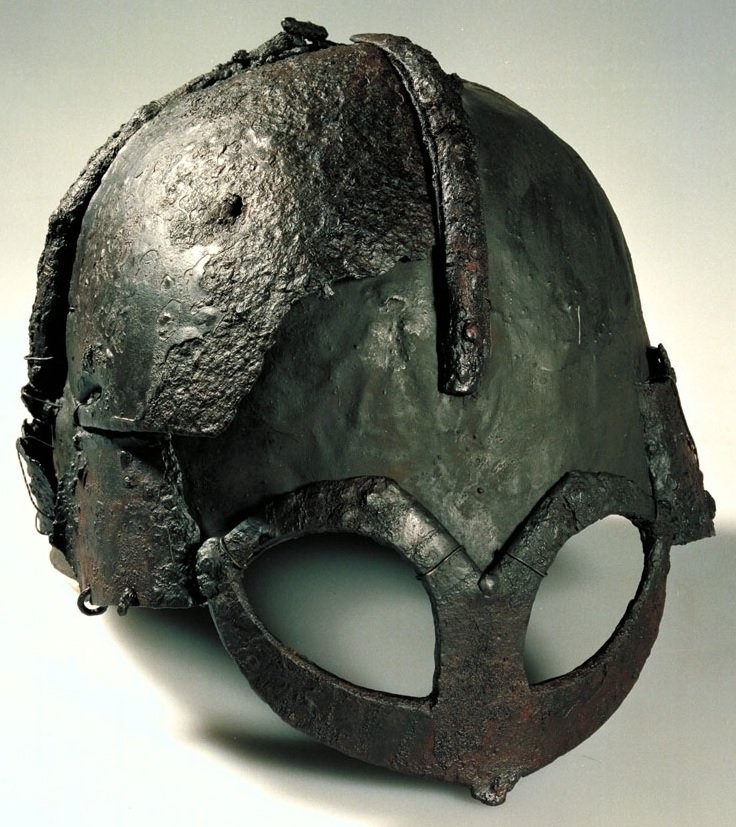
The mail went onto the pyre. It had been folded and placed on a cauldron that in turn covered the helmet and other objects – not an accident, but a deliberate arrangement by the people who built the fire. Burning and a thousand years in the soil broke the garment into more than eighty larger and smaller fragments. Mixed among them there may be remains of a mail curtain belonging to the Gjermundbu helmet; the two can no longer be reliably separated.
Until 1992 the find was displayed only as a heap of fragments. Only then was it carefully assembled and mounted on a plastic support, where it remains today in the Museum of Cultural History in Oslo under inventory number C27317i.
The mail did not come alone. The inventory includes a helmet, a Petersen type S sword with chape, two type K axes, spearheads of types G and K/M, four shield bosses, eight arrows, two spurs, two stirrups, five horse bits, a sledge with its rattles, a cauldron, a chest, a pan and a range of other tools.
That list matters more than it looks. Four shield bosses and five bits in one grave mean this was not one warrior's personal kit but a display of wealth. Anyone buried like this belonged to the narrow top of a society. In that ensemble the mail is not one tool among tools; it is the most expensive object on the pile. For an overview of the individual categories, see our guide to Viking Age weapons.
Popular accounts repeat that the Gjermundbu mail consists of some 25,000 rings. The figure is correct – but it describes the present, reassembled state, not the original garment. That reassembled state weighs 5.5 kilograms. Its reconstructed length is 55 centimetres, and even that is explicitly a lower limit: the shirt was short and short-sleeved, but nobody knows how much was lost to fire and soil.
For the complete original, 8 to 10 kilograms are estimated. That too is an estimate, not a measurement. So anyone reading that a Viking wore “a mail shirt of 25,000 rings” is quoting a number correctly and a fact incorrectly. The honest sentence is: about 25,000 rings survive from a shirt that originally had considerably more.
The dating is well bracketed but not fixed to a decade. Kim Hjardar and Vegard Vike place the grave between 950 and 975; Frans-Arne Stylegar and Ragnar Børsheim argue in their 2021 reassessment for the end of the 10th century. The combination of a type S sword and type C2 stirrups points most readily to the 970s to 990s.
The closest relatives of the grave are not neighbours but scattered: the mound at Hafurbjarnarstaðir in Iceland and mounds 12 and 15 at Valsgärde in Sweden. Stylegar and Børsheim also stress eastern traits in the inventory. Whoever was buried here had connections reaching well beyond Ringerike.
Denmark long counted as empty. As late as 2002 Anne Pedersen noted that there were no mail finds there at all – remarkable for a country with superbly preserved Roman Iron Age armour. That changed in 2010, when soil from a burnt pit house at Bispetorvet in Aarhus was sieved and produced two heavily corroded iron lumps that X-rays revealed as ring weave. The larger piece measures about 5 × 3.5 centimetres and holds some eighty rings; the top row was copper alloy, presumably a decorative edge. The house was built at the end of the 10th century and burnt down in the early 11th.
Add to that: some twenty rings from grave 976 at Hedeby, catalogued for decades as a “chain link” and only recently recognised as weave; ten rings from Viborg Søndersø from a 1000–1300 horizon; four interlinked rings from Tissø that Vegard Vike would rather place in the 13th century; rings from Birka and a find from Slite on Gotland. And one detail worth pausing over: small pieces of mail in the graves of women and children are not unusual in the early Middle Ages. The Hedeby piece may never have been armour at all, but an amulet.
The comfortable explanation is that mail rusts away and therefore nothing is left. There is truth in that. A ring of one-millimetre wire has an enormous surface area relative to its mass; it corrodes many times faster than a solid sword blade. Where weave survives, it usually survives as a rusty lump recognisable only under X-ray – which is exactly what happened at Aarhus and Hedeby.
But the argument does not carry all the way. The same graves that contain no mail yield swords, axes, spearheads, stirrups and bits in quantity – all iron, all under the same conditions. The point is sharpest in the richly furnished Danish equestrian graves: they hold weapons and horse gear in abundance and not a single mail shirt. People who owned mail, as a rule, did not put it in the ground. It was inherited, passed on, repaired, and in the end melted down. Its rarity in the soil is partly chemistry – and to a greater degree economics.
It begins with iron wire, and wire was no small matter in the early Middle Ages. The slag inclusions in the riveted Gjermundbu rings run lengthways, indicating drawn material – iron driven repeatedly through the shrinking holes of a drawplate until it reached the desired gauge. Such drawplates are known from the North.
That is work before the work. The wire must be even or it tears when riveted; it must be annealed along the way or it turns brittle. For the wider context of how such things were made, see our article on Viking Age smithing. A single shirt swallows many hundred metres of it.
The finished wire is wound around a mandrel and the coil split lengthways – and there are the open rings. At Gjermundbu these riveted rings have a wire diameter of 1.0 to 1.4 millimetres and an outer diameter of roughly 7.5 to 8.7 millimetres.
Then comes the laborious part. The ends are flattened into an overlap 3.9 to 4.2 millimetres long. A conical hole is driven through that overlap from the inside, so that the burrs meet when the ring closes. A conical rivet with an oval foot goes in and is peened on the visible side into a strongly domed head 0.5 to 1.2 millimetres across. The rivets themselves are 1.6 to 1.9 millimetres long. The overlap runs consistently anticlockwise – the handwriting of one workshop.
Hold those measurements in your head for a moment. A rivet head half a millimetre wide, thousands of times over, without magnification, by daylight.
At Gjermundbu every second row consists not of riveted but of solid rings. Their material has a square section of 1.3 to 1.8 millimetres; the outer diameter is 7.5 to 8.4 and the inner 4.8 to 5.2 millimetres. Slag orientation and square section say the same thing: these rings were punched from sheet, not bent from wire.
Punched rings have sharp edges, and sharp edges eventually cut into their neighbours and into clothing. So they had to be rounded. At Gjermundbu this seems to have been done not by grinding but in a two-part die with rounded grooves that mechanically reshaped the edges. And here lies the loveliest detail of the whole find: at least one ring was placed into the die wrongly and came out squashed askew. It was used anyway. A thousand years later you are watching a craftsman shrug.
The weave is the classic four-in-one: each ring passes through its four nearest neighbours. It is the pattern that dominates in Europe from the Iron Age into the modern period, because it gives the best balance of density, mobility and material.
Shaping is done not by cutting but by adding and dropping rings. Where the body widens, rings enter the row; where it narrows, rings come out; the armpit needs freedom, the shoulder needs support. Work was probably done in manageable panels later joined into the garment. A mail shirt is therefore less forged than knitted – except that every stitch has to be riveted individually.
Vegard Vike's metallographic study answers a question that is often handled romantically: what was such a shirt made of? Answer: homogeneous ferrite, that is uncarburised, soft iron. No steel, no hardening, no secret alloy.
The riveted rings contain almost no slag, the punched ones noticeably more – a side effect of being made from sheet. Both show an unusual nitrogen enrichment traceable to the heat of the pyre. Traces of a copper alloy sit on the surface of some rings, transferred from a corroded neighbouring object, probably the scabbard chape. A decorative non-ferrous edging of the kind found elsewhere is absent from this shirt – at least from what remains of it.
Caution is required here. The figures in circulation – “half a year of work”, “a thousand hours” – all come from modern reconstructions and extrapolations. Not one Viking Age source states how long a mail shirt took to make. No text names working days; no account names wages.
What can be said responsibly is that the number of operations is known and countable. With some 25,000 surviving rings, roughly half of which had to be individually pierced and riveted, you arrive at tens of thousands of separate hand movements – and that is after drawing the wire, coiling it, cutting it and punching the solid rings. A mail shirt was months of labour. Whether three months or six, one master alone or a workshop with assistants: unknown.
Scandinavia gives us no prices. The Frankish realm does. The Lex Ribuaria, a law book of the Rhineland Franks whose core belongs to the 7th century, fixes compensation values: a brunia, a mail shirt, is worth twelve solidi. A helmet six. A sword with scabbard seven, a sword alone three. Greaves six. Shield and lance together: two.
The ratio is the real statement. A mail shirt equalled six shield-and-lance sets, two helmets, or four bare swords. Twelve solidi were, in early medieval terms, the fortune of a prosperous farmer, bound up in a single garment. That the figures come from the Rhineland and are two to three centuries older than Gjermundbu has to be kept in mind – as an order of magnitude they still hold.
How seriously the Carolingians took the matter shows in a second observation: they tried again and again to stop the export of armour, and in 803 Charlemagne forbade the sale of bruniae beyond his borders. The bans were repeated, which is rarely a sign of success. Contemporary sources suggest that the Northmen obtained their mail partly from unscrupulous Franks. An export ban is always also proof that a market existed.
In the sagas the brynja almost never appears as a purchase. It is inherited, given, taken as plunder or handed over as compensation. In these texts a mail shirt changes hands the way an estate does – through people, not through prices.
How neatly that matches the archaeology is striking. Objects that are inherited and passed on do not end up in graves; they stay in circulation until they are useless. The sagas are late, literary and no inventory list – but on this point text and archaeology say the same thing. A mail shirt in this society was less equipment than property with a history.
And the storytellers knew exactly what such a garment weighed, literally and otherwise. In Harðar saga, Kjartan wears a tvífǫld brynja, a double ring-shirt, and is still split to the waist. In Grænlendinga þáttr, Sæmundr is offered an old spangabrynja as compensation for a slain kinsman, takes it as an insult and throws the thing on the ground – whereupon more men die. Equally telling is when mail is not worn: in Grettis saga, Grettir picks up spear, sword and helmet before a fight and leaves the mail shirt lying. And before Stamford Bridge in 1066 the Norwegians are said to have left their mail on the ships on a hot day. Those who wore it had good reason – and so did those who took it off.
The Old Norse word is brynja. Poetry plays with it more freely: hringserkr, the ring-shirt, is one of the standard circumlocutions, and again and again mail is called “Hamðir's shirt” – serkr Hamðis, skyrta Hamðis, klæði Hamðis.
The kenning has a concrete origin. In Hamðismál, Hamðir and Sörli storm the hall of the Gothic king Jörmunrekkr. The defenders' weapons achieve nothing, and the king issues an order that explains an entire armour technology in four lines:
Þá mælti þat Jörmunrekkr, / jarla vísi: / “Grýtið ér á gumna, / alls geirar né bíta, / eggjar né járn, / Jónakrs sonu.”
Then spoke Jörmunrekkr, lord of jarls: “Stone the men, since neither spears bite them nor edges nor iron, the sons of Jónakr.”Hamðismál 24 (25 in some editions), Old Norse text after the public-domain edition; translation: Glanz & Gravur
Stones, then, because iron does not bite. It is hard to sum up more briefly what ring weave does – and where it stops.
Against the edge, mail is excellent. A cut drawn across the arm finds nothing to catch on; the weave yields and stays closed. Against impact it is close to useless. The energy of a heavy blow passes straight through the rings into skin and bone. Take an axe on the shoulder in a mail shirt and you have no cut but possibly a shattered collarbone.
How brutal that could look is shown by the femur of a man of about twenty who died of combat injuries in the 11th century: the bone carries the impressions of mail rings. A blow had apparently driven the weave through the muscle tissue and onto the bone. The reading is not uncontested – people who have run cutting tests with modern reproductions find it hard to accept – but no convincing alternative explanation for the marks has yet been offered.
The thrust is the third case, and it is undecided. The sagas repeatedly describe spears driven through mail; at Stiklestad in 1030 Þórir hundr thrusts his spear expressly under the king's mail. Experimental work on arrows against mail is equally inconclusive: results vary widely with ring size, rivet form, arrowhead and backing. One detail bears directly on Gjermundbu – wedge rivets hold markedly better than round ones, and Gjermundbu has round ones. And several layers of linen beneath the weave change the picture so much that the question “does mail stop an arrow?” cannot be answered at all without specifying what was worn underneath.
Which brings us to the largest open gap. Padded undergarments are well attested before and after the Viking Age, and anyone who has ever worn mail considers them indispensable. For the Viking Age itself there is neither archaeological evidence nor a mention in the texts. That is not a small gap; it is one to be lived with. Textiles perish, and the absence of a find proves nothing – but it equally fails to prove the opposite. Anyone putting a padded gambeson into a Viking Age reconstruction is making a plausible assumption and should label it as an assumption, not a finding.
What did those who could not afford mail wear – that is, the overwhelming majority? The honest answer, on current evidence: clothes. And a shield.
For lamellar armour there is exactly one significant Scandinavian find: some 720 lamellae scattered across the so-called Garrison at Birka, the largest coherent piece consisting of twelve plates. Of these, 267 could be analysed and sorted into eight types; the dating points to the first half of the 10th century, the origin to the nomadic world of the Near and Middle East, with the closest parallel at Balyk-Sook. Even the interpretation is contested: Niklas Stjerna reads the piece as symbolic rather than military, while Timothy Dawson doubts that more than three of the eight types are lamellae at all and takes the rest for recycled scrap. To this can be added two graves excavated at Snäckgärde on Gotland in 1826 with “armour scales” on the chest – the finds are lost, and only the description survives. Lamellae in the North were import and exception, not alternative.
The real body protection of the Viking Age was the shield: light, cheap, made in days, replaceable – and in the closed formation of the shield wall more effective than any single piece of iron. Weigh effort against effect soberly and it becomes obvious why ring weave stayed exceptional.
That leaves iconography, and it disappoints. The Bayeux Tapestry shows mail in quantity, but was made in England in the 1070s, that is after the Viking Age, and it is an embroidery with its own pictorial conventions, not a technical drawing. The Gotlandic picture stones are too stylised for weave to be identified with confidence. The die matrices from Torslunda belong to the Vendel period, several generations before the Viking Age. Convincing Scandinavian depictions of mail are decidedly rare.
Which makes one recent find all the more interesting. In March 2024 a gilded silver mount came to light at Namsos in Norway: 31 millimetres tall, 5.4 grams, a human figure being swallowed by a beast. The torso carries a texture that reproduces ring weave remarkably closely and extends along the arms at least to the elbows. The scene is cautiously read as Óðinn in the jaws of the wolf Fenrir – cautiously, because a single figurine does not make an iconography. As pictorial evidence for mail in Viking Age Scandinavia it is currently the best we have. Which says a great deal about the state of the evidence.
Viking Age Scandinavia has produced exactly one more or less reconstructable mail shirt: Gjermundbu, Grave I, a cremation of the second half of the 10th century, over 85 fragments, today some 25,000 rings and 5.5 kg on a plastic support in the Museum of Cultural History, Oslo (C27317i). The weave is four-in-one with alternating riveted and punched rings; the material is uncarburised soft iron. Other Scandinavian evidence is limited to tiny fragments from Aarhus, Hedeby, Viborg, Birka and Gotland. The Lex Ribuaria values a mail shirt at twelve solidi – six times shield and lance together. In 803 Charlemagne banned the export of bruniae.
“Every Viking wore mail” is false: the record gives one shirt for three hundred years, and even the rich Danish equestrian graves contain none. “Vikings wore studded leather armour” is film-industry invention – there is no evidence for Viking Age leather armour, archaeological or written, and the fact that leather perishes is not a substitute for proof. “Mail corrodes, which is why the finds are missing” only goes so far: swords, axes and stirrups from the same graves survived – the rarity is mainly economic, not chemical. “Mail was useless against arrows” is as untenable as its opposite: test results vary enormously with rivet form, ring size, arrowhead and backing. And the “25,000 rings” describe the surviving remnant, not the complete garment.
A Viking Age mail shirt is not a costume item but an economic statement. It holds months of labour, the value of a farm, the wealth of a family – and for that reason it was almost never put into the ground. What we have is one burnt shirt from a mound in Ringerike, in which a craftsman a thousand years ago left a crooked ring in place because it had to do.
You can regret that as a thin evidential base. Or you can read it as it was meant: whoever wore a brynja wore something most of their contemporaries never saw up close in their lives.
The Gjermundbu Helmet · Weapon Lore · The Viking Shield · The shield wall · Viking Smithing · The Spear.
All History & Finds articles →
Some peoples gave themselves a name. Some had one pinned on them by their neighbours. And then there are the Convenae …
Read more →