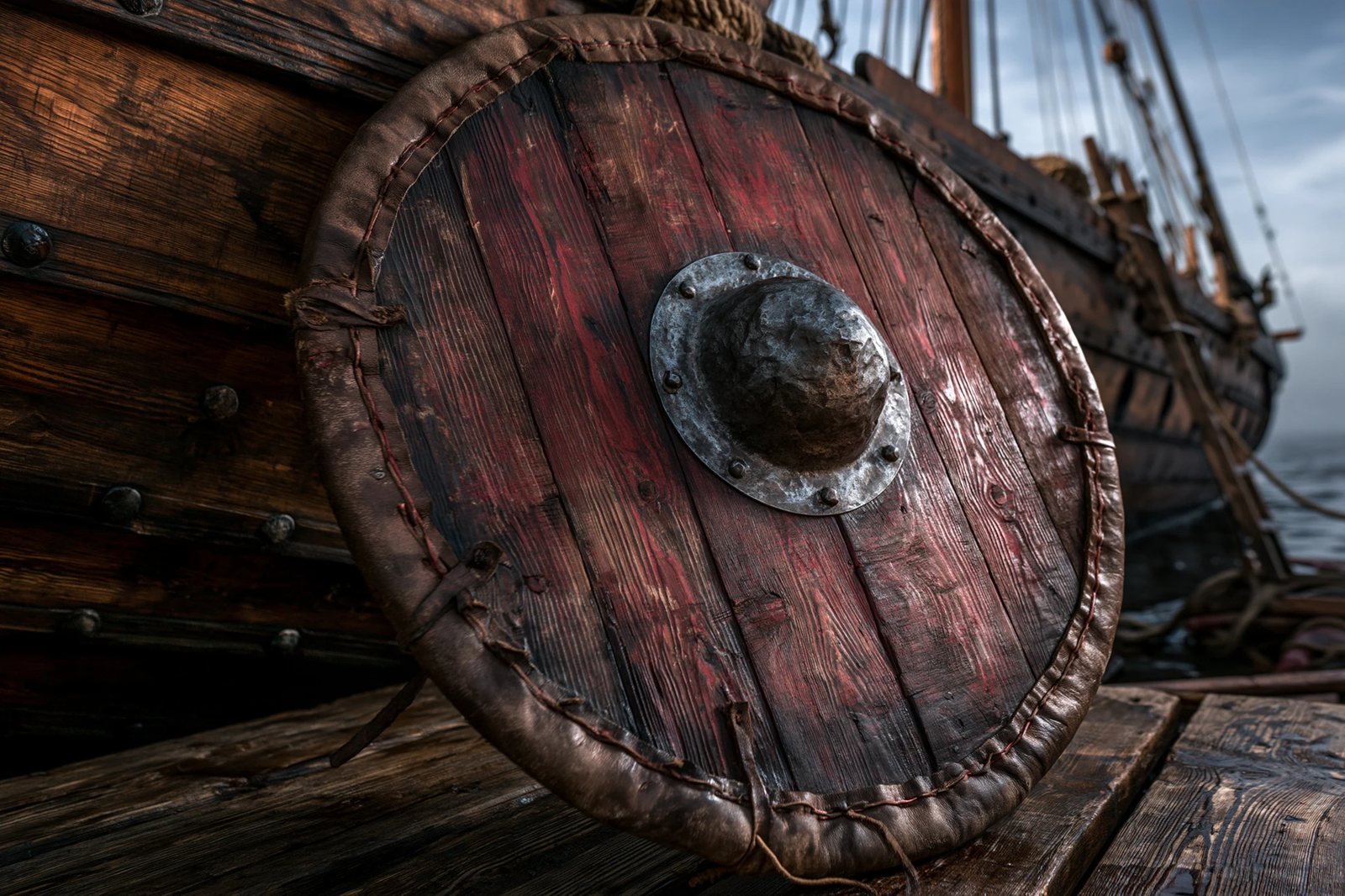
Sword and axe get the glory, yet the most common kit of the Viking warrior was round, wooden and surprisingly light: the round shield. It was no passive board to cower behind, but an active weapon - and far thinner than most people believe.
Picture a Viking and you usually see first the round shield with the iron boss at its centre. Rightly so: the round shield was the most widespread protective kit of the north. It was comparatively cheap to make, universally usable and in Norwegian law even required - the Gulathing law demanded of the free man a basic set of weapons for the country's defence, the so-called folkvapn, typically an axe or sword, a spear and a shield.
Unlike mail or helmet, which stayed costly and rare, the shield was practically standard. It turned an armed farmer into a fighting man. And because shields quickly broke in use, they were built in great numbers - consumables in the best sense.
At the same time the shield was the first thing a warrior lost in a fight. It splintered, split at the rim, shed its boss - and was then thrown away and replaced. That is exactly why archaeologists find far more iron shield bosses than complete shields: the wood decayed, the boss remained. Through these bosses, at least, the size and spread of the shields can be reconstructed.
A Viking round shield was made of several planks butted side by side, glued and assembled into a round disc of about 80 to 90 centimetres across. Light wood was preferred - linden (basswood), but also spruce, fir or pine. Weight was decisive: the shield had to be held for hours and moved in a flash.
And here comes the point that surprises most people: these shields were thin. The best surviving evidence, the shields from the Gokstad ship, measures only about seven millimetres at the centre and tapers thinner still toward the rim. The range of surviving and reconstructed shields lies roughly between six and twelve millimetres. Such a board is no indestructible armour - it is a light, agile tool that will sometimes splinter in a fight. That was exactly the intention.
There was no single size. The diameters of the finds vary markedly, and older shields of the Vendel and early Viking period could be cut differently from the late ones. The number of planks varies too - sometimes five broad boards, sometimes more narrow ones. But the basic idea stayed the same over centuries: light, round, held in the fist.
At the centre of the shield gapes a hole, domed over by a half-round iron cup - the shield boss. Behind it, running across the hollow, is a hand grip. The warrior therefore held the shield centrally in his fist, not on the forearm at the rim like a later knightly shield. The iron boss protected the hand and could also be used offensively: a punch with the boss into an opponent's face was a recognised move.
The rim was the weak point of any shield - here the wood splintered first. It was therefore often stitched round with leather or rawhide, more rarely reinforced with narrow metal clamps. Whether and how fully the shields were additionally faced with hide or linen is one of the most exciting open questions in the field, because organic material hardly survives.
Behind the boss the grip often ran as a plain wooden or iron bar, sometimes wrapped in leather for a better hold. Because the hand sat in the middle of the shield, the whole disc could be turned and tilted in a flash - an agility a shield strapped to the arm could never have matched. The price was the strain on the wrist; a heavy shield would quickly have become a burden here. That too explains why the Vikings built their shields so light.
We owe our picture of the Viking shield in large part to a single find: the Gokstad ship from Norway. Along the ship's sides 64 round shields were fastened, painted alternately yellow and black. They give us the most reliable measurements and the certainty that shields were painted - plainly, with high contrast, visible from afar.
One must be careful, though: the Gokstad shields were hung for display on a showpiece ship and need not match the battle shield in every detail. Even so they are the yardstick against which all reconstructions are measured. A second important find comes from the Danish ring fortress of Trelleborg, where the remains of an almost complete shield were found.
Beyond the painting comes the question of signs and patterns. Picture stones and later sources show shields with segments, spirals or simple motifs, yet a fixed system of arms like later knighthood did not yet exist. Colours and patterns probably served recognition in the melee and adornment - not hereditary heraldry. Anyone painting an "authentic" Viking shield today is on thin ice here: much is plausible reconstruction, little is securely attested for a particular motif.
In recent years the archaeologist Rolf Warming, with colleagues, has thoroughly shaken up the old certainties. Together with the museum at Trelleborg and the National Museum of Denmark a shield was reconstructed that is deliberately faced with rawhide - "the first authentic round shield in 1000 years", as the project confidently called it. Rawhide, that is untanned, dried animal hide, sets board-hard and catches blows surprisingly well.
The problem: hide decays in the ground, and so with finds over 1100 years old it can hardly ever be shown which hide was worked and how. Warming's experiments suggest that a rawhide facing makes a thin wooden shield markedly more resistant - a shield that splinters but does not fall apart at once. Whether that was the rule or the exception remains under discussion. The key point: the thin shield was no construction error but part of a system.
Warming's experiments showed something else: a thin, slightly yielding shield "swallows" a blow better than a rigid board. Where a thick, stiff shield passes the full force to the arm, a thin, elastic shield absorbs part of the energy and steers the blade aside. The supposed weakness - the slight thickness - was in truth part of the strength.
Here lies the greatest misunderstanding. A Viking did not crouch motionless behind his shield waiting for hits. A thin shield in the fist is an active weapon: you do not catch a blow bluntly but deflect it with a turn, "bind" the enemy blade, hook away a foreign shield with the rim and thrust forward with the boss. The shield was attack and defence at once. That it splintered in the process was reckoned with - a shield was a consumable, not an heirloom.
Most often the shield appeared in a duo with the spear, the north's real everyday weapon. The shield covered while the spear point stabbed at distance; only in close quarters did axe or sword come into play. Seen this way, the round shield was the connecting element of almost every fighting kit - the one thing practically every warrior carried, whatever he held in the other hand.
Out of many single shields comes the most famous formation of the Viking Age: the shield wall, in which the warriors stand shoulder to shoulder and join their shields into a front. Just how tightly the shields really overlapped and how rigidly the line stood is disputed among specialists - we have devoted a separate article to the shield wall. For the shield itself it is enough here: it was not only individual protection but the building block of a tactical wall. And that the word "shield" sits so deep in the warrior's language is shown already by Old English verse, which names the warrior simply by his wood:
No aliens ever at ease thus bore them, linden-wielders: yet word-of-leave clearly ye lack from clansmen here...Beowulf, trans. Francis B. Gummere, 1910, public domain
"Linden-wielders" - so the Danish coast-guard names the armed men he challenges. The warrior and his shield of lindenwood have become one.
Viking round shields were made of glued wooden planks (preferably linden, also spruce/fir/pine) about 80 to 90 cm across, with a central iron boss and a grip held in the fist. The 64 shields of the Gokstad ship (about 7 mm at the centre, thinner toward the rim, painted yellow and black) give the most reliable measurements; a further find comes from Trelleborg. Surviving and reconstructed shields lie roughly at 6 to 12 mm thick. The rim was faced with leather or rawhide; reconstruction research (Rolf Warming, National Museum/Trelleborg) examines the rawhide facing.
The thick, heavy plank shields of film and games did not exist - real shields were, at six to twelve millimetres, astonishingly thin and deliberately light. They were consumables that splintered in a fight, not indestructible armour. The image of the warrior cowering motionless behind his shield also misleads: the thin round shield was an active weapon for deflecting, binding and thrusting. And the perfectly closed, immovable shield-wall of many action films is a simplification - just how tightly the line really stood is disputed among specialists to this day.
The Viking Axe · The Viking Sword · The shield wall · The Great Heathen Army · Berserkers.
Sources: excavation of the Gokstad ship (Museum of Cultural History, Oslo); Rolf Warming et al. on the reconstruction and function of the Gokstad shields and the Trelleborg shield project (National Museum of Denmark); ScienceNorway, "New studies are upending our ideas about Viking shields"; the Gulathing law on the folkvapn; Beowulf in the translation by Francis B. Gummere (1910, public domain).
All History & Finds articles →
If the axe was the weapon of the common man, the sword was its opposite: costly, rare, inherited and often given its …
Read more →