Wolin, at the mouth of the Oder in today's Poland, was one of the largest and richest trading towns of the Viking-Age Baltic, flourishing from the 9th to the 11th century. It was a Slavic town of the Wolinians, where Scandinavians, Saxons and other strangers came to trade. Adam of Bremen called it Jumne around 1075 and claimed it was the largest city in Europe; later writers knew it as Julin. Polish archaeologists led by Władysław Filipowiak have dug there since 1952. Here is what the evidence shows, what is legend, and where Jomsborg and Vineta fit in.
Picture a waterfront where, in a single morning, you might hear Slavic, Old Norse and Old Saxon. Flat-bottomed oak boats lie along a timber quay. Smoke rises from a furnace behind a row of houses. On the market someone is weighing out lumps of silver cut from coins struck in Baghdad or Samarkand, while next to him lie heaps of amber beads, antler combs and glass beads in every colour. This is not a set for a streaming series. It is, more or less, what archaeology tells us about Wolin at the mouth of the Oder in the 10th century.
Today Wolin is a quiet little town of just under 5,000 people. It also happens to sit at the centre of two of the most famous legends of the North: the sunken city of Vineta and the warrior fortress of Jomsborg. That makes things more complicated, not less. So let us take it step by step: first the written sources, then the finds, then the legends.
The Oder does not simply flow into the sea. It first spills into the Szczecin Lagoon and only then reaches the Baltic through three channels: the Peenestrom in the west, the Świna in the middle and the Dziwna (German Dievenow) in the east. Between them lie the islands of Usedom and Wolin. The town of Wolin sits at the southern tip of its island, right on the Dziwna, at the point where the river was easiest to cross. A sea route to the open Baltic, an inland waterway via the lagoon and the Oder deep into central Europe, and an overland road along the coast all met here.
Adam of Bremen described this in his own learned way: there, he wrote, you could see "Neptune of a threefold nature", because the island was washed by three straits. He almost certainly meant these river mouths. For merchants the spot was ideal, and nodes like this shaped the whole trading world of the Viking Age.
The so-called Bavarian Geographer, a Latin list of peoples compiled in the 9th century, names a people called the "Velunzani". Many historians identify them with the Wolinians, the Slavic tribe of the Oder mouth; it is plausible but not certain. For the year 967, the Saxon chronicler Widukind of Corvey describes the battle in which the renegade Saxon count Wichmann was killed fighting Mieszko I of Poland; Wichmann's allies are usually taken to be the Wolinians. Thietmar of Merseburg mentions envoys of the "Liuilni" at the court of Henry II in 1007, which is also generally read as a reference to Wolin.
Around 965 the Jewish merchant and envoy Ibrāhīm ibn Yaʿqūb from Muslim Spain travelled through central Europe. His report survives only in extracts quoted by later Arab geographers. In it he describes a great town by the sea with twelve gates and a harbour. The reading of its name in Arabic script is uncertain, but most scholars think of Wolin.
Then comes Adam of Bremen with "Jumne" or "Iumne", the biographers of Bishop Otto of Bamberg with "Julin", the Danish historian Saxo Grammaticus around 1200 with "Iulinum", and the Old Norse sagas with "Jóm" and "Jómsborg". The modern name Wolin goes back to the Slavic form. The historian Adolf Hofmeister argued in detail in the 1930s that all these names refer to one place, and the excavations have since borne him out.
The most famous description comes from Adam of Bremen, who wrote his history of the archbishops of Hamburg around 1075. In his second book he surveys the lands east of the Elbe and arrives at the mouth of the Oder. In our own rendering of the Latin:
At the mouth of the Oder lies the most noble city of Jumne, a much-frequented trading place for the barbarians and Greeks round about. It is truly the largest of all the cities that Europe contains. Slavs live there together with other peoples, Greeks and barbarians. Even Saxon newcomers may live there on equal terms, provided they do not openly profess their Christianity while they stay. Adam of Bremen, Gesta Hammaburgensis ecclesiae pontificum, Book II (our own translation from the Latin)
Adam adds that all the inhabitants still followed pagan rites, yet no people could be found more honourable or kinder in their manners and hospitality. The town was rich in the goods of all northern nations. Then come two puzzling details: a "pot of Vulcan", which the inhabitants called Greek fire, and that threefold Neptune. Whether the "pot of Vulcan" was a harbour beacon, a signal fire or simply a learned flourish is unknown; Adam himself cites the late Roman writer Solinus, which sounds more like book learning than eyewitness detail.
And that is the crucial caveat: Adam never went to Jumne. He wrote in Bremen and relied on merchants, missionaries and the Danish king Sven Estridsen, with whom he spoke. "Largest city in Europe" is praise at second hand – Constantinople, Córdoba and Kyiv were certainly larger. But if a Bremen cleric praises a pagan Slavic town in such glowing terms, its reputation must have been enormous. Adam also gives travel times: seven days overland from Hamburg to Jumne, and fourteen days' sailing from Jumne to Ostrogard in Russia, probably Novgorod.
Another detail in Adam made Wolin famous in Scandinavia. After a rebellion by his son Sven, he writes, the Danish king Harald Bluetooth fled wounded to the Slavs at Jumne, was kindly received, and died of his wound there. This probably happened around 986 or 987. Whether Harald also founded a fortress at Wolin, as the sagas later claim, is a different question entirely.
As early as the first half of the 19th century, antiquarians were probing the ramparts of what was then the small Pomeranian town of Wollin, driven mostly by the romantic search for Vineta and Jomsborg. In the 1930s professional excavations followed under Otto Kunkel and Karl August Wilde of the Pomeranian State Museum in Stettin, who cut through the western rampart and found deep occupation layers.
After 1945 Wolin became part of Poland, and Polish archaeology made it one of its flagship projects. From 1952 the excavations were led by Władysław Filipowiak (1926–2016) on behalf of the Polish Academy of Sciences; from 1955 to 2000 he was also director of the National Museum in Szczecin. Most of the material that research still relies on comes from excavations between 1961 and 1986. As early as 1958 Filipowiak proposed an open-air museum at Wolin.
Today the Institute of Archaeology and Ethnology of the Polish Academy of Sciences continues the work, with Wojciech Filipowiak among others. In 2021 a team examined burial mounds of the 9th and 10th centuries on Gallows Hill (Wzgórze Wisielców), one of the town's large early medieval cemeteries, where cremations dominate; a possible boat burial remains unconfirmed. More recently, unusual huts of the 11th or 12th century were uncovered on Silver Hill, with Norwegian whetstones and glass beads, and the excavators suspect that the town's earliest harbour lies beneath them.
Early medieval Wolin was not a single fortress but a cluster of settlements. In the centre, roughly where the old town lies today, a fortified core with a timber-and-earth rampart grew up in the 9th century. Two suburbs lay beside it and were themselves fortified between the late 9th and the 10th century. To the north rises Silver Hill (Polish Srebrne Wzgórze), where archaeologists found a marketplace, workshops and a landing place of its own. Further out lay cemeteries such as Gallows Hill. Some researchers, including Wojciech Filipowiak, see Silver Hill as the place where Scandinavians in particular traded without living in the Slavic town core.
The harbour works are among the most impressive finds. In a trench opened in 1986, timber quays came to light whose wood was dated by dendrochronology – counting tree rings – to 838, to around 889 and to around 902. So the quay was in use from the early 9th to the early 10th century. Equally telling is what was found of the ships themselves: according to Wojciech Filipowiak, virtually all the boats were local builds, not Scandinavian longships. The Wolinians built their own vessels in the Slavic tradition, with wooden pegs rather than iron rivets – a picture that fits well with Ralswiek on Rügen.
How many people lived here can only be estimated; modern estimates usually suggest several thousand at the town's height, similar to Danish Hedeby. By northern European standards that was huge.
Wolin was not just a place where goods changed hands; it was a workshop. On Silver Hill and in the town, excavators found traces of many crafts: antler and bone working for combs and pins, non-ferrous metal casting, smithing, leatherworking, woodworking, pottery and glass bead making. North of Silver Hill there was probably an iron-smelting site with numerous furnaces. If you are curious about the antler craftsmen, we have a separate piece on the comb makers of the Viking Age.
Most characteristic of all is amber. The fossil resin washes up on the Baltic shore and could be gathered almost on Wolin's doorstep. The excavations produced raw lumps, half-finished pieces and waste in large quantities, along with finished beads, pendants and gaming pieces. Wolin was one of the leading amber-working centres of the southern Baltic. For us in the workshop that is a familiar sight: you recognise a trade by its offcuts more readily than by its finished pieces.
Goods came to Wolin from every direction: Scandinavia, the Rhineland, Rus, Byzantium and the Islamic world. Norwegian whetstones, glass beads, oriental silver and western coins all turn up in the layers. In the other direction, amber, furs, honey, wax and very probably enslaved people left the region for distant markets. That last commodity is part of the truth of this trade, even if it is hard to trace archaeologically.
In the 10th century people on the southern Baltic did not pay with coins in the modern sense but with silver by weight. Coins, jewellery and ingots were chopped up and weighed on fine balances – the so-called hacksilver. Silver Hill produced hoards with Arabic and western European coins, jewellery and single coins. One house yielded a Magdeburg cross penny from around 965–985, another a Hedeby half-bracteate from the same decades.
One story has a bitter aftertaste. In 2006 looters with metal detectors plundered a silver hoard on Silver Hill; part of it was recovered. Its youngest coins show it was buried around 980–984, just a few years before Harald Bluetooth, according to Adam, died at Jumne. There is no direct link, but the find shows how much silver was flowing through Wolin in those years. For the bigger picture, see our article on the great Viking silver hoards.
The Arabic dirhams reached the Baltic via the Volga and the Rus. Their flow dried up in the late 10th century, after which German and Anglo-Saxon pennies dominated. Wolin sat right at the point where these two silver streams met, and its coin finds reflect the change.
Wolin remained a pagan town into the 12th century, and archaeology shows it in small but eloquent objects. The best known is a yew-wood figurine only about 9.3 centimetres tall with four faces looking towards the four cardinal points. It lay in a domestic layer of the second half of the 9th century, among wood shavings, dung and household rubbish. It is popularly called the "Światowid of Wolin", after the four-headed god Svantevit whom Saxo Grammaticus describes at Arkona on Rügen. Whether the little figure really represents Svantevit is uncertain, but it strongly suggests that many-faced divine images were familiar in Wolin too.
A second yew figure, 11.2 centimetres tall with a single face, dates from the first half of the 11th century and is kept in the National Museum in Szczecin. It was long seen as an idol; some researchers think of a warrior in a pointed helmet, and a toy cannot be ruled out. In 2012 a rescue excavation by the harbour produced a wooden figure about a metre long from the 11th century, possibly a cult image, and a small antler mouthpiece carved with twelve faces.
Filipowiak interpreted a feature in the town centre as a temple: a small timber building about five by five metres within a fenced courtyard. The interpretation is debated, and his 1992 reconstruction of a younger temple with a cult statue is now considered to go too far. That Wolin had sanctuaries, however, is confirmed by Otto of Bamberg's biographers. They describe a huge column bearing a spear which the Wolinians revered as the spear of Julius Caesar – the town's supposed founder, after whom Julin was said to be named – and a festival for a deity at the beginning of the year, with dancing. The Caesar story is a learned name-etymology, not history.
This is the moment to adjust the lens. Popular accounts often call Wolin a "Viking town". That is misleading. Wolin was a town of the Slavic Wolinians, with Slavic pottery, Slavic houses, Slavic gods and Slavic ships. Scandinavians were present – as merchants, craftsmen, perhaps also as warriors in the town's service – but as guests and partners, not as founders or masters. Adam says as much himself: Slavs live there together with other peoples.
Politically, Wolin was remarkably independent for a long time. There seems to have been no king, but a civic community with elders and assemblies, much as among the Pomeranians and the Liutizi. The town resisted Mieszko I and later Bolesław the Brave, sent its own envoys to the German king and made alliances on its own terms. For the wider context, see our article on the Vikings in the Baltic and the land of the Wends.
Around the middle of the 11th century archaeology shows a clear break. The sagas report that the Norwegian-Danish king Magnus the Good attacked and burned Jomsborg in 1043. How far this affected Wolin is hard to say, but the timing fits the excavated evidence. Around 1098 the Danish king Erik Ejegod is said to have campaigned against the town again. Economic change added to the pressure: the flow of oriental silver had dried up, trade routes shifted, and new centres such as Szczecin grew in importance.
Around 1121/22 the Polish duke Bolesław III Wrymouth subdued Pomerania, Wolin included. That was the beginning of the end of the old order.
In 1122 a missionary named Bernard, a Spanish hermit, tried to preach in Wolin. He appeared barefoot in a shabby habit. The Wolinians took him for a beggar or a spy, beat him and sent him away. The lesson was clear: anyone hoping to convert Pomerania had to arrive in style.
That is exactly what Bishop Otto of Bamberg did when he came to Pomerania in 1124 on Bolesław's behalf – with a retinue, gifts and the duke's backing. At Wolin his reception was at first dangerously hostile, and Otto and his companions had to leave the town. The Wolinians declared that they would accept baptism if Szczecin, the more important neighbouring town, did so first. When Szczecin converted, Wolin followed. A thoroughly urban decision: calculation rather than revelation. In 1128 Otto returned, because several towns had lapsed back into paganism; it is in the accounts of this second journey that his biographers mention Caesar's spear and the New Year festival.
On 14 October 1140 Pope Innocent II confirmed the church of St Adalbert in Wolin as the seat of the first Pomeranian bishopric. Its first bishop was Adalbert, a former chaplain of Bolesław. For a short while, Wolin was the ecclesiastical centre of Pomerania.
In the 12th century the balance of power in the Baltic turned. Wendish pirates raided the Danish coasts, and the Danes under King Valdemar I and Bishop Absalon responded with great naval expeditions against Rügen and Pomerania. Arkona fell in 1168. Saxo Grammaticus describes several campaigns against "Iulinum" in the 1170s. Wolin's fortifications were probably destroyed in this period – on the archaeological evidence, likely in 1173 and again around 1184. The bishop's seat moved around 1175/76 to Cammin, today's Kamień Pomorski.
In the 13th century a new, small town under Lübeck law grew up on the old ramparts. It remained a modest country town. The great trading role had long since passed to Szczecin and the German Hanseatic towns.
The sagas of the 12th and 13th centuries tell of Jomsborg, a fortress in the land of the Wends with a harbour for hundreds of ships, home to a warrior brotherhood bound by strict rules: the Jomsvikings. Their story deserves its own article, linked here. For Wolin, only one question matters: was Jomsborg here?
Honestly, we do not know. Many scholars consider Wolin or its immediate surroundings the most likely candidate, because Jumne, Julin and Jóm fit together linguistically and Wolin was the only town of this size at the Oder mouth. But no stronghold that could clearly be called a Scandinavian fortress has been found, and the sagas were written centuries after the events they describe. The historian Jakub Morawiec has shown how much Jomsborg is a literary place where storytelling patterns about honour and loyalty have settled.
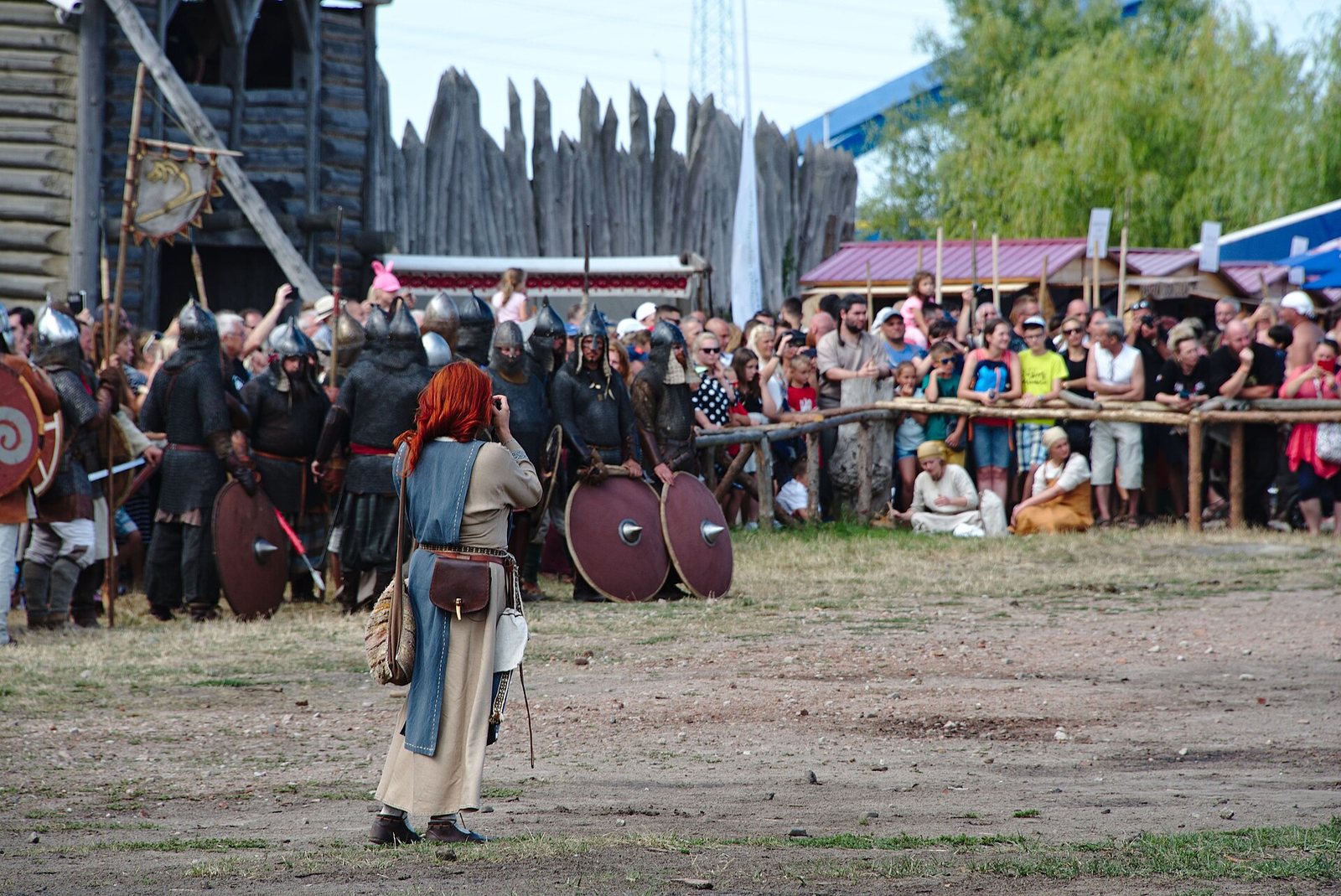
Many people today know Wolin chiefly through the Festival of Slavs and Vikings. It was first held in 1993 and in 1999 moved to the river island of Wolińska Kępa, where the Centre of Slavs and Vikings with reconstructed houses opened in 2008. Every summer hundreds of re-enactors arrive from all over Europe. Dates, programme and travel tips are in our guide to the Festival of Slavs and Vikings in Wolin.
In fairness, one note belongs here. Researchers close to the Wolin excavations remarked in 2021 that the centre is more a theme park than a museum, that the Viking element is overplayed compared with the archaeological record, and that the Slavic side sometimes feels like an add-on. At the same time they acknowledge that it gets people excited about history. Our advice: enjoy the spectacle, then visit the National Museum in Szczecin, where the real finds are kept.
Behind Vineta lies a copyist's slip, behind Jomsborg a saga – and behind both a real, Slavic, wealthy town that welcomed strangers.
Where is Wolin? Wolin is in north-western Poland, at the southern end of Wolin island on the Dziwna, one of the three mouths of the Oder, about 50 kilometres north of Szczecin.
Is Wolin the same as Jumne? Yes. According to current research, Adam of Bremen's Jumne is Wolin. The Julin of Otto of Bamberg's biographers and Saxo's Iulinum refer to the same place.
Was Wolin a Viking town? No, Wolin was a Slavic town of the Wolinians. Scandinavians lived and traded there, as did Saxons and others, but the population, houses, ships and religion were predominantly Slavic.
Is Wolin the sunken city of Vineta? The name Vineta is most likely a scribal corruption of Jumne in Helmold's manuscripts. The drowning story is legend; the real town behind it is, on current evidence, Wolin.
Was Jomsborg at Wolin? Possibly, but it is not proven. No Scandinavian fortress has been found there, and the sagas about Jomsborg were written centuries later.
When did Wolin become Christian? In 1124, through Otto of Bamberg's mission, after Szczecin had converted. In 1140 Wolin became the seat of the first Pomeranian bishopric.
For courage. For remembrance. For legends that live on.
The Jomsvikings · Ralswiek on Rügen · Menzlin on the Peene · Hacksilver – silver as currency · Viking traces in Germany.
All History & Finds articles →
Many call the Varus battle the „big bang of Germany". Yet another battle shaped our lands far more deeply – one in …
Read more →High above the world of humans, beyond the burning rainbow bridge, lies Asgard – the fortified home of the Æsir. It is …
Read more →Almost 1,500 years before the first Germanic peoples entered Roman history books, a highly developed Early Bronze Age …
Read more →Between the world of humans and the world of the gods a bridge of light is stretched: Bifröst, the rainbow. It is the …
Read more →