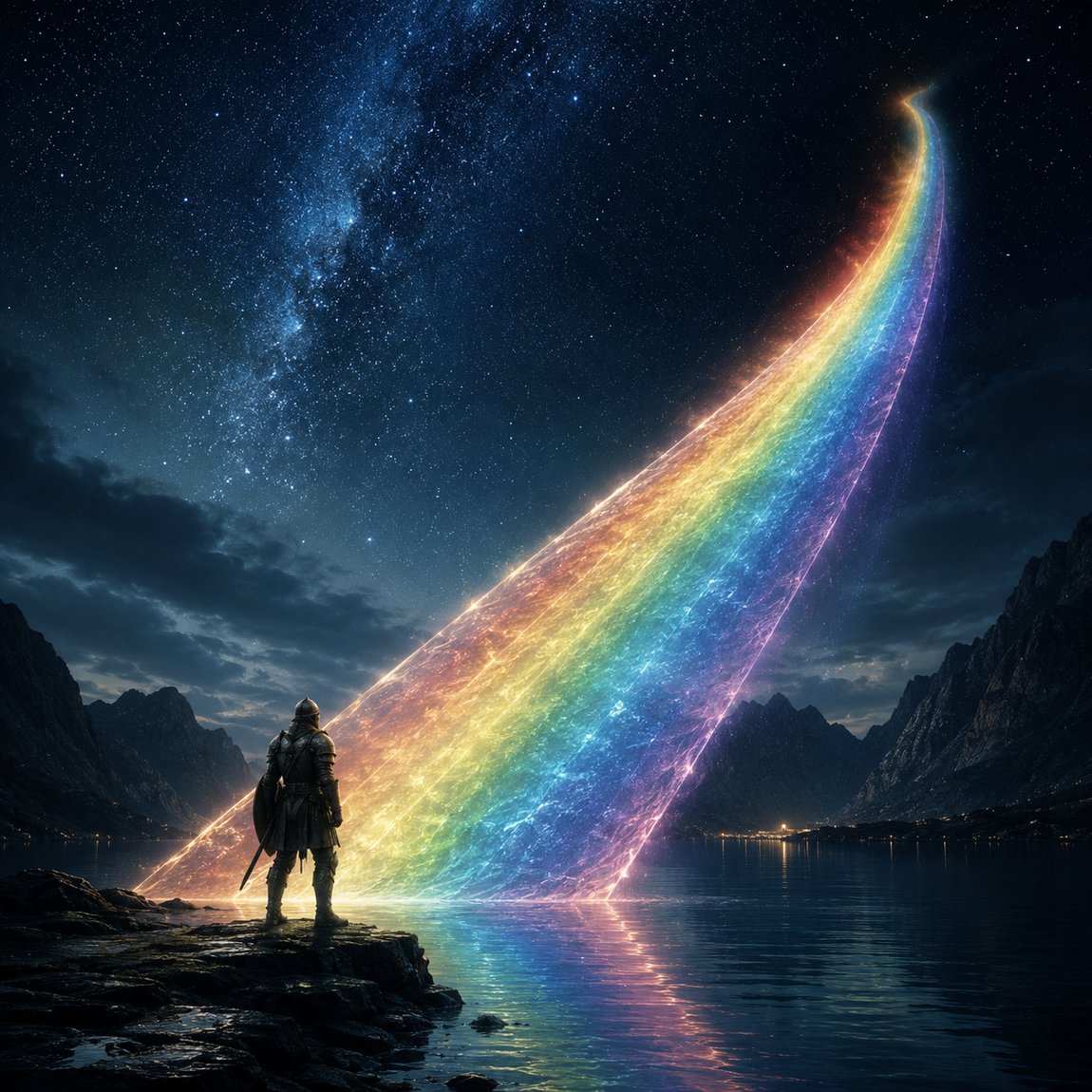
Bifrost (Old Norse Bifröst) is the bridge in Norse mythology that leads from the earth up to the gods – from Midgard to Asgard. Around 1220 Snorri Sturluson described it as a three-coloured rainbow whose red band is burning fire. It is guarded by Heimdall, and at Ragnarök it collapses. Here is what the medieval sources actually say, what the name means, where Snorri interprets rather than transmits, and why Viking Age Scandinavians built real bridges for the good of their souls.
Imagine building the finest structure in the world, with more craft and skill than anything else ever made. It links two worlds, it shines in three colours, and at its far end sits a watchman who can hear grass grow. And from day one you know: it is going to break.
That is how the Norse tradition tells the story of Bifrost. The bridge is not a battlefield. It is infrastructure – the gods' daily commute to their court of law. Precisely because of that, it reveals a whole worldview: even the road between humans and gods is built, guarded and finite.
There is a catch, though, and it is typical of Norse mythology as a whole. The familiar picture – rainbow, three colours, red fire – comes almost entirely from one source, the Prose Edda of the Icelander Snorri Sturluson. The older poems say less, and in places something different. So we take it step by step: the names, the poems, Snorri, and then the interpretations.
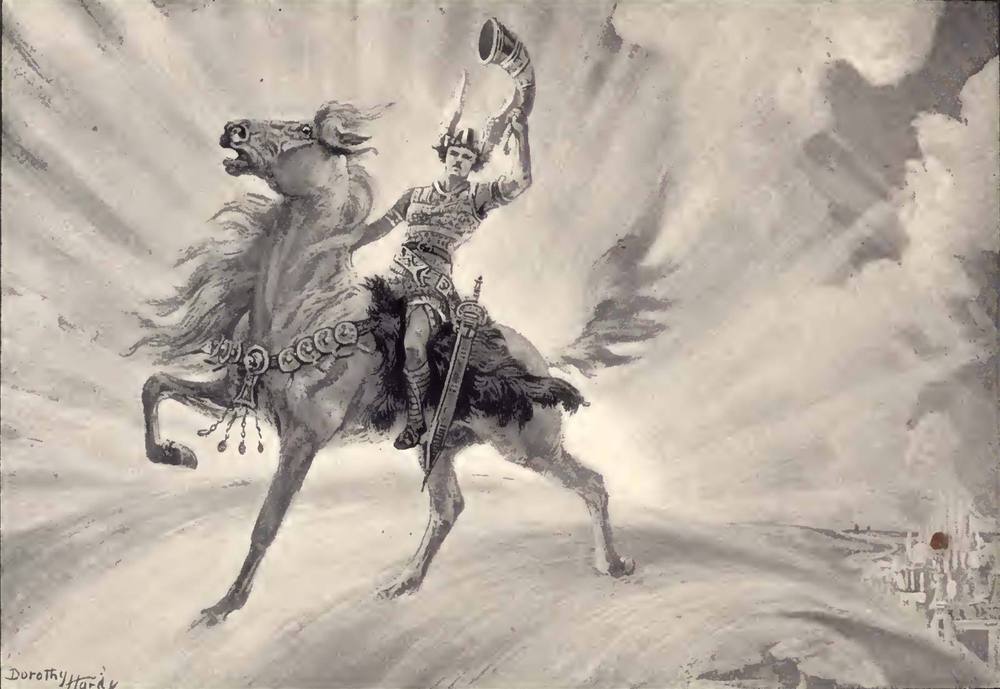
The manuscripts cannot even agree on the name. The main witness to the Poetic Edda, the Icelandic Codex Regius (a vellum manuscript from around 1270), writes Bilröst. Snorri and the skaldic poets – the court poets of the North with their intricate verse – use Bifröst. A third name is Ásbrú, “the Æsir's bridge” or “bridge of the gods”.
In the Poetic Edda the bridge appears in just three stanzas: as the burning ásbrú in Grímnismál 29, and as Bilröst in Grímnismál 44 and Fáfnismál 15. Snorri states in Gylfaginning chapter 15 that Bifrost is also called Ásbrú, and so stitches the traditions together – very much his method, as our portrait of Snorri Sturluson shows.
The second element is the easy part. Old Norse röst is a measure of distance, originally perhaps the stretch between two resting places; it is related to German Rast, “rest”. A nice detail: Snorri says Heimdall can see a hundred rastir by day or night. The guard and his bridge are measured in the same unit.
The first element is where the arguments start. Bif- is usually linked to the verb bifa, “to tremble, to shake, to sway”. Rudolf Simek, in his standard dictionary of Germanic mythology, renders the name as “the swaying road to heaven”. Andy Orchard leans towards the shimmer of light and suggests “the shimmering path”.
The form Bil- points elsewhere. Old Norse bil can mean “a moment, a short while”, but also “a gap, a weak point”. Bilröst would then be the road that is only visible for a moment – or the road with a weak spot. Simek thinks Bilröst may well be the older form, with Bifröst a later reinterpretation. That is plausible but not proven.
Every one of these readings fits a rainbow: it shimmers, it looks fragile, and it vanishes within minutes. And every one fits a bridge whose end is already written into the story.
In Grímnismál, “The Sayings of Grímnir”, Odin sits in disguise between two fires at the hall of King Geirrøðr and unfolds his knowledge of the divine world. Henry Adams Bellows translated stanza 29 in 1923:
Kormt and Ormt and the Kerlaugs twain / Shall Thor each day wade through, / (When dooms to give he forth shall go / To the ash-tree Yggdrasil;) / For heaven's bridge burns all in flame, / And the sacred waters seethe.Grímnismál 29, transl. Henry Adams Bellows, The Poetic Edda, 1923
The Old Norse says því at ásbrú brenn öll loga – “for the Æsir's bridge burns all with flame”. So the fire is already there in the poem, centuries before anyone wrote down the word “rainbow”.
Stanza 30 lists the horses the Æsir ride each day to give judgement, among them Gulltoppr, which Snorri names as Heimdall's horse. The stanza does not mention the bridge; that the gods ride over Bifrost is Snorri's addition. Stanza 44 then ranks the best of everything, and the bridge stands in exalted company. In Bellows' words: “Bifrost of bridges, Bragi of skalds”, alongside Yggdrasil, Skíðblaðnir, Odin and Sleipnir.
The third passage comes from a very different poem. In Fáfnismál the dragon Fáfnir lies dying and answers Sigurd's questions. Asked about the island where Surtr and the gods will mingle their blood, he replies:
Óskópnir hann heitir, en þar öll skulu geirum leika goð; Bilröst brotnar, er þeir á brú fara, ok svima í móðu marir.Fáfnismál 15, Old Norse text after heimskringla.no
In our own rendering: Óskópnir it is called, and there all the gods shall play with spears; Bilröst breaks when they go onto the bridge, and the horses swim in the river. Note the “they”: on the usual reading it means the gods themselves. That is a different picture from Snorri's.
The detail arrives with Snorri Sturluson's Prose Edda, written around 1220, more than two centuries after Iceland adopted Christianity. Its first part, Gylfaginning (“The Deluding of Gylfi”), is a dialogue: the disguised King Gylfi, calling himself Gangleri, asks the questions, and three mysterious figures – Hárr, Jafnhárr and Þriði – answer.
In chapter 13 Gangleri asks for the way from earth to heaven. Hárr laughs at the question and explains that the gods built a bridge from earth to heaven called Bifrost – and then, roughly: you must have seen it; perhaps you call it the rainbow. It has three colours, is very strong, and was made with more art and skill than other works („með þrimr litum ok mjök sterk ok ger með list ok kunnáttu meiri en aðrar smíðir“).
Then, without a pause, comes the ending: the bridge will break when the sons of Muspell ride over it. Gangleri reacts as any sensible client would. If it can break, he says, the gods did not build in good faith, since they can do whatever they want. Hárr's answer is one of the hardest lines in the whole Prose Edda:
Eigi eru goðin hallmælis verð af þessi smíð. Góð brú er Bifröst, en enginn hlutr er sá í þessum heimi er sér megi treystast, þá er Múspellssynir herja.Snorri Sturluson, Gylfaginning 13, Old Norse text after heimskringla.no
Our own translation: The gods deserve no blame for this work. Bifrost is a good bridge, but there is nothing in this world that can be relied upon when the sons of Muspell go raiding. It is not a builder's warranty dispute. It is theology in a single sentence.
Chapter 15 fills in the rest. Every day the Æsir ride over Bifrost, also called Ásbrú, to their court at the Well of Urd beneath Yggdrasil, where the Norns live. Gangleri asks whether fire burns over Bifrost. The answer: „Þat, er þú sér rautt í boganum, er eldr brennandi“ – what you see as red in the bow is burning fire. Without it, frost giants and mountain giants could climb into heaven if anyone who wished could cross. In chapter 17 Himinbjörg, “Heaven's Fells”, stands at the edge of heaven where Bifrost reaches it.
So Snorri takes the burning Æsir's bridge of Grímnismál 29, equates it with the rainbow everyone can see, and turns the fire into a security barrier against the giants. Elegant – and clearly an explanation, not just a transmission.
Today we count seven colours in a rainbow, a division that goes back to Isaac Newton in the seventeenth century. The Middle Ages followed Aristotle, whose Meteorology distinguished three main colours.
In a 2007 article in the journal Maal og Minne, the Scandinavianist Kirsten Wolf showed that Snorri's three colours ultimately derive from Aristotle. The two colours Snorri leaves unnamed were, on her analysis, probably green and blue. He names red because his point depends on it: the fire. In other words, the three colours are medieval learning rather than Viking Age lore. That does not make Snorri worthless as a source, but it is worth knowing where they come from.
All the gods ride to court every day – except Thor. He wades through Körmt, Örmt and the two Kerlaugar, rivers about which nothing else is known; Bellows noted as much in 1923.
Why does the strongest of the gods have to get his feet wet? The reason is given in Grímnismál 29 itself: “for heaven's bridge burns all in flame”. Snorri quotes the stanza in chapter 15 without adding an explanation of his own.
We like the open ending better than any explanation bolted on later. Thor wades through raging rivers elsewhere too, most famously on his way to the giant Geirröd.
At the heavenly end of the bridge lies Himinbjörg. Grímnismál 13 names it as the eighth dwelling of the gods. Bellows again: “In his well-built house does the warder of heaven / The good mead gladly drink.” So even the watchman gets a drink after his shift.
In Gylfaginning 27 Snorri turns this into a profile. Heimdall, “the white god”, was born of nine maidens, all sisters. He needs less sleep than a bird, sees a hundred leagues by night as well as by day, and hears grass growing on the earth and wool on sheep. His teeth are gold, so he is called Gullintanni, “Gold-tooth”. He sits at Himinbjörg on the edge of heaven and guards the bridge against the mountain giants.
The nine mothers also appear in the Eddic poem Hyndluljóð (more in our article on Heimdall's nine mothers). The same watch is mocked in Lokasenna: in stanza 48 Loki tells Heimdall he is doomed to stand forever with a muddy back (aurgu baki) as the gods' watchman. Anyone who has worked a night shift in the rain will feel that one.
The only built gateway into the divine world is guarded by the being who sleeps least and hears most. For more, read our portrait Heimdall – guardian of the bridge.
A guard needs an alarm: the Gjallarhorn, the “resounding horn”, which according to Snorri can be heard in all worlds. Yet the sources do not line up neatly. Völuspá 27 says that Heimdall's hljóð is hidden beneath the holy tree. The word can mean “hearing” or “sound” – and so perhaps the horn. If hearing is meant, Heimdall would have left it as a pledge, just as Odin left his eye.
Right after that, in Völuspá, Mímir drinks mead every morning from the All-father's pledge – Odin's eye in the well. In Snorri (chapter 15), by contrast, he drinks from the well using the Gjallarhorn. On the ending, though, both agree: in Völuspá 46 Heimdall blows loud with the horn raised high; in Snorri (chapter 51) he wakes all the gods with the Gjallarhorn. The bridge's guardian is also the one who announces the end.
The end of Bifrost is built into the story from the start. But who brings it down is told in different ways – a detail most retellings skip.
In Snorri it is straightforward. In Gylfaginning 51, amid the din of Ragnarök, the sky splits open and the sons of Muspell ride forth, led by Surtr with fire before and behind him. When they ride over Bifrost, it breaks – “as was said before”, Snorri adds, pointing back to chapter 13. Muspell is the fiery realm in the south.
In Fáfnismál, on the usual reading, it is the gods themselves who step onto the bridge on their way to battle at Óskópnir; it breaks beneath them, and their horses have to swim the river. And in Völuspá 51 the people of Muspell do not use a bridge at all: they come across the sea, in a ship steered by Loki.
Snorri wove these threads together: the enemy rides over the very bridge built to keep them out, and the fire no longer helps. It is powerful storytelling – but “the” story of Bifrost is a composition.
In the battle itself Heimdall and Loki kill each other (chapter 51). As early as the late tenth century, the Húsdrápa of the skald Úlfr Uggason has the two wrestling in the shape of seals over the necklace Brísingamen. In the world that rises afterwards, no new bridge is mentioned anywhere.
Snorri clearly means the rainbow. But was that already the idea behind the older poetry? Scholars discuss three answers.
The rainbow. In its favour: Snorri's explicit testimony and the etymology. Against it: the Poetic Edda never uses the word. Both are possible – that Snorri recorded an old belief, or that he equated a puzzling “burning bridge” with the most obvious arc in the sky.
The Milky Way. Several scholars have proposed that the bright band of the Milky Way was originally meant; reference works such as those by Simek and Lindow report this view. One argument: a road the gods use every day ought to be in the sky all the time, not only after rain. There is no direct source evidence, however. No Old Norse text equates Bifrost with the Milky Way.
The northern lights. The aurora is sometimes suggested because it flickers, shows several colours and can glow red. There is neither source evidence nor broad scholarly support for this.
Now for something you can actually walk on. In a landscape of bogs and fords a bridge was a major undertaking. Especially in the Swedish province of Uppland, many eleventh-century rune stones carry inscriptions along the lines of: so-and-so had this stone raised and this bridge made – for the soul of the deceased. During the conversion period, bridge-building counted as a pious deed that benefited both the soul and the family's reputation.
The best-known example is Jarlabanke's bridge at Täby, north of Stockholm, a causeway about 116 metres long and 6.4 metres wide. The stones U 164 and U 165 at its ends state that Jarlabanke raised them in his own memory while still alive and made this bridge for his soul – and that he alone owned all of Täby. Modesty was clearly not part of the plan.
More poetic is the Sälna stone (U 323) in Skånela. Three brothers raised it for their father, ask God to have mercy on his soul, and say, roughly: ever shall it lie while people live, the bridge, firmly founded and broad, in memory of the good man. No better road-marker could be made.
A direct link between these Christian-era soul-bridges and Bifrost cannot be proven. Both show, however, that the bridge was the most visible sign that a crossing was possible. Norse tradition also knows a second mythical bridge, Gjallarbrú, on the road to the realm of the dead. The scholar John Lindow has read the two as counterparts: Bifrost leads up, Gjallarbrú leads down. More in our article The road to Hel.
The North is not alone in imagining bridges between worlds. A few well-attested examples:
None of this should be turned into a shared primeval myth, as nineteenth-century scholars liked to do. The parallels rather show how natural the image is: when people describe the passage to another world, they reach for the hardest crossing in their own lives – the river, with a bridge over it.
Bifrost got its most famous stage outing from Richard Wagner, even though the name is never used. At the end of Das Rheingold (first performed in Munich in 1869), Donner swings his hammer, and Froh conjures a rainbow bridge to the gods' new fortress: “Zur Burg führt die Brücke, leicht, doch fest eurem Fuß” – the bridge leads to the castle, light yet firm beneath your feet. Over it the gods enter Valhalla. In the sources, however, Bifrost does not lead to Valhalla but to the court at Yggdrasil.
The image most people have today comes from Marvel. The Bifrost has been part of the Thor comics since the 1960s, and in the 2011 film Thor it becomes a kind of cosmic transport beam, which the scientist Jane Foster describes as an Einstein-Rosen bridge – a wormhole.
Three ideas live in Bifrost, and they belong together.
Closeness. A rainbow is visible. Whoever sees it sees the road of the gods. The other world is not infinitely far away but at the end of a road you can trace with your eyes. And the gods use it not for triumphal processions but for their daily trip to the Thing beneath the world tree. They do not rule by decree. They hold assembly.
Danger. The red band is fire. Whoever steps on the road without leave burns. Beauty and threat are the same thing seen from two sides.
Transience. A rainbow lasts minutes. Hárr's line, that nothing can be relied upon when the sons of Muspell come, is sober knowledge of the world. And yet the gods built anyway, with more art than anything else. That may be the most Nordic attitude of all.
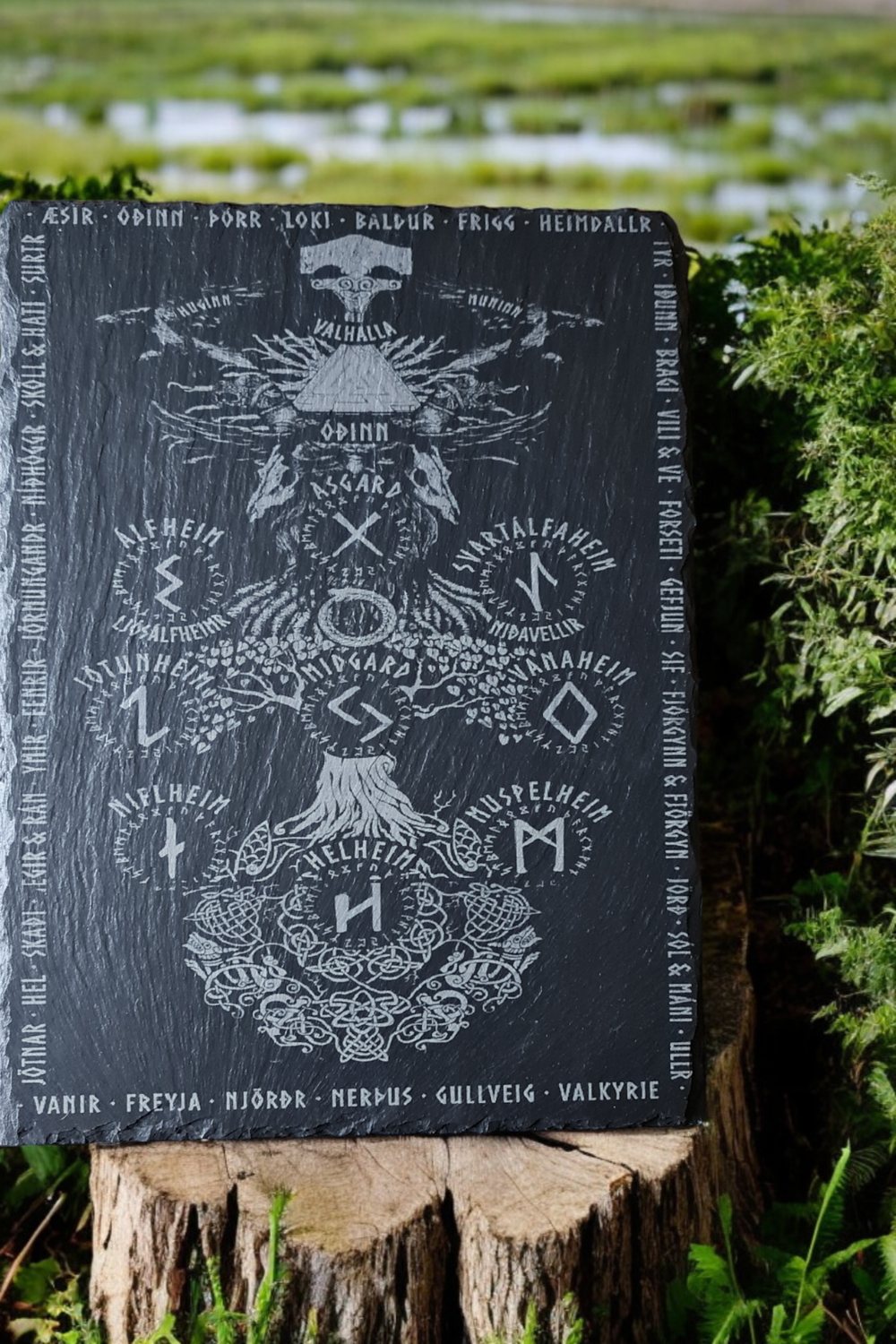
What is Bifrost in Norse mythology? Bifrost is the bridge leading from the earth (Midgard) to the gods' heaven (Asgard). The gods ride over it every day to their court at the world tree Yggdrasil, and Heimdall guards it.
What does the name Bifrost mean? Röst means a stretch of road or a measure of distance. Bif- is usually linked to bifa, “to tremble, sway”, giving something like “the swaying road to heaven”; the variant Bilröst may mean “the fleeting road”. The etymology is disputed.
Is Bifrost a rainbow? That is how Snorri Sturluson described it around 1220: three colours, with a red band of fire. The older Poetic Edda only speaks of a burning bridge; whether a rainbow was meant there is an open question.
Who guards the rainbow bridge? Heimdall, who lives at Himinbjörg at the top end. According to Snorri he needs less sleep than a bird, hears grass grow and announces Ragnarök with the Gjallarhorn.
Why can't Thor cross the Bifrost? According to Grímnismál 29 Thor wades through four rivers because the Æsir's bridge burns with flame. The popular explanation that his heat or weight would destroy it is not in the sources.
What happens to Bifrost at Ragnarök? According to Snorri, the sons of Muspell ride over it under Surtr and it breaks. In Fáfnismál it breaks beneath the gods themselves as they ride out to the final battle.
For courage. For remembrance. For legends that live on.
Heimdall & the Gjallarhorn · Asgard · The nine worlds · Ragnarök · Surtur.
All History & Finds articles →
Long before the Edda was written down, the people of Gotland told their stories in stone – in images that still puzzle …
Read more →Since 1878, Birka’s grave Bj 581 had been the textbook example of a high-status Viking warrior – the „ultimate Viking" …
Read more →Sometimes history is found not with the spade but with the computer. For a long time four of Harald Bluetooth's famous …
Read more →„So did they wear horned helmets or not?" The honest answer is a double no and yes: the Vikings did not. But the North …
Read more →