
Ragnarök is the doom of the gods and the world in Norse mythology: the Fimbulwinter, monsters set loose, the last battle on Vígríðr and a world-fire – after which a new earth rises from the sea. Norse mythology is the only great tradition in which the gods themselves are doomed – and in which they know it. Ragnarök, the ‘fate of the powers’, is their end: Fimbulwinter, the wolf set loose, the last battle, the world-fire. And yet the great poem does not end in darkness.
Ragnarök (Old Norse ragna rǫk, ‘doom/fate of the powers’; popularly ragnarøkkr, ‘twilight of the gods’) is the climax and the end of the Norse myths. Unlike in many religions, the gods here are not eternal. They too have a predetermined end – and they march into a battle they know they will not win. This attitude, to face the inevitable head on, is the core of the whole Norse world of thought.
This piece goes deep. If you only need one answer, it is here – everything below is the evidence for it.
What is Ragnarök? The foretold end of the gods' world: a threefold winter with no summer between, Fenrir and Loki breaking loose, a last battle on the plain of Vígríðr, and the world-fire brought by Surtr out of Muspellsheim.
What does the word mean? Ragna rök means "fate of the powers", not "twilight of the gods". The twilight variant ragnarøkkr is a later reinterpretation – it is how Wagner arrived at his title.
Who dies? Odin in Fenrir's jaws, Thor of Jörmungandr's venom after nine steps, Freyr by Surtr's sword, Týr and the hound Garmr each killing the other, Heimdall and Loki likewise.
Who survives? Odin's sons Víðarr and Váli, Thor's sons Móði and Magni with the hammer, and Hœnir. Baldr and Höðr return from Hel. Of humankind, Líf and Lífþrasir remain, sheltering in "Hoddmímir's wood".
What comes after? The Vǫluspá has the earth rise green from the sea again, the fields bear unsown, and the surviving Æsir find the golden gaming pieces of old lying in the grass. Not nothing – a second beginning.
Start with the word, because that is where the first misunderstanding begins.
Old Norse ragna rök is built from ragna, the genitive plural of regin, "the powers that take counsel" – meaning the gods – and rök, which means fate, doom, and also cause or reason. Together: the fate of the powers. Or, put harder: their doom.
Beside it stands a second form, ragnarøkkr. Here røkkr means twilight, the darkening of the sky. Twilight of the gods. That form appears in Snorri's Edda, and the manuscripts sometimes carry both.
Which is older? Most scholars favour ragna rök. Many treat ragnarøkkr as a later folk-etymological reshaping – two words that sound almost identical, and the darker image won.
The man who spread it never had to write a line of Old Norse. In 1876 Richard Wagner called the final part of his Ring cycle Götterdämmerung, and ever since, German and English audiences have known the event by a name it probably never had.
Everything we know about the end of the world rests on very few texts, and it is worth knowing them individually, because in places they disagree.
The Völuspá is the main source. A seeress tells Odin the history of the world from its making to beyond its ending. The poem survives in the Codex Regius, an Icelandic manuscript of about 1270, and in a second version in the Hauksbók of about 1302–1310. The two differ in stanza count and order – so anyone quoting "the Völuspá" is always quoting an editor's decision.
The Vafþrúðnismál supply the decisive additions: the Fimbulwinter, the survivors Líf and Lífþrasir, the daughter of the sun. The poem is framed as a contest of knowledge between Odin and a giant.
Snorri's Gylfaginning, around 1220, arranges the material into a continuous narrative. Snorri knew stanzas we no longer have, and he fills gaps. Where he names names that appear nowhere else, caution is required.
And then there are single skaldic stanzas and – easily overlooked – pictures cut in stone, older than any of these manuscripts.
The end really begins in the midst of the gods’ golden age – with a murder. Baldr, the brightest and best of the Æsir, is killed through Loki’s cunning: the blind Höðr, guided by Loki, throws a sprig of mistletoe, the one thing in the world that had not sworn to spare Baldr. With Baldr’s death the light goes out in Asgard, and the gods bind Loki to three stones in punishment, a venom-serpent above his face. His writhing under the drops makes the earthquakes. So he lies – until he breaks free at Ragnarök. Baldr’s death is the first crack; all else follows from it.
The downfall is preceded by the Fimbulwinter (‘the mighty winter’): three winters in a row with no summer between them. Moral order collapses – ‘brother slays brother for greed’, says the Völuspá; it is an axe-age, sword-age, wind-age, wolf-age before the world falls.
“Brothers shall fight and fell each other, / and sisters’ sons shall kinship stain; / hard is it on earth, with mighty whoredom; / axe-time, sword-time, shields are sundered, / wind-time, wolf-time, ere the world falls.”Völuspá 45, translation after Henry Adams Bellows (public domain)
The wolves Sköll and Hati, who have chased sun and moon since the beginning, finally catch their prey: the sun is swallowed, the moon torn apart, the stars go out. Earthquakes burst every fetter. And the end is heralded, says the Edda, threefold by a cock’s crow: in Valhalla the golden cock Gullinkambi wakes the fallen warriors, in the dark wood crows the red Fjalar, and deep in the world of the dead a third, soot-red cock. Three worlds, three calls, one doom.
Before the fighting comes the cold. The Vafþrúðnismál describe the Fimbulwinter: three winters in a row with no summer between them. Snow from every quarter, frost, cutting winds. Only then does everything come apart.
And here it gets interesting, because there is an event we can trace in the ground and in the ice that fits.
In AD 536 the sky darkened across much of the northern hemisphere. Mediterranean writers of the time describe a sun without brightness. Tree rings in northern Europe show extremely weak growth in the years that follow; Greenland ice cores carry sulphur traces from major volcanic eruptions. Several events appear to have struck in sequence – 536, 540, 547. Researchers speak of the coldest decade of the last two thousand years.
Scandinavian archaeology shows a sharp break in the same window: farms abandoned, settled land contracting, and a striking number of gold hoards – gold goes into the ground when people want to avert something large.
The Swedish archaeologists Bo Gräslund and Neil Price proposed in 2012 that the memory of that decade survives in the Fimbulwinter. It is a carefully argued case. It is not proven, and with the available evidence it cannot be – roughly seven hundred years of oral transmission lie between the event and the writing.
Now the bound monsters break free – all of them children of Loki. The wolf Fenrir, so long fed and feared, bursts the magic fetter Gleipnir; his gaping jaws reach from earth to sky. The Midgard Serpent Jörmungandr writhes onto land and spews venom; the sea floods over its banks. And Loki himself comes free and sets himself at the head of the powers of chaos.
Across the churning sea comes the most dreadful of all ships: Naglfar, built entirely from the finger- and toenails of the dead. At its helm stands the giant Hrym (in another version Loki himself), aboard it the hosts of frost giants. From the south breaks Surt, the fire giant, with the sons of Muspell and a sword brighter than the sun; beneath their charge the rainbow bridge Bifröst shatters. The hound of hell Garm howls before the Gnipa cave. And the watchman Heimdall lifts the Gjallarhorn to his lips and blows for the last time – the call that gathers the gods to battle.
“Now Garm howls loud before Gnipahellir, / the fetters will burst, and the wolf run free.”Völuspá (refrain), translation after Henry Adams Bellows (public domain)
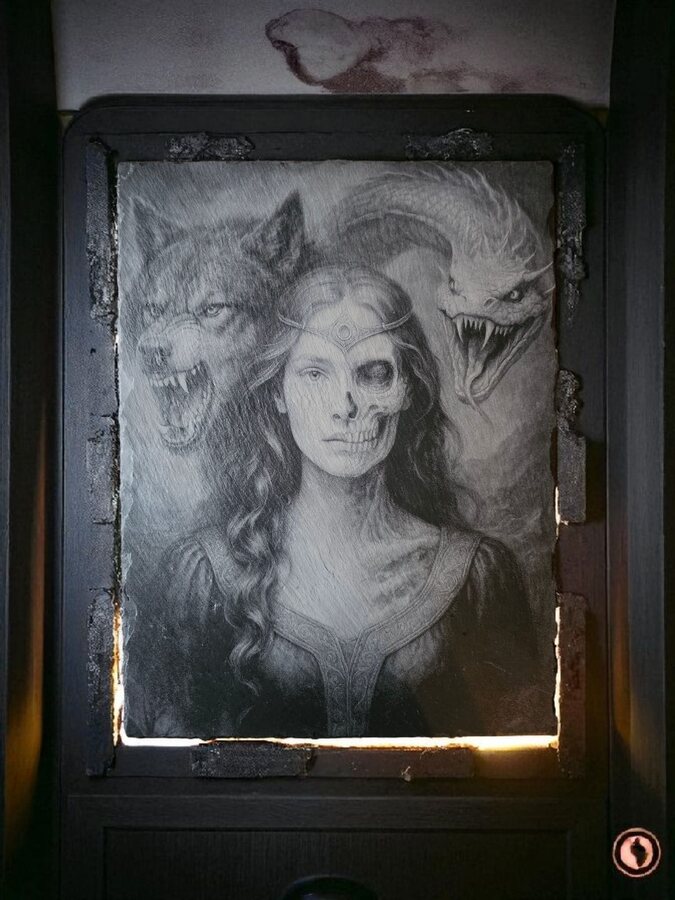
Before anything happens, there is crowing. Three times, in three places.
The Völuspá names them in turn: Fjalarr, the cock in the gallows-wood, wakes the giants. Gullinkambi, Goldencomb, wakes the einherjar in Valhöll. And a third, sooty red, crows below in Hel's halls. Three worlds, three wake-up calls, in a single run of stanzas.
Then Heimdallr lifts the Gjallarhorn. The name belongs to gjalla, "to resound, to shriek" – the same element as in Gjöll, the river of the dead. Snorri says the horn stands beneath the root at Mímir's well, and that Mímir drinks from it each morning. Odin gave an eye for one draught of that well.
The seeress says the sound carries across all worlds. It is the signal after which nothing can be taken back.
With it comes the shuddering of Yggdrasill. The old ash groans; the tree that until now has only stood and suffered begins to move. And the hound Garmr bays before Gnipahellir – the refrain that returns again and again in the Völuspá and paces the poem like a drumbeat.
And then a ship works loose.
Naglfar is its name, and it is the greatest of all ships. The Völuspá says only that it floats free; Snorri explains what it is made of: the nails of dead men. And he draws a thoroughly practical conclusion. Anyone who dies with untrimmed nails supplies building material. Therefore, says Snorri, a corpse's nails should be cut – whoever neglects it hastens the end of the world.
It is one of the few places where a myth turns straight into an instruction. And it sounds very much like a real custom.
Except that it is disputed whether the nails in the name are fingernails at all. Old Norse nagl means fingernail; nagli means iron nail, rivet. A ship of rivets would simply be a riveted ship – and that is exactly how Viking ships were built, with thousands of iron rivets through clinker-laid planking.
Some scholars therefore treat the fingernail reading as a folk etymology that Snorri either found or formulated. Others point out that beliefs about the nails and hair of the dead are widespread, and that the custom may be older than the text.
Who steers her? Here too the sources part. The Völuspá puts the giant Hrymr at the helm; Snorri puts Loki there. Both stand in black and white, each in its own source.
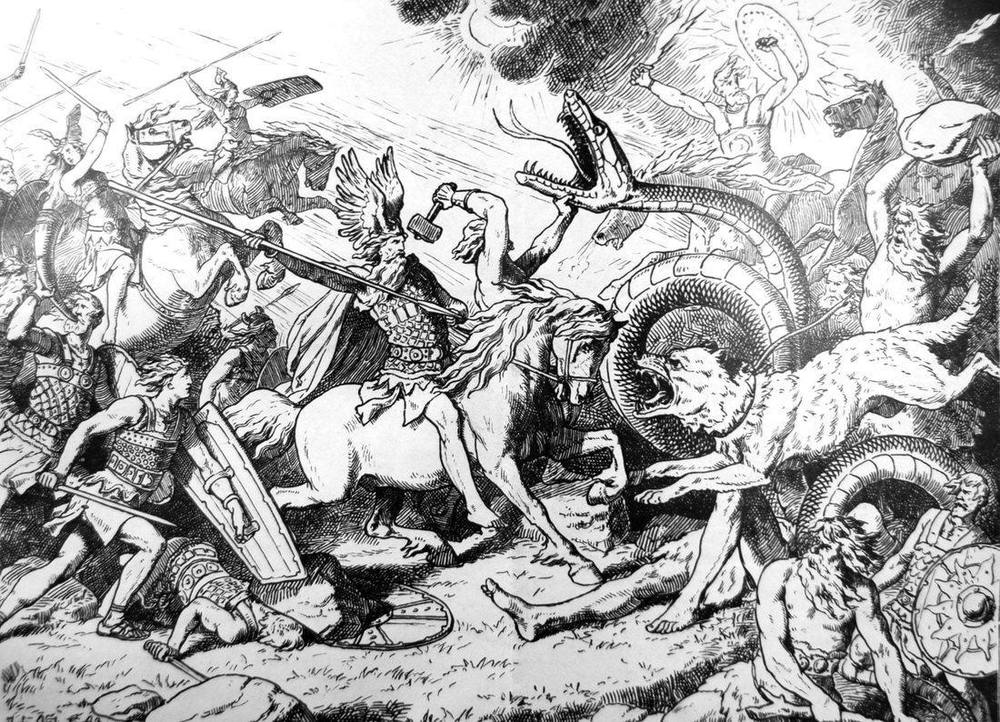
The battle is not a melee. It is a sequence of single combats, and almost every one of them is set up long in advance.
Odin against Fenrir. The wolf swallows him. With that, the binding comes undone that began in Týr's story – the gods tied the wolf down, but never removed him. Víðarr, Odin's silent son, avenges him: he sets his foot in the wolf's jaw and tears it open. Snorri even explains where the shoe comes from – from every scrap of leather people throw away when trimming their shoes.
Thor against the Midgard Serpent. He kills her and walks nine paces before her venom brings him down. That too has a prehistory: Thor once had her on his line, and Hymir cut the cord.
Freyr against Surtr. Freyr falls, and the Skírnismál say why: he gave away his sword to win Gerðr. A love story whose price comes due at the end of the world.
Heimdallr against Loki. They kill each other. The two had clashed before, in a tale about Freyja's necklace of which only fragments survive.
Týr against Garmr – so Snorri. The Völuspá names Garmr but no opponent. Whether Týr faces the hound or the wolf he once fed is one of those places where Snorri tidies up what the older source leaves silent.
On the field of Vígríðr, a hundred leagues in every direction, the armies meet: the Æsir and the fallen Einherjar from Valhalla against giants, monsters and the sons of Muspell. The fights have been fated since the beginning – each god has his foe, and most of them fall:
Odin rides in a golden helm against Fenrir – and is swallowed by the wolf. But his silent son Vidar avenges him at once: he sets his foot in the wolf’s lower jaw and tears its maw apart. Thor slays the Midgard Serpent with his hammer – walks nine steps back and falls dead, poisoned by its venom. Freyr, who once gave away his sword for love of the giantess Gerd, stands weaponless before the fire giant Surt and falls. Tyr, the one-handed god of law, and the hound Garm kill each other. Heimdall and Loki, watchman and adversary, deal each other death. It is an end without victors.
At last Surt flings fire over the whole world. All burns; the stars fall; the earth sinks into the sea.
“The sun turns black, earth sinks in the sea, / the hot stars down from heaven are whirled; / fierce grows the steam and the life-feeding flame, / till fire leaps high about heaven itself.”Völuspá 57, translation after Henry Adams Bellows (public domain)
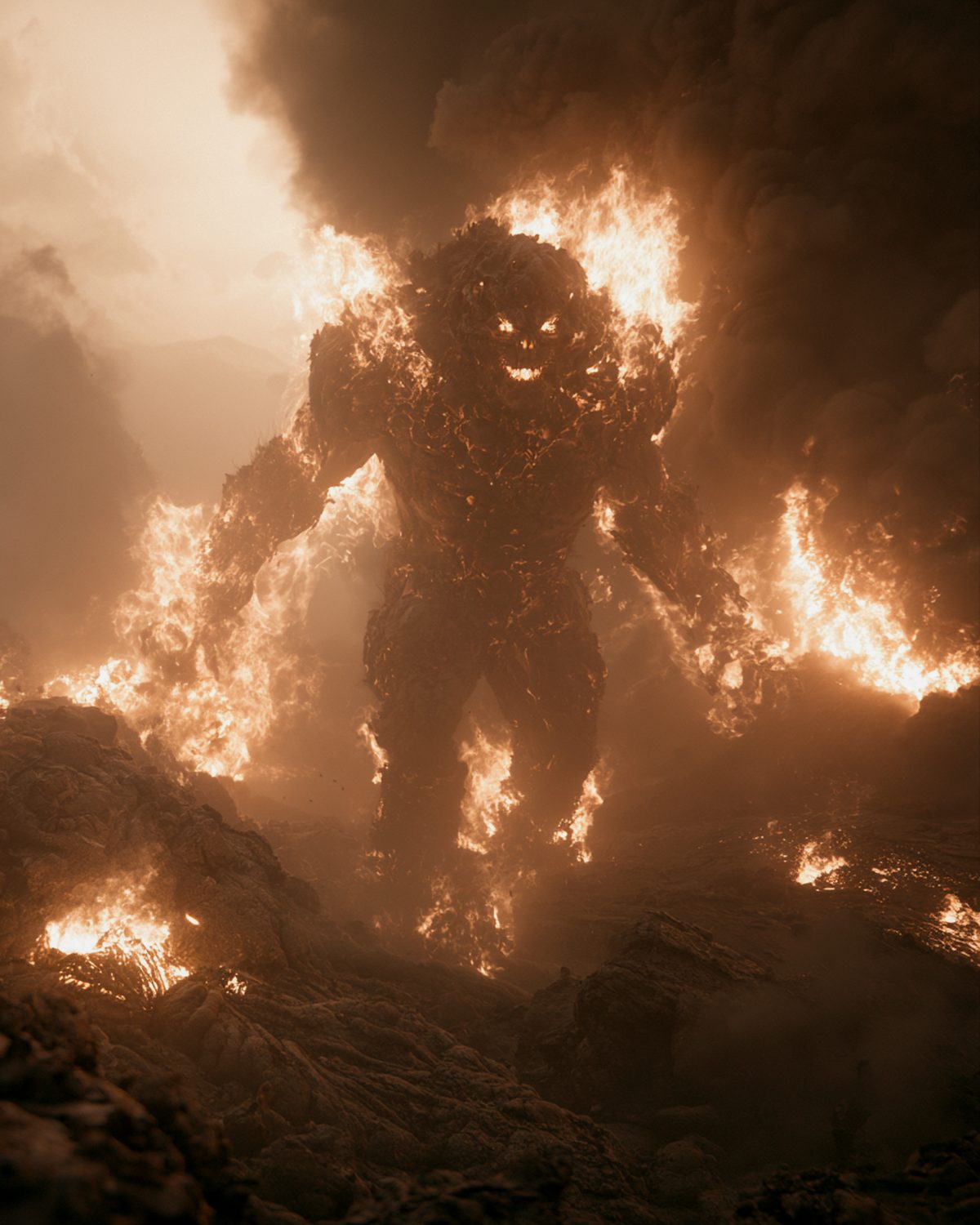
The end is not one. That is the point at which the Norse account parts company with almost everything else that goes by the name of apocalypse.
Víðarr and Váli live, Odin's sons. Móði and Magni, Thor's sons, take up Mjöllnir – the hammer goes on. Baldr and his brother Höðr come back from Hel, the killed and the killer together. Hœnir is there, choosing the lots.
And then comes an image you do not forget. The seeress says: in the grass they will find again the golden gaming pieces they owned in the first days.
No throne, no victory, no new order. A board game lying in the grass. The gods of the old time had it, it was lost, and the survivors find it again. Anyone who has ever found something after a move or a fire knows that gesture.
People remain too. Líf and Lífþrasir have hidden in Hoddmímis holt and lived on the morning dew; from them the new generations come. And the daughter of the sun keeps to her mother's road.
The earth rises green out of the water, eagles fly, fish are caught. Unsown fields bear. The world goes on, with a different cast.
The strongest argument against the suspicion that Ragnarök is a late, Christianised construction is not in any manuscript. It is on stone.
The Gosforth Cross in Cumbria, north-west England, was made around 930 to 950 – roughly three centuries before the Codex Regius. It is a Christian stone cross, and along its shaft stand scenes long read as Ragnarök: a bound figure with a woman above him, read as Loki and Sigyn; a rider driving a spear into the jaws of a monster, read as Víðarr.
Thorwald's Cross at Kirk Andreas on the Isle of Man, about 940, shows a man with a spear and a raven, his foot in the mouth of a great beast – Odin and Fenrir. On the reverse stands a Christian scene. Both on the same stone.
The Ledberg stone in Östergötland and the Tullstorp stone in Scania carry comparable motifs; the Altuna stone in Uppland shows Thor's fishing trip with the serpent.
What this does and does not establish: these pictures show that the motifs were current in the Norse world in the tenth century – before Snorri, before the manuscripts, partly in an already Christian setting. They do not show that the story ran exactly as the Völuspá tells it. A picture without a text cannot be read against one.
The Völuspá does not end in darkness. From the sea a new, green earth rises up; some gods return, a human couple has survived within the world tree, and a new sun – the daughter of the old – shines. In the North, Ragnarök is no mere end but a cycle: downfall and rebirth. We devote a separate piece to this hopeful outcome: ‘What comes after Ragnarök – end or new beginning?’.
This question has followed the Völuspá for over a century, and it is not settled. We set out both sides without declaring either one the truth.
For Christian influence: the poem was written down in an Iceland that had been Christian for some two hundred years, by Christian scribes. Individual features have counterparts in the Book of Revelation: a world fire, stars falling from the sky, a place of punishment for perjurers and murderers, a renewed earth, and a mighty one who comes at the end and judges all – Völuspá 65, a stanza found only in the Hauksbók. The Old High German Muspilli of the ninth century, a Christian poem about the world's end, shares with the Edda the word Muspilli/Múspell, whose origin is unexplained.
Against it: the pictures on the tenth-century stone crosses show the motifs before anyone wrote them down. The architecture of the story – combats in pairs, oath-breaking as the trigger, a recurring refrain from the seeress – follows no Christian model. And central elements such as the Fimbulwinter, the swallowed sun or the surviving sons have no counterpart in the Apocalypse.
The common position today lies between the two: a heathen core, written down in Christian times and coloured in places. Which stanza belongs to which layer cannot be cleanly separated.
"All the gods die." No. Odin, Thor, Freyr, Heimdallr and Loki fall. Víðarr, Váli, Móði and Magni survive, Baldr and Höðr return, Hœnir is there. The idea of a total end of the divine world is a shortcut that simply cuts away the close of the Völuspá.
"Ragnarök is the Norse Last Judgement." Nobody is judged. There is no testing, no separation of the good from the wicked, no reward. There is a doom that arrives because oaths were broken and because it is so fated. The Norns stand closer to this logic than any court.
"Ragnarök happened on 22 February 2014." That was a marketing campaign. The Jorvik Viking Centre in York announced the date in 2013 to promote its festival – a well-made stunt, passed on by news sites worldwide as a supposed Viking prophecy. No source gives a date for Ragnarök. Not one.
What comes after Ragnarök? · The Norse pantheon · Loki · Tyr & Fenrir · Thor · Heimdall · Yggdrasil · Ginnungagap · Ymir & the making of the world.
Poetic Edda (Codex Regius): Völuspá (st. 42–66), Vafþrúðnismál. Snorri Sturluson, Prose Edda / Gylfaginning (ch. 51), c. 1220. English public-domain translation: Henry Adams Bellows, The Poetic Edda (1923). Archaeology: Gosforth Cross (St Mary’s, Cumbria, 10th c.); Thorwald Cross, Kirk Andreas (Isle of Man). Scholarship: Bo Gräslund & Neil Price, ‘Twilight of the gods? The “dust veil event” of AD 536 in critical perspective’, Antiquity 86 (2012), 428–443; Clive Oppenheimer et al., ‘The Eldgjá eruption …’, Climatic Change 147 (2018); Rudolf Simek, Dictionary of Northern Mythology; John Lindow, Norse Mythology (2001). Evidence and interpretation are kept apart.
Ragnar Lodbrok, so the saga goes, died in a pit of snakes – laughing, we are told, and with a threat on his lips. His …
Read more →A dwarf's curse, a re-forged sword and a thrust from below: how young Sigurd slew the gold-greedy dragon Fafnir …
Read more →It is the most famous smithing scene of the North: two dwarf brothers, a wager on Loki’s head, and a fly that stings at …
Read more →Some heroes set out with a sword. Svipdagr sets out with the protective charms of his dead mother – and with a task he …
Read more →Ragnarök is the prophesied doom of the gods: the Fimbulwinter, the freed Fenrir, the death-ship Naglfar and the final battle on the field Vígríðr.
Odin falls to Fenrir, Thor to the Midgard Serpent, Freyr to Surtr, Tyr to Garm and Heimdall to Loki – most die paired with their opponent.
The world rises anew and green from the sea. The humans Líf and Lífþrasir survive, Baldr returns, and a younger generation of gods remains.
