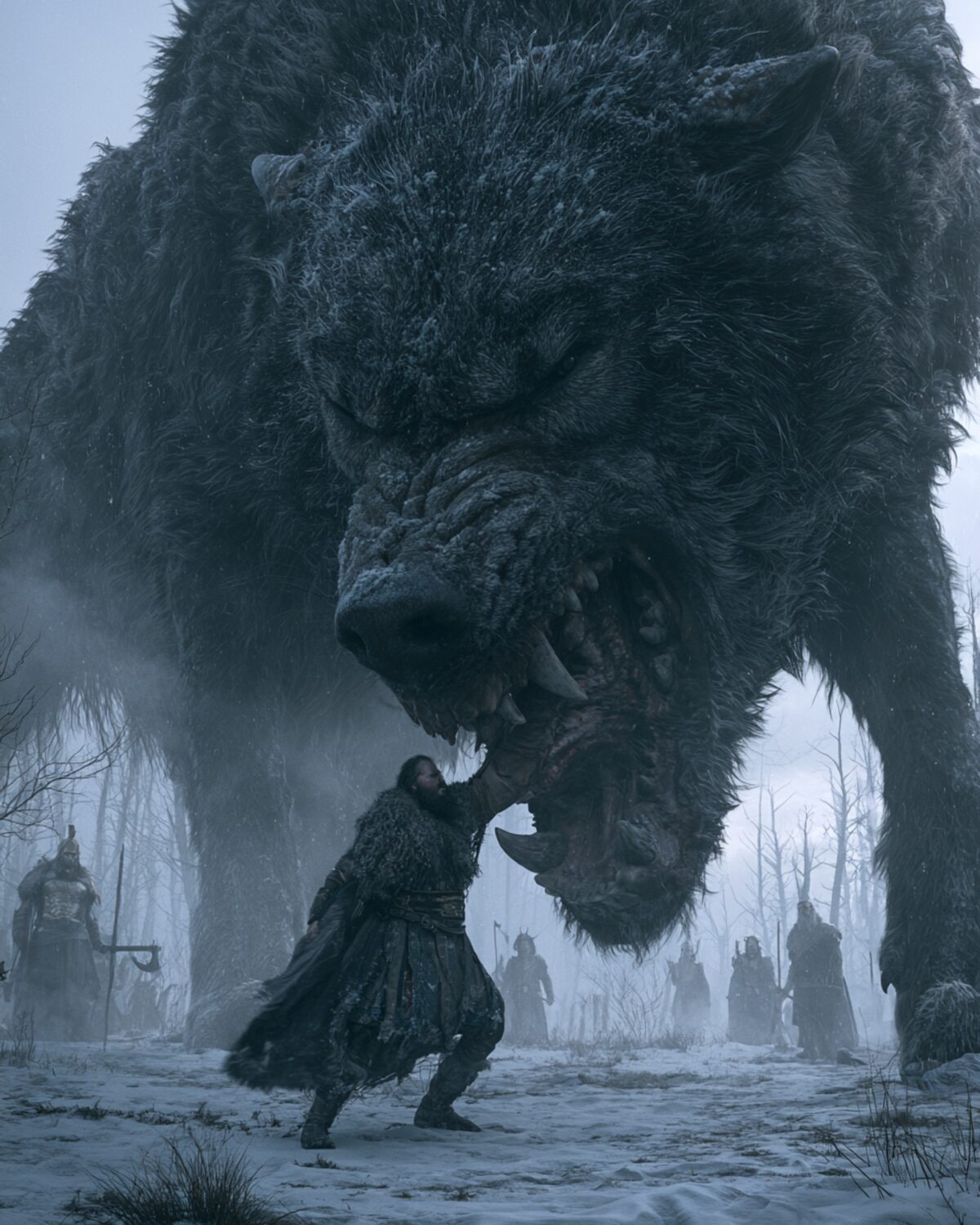
Tyr (Old Norse Týr, Proto-Germanic *Tīwaz) is the one-handed god of Norse mythology who placed his right hand in the jaws of the wolf Fenrir as a pledge, so that the gods could bind the beast. His name is a distant cousin of Zeus and Jupiter, it lives on in Tuesday, and the Romans equated him with Mars. In the Eddas he has barely any stories left – which is exactly why it pays to look closely: at Roman altars on Hadrian's Wall, rune poems, place names and two poems that disagree about who his father was.
Picture a hall full of gods. In front of them lies a wolf that has grown far bigger than anyone is comfortable with, and next to it a ribbon as thin as silk. The wolf names one condition. Everyone suddenly finds the floor fascinating. Everyone but one.
That is the scene everyone knows Tyr for. But it is only the last chapter of a much longer story. His name is older than Odin's, older than Thor's, older than any runic inscription – and it has been hiding in a word you use every single week.
In Old Norse he is Týr, in Old English Tīw, in Old High German Ziu. All three go back to Proto-Germanic *Tīwaz (the asterisk marks a reconstructed form that is not directly attested). And *Tīwaz in turn belongs to the Indo-European word family around *dyeu-, “sky, bright day”, and *deiwos, “heavenly, divine”.
The same family produced Greek Zeus, Vedic Dyaus, Latin Jupiter (from a phrase meaning “sky father”) and Latin deus, “god”. So Tyr is not related to these gods because someone borrowed a myth. The names are siblings, descended from one shared word several thousand years ago. We look at that older figure in our article on Tiwaz.
Old Norse never quite forgot the original meaning. In poetry the plural tívar simply means “the gods”. And -týr appears as the second element of other gods' bynames: Hangatýr, “god of the hanged”, and Sigtýr, “god of victory”, are names of Odin. Call Odin Hangatýr and you are using Tyr's name as the plain word for “god”.
The Goths knew it too. Their fourth-century alphabet survives in a later manuscript with letter names, and the name given there for T is tyz – one of the earliest written traces of the name anywhere.
In the Roman week the second day belonged to Mars: dies Martis. When Germanic peoples adopted the seven-day week, they swapped Mars for their own god. The result was Old English Tīwesdæg, today's Tuesday, Old Norse Týsdagr, Swedish tisdag, Danish and Norwegian tirsdag, West Frisian tiisdei. French kept Mars himself: mardi.
German hides him better. Alemannic dialects in the south-west and in Switzerland still say Zischtig, a descendant of Old High German Ziestag – Ziu's day. Bavarian went its own way: Ertag or Erchtag is usually traced back to the Greek war god Ares.
And standard German Dienstag? It came in from Low German and Dutch (dingesdach, dinsdag). The usual explanation links it to the epithet Thingsus – the god of the thing, the assembly. Well argued, though not undisputed. The whole week and its gods are laid out in our article on Germanic weekdays.
The earliest evidence of Tyr's worship does not carry his name but a Roman one. Roman writers translated foreign gods into their own – the so-called interpretatio Romana. Which god hides behind the Latin name has to be worked out.
Around AD 98 Tacitus writes in the Germania (ch. 9) that the Germans worship Mercury above all and even offer him human sacrifice on certain days, while Hercules and Mars are appeased with animal offerings. Scholars have long seen Tiwaz behind this Mars, and the weekday names make the equation very likely.
Two more passages show how much this Mars mattered. In the Annals (13.57) the Hermunduri, at war with the Chatti in AD 58, dedicate the enemy army in advance to Mars and Mercury. In the Histories (4.64) the Tencteri give thanks to their common gods and “above all to Mars”, the chief of the gods.
Then there is Germania 39: the Semnones enter their sacred grove only when bound with a fetter and worship there a “ruler of all” (regnator omnium deus). Some scholars have seen Tiwaz in him – a god approached in fetters, a god who has the wolf fettered. That is an interpretation. Tacitus gives no name.
The best evidence is carved in stone and comes from an unexpected corner: the Roman fort of Vercovicium, today Housesteads, on Hadrian's Wall in northern England. In 1883 two altars turned up at the foot of the north slope of Chapel Hill. Both are now in the museum at Chesters.
One of them (RIB 1593) is dedicated to Deus Mars Thincsus and two female deities, the Alaisiagae, named Beda and Fimmilena. The other (RIB 1594) is dedicated to Mars and the two Alaisiagae and can be dated: the unit carries the honorific title of Emperor Severus Alexander, so AD 222–235. A carved lintel found with them shows Mars with sword, shield and spear.
Who set them up? Here we have to correct the earlier version of this article. They were not simply “Frisian soldiers” but Germanic tribesmen of the Tuihanti – people from Twente in today's Dutch province of Overijssel – serving in a Frisian unit, the cuneus Frisiorum. Men from the lowlands between the IJssel and the Ems, honouring their own god in Latin letters at the edge of the empire.
The epithet Thincsus is usually read as *Þingsaz, “belonging to the thing”. We cover the inscription in detail under Mars Thingsus.
From Thincsus and from Tuesday, many scholars built a picture: Tyr as the patron of the thing, the legal assembly where disputes were settled, verdicts given and oaths sworn. Georges Dumézil went further and saw Odin as the magical, unpredictable side of sovereignty and Tyr as its legal, contractual side – on the model of the Vedic pair Varuna and Mitra.
It is an elegant theory, and it remains a theory. No Old Norse text calls Tyr the “god of law”. Snorri even says, in his own way, the opposite: Tyr is not called a reconciler of men. And in Lokasenna, Loki taunts him that he could never settle anything between two parties.
War and law were not opposites in these societies, though. Both were ways to end a dispute – one with words before witnesses, the other with weapons. A god who grants victory and watches over oaths is less strange than he looks to us.
The great story is told by Snorri Sturluson around 1220 in Gylfaginning, the first part of his Prose Edda. Only he tells it at this length – a Christian scholar arranging old poetry into a system.
Fenrir, one of Loki's children by the giantess Angrboða, was raised among the gods. Only Tyr dared to go to him and give him meat. The wolf grew every day, and the prophecies spoke of disaster.
He snapped the chains Læðingr and Drómi without effort. So Odin had the dwarves make a third fetter: Gleipnir, smooth and soft as a silk ribbon, made from the sound of a cat's footfall, the beard of a woman, the roots of a mountain, the sinews of a bear, the breath of a fish and the spittle of a bird.
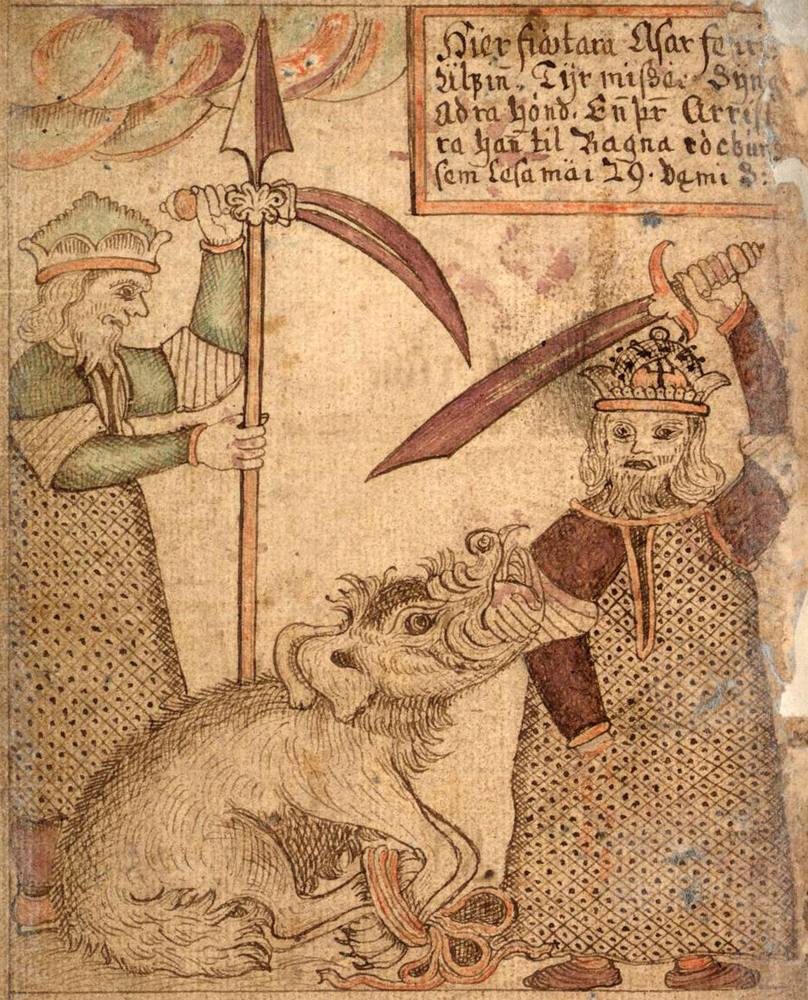
On the island of Lyngvi in the lake Ámsvartnir the gods offered the wolf the ribbon. Fenrir smelled a trick: a band this flimsy was either no honour to break or made with cunning. He agreed only if one of the gods laid a hand in his mouth as a pledge of good faith.
Snorri describes how each god looked at the next and none wanted to give up his hand – until Tyr stretched out his right. The harder Fenrir strained, the tighter the band held. Then everyone laughed, Snorri says, except Tyr. He lost his hand.
A sword wedged between the wolf's jaws keeps them propped open, and his slaver runs off as the river Ván – until the end of the world.
Read it as a contract for a moment.
Tyr gives a pledge. He stands surety with his own body that the gods' promise is honest – and the promise is a lie. The god later associated with oaths and order knowingly vouches for a deception, and pays at the same instant with the hand you swear with, shake on a deal with, seal a bargain with.
Snorri even attaches a little etymology: the place where the hand was bitten off is called úlfliðr, “wolf-joint”, ever since – the Old Norse word for the wrist. Whether that was popular wordplay or Snorri's own learning, we cannot tell.
It is not a comfortable story. The gods cheat because the alternative is ruin, and it costs them. If you want spotless heroes, Norse myth will disappoint you. If you want characters who carry guilt and act anyway, you are in the right place.
In Lokasenna, a poem of the Poetic Edda, Loki insults one god after another at the sea giant Ægir's feast. In stanza 37 Tyr stands up for Freyr. Immediately it is his turn.
“Be silent, Tyr! for between two men / Friendship thou ne'er couldst fashion;”Lokasenna 38, translated by Henry Adams Bellows (1923)
Loki then reminds him of the right hand Fenrir tore away. The Old Norse line is ambiguous: Bellows and many modern translators read it as “never able to make peace between two”, while the German translator Karl Simrock took it as “no good at fighting two at once”. The first reading fits neatly with Snorri's remark that Tyr is no reconciler.
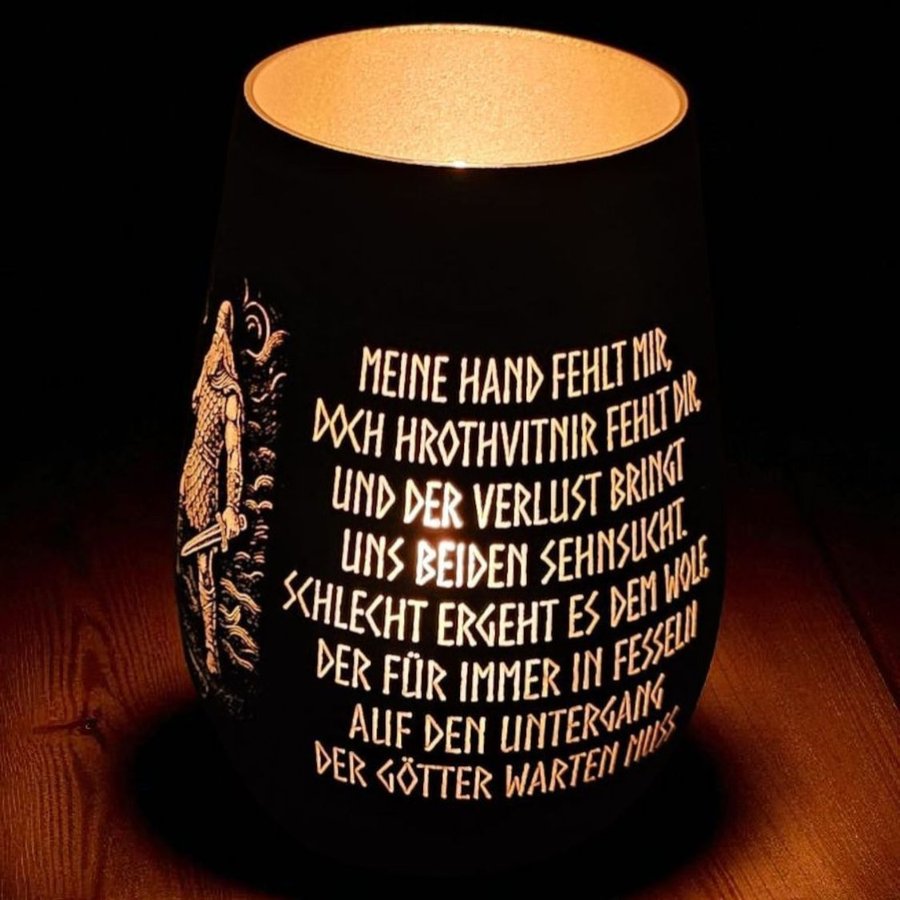
Tyr's reply in stanza 39 is dry: he lacks a hand, Loki lacks his wolf, and the loss pains them both – while the wolf waits in fetters for the doom of the gods. In stanza 40 Loki twists the knife: Tyr's wife had a son by him, and Tyr never got compensation for the wrong. This is the only passage in the sources that mentions a wife of Tyr at all. She has no name.
Here the sources openly contradict each other – and that is instructive.
In his handbook for poets, Skáldskaparmál, Snorri makes Tyr a son of Odin and lists the poetic circumlocutions for him: “the one-handed god”, “the wolf's foster-father”, “god of battles”, “son of Odin”. That fits his system, in which Odin fathers nearly everyone.
The Hymiskviða, a poem of the Poetic Edda, tells it differently. In stanza 5 Tyr explains that his father owns a huge cauldron – “a kettle my father fierce doth own”, in Bellows' version – and that father is the giant Hymir, who lives east of the Élivágar at the edge of heaven. In stanza 8 Tyr meets his nine-hundred-headed grandmother and his mother, who brings the guests beer dressed in gold. In stanza 11 Hymir is told that his son has come to his hall.
The philologist Finnur Jónsson wanted to emend “father” to “grandfather” to make the problem go away. Few were convinced. It is more honest to let the contradiction stand: there was never a canonical version of Norse mythology.
The Hymiskviða is also Tyr's second and last story, and it is all about beer. Ægir is to host a feast for the gods but has no cauldron big enough. Tyr knows where to find one, so he and Thor set off for Hymir's hall.
What follows is rough stuff: Thor eats two of the giant's oxen in one go, fishes up the Midgard Serpent with an ox head as bait, and shatters Hymir's unbreakable cup against the giant's own skull.
Then the cauldron. In stanza 34 Tyr tries twice to move it, and twice it stands fast. Thor flips it onto his head, its rings clattering at his heels, and walks off.
In his own family story Tyr is reduced to giving cues: he knows the way, someone else does the lifting. Snorri tells the fishing trip too (Gylfaginning 48) – without Tyr.
At the end of the world Tyr does not face Fenrir; the wolf is reserved for Odin. Tyr's opponent is Garm, the hound chained before the cave Gnipahellir. According to Snorri (Gylfaginning 51) he breaks loose, fights Tyr, and each becomes the other's death.
It is a powerful image: the god who helped fetter the wolf dies fighting another fettered beast. But careful. The Völuspá, the poem Snorri relies on most for Ragnarök, does not mention Tyr in the final battle at all. There Garm bays before Gnipahellir, the fetter breaks, the wolf runs free – and because the refrain reads that way, some scholars have suggested that Garm and Fenrir were originally one and the same animal. Either way, the duel of Tyr and Garm is Snorri's version.
Tyr is one of very few gods whose name is attached to a rune: ᛏ, the sound t, reconstructed as *tīwaz in the Elder Futhark and called Týr in the Younger Futhark. It looks like an arrow pointing upwards.
And for this rune we have actual instructions from the poetry. In Sigrdrífumál the valkyrie Sigrdrífa teaches the hero Sigurd rune-lore, beginning with the victory runes:
“Winning-runes learn, if thou longest to win, / And the runes on thy sword-hilt write; / Some on the furrow, and some on the flat, / And twice shalt thou call on Tyr.”Sigrdrífumál 6, translated by Henry Adams Bellows (1923)
Whether “Tyr” means the god you invoke or the t-rune you cut twice is debated among runologists. Probably both, since the rune carries the god's name. What is rare is a text this specific about sign, place and name.
The medieval rune poems confirm the link. The Norwegian one says Týr er æinendr ása – Tyr is the one-handed among the Æsir. The Icelandic poem calls him “leavings of the wolf” and “prince of temples” and glosses him in Latin as Mars. The Old English rune poem, by contrast, calls the sign Tir and describes it as a token that keeps faith and never strays from its course through the night. Many read that as a guiding star, perhaps the Pole Star. No god is named there.
And the finds? The ground gives no confessions, but it does give patterns. On the Kylver stone from Gotland, a grave slab of around 400, the complete futhark is followed by a fir-tree-like sign usually read as eight stacked t-runes. On the Lindholm amulet from Scania, an inscribed piece of bone, a run of repeated signs includes three t's in a row, followed by the well-known formula word alu. And the Danish gold bracteate Seeland-II-C (around 500) ends its inscription with three stacked t-runes.
Such repetitions are often explained as intensification, as an invocation of Tyr or as a victory sign. What is certain is only that the t-rune turns up stacked or repeated remarkably often in these contexts. You will often read that it was routinely cut into swords and spears. Clear early examples are scarce; we show what actually appears on old blades in runes on weapons.
Is there an image of Tyr? Possibly. A Migration Period gold bracteate from Trollhättan in western Sweden shows a figure whose hand is seized by an animal. The obvious reading: Tyr and Fenrir. Bracteates are thin stamped gold pendants – without captions.
A later candidate comes from England: a stirrup-strap mount found near Dereham in Norfolk, probably tenth century and recorded with the Portable Antiquities Scheme (NMS-DAF1F7), which Norfolk's heritage service interprets as the moment the wolf bites off Tyr's hand.
Place names show whether a god was worshipped or merely sung about. With Tyr there is a trap: because tý- can also just mean “god”, it is often impossible to tell whether a name means “Tyr's place” or “the gods' place”.
The best-known case is Tissø on Zealand, on whose shore archaeologists excavated a large Viking Age magnate's estate with a cult enclosure. The University of Copenhagen's name research unit offers three readings: “Tyr's lake”, “the god's lake” or “the gods' lake”. The second element may even originally have meant “island”. More in our article Tissø – the lake of the god Týr.
Further candidates: Tyrseng near Viby in Jutland, “Tyr's meadow”; Tisvilde and Tirslund in Denmark; Tysnes in western Norway; in Sweden Tiveden, though its reading as “Tyr's forest” is uncertain. In England, Tysoe in Warwickshire and Tuesley in Surrey are linked with Tīw. In every case: interpretation yes, proof no.
Which leaves the question that nags everyone who spends time with Tyr: if his name once meant “god” itself and is related to Zeus, why does he play such a minor part in the Eddas?
The classic answer is that Tyr was a displaced sky god. In the earliest times *Tīwaz supposedly stood at the top, before Woden/Odin pushed him aside and took over his rank and titles. What remained was a specialist in victory, oaths and courage. We follow the continental names in Wodan, Donar and Ziu.
There is a fair amount in its favour: the etymology, the plural tívar, Tacitus' high-ranking Mars, the altars. Against it stands the state of the sources. There is not one text from the time when Tyr supposedly ruled. A cognate name does not automatically make a father of the gods. And Snorri wrote more than two centuries after Iceland became Christian.
Snorri preserves two sayings that reveal more about the values behind the figure than any retelling. Someone who surpasses everyone else and never flinches is called týhraustr, “Tyr-brave”. Someone especially wise is týspakr, “Tyr-wise”. And Tyr himself, Snorri writes, has great power over victory in battle; brave men do well to call on him.
That is the core of the figure: Tyr is not brave because he feels no fear, but because he knows exactly what putting his hand in that mouth will cost him – and puts it there anyway.
The Tiwaz rune is one of our favourite motifs in the workshop: three lines that cut cleanly into slate, wood and glass. We engrave it as what it is – a letter with a long history, not a charm with a guarantee. It works best with a story attached: ᛏ on a slate plaque with a name in runes, for someone who stood up for others, or as a sign of a promise on a wedding piece (a modern idea, not a Viking custom). Find your name in the Elder Futhark with our rune name generator, and bring your own designs to life through a custom engraving.
What is Tyr the god of? In the sources mainly courage and victory in battle; Snorri calls him the boldest of the Æsir. His popular role as a god of law and oaths is inferred from inscriptions like “Mars Thincsus” and from the story of his hand.
Why does Tyr have only one hand? He placed his right hand in Fenrir's mouth as a pledge so the wolf would let itself be bound with Gleipnir. When Fenrir realised he could not break free, he bit it off.
Is Tyr Odin's son? In Snorri's Edda, yes. In the Eddic poem Hymiskviða, however, his father is the giant Hymir. Both versions exist side by side; there was no official family tree.
Why is Tuesday named after Tyr? Germanic peoples replaced the Roman day of Mars with their own equivalent god, Tīw, giving Tuesday, Swedish tisdag and Swiss German Zischtig. German Dienstag probably derives from his epithet Thingsus.
What does the Tiwaz rune mean? It stands for the sound t and bears Tyr's name. In Sigrdrífumál it belongs to the victory runes, and the Norwegian rune poem calls Tyr the one-handed among the Æsir.
Who does Tyr fight at Ragnarök? According to Snorri, the hound Garm, and the two kill each other. The Völuspá does not name Tyr in the final battle.
For courage. For remembrance. For legends that live on.
Fenrir · Odin · Ragnarök · The Norse pantheon.
All Gods & Goddesses articles →
He is one of the best-known “unknown” gods: everyone who studies the mythology knows his name – and yet Ullr scarcely …
Read more →Odin is the god who pays any price for knowledge – his eye, death on the tree, and nearly his head. In Vafþrúðnismál he …
Read more →Think of Norse gods and you think of the Aesir: Odin, Thor, Tyr. But the sources know a second divine family – the …
Read more →In Germanic thought vengeance was no blemish but a duty – and the North gave it two gods. Víðarr, the silent god who at …
Read more →