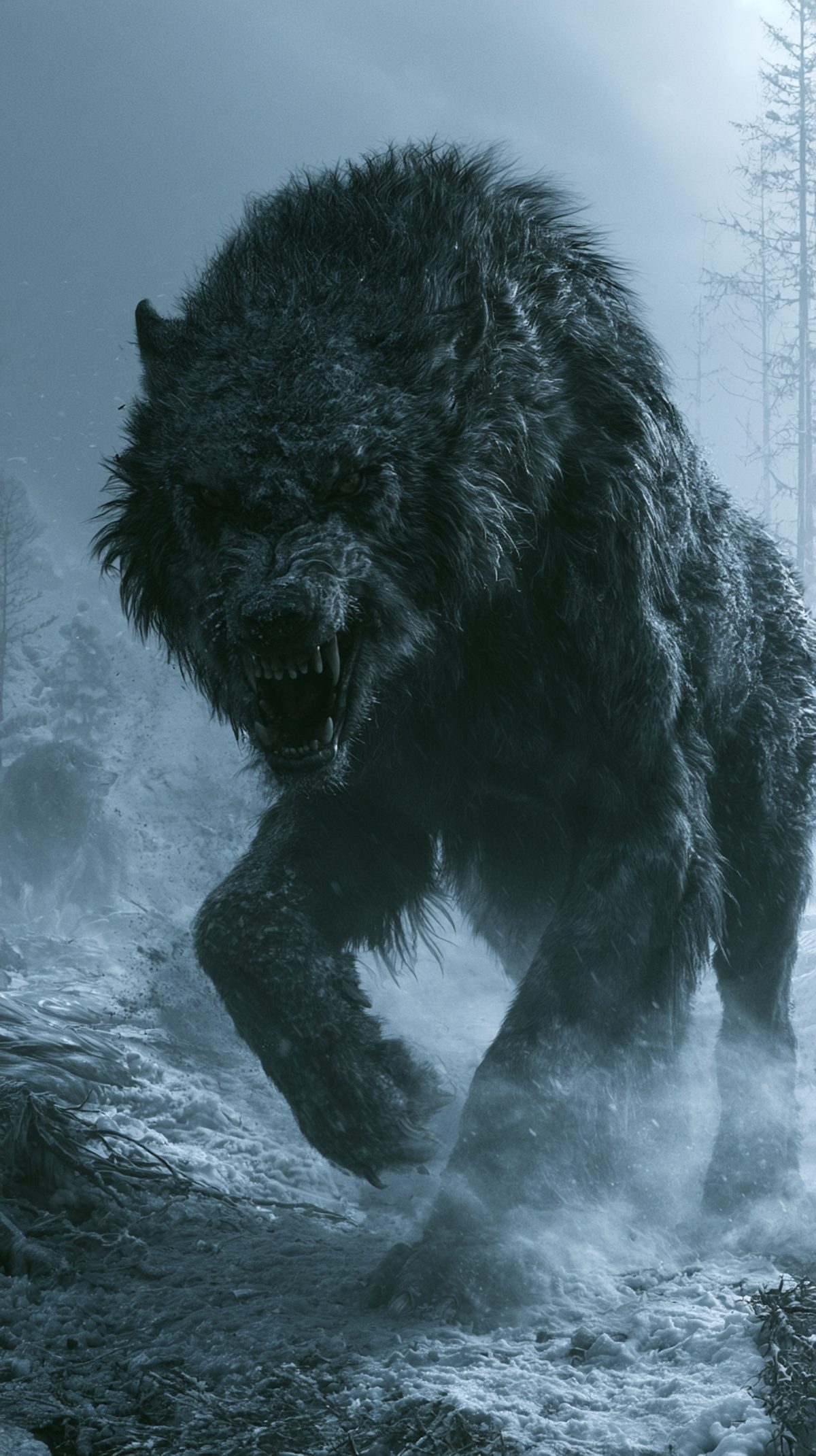
Fenrir (also Fenrisúlfr, the "Fenris wolf") is the monstrous wolf of Norse mythology: a son of Loki and the giantess Angrboða, raised by the gods, bound by a trick and fated to swallow Odin at Ragnarök. He costs Tyr his hand, he is named as the sire of the wolves that hunt sun and moon, and he dies only at the hands of Odin's son Víðarr. Here is what the Eddas actually say about him, where Viking Age carvers put him in stone, and what he means.
Imagine raising an animal you know will one day kill you. You don't even feed it yourself, because you're afraid to. You watch it grow, day after day. And when you finally tie it down, you do it with a lie. That is the story of Fenrir – and it is so dark precisely because nobody in it stays innocent.
A word on sources first, so you can weigh what follows. Almost everything we know about Fenrir comes from two thirteenth-century Icelandic works. The Poetic Edda survives mainly in the Codex Regius, written around 1270; many of its poems are older, though how much older is debated. The Prose Edda of Snorri Sturluson (c. 1220–1225) is a handbook for poets that retells the myths, arranges them and sometimes smooths them over. On top of that we have a few skaldic verses from the tenth century and a handful of Viking Age carvings. We keep these layers apart.
The wolf goes by several names, and each tells part of his story. Fenrir is the basic form. Its origin is not entirely settled. It is often linked to Old Norse fen, "marsh, bog", which would make Fenrir something like "the fen-dweller". That is a plausible reading, not a proven one. Tellingly, skaldic poets could use fenrir simply as a word for "wolf" – the name had become so famous that it turned into a common noun.
Fenrisúlfr literally means "Fenrir's wolf" or "the Fenrir wolf", which gives us the English "Fenris wolf". Snorri uses it constantly, and it already appears in a tenth-century skaldic poem, as we'll see.
Hróðvitnir can be read as "fame-wolf"; vitnir is a poetic word for wolf. In the Lokasenna he is called Hróðrsvitnir, and in Grímnismál the moon-chaser Hati is called "Hróðvitnisson", son of Hróðvitnir – which is why Fenrir is usually taken to be that wolf's father.
Vánagandr (also Vánargandr) means "monster of the Ván". The Ván is the river that, according to Snorri, flows from the slaver of the bound wolf.
Fenrir is one of three children that Loki fathers with the giantess Angrboða, whose name means roughly "she who brings grief". His siblings are the Midgard Serpent Jörmungandr and Hel, ruler of the dead. The family tie is already attested in the Poetic Edda: the so-called "Short Völuspá", preserved inside Hyndluljóð, says in effect that Loki got the wolf on Angrboða. Snorri turns this into a full narrative in Gylfaginning, the first major part of his Edda.
According to Snorri (Gylfaginning, ch. 34), the gods learn from prophecies that great harm will come from these siblings – bad on their mother's side, worse on their father's. Odin has the three children brought to him and deals them out. The serpent he throws into the sea, where it grows until it encircles the whole earth. Hel he sends to Niflheim and gives her power over the dead. Only the wolf stays with the Æsir. Why him? Snorri doesn't say. The folklorist John Lindow has wondered whether Odin's close bond with wolves played a part, or whether Loki's status as Odin's blood-brother made it impossible simply to dispose of his son. Both remain speculation.
So the wolf grows up among the gods, "at home", as Snorri puts it. And here comes the most famous detail: only Tyr has the courage to go near him and give him food. In Snorri, Tyr is the boldest of the Æsir, the god who grants victory in battle – and, on the usual reading, a god of law and oaths. The others keep their distance.
Fenrir grows by the day, and the prophecies say he will be the gods' ruin. So why not just kill him? Snorri's answer is striking: the gods held their sanctuaries and places of peace in such honour that they would not defile them with the wolf's blood. The peace of the holy place outweighs their own safety. Whether this is an old idea or Snorri's own explanation cannot be decided.
Snorri tells the binding at length; we only summarise it here, because the magical ribbon gets its own article: Gleipnir – the fetter made of six impossible things.
First the gods forge a strong iron chain called Lœðingr and invite the wolf to test his strength on it. Fenrir reckons he can manage, lets himself be bound, strains once – and the chain snaps. The second chain, Drómi, is twice as strong. The wolf has grown and smells glory. He shakes himself, dashes himself against the ground, and Drómi flies apart too. Hence, Snorri says, the saying "to get loose from Lœðingr, to dash out of Drómi" for pulling through a hard situation.
Now Odin sends Skírnir, the servant of the god Freyr, to the dwarves in Svartálfaheimr. They make Gleipnir from six things that no longer exist – among them the sound of a cat's footfall and the beard of a woman. The ribbon is as soft as silk. The gods row the wolf out to the island of Lyngvi in the lake Ámsvartnir and show it to him. Fenrir is suspicious: there is no fame in snapping such a thin band, and if it was made with craft and guile, he wants none of it on his legs.
Fenrir sets a condition. One of the gods must put a hand in his mouth as a pledge of good faith. The Æsir look at each other; nobody wants to. Then Tyr holds out his right hand and lays it between the wolf's teeth. The gods bind Fenrir. The more he struggles, the tighter the band grows. Everyone laughs – except Tyr. He loses his hand.
Snorri adds a dry remark: that is why Tyr is not called a reconciler of men. Whoever has once sealed a deal with a false pledge is no longer fit to make peace. That tension is the real heart of the scene. The god who stands for oath and law makes the saving deception possible by letting his pledge be forfeited. The French scholar Georges Dumézil therefore read Tyr as a "jurist god" who rescues the order of the world through a deliberately false pledge – an influential thesis, though not an uncontested one.
That the story is not Snorri's invention is shown by Lokasenna, the poem of Loki's insults at the feast of the sea-giant Ægir. In stanza 38 Loki mocks Tyr: he could never bring two people to agreement, and he should remember the right hand Fenrir tore from him. Tyr answers in stanza 39, here in our own rendering:
"I lack a hand, but you lack Hróðrsvitnir; / the loss is hard for both. / Nor does the wolf fare well: / in fetters he must wait for the doom of the gods."Lokasenna 39, our own translation
Tyr has lost his hand, Loki his son, and Fenrir lies bound. Nobody has won.
According to Snorri, the gods then anchor the fetter with a chain called Gelgja to the rocks Gjöll and Þviti, deep in the earth. When the wolf snaps at them, they ram a sword into his mouth: the hilt in his lower jaw, the point in his palate. From his slaver flows the river Ván, a name usually rendered "expectation" or "hope". There he lies, Snorri writes, until the doom of the gods.
Fenrir is not the only wolf in Norse cosmology. Two wolves hunt the heavenly bodies: Sköll chases the sun, Hati the moon. So says Grímnismál, stanza 39, where Hati is explicitly Hróðvitnir's son. There is more on both in our article on Sköll and Hati.
The Völuspá, the "Prophecy of the Seeress", widens the picture. In stanza 40 an old woman sits in the east in the Iron Wood (Járnviðr) and there gives birth to Fenris kindir – "Fenrir's brood" or "Fenrir's kin". One of them, in troll's shape, will become the robber of the heavenly light. Whether sun or moon is meant stays open; Old Norse tungl can denote either. Snorri picks this up in chapter 12 of Gylfaginning: a giantess in the Iron Wood bears giants in wolf shape, and the mightiest, Mánagarmr, the "Moon-hound", will be filled with the flesh of all who die.
Vafþrúðnismál, a contest of knowledge between Odin and the giant Vafþrúðnir, also knows the sun-eater. In stanza 46 Odin asks where a sun will come from to light the smooth sky once Fenrir has devoured this one. The giant replies in stanza 47: the sun will bear a daughter before Fenrir catches her, and after the gods have fallen the daughter will ride her mother's paths. Note that here it is Fenrir himself who takes the sun, not Sköll. The sources do not agree, and Andy Orchard has suggested that Fenrir, Sköll, Hati and the hound Garmr may originally have been names for a single wolf figure.
The refrain of Völuspá is one of the eeriest lines in the Edda. Several times (stanza 44 in Bellows' numbering) the seeress says, in substance: Garmr bays loudly before Gnipahellir, the fetter will break and the greedy one run free. The "greedy one", Old Norse freki, is usually taken to be Fenrir.
Then comes the moment everything has been heading for. Stanza 53 says that Odin goes out to fight the wolf, and that this is Frigg's second sorrow – the first being the death of her son Balder. Vafþrúðnismál is blunter. In stanza 53 the giant says, in our own rendering:
"The wolf will swallow the father of men; / Víðarr will avenge it: / he will cleave the cold jaws / of the wolf in battle."Vafþrúðnismál 53, our own translation
Snorri paints the scene on a grand scale in chapter 51 of Gylfaginning. The Fenris wolf advances with his mouth agape, his upper jaw touching the sky and his lower jaw the earth – and he would open it wider if there were room. Fire blazes from his eyes and nostrils. Odin rides against him with his spear, and the wolf swallows him. For the full course of the last battle, see our in-depth article on Ragnarök.
Straight after, Víðarr steps in, Odin's silent son. How he kills Fenrir is told three different ways, a fine example of how alive oral tradition was:
The shoe is one of the most endearing details in the whole Prose Edda – it turns every cobbler's offcut into a small contribution to the end of the world. Whether it is old or Snorri's own touch, we don't know. Remarkably, though, a stone cross from northern England, which we'll come to shortly, shows exactly this posture: foot in the lower jaw, hand on the upper.
Fenrir was well known long before Snorri wrote. Two memorial poems for dead kings from the tenth century, preserved in later manuscripts, prove it. In Eiríksmál, probably composed soon after Erik Bloodaxe's death in 954, Odin explains why he is taking the king to Valhalla: it can never be known when the grey wolf will fall upon the dwellings of the gods.
In Hákonarmál, composed around 961 by the skald Eyvindr skáldaspillir on the death of King Hákon the Good, the final stanza says in substance that the Fenris wolf will run unbound upon the homes of men before so good a king comes again. The name Fenrisúlfr stands there explicitly – some 250 years before Snorri. The wolf breaking free was already a Viking Age image for the end of all things.
The pictures are even more striking, because here we see what Viking Age people themselves had carved in stone. Interpretation remains interpretation, though – picture stones come without captions.
Thorwald's Cross, Isle of Man. In the church at Andreas in the north of the Isle of Man stands a damaged cross-slab, number 128 in the catalogue of Manx crosses. Its runic inscription survives only in part; what can be read says that a man called Þorvaldr raised the cross. The dating varies: the runic database Rundata puts it around 940, others prefer the eleventh century. One face shows a bearded figure with a spear pointing downwards, his foot in the jaws of a wolf, a large bird on his shoulder. Most scholars see Odin with one of his ravens, being devoured by Fenrir at Ragnarök. The other face shows a figure holding a cross and a book, with a fish and serpents – usually read as Christ's triumph over evil.
The Gosforth Cross, Cumbria. In the churchyard of St Mary's at Gosforth in north-west England stands a slender red sandstone cross, about 4.4 metres tall, usually dated to the first half of the tenth century and made in a region settled by Scandinavians. One scene shows a man with a spear facing a monstrous head, one foot in its lower jaw, one hand on its upper jaw. This matches Snorri's Víðarr scene so closely that the reading is widely accepted. The same cross shows the bound Loki with Sigyn, a figure with a horn usually identified as Heimdall, and a crucifixion. Whether the carver used the old myths as a parable for the Christian message is still debated.
The Ledberg stone, Östergötland. The runestone at Ledberg in Sweden (Ög 181) dates from the eleventh century. Bisi raised it for his father Þorgautr, and it ends with a puzzling charm read as þistill, mistill, kistill – "thistle, mistletoe, casket". The images show a ship and armed men. At the top of the second face a wolf bites a figure's foot; below lies a helmeted man without legs. The usual reading sees Odin's death by Fenrir. Other scholars read the images as the story of the dead man himself, with the wolf as an image of battle, as so often in skaldic verse.
Odin himself keeps two wolves, Geri and Freki, and feeds them from his table. In skaldic poetry the wolf is the beast of the battlefield; in kennings, the poets' figurative circumlocutions, "feeding the wolf" simply means killing enemies. Read more in our article on the wolf in the North.
How ambivalent the animal was is shown by the úlfheðnar, the "wolf-skins". Already in Haraldskvæði, a praise poem for Harald Fairhair from around 900, they appear alongside the berserkers – warriors who identified with the wolf. The wolf was not only an enemy but also a model of ferocity and fighting power.
You can see it in names too. Úlfr, "wolf", was a common man's name in the Viking Age and lives on in compounds such as Þórólfr, Ingólfr or Gunnúlfr. On Swedish runestones we meet, for example, the Ulf from Uppland who according to inscription U 344 took three payments of geld in England. Egil's grandfather in Egils saga bore the nickname Kveldúlfr, "Evening-wolf", because he grew strange and irritable at nightfall. The wolf had many faces; Fenrir was simply the darkest.
The sources explain nothing; they tell. Still, some readings are well grounded.
The bound monster. Fenrir belongs to a pattern that John Lindow and others have traced: an enemy of the gods is bound and breaks loose at the end. Loki himself lies bound with the entrails of his son until Ragnarök. In this picture the world's order rests not on a final victory but on a postponement. The gods buy time, nothing more.
Guilt on both sides. Fenrir is born the way he is. He does the gods no harm before they deceive him. They act out of fear of a prophecy – and fulfil it by doing so. This tragic loop is what makes the story feel modern. Even Tyr admits in Lokasenna that the wolf is not faring well.
Christian readings. On the Gosforth and Thorwald crosses the wolf stands beside Christian images. Equating Fenrir with the Devil, however, is a later simplification that does not do the sources justice.
The bound wolf is one of the most popular Norse motifs of our time. As a tattoo he stands for very different things: untamed strength, freedom, the struggle against one's own fetters, sometimes loyalty, through the link with Tyr. The sources offer hooks for all of these but no fixed "meanings" – a Fenrir design says what you put into it.
If you are looking for a Fenrir motif, pay attention to the styling. Viking Age wolves are stylised, elongated and woven into interlace, not photorealistic. For something close to the sources, take scenes from the monuments: the wolf with the sword in his jaws, Tyr with his hand in the maw, Víðarr with his foot in the lower jaw. We engrave motifs like these in our workshop in Alsdorf on natural slate, wood and glass. For tips on style and imagery, see our guide to Viking motifs for engraving and tattoos.
What we like about Fenrir is that he is not one thing: threat and victim at once, force of nature and betrayed child. The gods bind him, but only for a time. And Tyr's missing hand is a reminder that every order has its price.
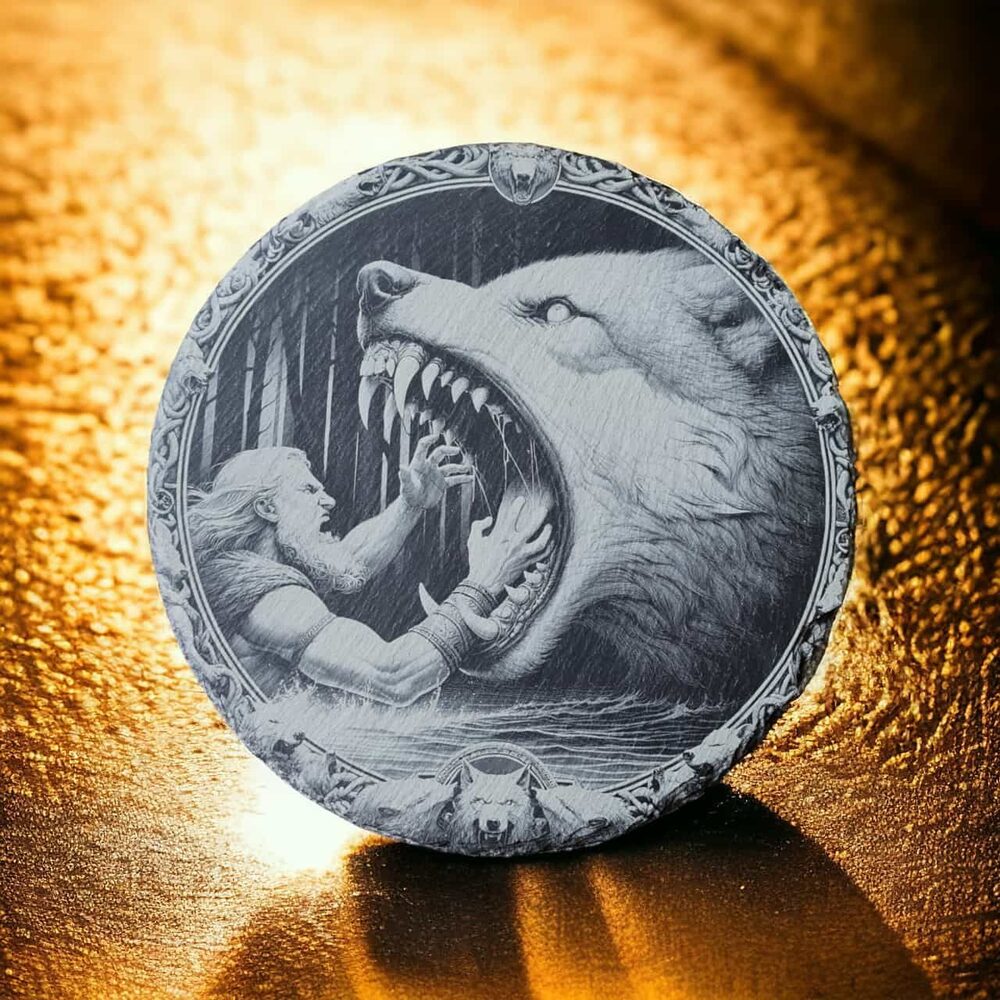
What does the name Fenrir mean? The origin is not entirely certain. The name is usually linked to Old Norse fen, "marsh, bog", and read as "fen-dweller"; Fenrisúlfr means "Fenrir's wolf".
Who are Fenrir's parents? Fenrir is the son of the god Loki and the giantess Angrboða. His siblings are the Midgard Serpent Jörmungandr and Hel, ruler of the dead.
Why does Tyr have only one hand? Tyr put his right hand in Fenrir's mouth as a pledge so the wolf would let himself be bound with Gleipnir. When Fenrir realised he could not break free, he bit it off.
Who kills Fenrir? Odin's son Víðarr avenges his father. Depending on the source he cleaves the wolf's jaws, tears his maw apart or drives a sword into his heart.
Are Sköll and Hati Fenrir's children? In part. Grímnismál calls Hati "son of Hróðvitnir", and Hróðvitnir is a name of Fenrir. Völuspá speaks more generally of "Fenrir's brood" in the Iron Wood.
Is Fenrir good or evil? The sources do not think in those terms. Fenrir is a destructive power, but the gods also betray him – which is why many people today see him as a tragic figure.
For courage. For remembrance. For legends that live on.
Tyr – the god who gave his hand · Loki · Jörmungandr, the Midgard Serpent · Ragnarök · The Norse pantheon · The nine worlds.
What does the strongest god do when he has been stripped of his hammer, his belt of strength and his iron gloves? He …
Read more →In the beginning there was no word and no bang, but a void: Ginnungagap, the ‘yawning gap’. Between the fire in the …
Read more →Neither iron nor chains tamed the mightiest monster of the North, but a ribbon thin and soft as a silken thread …
Read more →A king has gold and peace ground for him – and grants the maids who turn the mill no rest. Grottasöngr is one of the …
Read more →