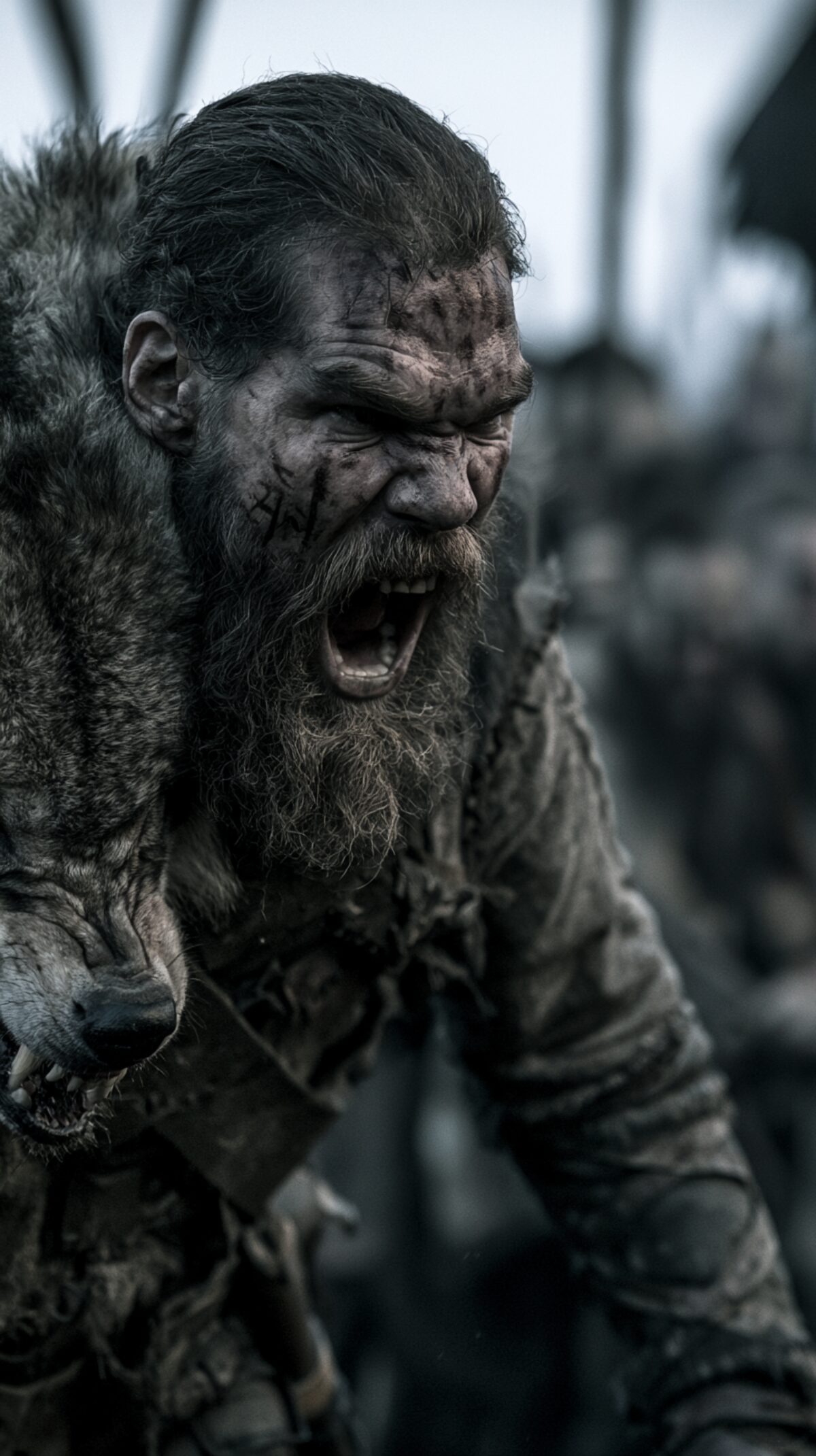
Few animals wear as many faces in Norse tradition as the wolf. He is the devourer who swallows the sun at the end of the world and kills Odin – and at the same time the faithful companion at the All-Father's side. He stands for the untamed beyond the fence, and for the person the community has cast out. Here is what the sources really say, and where later fantasy begins.
For the people of the Viking Age the wolf was no distant legend but a real counterpart. He took livestock, followed the armies across the battlefields and howled in the winter nights at the edge of the farms. From this experience grew an ambivalent image: the wolf is dangerous, greedy and destructive – yet he is also cunning, tireless and strong within the pack. It is precisely this double nature that makes him so many-layered in the mythology. He can be the enemy of the gods and still serve the highest god; he can stand for the end of all things and still be admired.
Anyone who wants to understand the wolf in the North must not pin him to a single symbol. He is neither simply "evil" nor simply "noble". He is both – and in that tension lies his lasting power.
The darkest figure is Fenrir (Fenrisúlfr), the giant wolf-child of Loki and the giantess Angrboða. The gods raised him in Asgard, but when his size and hunger grew uncanny, they resolved to bind him. Two iron chains the wolf tore apart with ease; only the fetter Gleipnir, forged by the dwarves – thin as a silk ribbon and made from six impossible things – held him. The price was high: only because the god Týr laid his hand as a pledge in Fenrir's jaws was the wolf tricked, and Týr lost the hand.
At the world's fire, Ragnarök, Fenrir breaks free. With gaping jaws that reach from earth to sky, he devours Odin himself. Only Odin's son Víðarr avenges his father and kills the wolf. Fenrir thus embodies the chaos that overtakes every order in the end. More in our own article on Fenrir.
Not one wolf alone threatens the order, but several. In the sky two wolves chase the heavenly lights: Sköll pursues the sun, Hati Hróðvitnisson the moon. Day after day they drive the lights across the sky, always close behind them. At Ragnarök they catch their prey and swallow sun and moon – the world sinks into darkness before it rises anew.
These wolves are more than monsters; they explain the course of time itself. As long as the sun flees and the wolf hunts, the world turns. Only when the hunt ends does the old order end too. We have devoted a separate article to them: Sköll and Hati.
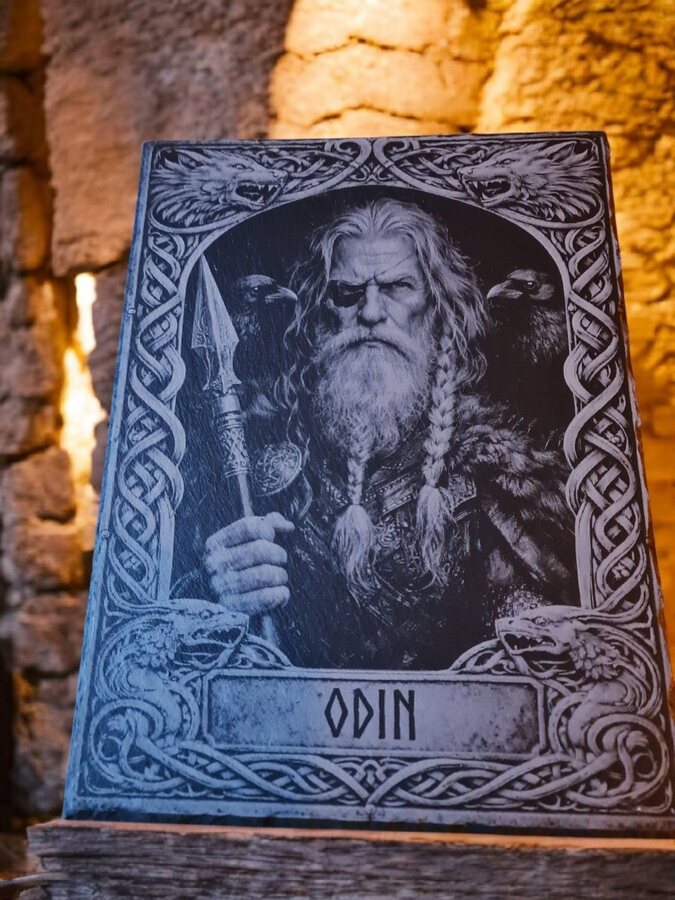
Yet in the North the wolf is not only an enemy. At Odin's side lie two wolves, Geri and Freki – both names simply mean "the ravenous one". The All-Father feeds them all his meat at his meals in Valhalla, while he himself lives on wine alone. Here the image is reversed: the wolf is not a devourer of the gods but their retinue. The lay Grímnismál puts it plainly:
Geri and Freki / the war-glad, glorious / Father of Hosts does feed; / but on wine alone / the weapon-famed / Odin lives for ever.Grímnismál 19, after Karl Simrock 1851 (public domain)
Together with the ravens Hugin and Munin, the wolves belong to the fixed image of Odin as lord of battle and death. Wolf and raven are the animals of the battlefield – both feed on the fallen. Odin makes precisely these animals his own. Read more about the pair in Geri and Freki.
Alongside the berserkers the sources name a second group of raging fighters: the Ulfheðnar, literally the "wolf-coats" or "wolf-skins". They are described as Odin's own warriors, who in the frenzy of battle howled like wolves, fought wrapped in wolf-pelts and feared neither fire nor iron. The skald Þórbjörn Hornklofi mentions them in the Hrafnsmál beside the berserkers in the host of Harald Fairhair.
The image is powerful: the warrior as if putting on the nature of the wolf, turning into the pack animal, fighting no longer as an individual but as a beast. Whether such wolf-warriors really existed as a fixed institution is uncertain, though – more on that shortly. For a deeper dive, see our article on berserkers and Ulfheðnar.
The Old Norse language itself reveals the wolf's double nature. There is not one word for him but two. Úlfr is the neutral, everyday word for the animal – it is what the wolf is called, and what countless people are called. Vargr, by contrast, carries a dark overtone: it means both "wolf" and "criminal, evildoer, outlaw". Whoever was a vargr was both – a rending beast and a person outside the law.
This linguistic link was no accident but reflected a harsh social reality. Whoever committed serious crimes could be declared an outlaw by the thing. Such an outlaw lost all legal protection: he could be killed without penalty, no one was allowed to shelter or help him. He had to leave the settlement and live in the forest – where the wolf, too, dwells.
So the outlaw literally became a vargr: cast out from the community of men, assigned to the beastly and the wild. In the North the wolf therefore stands not only for an external threat but for the loss of human order itself. Whoever breaks the peace becomes a wolf.
Despite – or precisely because of – his strength, the wolf was a popular element in personal names. Here úlfr, the neutral word, was always used. The simplest name is simply Úlfr ("wolf"). To it come countless compounds: Þórólfr ("Thor-wolf"), Björnólfr ("bear-wolf"), Ásólfr, Brynjólfr ("mail-wolf"), Ingólfr or Herjólfr. The wolf also appears as a first name-element, for example in Ulfhild or Ulfljótr, the man who brought Iceland its first law.
The wish behind it is clear: whoever gave a child a wolf-name wished it strength, watchfulness and fighting power. As a namesake the wolf was sought after – there his strength counted, not his outlawry. To this day these names live on in forms such as Ulf, Wolf, Wulf or Rudolf.
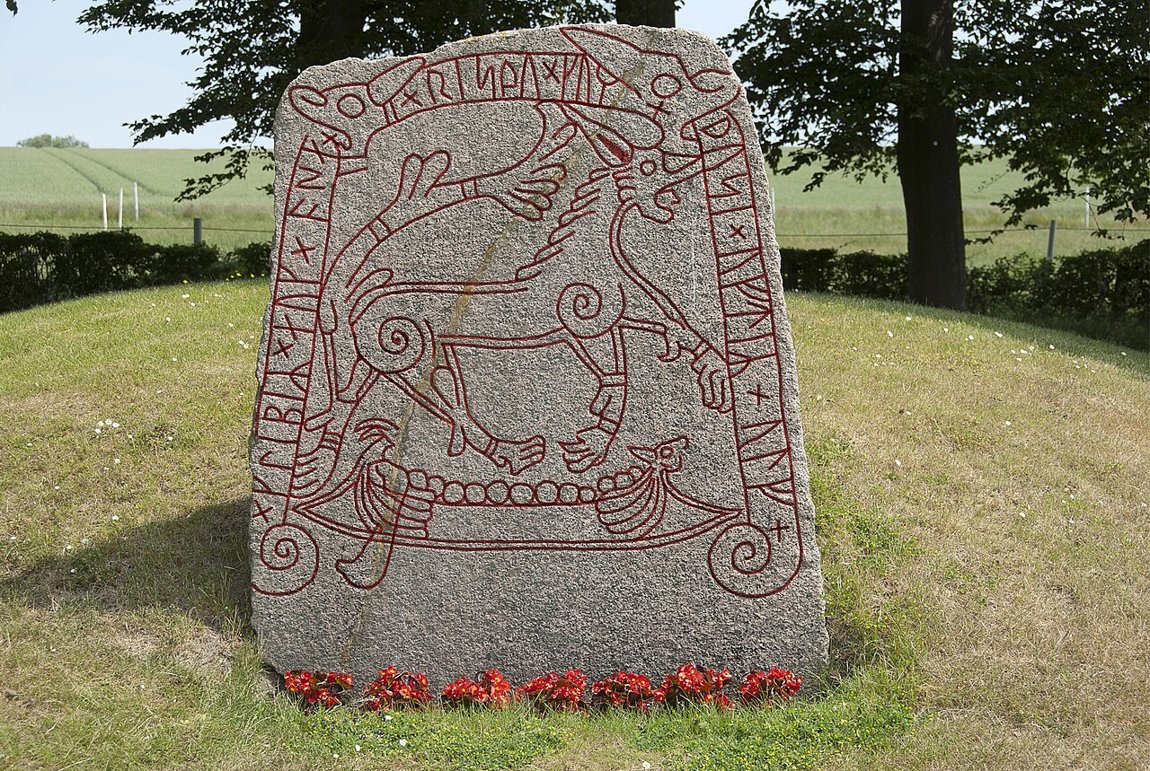
The wolf also appears in the art of the Viking Age, though rarely unambiguously identifiable. On the Thorwald Cross on the Isle of Man a figure is shown being devoured by a wolf – often interpreted as Odin and Fenrir at Ragnarök. On several picture stones and crosses wolves appear in scenes of battle and doom. Yet they cannot always be assigned with certainty, for wolf, dog and other predators are barely distinguishable within the Norse animal style.
This is an important note on honesty: much that is today confidently labelled "wolf" is a plausible interpretation, not a secured finding. The images often tell less clearly than the modern caption promises.
The apparent contradictions dissolve once one grasps the wolf as a boundary-dweller. He lives at the edge: between the fenced, ordered space of humans and the wilderness beyond, between life and death on the battlefield, between order and chaos. Precisely because he touches both sides, he can mean both. For the god who likewise stands between wisdom and wildness, rule and ecstasy, the wolf is the fitting animal. For the community, which defines itself through fence, law and peace, he is the threat from outside.
The wolf is therefore not a symbol for a single message, but for a truth: strength and danger, loyalty and wildness lie close together. That makes him more honest than any smooth symbol.
To this day the Norse wolf fascinates because he glosses over nothing. He stands for strength without concealing the shadow side. Whoever has a wolf motif engraved often chooses precisely this tension: the untamed, the endurance, the loyalty to the pack. What matters to us is telling the stories correctly – Fenrir is not the same as Geri and Freki, the hunting sky-wolf not the same as the wolf-warrior. Whoever knows this carries their motif with the full weight of its meaning. And in exactly that lies the difference between kitsch and a story worth telling.
Fenrir – the wolf · Geri & Freki – Odin's wolves · Berserkers.
All Beings & Creatures articles →
Almost everything that makes the gods mighty comes from a single set of hands: those of the dwarves. Thor’s hammer …
Read more →High up, in the crown of the world-ash Yggdrasil, sits an eagle. The sources give it no name, yet they say it knows a …
Read more →Between gods and humans dwells a third, half-hidden race: the elves (Old Norse álfar). They are bright and beautiful …
Read more →Say „Norse dragon" and most people picture the version from film and fantasy: winged monsters breathing fire. The …
Read more →