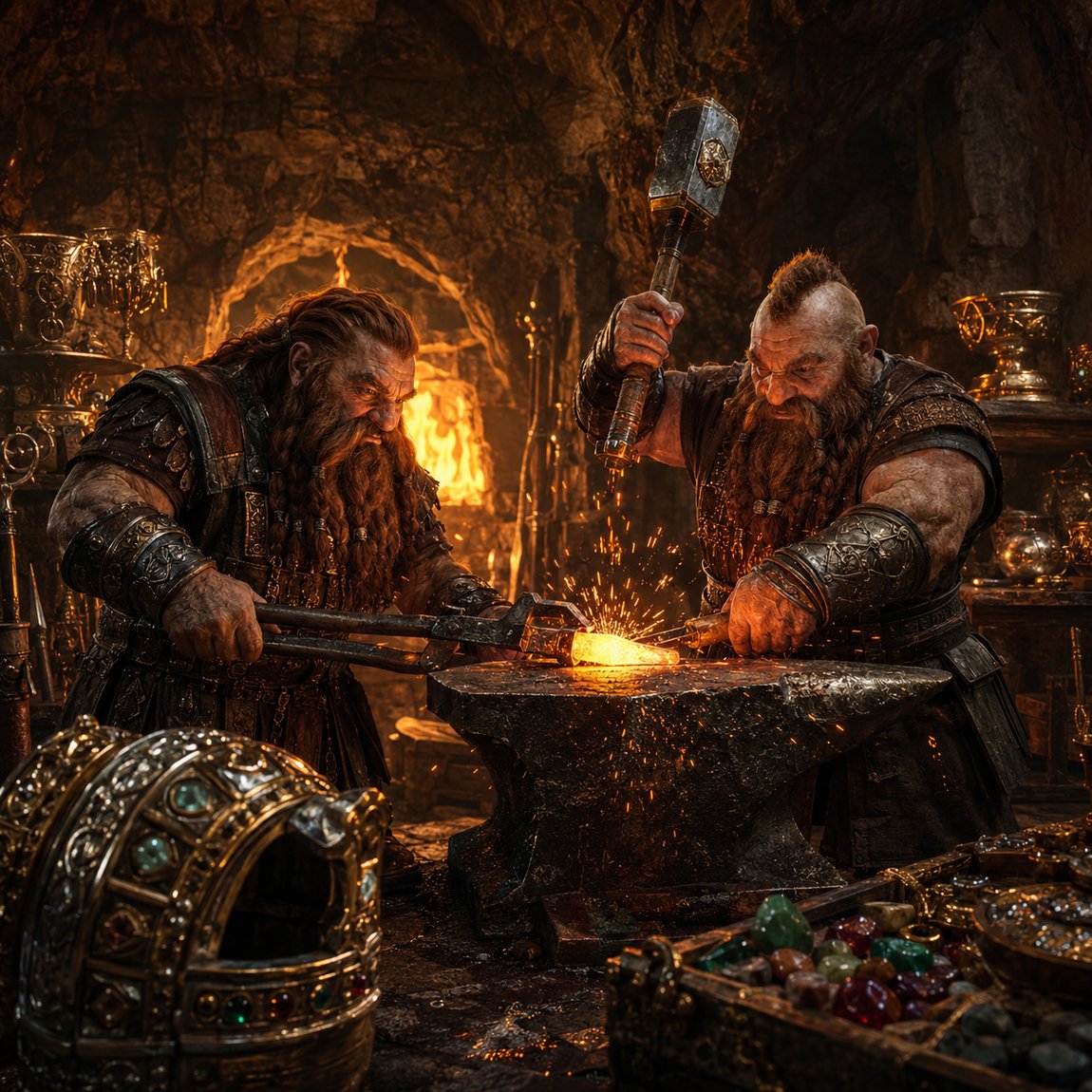
Dwarves (Old Norse dvergar) are beings of stone and earth in Norse mythology who, according to the Edda, emerged from the body of the primeval giant Ymir and forged the greatest treasures of the gods: Mjölnir, Gungnir, Draupnir, Gleipnir. They hold up the sky, guard cursed gold, carve runes and shun the sun. Here is what the Völuspá and Snorri actually say, which dwarf names the Edda preserves, what Tolkien made of them, and why a skull fragment from Ribe shows the dwarf as a demon of disease.
Dwarves came first. Before there was a single human being in the world, the gods sat down to decide who would shape the dwarf-folk. That is the order of events in the Völuspá, the seeress's prophecy that opens the Poetic Edda. The gods have just set the sun and moon on their courses, built shrines, set up forges, smithed treasure, made tongs and tools, and played with golden pieces on the meadow. Then they take their judgement seats and turn to the dwarves. Only many stanzas later do three gods find two driftwood logs on the shore and make Ask and Embla, the first humans.
That sequence tells you something. In Norse tradition dwarves are not fairy-tale helpers in pointed caps. They belong to the architecture of the world: older than humanity, indispensable to the gods, and more than a little uncanny. What the sources actually say about them is thinner and much stranger than the garden-gnome tradition would suggest.
The oldest trace is in the Völuspá, stanza 9 in the usual numbering of the Codex Regius. The gods ask who shall make the host of dwarves ór Brimis blóði ok ór Bláins leggjum – from Brimir's blood and from Bláinn's bones. The poem never explains who Brimir and Bláinn are. Many scholars take both as by-names of the primeval giant Ymir, though that is not certain: later in the same poem Brimir turns up as the owner of a beer hall.
Stanza 10 then names the first dwarves. Mótsognir (Móðsognir in some editions) became the mightiest of all dwarves, Durinn the second. Together, the poem says, they made many human-like figures in the earth, as Durinn told. Whether that means more dwarves or early models of humankind, the stanza leaves open.
Around 1220 the Icelander Snorri Sturluson tidied the story up in his Prose Edda. In Gylfaginning 14 he writes, roughly: the gods remembered how the dwarves had quickened in the soil and down in the earth like maggots in flesh. The dwarves had first taken shape and come alive in Ymir's flesh, and at that time they were maggots; but by the decision of the gods they gained human understanding and the likeness of men, and yet they live in the earth and in rocks (our own rendering).
A visceral image: the world is built from Ymir's corpse – soil from his flesh, rock from his bones – and that flesh is crawling. The dwarves are literally children of the earth. Small wonder they later live inside stone and work ore.
A few chapters earlier, in Gylfaginning 8, Snorri describes how the sons of Borr made the sky from Ymir's skull and raised it over the earth with four corners. Under each corner they set a dwarf: Austri, Vestri, Norðri and Suðri – East, West, North and South.
The same four names appear in the Völuspá's dwarf list (stanza 11), but there they do nothing at all. Whether Snorri knew a lost sky-bearer tradition or built one around four conveniently named dwarves, we cannot tell. In favour of an older image is skaldic poetry: in the poets' language the sky can be called the burden of the dwarves or the helmet of Austri. Snorri lists such circumlocutions – kennings, poetic stand-ins for ordinary words – in his handbook for poets, Skáldskaparmál.
In the middle of the Völuspá, between creation and the making of humans, sits a passage that can seem almost comic on first reading: the Dvergatal, the "tally of dwarves". Across stanzas 11 to 16 the seeress simply lists names, some sixty of them, with no story attached. A sample: Nýi and Niði, Norðri and Suðri, Austri and Vestri, Alþjófr, Dvalinn, Bívurr, Bávurr, Bömburr, Nóri, Ánn, Ánarr, Ái, Mjöðvitnir. Then Veigr and Gandálfr, Vindálfr, Þráinn, Þekkr and Þorinn, Þrór, Vitr and Litr. Later Fíli and Kíli, Fundinn, Náli, Hornbori, Lóni, Aurvangr, Eikinskjaldi. And in stanza 15: Draupnir, Dolgþrasir, Haugspori, Hlévangr, Glói, Dóri, Óri, Dúfr, Andvari, Skirfir, Virfir.
Many of the names mean something. Dvalinn is roughly "the dawdler" or "the sleeper", Alþjófr "arch-thief", Vitr "wise", Eikinskjaldi "oak-shield". Many etymologies are guesswork, as Henry Adams Bellows frankly admitted in 1923.
Stanza 14 frames the list in an odd way. Now it is time, says the seeress, to count the dwarves in Dvalinn's band down to Lofarr – those who went from the hall of stone to the seats of Aurvangar and on to Jöruvellir. A migration, then: a fragment of an origin legend about a dwarf people that is otherwise lost. Stanza 16 promises that Lofarr's line will be remembered as long as people live. On that point, at least, the seeress turned out to be right.
If some of those names rang a bell, you are not imagining it. The Oxford philologist J. R. R. Tolkien took the names of the dwarf company in The Hobbit (1937) almost wholesale from the Dvergatal: Thorin with his epithet Oakenshield, Dwalin, Fíli and Kíli, Bifur, Bofur and Bombur, Nori, Dori and Ori, Óin and Glóin, with Thráin and Thrór as Thorin's father and grandfather and Durin as the ancestor of the line. Even the wizard's name comes from here. In the Edda Gandálfr is a dwarf, and the name can be understood as something like "wand-elf" or "magic elf".
That is reception, not evidence: Tolkien's bearded miners tell us nothing about how tenth-century Scandinavians pictured dwarves. Tom Shippey traces these borrowings in detail in The Road to Middle-earth.
The dwarves' greatest fame rests on their craft, and Snorri tells the best-known episode in Skáldskaparmál. It starts with a nasty prank: Loki cuts off the hair of the goddess Sif. Thor threatens to break every bone in his body, and Loki swears to make it good. He goes to the dwarves known as the sons of Ívaldi. They forge golden hair that grows on Sif's head like real hair, the ship Skíðblaðnir, which always has a fair wind and can be folded up like a cloth, and the spear Gungnir for Odin.
Loki cannot leave it there. He bets his own head with the dwarf Brokkr that Brokkr's brother – called Eitri in Snorri, Sindri in some editions and in popular retellings – cannot make three treasures as good. We tell the full story in Sindri and Brokkr. In short: Loki, in the shape of a fly, bites Brokkr three times while he works the bellows, the last time between the eyes. Out of the forge come the golden boar Gullinborsti, the ring Draupnir, from which eight rings of equal weight drip every ninth night, and Mjölnir, whose handle came out too short. The gods judge the hammer the best treasure of all, and the dwarves win.
Loki keeps his head anyway. He wagered his head, he argues, not his neck, and Brokkr has no right to touch that. So the dwarf takes an awl and a thong and sews Loki's lips together.
Two more famous pieces come from other sources. The fetter Gleipnir, which binds the wolf Fenrir, was made at Odin's request by dwarves in Svartálfaheimr, according to Gylfaginning 34, from six things: the sound of a cat's footfall, a woman's beard, the roots of a mountain, the sinews of a bear, the breath of a fish and the spittle of a bird. And the necklace Brísingamen already belongs to Freyja in the Eddic poems; but the story that four dwarves made it, and that Freyja paid with a night spent with each of them, appears only in Sörla þáttr in the late fourteenth-century Flateyjarbók. The four are named there as Alfrigg, Dvalinn, Berlingr and Grérr.
| Treasure | Smith | Owner |
|---|---|---|
| Sif's golden hair | Sons of Ívaldi | Sif |
| Skíðblaðnir | Sons of Ívaldi | Freyr |
| Gungnir | Sons of Ívaldi | Odin |
| Gullinborsti | Eitri (Sindri) and Brokkr | Freyr |
| Draupnir | Eitri (Sindri) and Brokkr | Odin |
| Mjölnir | Eitri (Sindri) and Brokkr | Thor |
| Gleipnir | unnamed dwarves in Svartálfaheimr | the gods (Fenrir's fetter) |
| Brísingamen | Alfrigg, Dvalinn, Berlingr, Grérr (only in Sörla þáttr) | Freyja |
One Eddic poem belongs entirely to a dwarf: the Alvíssmál, "the sayings of All-wise". The dwarf Alvíss arrives to collect a bride promised to him while Thor was away – Thor's own daughter. Thor finds him pale as a corpse. Alvíss explains that he lives beneath the earth and that his home is under a stone.
Thor agrees to the marriage if the dwarf can answer his questions, and asks stanza after stanza: what is the earth called among men, gods, giants, elves and dwarves? What are the moon, the wind, the sea, the ale called? Alvíss knows everything. Among the dwarves, he says, the sun is called Dvalins leika, "Dvalinn's playmate" or "Dvalinn's deceiver" – a lovely and slightly sinister name for the light that is dangerous to his kind.
The poem closes with Thor's dry compliment. He has never seen so much ancient lore in one breast, but he has kept the dwarf talking with great cunning. "Day has overtaken you, dwarf; now the sun shines into the hall" (paraphrased). And there the poem stops.
No dwarf story has cast a longer shadow than that of Andvari. It is told in the prose and verse of the Eddic poem Reginsmál and by Snorri in Skáldskaparmál. Odin, Loki and Hœnir, out travelling, kill an otter that is really Otr, son of Hreiðmarr. As compensation the father demands that the otter skin be filled with gold and covered completely on the outside.
Loki fetches the gold from Andvari, a dwarf who lives in a waterfall in the shape of a pike. In Reginsmál Loki catches him with the net of the sea goddess Rán; in Snorri he grabs him with his bare hands. Andvari has to hand over all his gold and asks to keep just one small ring. Loki takes that too. So the dwarf curses ring and treasure: they will be the death of whoever owns them.
The curse works. Hreiðmarr is killed by his son Fáfnir, Fáfnir becomes a dragon brooding on the hoard, Sigurd kills him, and from there the ring's trail runs through the doom of the Völsungs and Niflungs. We follow the whole chain in our article on Sigurd. Andvari, incidentally, also appears in the Dvergatal – one of the very few names on that list with a story of its own.
In the sources dwarves are not the gods' servants. They act on their own account, and not always gently. The dwarves Fjalarr and Galarr kill the wise Kvasir, catch his blood in three vessels, mix it with honey and brew the mead of poetry. Then they kill the giant Gillingr and his wife for good measure. Only when Gillingr's son Suttungr maroons them on a skerry that floods at high tide do they hand over the mead as compensation. Snorri tells this in Skáldskaparmál, and adds that this is why poetry can be called the "ship of the dwarves": it saved their lives.
The Hávamál shows a completely different side. In stanza 143, in the middle of the rune section (more on that in our article on the Rúnatal), Odin says, in paraphrase: Odin carved runes for the Æsir, Dáinn for the elves, Dvalinn for the dwarves, Ásviðr for the giants, and I carved some myself. Every people of the world has its own rune-master, and for the dwarves it is Dvalinn. He may be the most important dwarf in the tradition. He leads a band in the Dvergatal, the sun is named after him in the Alvíssmál, and the Eddic poem Fáfnismál calls some of the Norns "Dvalinn's daughters". A dwarf bound up with fate, runes and sunlight.
A few small but telling scenes complete the picture. At Baldr's funeral, according to Gylfaginning 49, Thor kicks a dwarf called Litr, who runs in front of his feet, into the burning ship. In Ynglinga saga a dwarf sitting under a large stone at sunset lures the Swedish king Sveigðir into the rock, and the king is never seen again. And at Ragnarök, the Völuspá says, the dwarves groan before their doors of stone.
In Gylfaginning 17 Snorri distinguishes two kinds of elves: light elves (ljósálfar), fairer than the sun, and dark elves (dökkálfar), blacker than pitch, who live down in the earth. A few chapters later Odin sends his messenger Skírnir "down into Svartálfaheimr to certain dwarves" to have Gleipnir made. And in Skáldskaparmál Loki goes to Svartálfaheimr to find Andvari. For Snorri, then, the dwarves live in the "world of the black elves".
Many readers have concluded that black elves, dark elves and dwarves are all the same thing in Snorri. Rudolf Simek considers the equation likely in his Dictionary of Northern Mythology. Others are more cautious. Terry Gunnell and Alaric Hall point out that the older Eddic poems name elves and dwarves as two separate groups side by side, in the Alvíssmál for instance, or in the Hávamál stanza on the rune-masters, where the elves have Dáinn and the dwarves have Dvalinn.
At the same time the boundary blurs in the names themselves. The Dvergatal includes dwarves called Gandálfr, Vindálfr and simply Álfr, "elf". A dwarf with "elf" in his name suggests the two ideas were closely related. Perhaps the learned Snorri squeezed an older, more fluid picture into a neat scheme of light and dark. A common assumption, but unprovable.
Almost everything so far comes from Icelandic manuscripts of the thirteenth and fourteenth centuries. One find is about five hundred years older. In 1973 archaeologists in Ribe, Denmark's oldest town, found a piece of a human skull cap, about 6 by 8.5 centimetres, with a drilled hole and a runic inscription. It is dated to around 725.
The text begins with three names: Ulfr, Odin and Hō-Tīwr, probably a form of the god Týr. Then comes a call for help against an ache or affliction – and at this point there is a word that the runologist Marie Stoklund read in 1996 as dvergr, "dwarf". The dwarf is overcome, according to her reading. Jackie Nordström re-examined the fragment under a digital microscope in 2021 and proposed that the text names a pair: "against the dwarf and the she-dwarf", a male-female couple of the kind common in charms. Staffan Fridell disagreed with her on the phonology in 2024 but kept the dwarf pair. The reading of individual runes remains disputed.
The Ribe skull shows a very different dwarf from the smith of the god-tales: a demon that brings disease, or simply is the disease. There are parallels around the North Sea. The Old English medical collection Lacnunga contains a charm Wið dweorh, "against a dwarf", most likely meaning a fever. And in 2015 a metal detectorist near Fakenham in Norfolk found a small lead plaque with the Old English runic text dead is dwerg, "the dwarf is dead" – probably a healing amulet, dated broadly to the eighth to eleventh centuries.
So the oldest securely dated dwarf in Scandinavia is not a smith at all, but a tormentor against whom people called on Odin and Týr.
In the German-speaking world the dwarf had a long career of his own. In the Nibelungenlied (c. 1200) the dwarf Alberich guards the Nibelung hoard and owns a cloak of invisibility that Siegfried takes from him – a clear relative of the Andvari story. The Middle High German poem about the dwarf king Laurin and his rose garden in Tyrol dates from the thirteenth century. Later, dwarves become little mountain men, wichtel and household spirits. August Kopisch's poem of 1836 made the Heinzelmännchen of Cologne famous, and the seven dwarves of the Grimms' Snow White (from 1812) shaped the picture for generations.
Pointed caps and garden gnomes belong to this late line, not to the Viking Age.
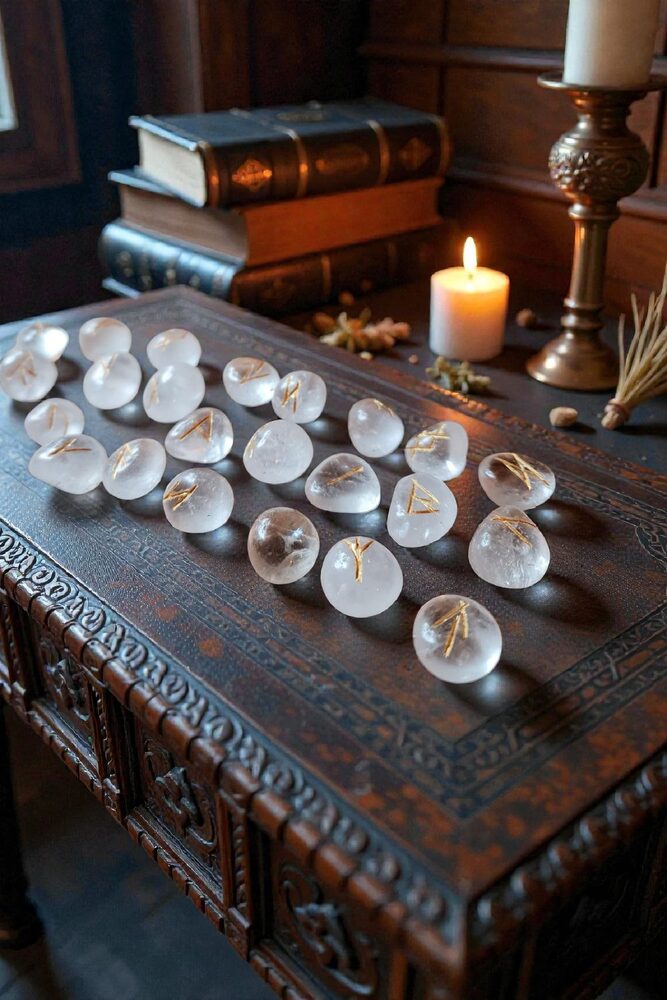
In our workshop in Alsdorf we use a laser rather than a hammer. A few ideas that we can stand behind on the evidence:
If you would like something along these lines, get in touch via our custom engraving page. We check spelling and rune transcription together with you.
Where do dwarves come from in Norse mythology? According to the Völuspá the gods made them from Brimir's blood and Bláinn's bones, probably names for the primeval giant Ymir. Snorri adds that they first arose as maggots in Ymir's flesh and were then given understanding and human form by the gods.
What are the dwarf names in the Poetic Edda? The Dvergatal in the Völuspá lists around sixty, including Mótsognir, Durinn, Dvalinn, Austri, Vestri, Norðri, Suðri, Þorinn, Fíli, Kíli, Gandálfr, Eikinskjaldi and Andvari. The exact list varies between manuscripts.
What did the dwarves make for the gods? Among other things Thor's hammer Mjölnir, Odin's spear Gungnir and ring Draupnir, Freyr's boar Gullinborsti and ship Skíðblaðnir, Sif's golden hair and the fetter Gleipnir. Dwarves forge Brísingamen only in a late fourteenth-century tale.
Do dwarves turn to stone in sunlight? The Alvíssmál ends with the sunrise catching the dwarf Alvíss; his petrification is inferred from the parallel of the giantess Hrímgerðr, who is explicitly turned to stone. For the dwarf it is never stated outright.
Are dwarves and dark elves the same? In Snorri the dwarves live in Svartálfaheimr, which suggests they are. The older Eddic poems, however, name elves and dwarves as separate groups, and scholars still debate the question.
For courage. For remembrance. For legends that live on.
The treasures of the gods · Sindri & Brokkr · Ívaldi & his sons · The giants · Ymir.
All Beings & Creatures articles →
Between gods and humans dwells a third, half-hidden race: the elves (Old Norse álfar). They are bright and beautiful …
Read more →At the feet of the father of the gods lie two wolves: Geri and Freki – both names mean „the greedy one". In the hall of …
Read more →The end of the world does not begin with thunder but with a rooster's crow — and it sounds three times over. Three …
Read more →On the roof of the hall of the slain stands a goat, and from her udder flows not a drop of milk but clear, bright mead …
Read more →