Elves in Norse mythology – Old Norse álfar, singular álfr – are a superhuman race that the Eddic poems name almost always alongside the gods, in the fixed pair "Æsir and elves". In the 13th century Snorri Sturluson split them into radiant light elves in Álfheimr and pitch-black dark elves beneath the earth. Skaldic verse and sagas add something more concrete: a real sacrifice, the álfablót. In Old English the elves cause illness; in German the Alb still sits on sleepers' chests. Here is what the sources actually say.
Autumn in Sweden, around the year 1019. A Norwegian poet and his companions are on the road – wet, tired and hungry. He knocks at a farmhouse door. A woman blocks the way: the household is heathen, she says, they fear the wrath of Odin, and right now they are holding the álfablót, the sacrifice to the elves. The poet is sent packing and turns the rebuff into a mocking verse. That verse is today the oldest secure evidence that people in the North really did sacrifice to the elves.
The álfar are perhaps the most puzzling beings in Norse tradition. They stand next to the gods constantly, yet they get almost no stories of their own. They have a world named after them, yet nobody can tell you exactly what they looked like. In this article we follow their trail through the Poetic Edda, through Snorri's tidy system, across Icelandic hills and Anglo-Saxon remedies, all the way to the German word for a nightmare. Along the way we keep three things apart: what is old and attested, what Snorri systematised, and what the modern world invented.
Old Norse álfr has relatives across the Germanic languages: Old English ælf, Middle High German alp or alb. Linguists reconstruct a Proto-Germanic form *albiz or *alboz. Where that word ultimately comes from is another matter. The most popular explanation links it to an Indo-European root meaning "white, bright", the same one behind Latin albus; the elves would then have been "the white ones, the shining ones". An older theory compares them with the Ṛbhus of the Indian Vedas, a group of skilled craftsman deities. Both ideas are possible. Neither is proven – so treat any confident statement that "elf means white" as a hypothesis, not a fact.
Personal names are firmer ground. The English king Alfred the Great was Ælfrǣd, "elf-counsel". Then there are Ælfric ("elf-ruler") and Ælfwine ("elf-friend") – the same compound as the Lombard king Alboin – and, in German, Alberich, the dwarf king of the Nibelungenlied. Through French Auberon, Alberich eventually became Oberon, Shakespeare's king of the fairies. Parents do not name their sons after pests. These names show that elves were an honourable, even desirable, kind of being.
Read the poems of the Edda and you keep tripping over the same pair of words: æsir ok álfar, "Æsir and elves". It is an alliterating formula, as fixed as "kith and kin". In Þrymskviða, Loki arrives in the land of the giants and the giant Þrymr greets him at once (st. 7, paraphrased): "How fare the Æsir? How fare the elves?" Völuspá uses the same double question in stanza 48, as the end of the world approaches. In Lokasenna the prose introduction tells us that "many Æsir and elves" were gathered at the sea giant Ægir's feast, and Loki later hurls insults at "the Æsir and elves who are in here".
The pair turns up in the Hávamál too. In his list of charms Odin boasts (st. 159) that he knows all the Æsir and elves in detail. In the next stanza the dwarf Þjóðrerir sings strength to the Æsir and prosperity to the elves before Dellingr's door. And in stanza 143, where the knowledge of runes is shared out, we read: Odin among the Æsir, Dáinn among the elves. Dáinn is otherwise a dwarf's name – a first hint at how closely elves and dwarves are entangled.
What does the formula tell us? First, that the elves stand on the same level as the gods, not beneath them. Together with the Æsir they form the community of "upper" powers, set against giants and humans. Some scholars go further and suggest that "Æsir and elves" may never have meant two sharply separate groups at all, but two names for similar beings. What is striking either way is how little the elves actually do in the myths. They are guests, onlookers, part of the audience. The Edda tells no adventure in which elves are the protagonists.
Poetic vocabulary adds a lovely detail. In several Eddic poems the sun is called álfröðull, roughly "elf-glory" or "elf-disc". In Alvíssmál, a battle of wits between Thor and the dwarf Alvíss, many things are given a special word "among the elves", just as there are special words among gods, giants and humans. In the poet's imagination, then, the elves even have their own language.
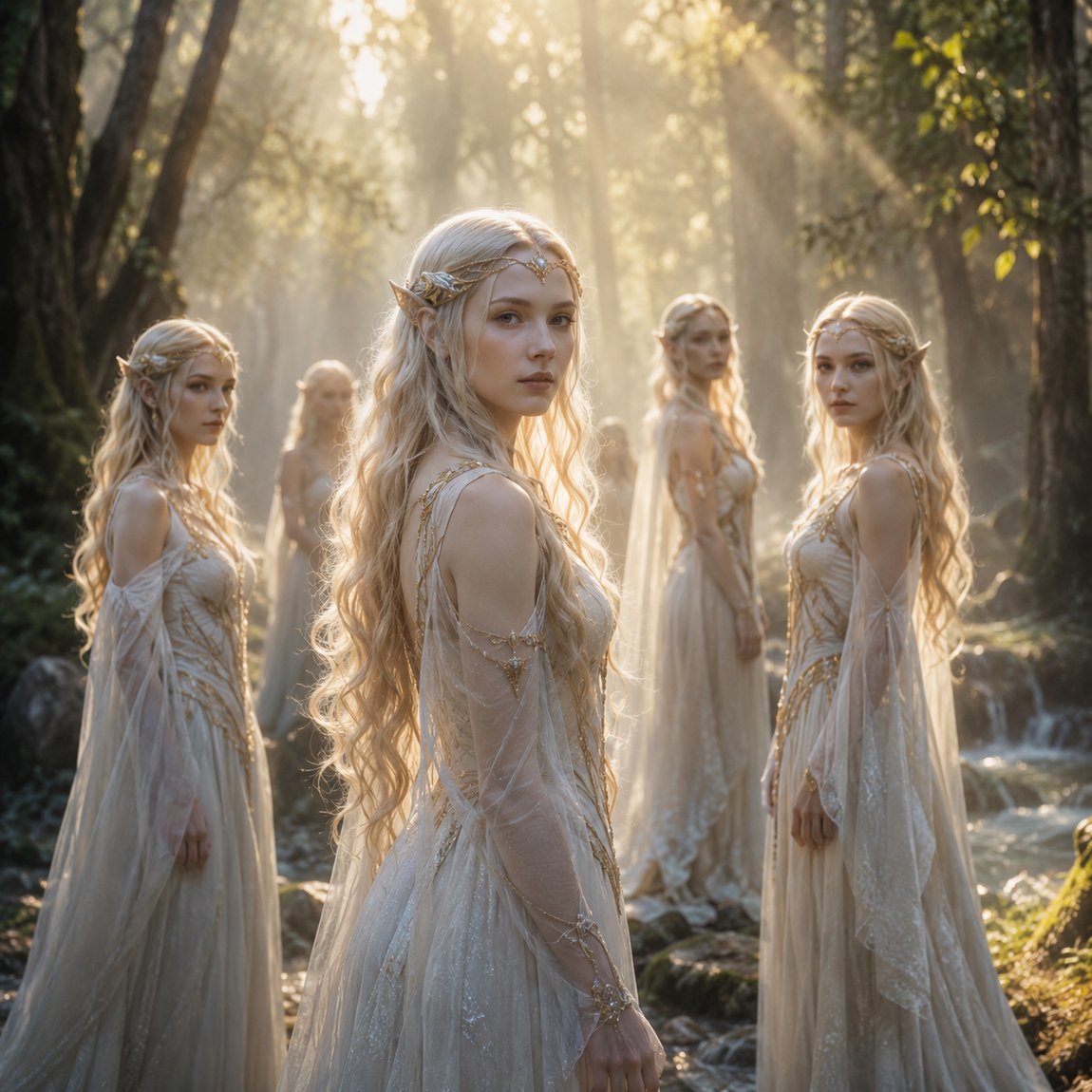
The best-known description does not come from the Viking Age but from Snorri Sturluson, who wrote his Prose Edda in Iceland around 1220. In Gylfaginning (ch. 17) he lists the dwelling places of the heavens. One of them is Álfheimr, "elf-home". There live the ljósálfar, the light elves, who according to Snorri are fairer to look at than the sun. The dökkálfar, the dark elves, live down in the earth. They are unlike the light elves in appearance and even more unlike them in nature, and they are blacker than pitch.
A little later Snorri names the highest heaven, Víðbláinn, and says that as far as he knows only light elves live there now. That sentence sounds suspiciously like Christian cosmology: angels in the upper heavens, dark figures under the earth. Snorri was a Christian, highly educated and well read in Latin learning. Many scholars therefore regard his neat division as his own systematisation – an attempt to put the colourful, contradictory material of the old poems into order, possibly shaped by the contrast between angels and demons.
The nine worlds as you often see them drawn today, with Álfheimr as one neat realm among others, are also a modern compilation. The Edda speaks of "nine worlds" but never gives a binding list. In the Poetic Edda, Álfheimr appears exactly once – as the property of a god.
Snorri uses a third term: svartálfar, black elves, and their realm Svartálfaheimr. In the story of the binding of the wolf Fenrir, Odin sends the messenger Skírnir down to Svartálfaheimr "to certain dwarves" to have the magic fetter Gleipnir made. And in the tale of the otter's ransom, Loki travels to Svartálfaheimr and meets the dwarf Andvari there. In Snorri, then, the people who live in Svartálfaheimr are dwarves.
Many scholars conclude that black elves and dwarves are simply the same thing in Snorri, and that the dark elves probably belong to that group as well. The Eddic poems point the same way: the dwarf Dáinn represents the elves in Hávamál, and dwarf names such as Gandálfr and Vindálfr contain the word álfr. On the other side, Snorri describes the dwarves elsewhere in their own right – they quicken like maggots in the flesh of the primeval giant Ymir – without mentioning dark elves at all. The debate remains open; you will find more on the subject in our article on Svartálfaheimr.
The practical upshot: the "dark elves" of modern fantasy – a cruel, separate race in black armour – have little to do with the sources. The dark elves of the North, insofar as we can grasp them at all, are skilled smiths beneath the earth, closer to Brokkr and Sindri than to any video-game villain.
The only passage in the Poetic Edda that names Álfheimr is Grímnismál, stanza 5. Odin is listing the halls of the gods and says, in our own rendering: the gods gave Álfheimr to Freyr in days of old as a tooth-gift. The tannfé, "tooth-fee", was a present given to a child when its first tooth came through. Young Freyr received an entire world – and with it, apparently, lordship over the elves.
Freyr belongs to the Vanir, the family of gods associated with fertility, wealth and good harvests. That he of all gods rules the elves is hardly an accident. In many sources the elves stand for thriving – the prosperity of farm and field. Some scholars have therefore suggested that the elves were closely related to the Vanir, or even another name for them. That cannot be proven. But the link between Freyr, fertility and elves runs through the tradition and fits well with what we know of the álfablót.
It echoes in Skírnismál as well, the poem of Freyr's wooing of the giantess Gerðr. Gerðr asks Freyr's messenger Skírnir whether he is one of the elves, or of the sons of the Æsir, or of the wise Vanir. Three groups in one breath. Whether these are three different peoples or simply poetic variation cannot be decided from this passage alone.
One figure connects the elves directly with craftsmanship: Völundr, the Wayland Smith of English legend. In Völundarkviða, one of the heroic poems of the Edda, the master smith is addressed more than once as álfa ljóði and vísi álfa – "lord of elves", "leader of elves". That is remarkable, because the prose introduction calls him and his brothers the sons of a king of the Finns, which sounds more like a human from the far North.
So why "prince of elves"? Scholars have argued about it for over a century. Some see a trace of an originally supernatural Völundr. Others read the title as a poetic honour for his unearthly skill. Others again point out that masterful smithing is usually the business of dwarves – which brings us straight back to the overlap between elves and dwarves. For a workshop like ours, the passage has its own charm: in the oldest poem about a smith, the best craftsman is declared king of the elves. We like the sound of that, even if our laser works with considerably less drama than Völundr's forge.
Back to our poet from the opening. His name was Sigvatr Þórðarson; he was court skald to the Norwegian king Óláfr Haraldsson and himself a Christian. Around 1019 his king sent him to Västergötland, to Earl Rögnvaldr. Sigvatr describes the journey in his Austrfararvísur, the "Verses on a Journey East". He is turned away several times. At one farm a woman tells him not to come in: the household is heathen and fears Odin's wrath. Then she drives him off, because an álfablót is under way inside. Other farms do not let him in either.
What actually happened at the sacrifice, Sigvatr does not say. He describes only the closed door. That in itself is telling: the álfablót was evidently not a great temple festival but a matter for the house, the family, the farm. Strangers were a disturbance. This fits well with what we know of the dísir and the dísablót, and with the wider picture of Germanic sacrifice, which was far more domestic than people often imagine.
The second famous passage is in Kormáks saga, an Icelandic family saga from the 13th century. In chapter 22 a man named Þorvarðr has been badly wounded by Kormákr in a duel. He asks the seeress Þórdís what might help him. Her answer, paraphrased: not far from here is a hill where elves dwell. Take the bull that Kormákr killed, redden the outside of the hill with its blood, and make the elves a feast of its meat. Then you will be healed.
This is a very different scene: not a farmhouse but a hill; not a seasonal festival but an emergency healing offering. The saga was written some 250 years after the events it describes, and it is a work of literature. We cannot safely conclude that people really sacrificed like this in the 10th century. But the idea that elves live in hills, accept blood and meat and can grant health was evidently still intelligible in 13th-century Iceland.
A third piece of the mosaic: the tradition about the Norwegian petty king Óláfr Geirstaðaálfr, "Óláfr, the elf of Geirstaðir", says that people sacrificed to the dead king in his burial mound to ask for good seasons. The nickname explicitly links a dead ruler with the elves. Many scholars take this as a sign that elves could also be understood as ancestors in the mound. That is an interpretation, not an established article of faith – but it explains why mounds, ancestors and fertility keep converging in the sources.
England deserves a look, because some of the Old English texts are older than the Icelandic ones. In Beowulf the poet lists the offspring of Cain (l. 112): giants, ylfe – elves – and walking dead. The Christian author files the elves among the enemies of God. Yet Old English poetry also knows the word ælfscīene, "elf-beautiful", used in biblical verse of Sarah and of the heroine Judith – expressly as praise of a woman's beauty. English elves, then, were radiantly beautiful and uncanny at the same time.
The dangerous side is clearest in the medical books. Bald's Leechbook from the 10th century has remedies against ælfadl, "elf-disease", and against wæterælfadl, a "water-elf disease". The Lacnunga collection contains the famous charm Wið færstice, "against a sudden stitch". It fights a stabbing pain that might come from a missile – and names outright the shot of the ēse (gods, cognate with the Norse Æsir), the shot of elves and the shot of witches. The same pair as in the Edda again: gods and elves, this time as causes of illness.
Out of ideas like these grew the later notion of elf-shot, especially in early modern Scottish folklore. There, Neolithic flint arrowheads turned up by the plough were taken for elf arrows that struck people and cattle down with sickness. How directly the early modern belief descends from the Anglo-Saxon charm is debated. More on northern healing can be found in our article on Viking medicine; a related healing charm from the Continent is the Merseburg Charms.
In the German-speaking world the old word survived mainly at night. In folk belief the Alb or Alp is a creature that sits on a sleeper's chest and squeezes the breath out of them. Hence Albdruck, "elf-pressure", and Albtraum, the everyday German word for a nightmare – literally an "elf-dream". Since the German spelling reform the form with b is preferred because it shows the link to the Alb, though Alptraum is still allowed. Here the Alb is no longer a shining being but a nocturnal tormentor: in the South, the dangerous side of the old elves survived, the radiant side hardly at all.
The German word Elfe, on the other hand, is a returnee. It was borrowed from English in the 18th century, when Shakespeare's A Midsummer Night's Dream and other English works were translated into German. A little later Johann Gottfried Herder turned the Danish ellerkonge, really "elf-king", into the Erlkönig, the "alder king" that Goethe made famous. The Erlkönig is, in short, a translation slip with a glittering career. The brothers Grimm then collected what remained of Alb and elf belief in Germany.
In Iceland, belief in supernatural hill-dwellers has stayed remarkably alive. People speak of álfar or huldufólk, the "hidden people". In folk tales they live in rocks and hillocks, look like humans, run farms, keep livestock and take revenge if their homes are disturbed. Related figures in Norway and Sweden include the huldra. With the land spirits, the landvættir, they share a close bond with a particular place.
The theme is present to this day. Road-building projects have repeatedly met with protests in which consideration for supposed elf dwellings was also demanded – for instance in the Gálgahraun lava field near Reykjavík in the 2010s. A survey by the folklorist Terry Gunnell of the University of Iceland found in 2007 that only a small share of respondents firmly believe in elves, while a considerably larger share were unwilling to rule them out. Distance matters here: modern huldufólk belief is folk belief, shaped by centuries of Christian-era storytelling. It is not simply the heathen álfablót of 1019 in modern dress, even if the line of hill-dwellers is astonishingly long.
Honestly: there is no single answer, and that is probably not a gap in our knowledge but a feature of the old belief itself. Several layers can be peeled out of the sources. First, in poetry the elves stand beside the gods as a second group of superhuman powers. Second, they are tied to Freyr, the Vanir and the thriving of farm and field. Third, they receive sacrifice, within the household or at the mound. Fourth, they can cause illness – and cure it. Fifth, they overlap with the dwarves and perhaps with the ancestors in the burial mound.
Everything else – light versus dark, good versus evil, pointed ears and silver hair – is Snorri's ordering, later folk tale or modern fantasy. J. R. R. Tolkien deliberately reached back to the old, human-sized, awe-inspiring elves, precisely as a counter-image to the tiny flower fairies of the 19th century. His Elves are a literary creation, but one that sits closer to the Edda than much of what came after.
For us in the workshop, elves are a rewarding and demanding motif at once. There is no "authentic" Viking-Age image of an elf, no amulet with an elf face, no rune reserved for them. If you want a piece that refers to the elves, it is better to draw on what is attested: the formula "Æsir and elves" in runes, Freyr and Álfheimr, the sun as álfröðull. That is how we work: an attested word on slate rather than an invented symbol.
What are elves in Norse mythology? Elves (Old Norse álfar) are superhuman beings who in the Edda are usually named together with the gods as "Æsir and elves". They are linked to Freyr, fertility and burial mounds, and received their own sacrifice, the álfablót.
What is the difference between light elves and dark elves? According to Snorri Sturluson (c. 1220), the light elves live in Álfheimr and are fairer than the sun, while the dark elves live under the earth and are blacker than pitch. Only Snorri makes this split; the Poetic Edda just calls them elves.
Are dark elves and dwarves the same? Very probably, at least in Snorri: in Svartálfaheimr, the world of the black elves, his stories place dwarves such as Andvari. Whether the dark elves are meant as well is debated among scholars.
Who rules Álfheimr? According to Grímnismál, stanza 5, the gods gave Álfheimr to the god Freyr as a gift for his first tooth. Freyr belongs to the Vanir, the gods of fertility.
What was the álfablót? A sacrifice to the elves mentioned by the skald Sigvatr Þórðarson in Sweden around 1019. It was held in late autumn on the farm, in private, and strangers were turned away. Kormáks saga also describes a healing offering at an elf mound.
Where does the German word Albtraum come from? From the Alb, a being of folk belief that sits on a sleeper's chest at night. The word is related to Old Norse álfr and Old English ælf – and so to the English word elf.
For courage. For remembrance. For legends that live on.
Freyr & Alfheim · The dwarves · The nine worlds · The god pantheon.
All Beings & Creatures articles →
At the feet of the father of the gods lie two wolves: Geri and Freki – both names mean „the greedy one". In the hall of …
Read more →The end of the world does not begin with thunder but with a rooster's crow — and it sounds three times over. Three …
Read more →On the roof of the hall of the slain stands a goat, and from her udder flows not a drop of milk but clear, bright mead …
Read more →Two black birds perched on the shoulders of a one-eyed god - few images are as tightly bound to Odin as this one. Their …
Read more →