The huldra (Norwegian, also hulder) and her Swedish sister, the skogsrå, are figures of early modern and modern Scandinavian folk belief: a strikingly beautiful woman from the front, given away from behind by a cow's tail or a back as hollow as a rotten tree. She lures men into the forest, keeps cattle on the mountain pastures, sometimes marries a human and loses her tail in the process. She has far less to do with the Vikings than many websites claim. Let's separate the layers.
Picture a Norwegian mountain pasture in late summer, some time in the nineteenth century. The cows are milked, the butter is churned, and the dairymaid sits alone outside the hut. The home farm is hours away down in the valley. Then she hears it: a herding call from the opposite slope, bells from cattle that are not hers, perhaps a tune no human fiddler could play. Anyone who had spent enough nights up there alone knew who that was. The huldra was driving her herd past.
Today you meet the same figure on postcards, in fantasy novels and, quite literally, as a dancer in a red dress beside a waterfall on the Flåm Railway. Centuries lie in between, and there are few northern beings in which folk belief, scholarly speculation and tourism have blended as thoroughly as in her. So we will go step by step: first what people actually told, then what researchers infer, and finally what poets and the travel industry made of it.
A quick map before we start, so nothing gets mixed up:
In the legends as they were recorded in the nineteenth and early twentieth centuries, the huldra is a young woman, more beautiful and stronger than any farm girl in the parish. She often has long fair hair, sometimes in a heavy plait. She appears suddenly at the edge of the forest or on the summer pasture, frequently with cows or sheep, and vanishes just as suddenly. Her voice is enchanting. Whoever follows her song or her call risks being "bergtatt" – taken into the mountain, held in the realm of the unseen.
Her flaw is at the back. In Norway it is usually a cow's tail, which she tries to hide under her skirt. In other versions, especially with the Swedish skogsrå, her back is hollow like a rotted tree trunk or covered in bark. Both do the same job: the figure looks human, but not quite. The detail is the test. Look closely, and you know who you are dealing with.
A fine rule of etiquette goes with it: you never mention the tail. In an often-told story a young man dances with a strange and very beautiful woman, notices the tail, and simply remarks politely that her garter, or her plait, has slipped down. He is rewarded for his tact. Those who mock her suffer bad luck in the byre or worse. That is the basic pattern of nearly every huldra legend. The encounter is not evil from the outset. Everything depends on how you behave.
The huldra also has a male counterpart, the huldrekall or hulder-man. He is less famous, in some tales ugly and long-nosed, and he quite often courts human women – especially dairymaids alone on the mountain.
According to the Store norske leksikon, Norway's national encyclopedia, "hulder" and "huldra" (the definite form, "the hulder") go back to the Old Norse verb hylja, "to cover, to hide". Its participle is huldr, "hidden". The huldra is therefore literally "the hidden one", and the huldrefolk are "the hidden people". That fits the core of the belief exactly: these beings live next to us, but you do not see them unless they want you to.
Confusion comes from a word that sounds the same in Danish and Norwegian: huld, meaning "gracious, kindly, well-disposed", related to German hold. That is a different word with a different origin. Reading the huldra as "the gracious one" is therefore folk etymology – it sounds lovely, but it does not hold up. The correct trail leads to hiding.
The name probably also reflects caution. If you would rather not call unseen neighbours by their "real" name, you talk around them: the hidden ones, the underground people, the good folk. Taboo names and substitute names of this kind are known from many cultures, and they show how seriously these neighbours were taken.
Write about the huldra and you soon end up with the Swedish skogsrå. The word means "forest rå". A rå is a ruling spirit, a kind of warden of a place; the word is traced through Swedish råda, "to rule, to govern", back to Old Norse ráða. Accordingly there is also the sjörå in lakes and the bergsrå in mountains and mines. Other names for the forest woman are skogsfru or skogsnuva.
Hulder and skogsrå overlap heavily, but they are not identical. The Norwegian huldra is tied above all to the summer pasture, to cattle and to the underground farms of her people. The skogsrå is more the mistress of the forest and its game, and her stories play out among charcoal burners and hunters. The charcoal burner, who had to watch his smouldering kiln for weeks on end, was the classic witness: the skogsrå was said to tend the kiln while he slept, and he left food for her in return. To the hunter who stayed faithful she gave good hunting; those who betrayed her came home empty-handed or met with an accident.
You could escape with tricks: turn your coat inside out, shoot with a silver bullet or coax a remedy out of her. In one Swedish legend the charcoal burner is told to knock three times on a pine before he comes to her. One day he forgets, sees her in her true shape – and is rid of her.
These records are valuable because they show that belief in the forest woman existed long before the Romantic collectors – and that it could have serious consequences for ordinary people. They also show the lens of their time: the judges saw not nature spirits but demons.
To understand the Norwegian huldra, you need to know the seter. That is the name for the summer farms on the mountain pastures, where livestock was taken in summer. Usually young women and girls spent weeks up there milking, making butter and cheese and tending the animals. Solitude, dusk, strange noises on the fell: an ideal setting for meetings with the unseen.
In folk belief the huldrefolk had their own farms and their own cattle, and huldra cows were bigger, sleeker and more beautiful than those of humans. The hidden people also used the summer pastures themselves. That is why, as the Store norske leksikon reports, people asked permission to stay when they moved up to the seter. In some places a stall was even kept free for a huldra cow. And anyone who lingered in autumn beyond the fixed day of the return to the valley disturbed the huldrefolk, who now claimed the pasture for themselves.
Good neighbourliness paid off: those who got on with the hidden people had particularly good luck with butter and cheese. Those who angered them found their cows giving less milk, or the milk spoiling. Music belongs to this world too. Norway has fiddle tunes, so-called huldreslåttar, which a fiddler supposedly learned from the underground people. And the herding calls with which dairymaids summoned their cattle find an eerie echo, in the legends, in the calls of the huldra herself.
If you like, the huldra is a mirror image of the dairymaid. She does the same things – milking, herding, singing – only richer, more beautiful and unbound. To young men she was both fantasy and warning; to the dairymaids, a rival to be reckoned with.
The huldra is not a lone being but the best-known member of a whole people. The huldrefolk live like humans, but underground, in mounds and mountains. They have farms, livestock, feasts and weddings. In Norway these neighbours are also called de underjordiske, the underground ones, or regionally tusser. In Iceland their counterpart is the huldufólk, still proverbial today; in Denmark, the elle-folk.
Christian origin legends explained where they came from. One version makes them fallen angels who, cast out of heaven, landed in mountains and waters. Another, particularly well known from Iceland, tells of children Eve hid from God because they had not yet been washed. What was hidden from God was to stay hidden from humans. Both stories explain after the fact why these beings exist – and fit them into a Christian world view without turning them into devils.
There are many relatives in the North. The elves (álfar) of Old Norse literature are an older layer, but not the same thing. The house spirit nisse or tomte shares the farm as a habitat with the huldra, along with the same sensitivity to bad manners. The trolls of folk legend also live in mountains, but they are usually clumsier, more dangerous and less human. And the Icelandic landvaettir show that the idea of inhabited places already had shape in the Middle Ages. The boundaries between these beings are fluid in the legends, incidentally; the same story can be told about the huldra in one valley and about trolls in the next.
Three story patterns keep coming back. The first is seduction. A herdsman, woodcutter or hunter meets the beautiful stranger and follows her. Some return days later, dazed; some never return. Against being taken into the mountain, people relied on prayer, the sign of the cross and soil from the churchyard. Those who had vanished were sought with church bells, whose sound was meant to call them back out of the mountain. Steel was also held to work: throwing steel over a huldra or touching her with it broke her power or bound her to the human world.
The second pattern is marriage. A young man wins a huldra as his wife, and she follows him to his farm. According to Norwegian legends she loses her tail when she is married in church; other versions link this to baptism. From then on she is outwardly human and can bear children. But she keeps her superhuman strength. The best-known episode: a husband who treats his wife badly, or keeps putting her off, watches her straighten a red-hot horseshoe with her bare hands. The message is unmistakable. This marriage works as long as he treats her decently.
The third pattern is reciprocity. Whoever helps the huldra or her people – as a midwife at a birth inside the mountain, for example – is rewarded. Whoever mocks her or disturbs her herd pays for it. The changeling stories belong here too: a sickly child was taken in some places for a substitute left by the underground people. This is where things turn dark, because such beliefs could end very cruelly for sick children in real life.
Now it gets tricky, because a great deal has been claimed here, especially online. Let us start with what is certain: the Poetic Edda, Snorri's Edda and the sagas of Icelanders contain no forest woman with a cow's tail. Nothing on rune stones or picture stones can be clearly assigned to her either. The huldra as we know her is a figure of modern folk tradition.
There is, however, one name that has occupied scholars since the nineteenth century. In Ynglinga saga, written by Snorri Sturluson around 1230, a Huld appears – a sorceress, a seiðkona. Drífa, the abandoned wife of the Swedish king Vanlandi, hires her to bewitch her husband into coming back or else to kill him. Vanlandi dies in his sleep, crushed by a night-hag (a mara). Later Huld is hired again and prophesies kin-slaying in the dynasty. Snorri bases this passage on the older poem Ynglingatal, but Huld herself only becomes tangible in his prose. How sorceresses of this kind worked is explained in our article on seiðr.
Then there is a lost story. According to Sturlu þáttr, a section of Sturlunga saga, the Icelander Sturla Þórðarson told a "Huldar saga" in 1263 aboard King Magnús Hákonarson's ship – the saga of Huld, a great troll-woman. The queen listened, the king later summoned him, and Sturla won favour at court. The text of Huldar saga does not survive. Whether it had anything to do with Snorri's Huld is an open question.
Finally, some scholars link the huldra with the German Holda (Frau Holle) and other veiled, hidden female figures of central Europe. It is an attractive idea, but methodologically shaky: a derivation of Holda from "hold", gracious, is also discussed, and an unbroken line from a medieval sorceress to a nineteenth-century pasture legend cannot be demonstrated.
What is well founded, on the other hand: the basic idea that the landscape is inhabited, and that hills, forests and unseen neighbours must be treated with respect, has deep roots in the North. Old Norse texts know of sacrifices to the elves, land spirits who must not be offended, and giantesses in the rock. The huldra is not a remnant of a particular goddess, but she stands in a long tradition of living alongside the unseen. For more on the dwellers in the rock, see our articles on the giants and the dwarfs.
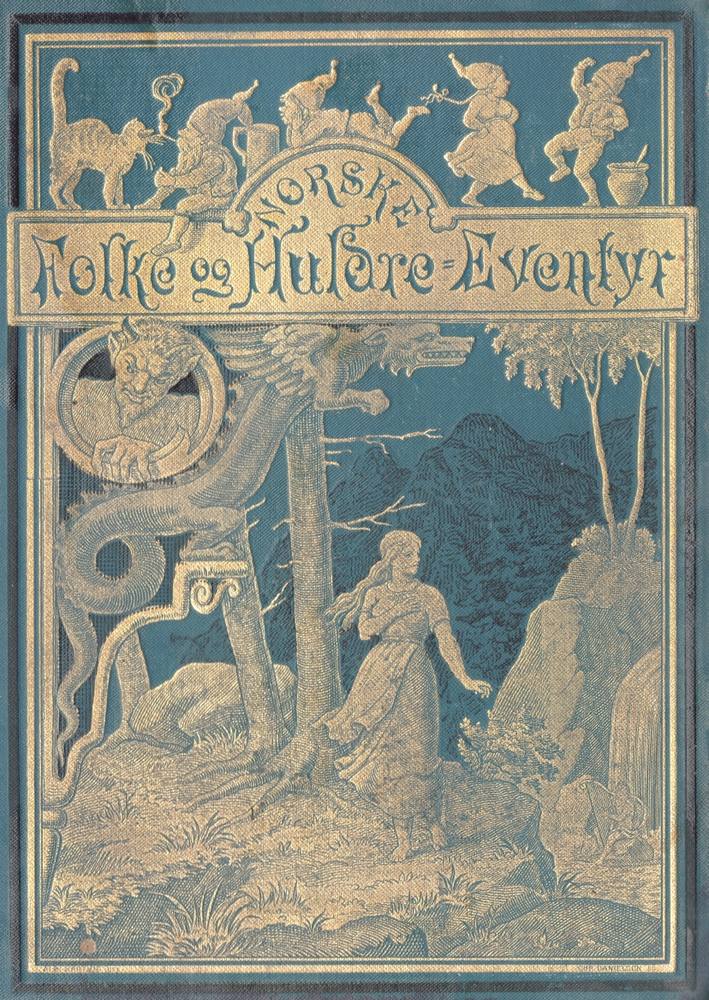
The huldra owes her worldwide fame mainly to the nineteenth century. The zoologist and folklorist Peter Christen Asbjørnsen published the two volumes of Norske Huldre-Eventyr og Folkesagn, "Norwegian Hulder Tales and Folk Legends", in 1845 and 1847. Unlike the famous Norske Folkeeventyr, he wrote this work without his partner Jørgen Moe. He wrapped the legends in frame stories: the narrator walks, fishes or hunts, sits down with locals and hears their accounts of the huldra, the nøkk and the underground people. The frames are literary constructions, but the legends embedded in them go back to genuine oral tradition.
Henrik Ibsen drew on these volumes. For his verse drama Peer Gynt (printed 1867) he took material from Asbjørnsen's mountain stories, including the legendary Peer Gynt himself and the buck-ride episode. In the second act Peer meets three dairymaids calling out for trolls, and then the "Woman in Green". She claims to be the daughter of the Dovregubben, the Mountain King. Note this carefully: in Ibsen she is a troll princess, not a huldra in the strict sense. But the scene clearly feeds on the huldra world: a seductive beauty in the woods, summer pasture, mountain, a realm you cannot enter with impunity. To become the king's son-in-law, Peer is to adopt troll customs – right down to having a tail tied on.
For the premiere in Christiania in 1876, Edvard Grieg wrote the incidental music. You certainly know "In the Hall of the Mountain King", even if you have never been to the theatre. That fixed the image for good: Norwegian mountains, dark halls, beautiful and dangerous women. Hear the word "huldra" today and you may well have Grieg's bassoons running through your head.
Other writers took up the figure as well. The poet Aasmund Olavsson Vinje, for instance, describes in his travel memoir of 1861 a visit to a summer farm where a dairymaid is jokingly called "Huldra". The huldra became part of the national self-image: wild, beautiful, slightly uncanny, closely bound to the landscape.
Ride the Flåm Railway today and you meet her in person. The roughly 20-kilometre line between Myrdal and Flåm was completed in 1940 and is regularly described as one of the steepest standard-gauge railways in the world. At the Kjosfossen waterfall, whose free fall measures 93 metres according to the operator, the train stops for about five minutes. In the summer season a woman in a red dress then appears on the slope above, dances to music from loudspeakers and disappears again among the rocks. The huldra show.
This is staged tourism, and nobody there pretends otherwise. It is still remarkable. The performance picks up exactly the old motifs: appearing and vanishing, music, the luring call, the beauty on the mountainside. For many travellers from around the world, this is their first and only encounter with the huldra. Our view: as long as you know it is a show, it is a lovely greeting from a living storytelling world. There is no reason, though, for historical kitsch about "Viking goddesses".
Legends are not factual reports, but they are honest testimony. The huldra tells us a great deal about the people who spoke of her. About young men working alone in the forest and thinking about women. About dairymaids hearing voices on the fell at night. About farmers who knew that a pasture season depended on weather, grass and luck, and who would rather share that luck with unseen neighbours than gamble it away. And about a Christian society that did not stamp out the strange but found a place for it: married in church, the huldra becomes a wife.
What we like most about her is the moral running beneath every variant: treat the land and its inhabitants decently. Say nothing about the tail. Do not stay too long when the time is up. Not a bad rule for anyone who turns a piece of slate or wood into something lasting. If you would like the huldra as a motif, we recommend showing her as what she is: a figure of folk legend, not a "Viking goddess". A pine forest, a summer pasture, a cow's tail under a skirt – that is all it takes. You will find a related protective idea from the same storytelling world in the troll cross, and an Icelandic relative with rather unappetising habits in the tilberi.
What is a huldra? A female figure of Norwegian folk belief: a beautiful woman with a cow's tail or a hollow back who appears in the forest and on summer pastures, owns cattle and can seduce men. In Sweden her closest equivalent is the skogsrå.
What does the name huldra mean? It goes back to Old Norse hylja, "to hide", and means "the hidden one". The reading "the gracious one" rests on a word that sounds the same but is unrelated.
Why does the huldra have a cow's tail? The tail or the hollow back is the tell-tale sign that exposes her as non-human despite her human beauty. In the legends she loses it when she is married in church or baptised.
Is the huldra in the Edda? No. Snorri mentions a sorceress named Huld, and a lost Huldar saga is recorded for the thirteenth century. Whether these are connected to the later huldra is an unproven theory.
What is the difference between a huldra and a skogsrå? Both are beautiful forest women with a giveaway back. The Norwegian huldra is more closely tied to summer pastures, cattle and the huldrefolk; the Swedish skogsrå to forest, game, hunters and charcoal burners.
Where can you see the huldra on the Flåm Railway? At the Kjosfossen waterfall, where the train makes a short stop. In summer a performer dances there as the huldra – a tourist show, not an ancient tradition.
For courage. For remembrance. For legends that live on.
The Draugr – the walking dead · The Trolls · Nisse & Tomte · Seiðr – the magic · The Wild Hunt.
All Beings & Creatures articles →
Before Brokkr and Sindri forged the hammer, others were at work: the sons of Ívaldi. Three wonders came out of their …
Read more →Far below, where the roots of the World Tree reach down into cold and darkness, lies a creature that never rests …
Read more →Between crown and root of the World Ash Yggdrasil scurries a small, restless creature: Ratatoskr, the squirrel. It …
Read more →