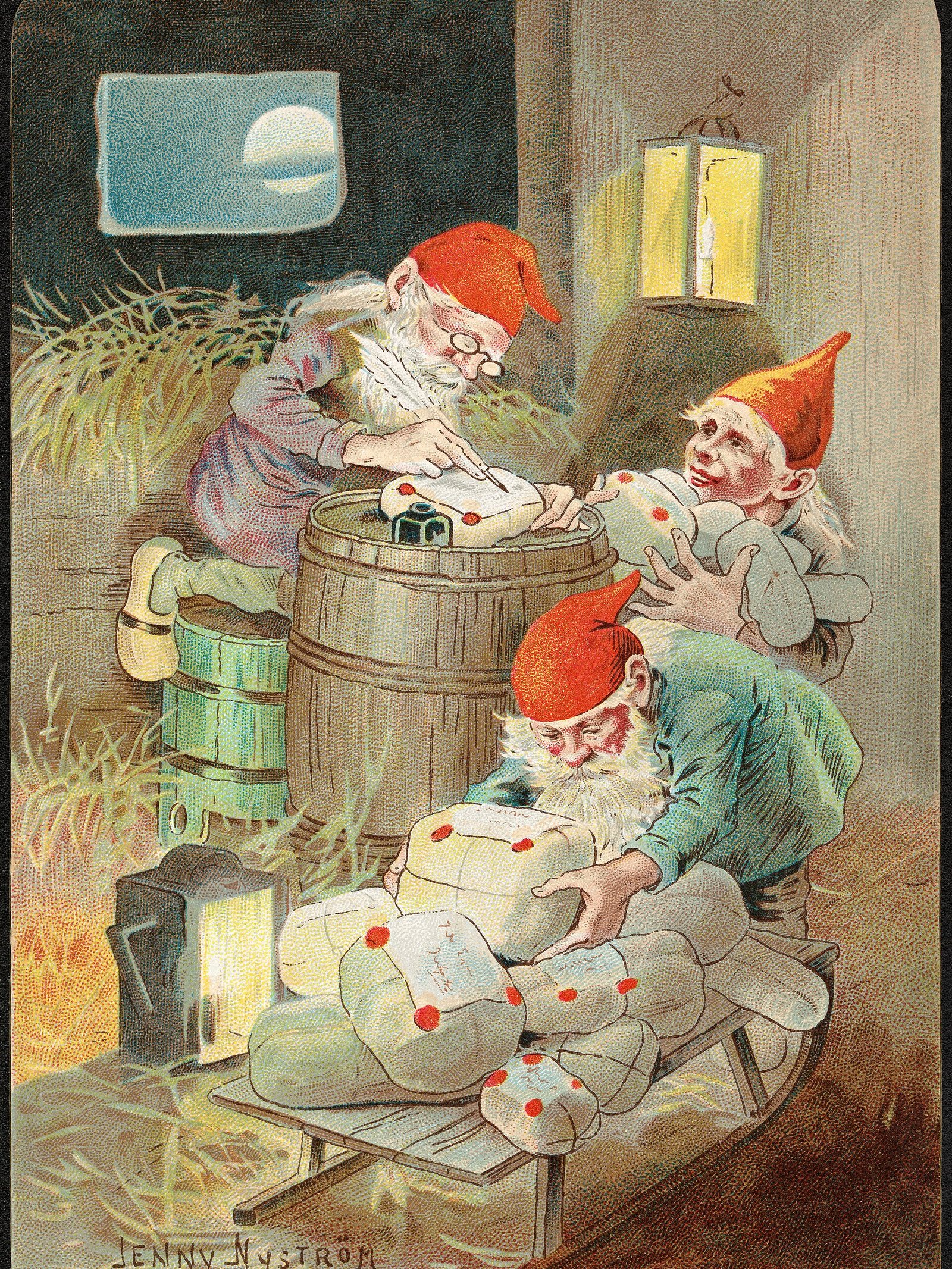
The nisse (Denmark, Norway) and the tomte (Sweden) are one and the same Scandinavian farm spirit: a small old man who invisibly tends barn and house, demands his bowl of porridge with butter at Christmas, and turns vicious if you forget it. He is traceable from the late Middle Ages but only really comes into focus in the early modern period. The kindly, red-capped gift-bringer is a 19th-century creation of painters, poets and Christmas cards. Here we separate the layers of time.
Picture a winter night on a farm in Småland or Jutland, sometime around 1850. The fire has burned low, the cows breathe in the byre, the frost cracks outside. And somewhere between the hayloft and the horse's manger, people believed, someone nobody sees is making his rounds: the tomte, the nisse. He checks whether the horse got hay rather than straw. He notes who worked on Sunday and who swore in the stable. And he remembers very precisely whether his porridge was waiting for him on Christmas Eve.
Today the same figure meets you as a felt gnome on the windowsill. Centuries lie in between, and with the nisse, what is documented, what folklorists suspected and what Romantics wished were true get mixed up constantly. So we take it one layer at a time.
A quick map first:
In folk belief as the 19th-century collectors wrote it down, the nisse or tomte is a single spirit per farm. He usually lives in the hayloft, under the stable threshold or in a corner of the barn. He is small – the size of a child is often mentioned – yet enormously strong and fast. He wears the clothes of a farmer of his day: grey homespun, knee breeches, a red cap. Swedish records speak of an old man with a wrinkled face; the Dane Axel Olrik, on the other hand, stressed that the older Danish nisse was rather beardless, like a boy. The full white beard is a later addition.
Mostly he stays invisible. You recognise him by his work: in the morning the cattle are groomed, the horse gleams, and there is more grain in the store than was ever brought in. The farm spirit is above all a spirit of thriving. He brings the farm "luck" in the most concrete sense: healthy animals, full barns. Some legends say he steals that luck from the neighbours, carrying grain across the fields stalk by stalk.
His names change from region to region. In Sweden he is the tomte or tomtegubbe ("old tomte"); in Scania, Halland and Blekinge the goanisse; in Uppland people speak of the gårdsrå, the "farm warden". In Norway, alongside nisse, you find tuftekall ("homestead fellow"), tunkall ("yard man"), gardvord ("farm guardian") and haugkall or haugbonde, the "mound man" or "mound farmer". In Finland his counterpart is the tonttu. Iceland is the odd one out: there is no nisse there, but there are the thirteen Yule Lads, the Jólasveinar and their mother Grýla – a tradition of its own, and a great deal rougher.
The Swedish name is the easier one. Tomte belongs to tomt, "building plot, homestead site", Old Swedish tompt, Old Norse topt or tupt – the same word that gives Norwegian tuft and therefore the tuftekall. The tomte is literally "the one of the homestead", the spirit of the plot. The basic meaning "spirit of the place" is not in dispute; the Dane Henning Frederik Feilberg devoted the first major monograph to the figure, "Nissens historie", in 1918. Tomtegubbe simply means "old tomte"; female tomtar or tomte children barely appear in the older records.
Nisse, by contrast, is a personal name. The prevailing view is that it is a pet form of Niels or Nils – in other words, of Nicholas. Danes called their house spirit "lille Niels", little Niels. Jacob Grimm already thought so. German household goblins carry everyday names too, such as Hinzelmann.
When the name arose is disputed: Falk and Torp thought of an import from Germany after the Reformation, Egil Birkeli of the 13th or 14th century. According to Store norske leksikon the word travelled from Denmark to Norway. A derivation from Old Norse niðsi, "dear little kinsman", has not caught on.
The oldest written trace leads to 14th-century Sweden. Old Swedish texts from the circle of St Birgitta (d. 1373) mention tompta gudhi, the "gods of the homestead", to whom one must not make offerings – the clergy forbid it. That is remarkable: the first piece of evidence is a prohibition, and it explicitly speaks of gods, not of harmless house sprites. What exactly the farmers venerated, the text does not say. But it shows that in the late Middle Ages there was a cult of beings tied to the farm that the Church regarded as heathen.
The next major witness is Olaus Magnus, the last Catholic archbishop of Uppsala, who lived in Rome after the Reformation. On his famous map of the North, the Carta Marina of 1539, and then in his "Historia de gentibus septentrionalibus" (History of the Northern Peoples, Rome 1555), he shows little spirits tending horses and sweeping in the stable. Olaus calls them demonic household spirits, spiritus familiares in Latin. That he means the tomte is very likely, even though the name never appears.
In Denmark-Norway the name nisse turns up in the late 16th century. The folklorist Tommy Kuusela points to the Danish "Sjælebog" (Soul Book) of Hans Lauritsen, 1587, which calls the house spirit puge – related to "Puck" and Swedish puke – and also uses the word nisse. For this Lutheran author the nisse is nothing but a little devil. A Norwegian legal text from around 1600 speaks of "Nisse pugen". In Finland, too, the reformer Mikael Agricola lists a tonttu in the 16th century among the beings the Finns worshipped.
The same line runs through the early modern period: Olaus Swebilius's catechism of 1689 lists tomtegubbar alongside trolls and water spirits as forbidden objects of superstitious worship. Such bans probably did more to publicise the belief than to stamp it out.
Now comes the exciting but uncertain part. Since the 19th century many scholars have seen in the nisse the descendant of a much older being: the ancestor who cleared the farm, lies buried in a mound on its land, and watches over his descendants from there. The Norwegian names haugbonde ("mound farmer") and gardvord ("farm guardian") seem to say exactly that. Store norske leksikon puts it this way: in Norwegian tradition the nisse replaced the gardvord, the farm's founder and first clearer, who was often buried in a grave mound on the farm and who received food and ale at the great festivals, above all at Christmas.
Is there support for this ancestor idea in old sources? Some, yes – but none that names the nisse himself:
Grave mounds on the farm: Archaeology shows clearly that Iron Age and Viking Age burial mounds often lay right next to the farm, visible to every generation. Farm and dead belonged together. You can read more about what these farms looked like in our article on the Viking longhouse.
The king in the mound: "Óláfs þáttr Geirstaðaálfs", a short tale in the Flateyjarbók (late 14th century), tells of the petty king Óláfr who after his death was venerated in his mound at Geirstaðir as an álfr, an elf: people sacrificed to him for good harvests. A dead man in a mound who brings the land prosperity – that is the structure we meet again in the farm spirit. The source, however, is Christian, late and literary.
The elf sacrifice: In his "Austrfararvísur" (Verses on an Eastern Journey, c. 1019), the skald Sigvatr Þórðarson describes being turned away from farm doors one evening while travelling through Götaland, because an álfablót, a sacrifice to the elves, was taking place inside and strangers were not admitted. That is a contemporary record of household cult directed at beings associated with prosperity and the ancestors. We have discussed what the elves actually were in our article on the Álfar (elves).
Add to this related ideas we cover in their own articles: the landvættir as spirits of whole regions, the dísir as female protective powers of the kin, fylgja and hamingja as personal and family luck, and ancestor veneration at Yule, when the dead return home for the midwinter feast.
Tellingly, folk tradition itself offers several explanations. Swedish records sometimes say the tomte is the spirit of the person who first settled the site, sometimes of the one who first lit a fire in the house, and sometimes – far less venerably – a man who moved boundary stones in life and found no rest after death. Folk belief was never a closed system. The farm spirit also shares features with trolls, dwarves and the "underground people"; compare our articles on trolls and dwarves.
No motif is as firmly tied to the nisse as his porridge. On Christmas Eve, so the custom went, you set a bowl of porridge in the barn or the hayloft with a generous knob of butter on top – the "butter eye", Norwegian smørøye. In Norway it was traditionally rømmegrøt, sour-cream porridge; today it is usually rice pudding. The Danish encyclopaedia adds sweet porridge every Saturday evening and before holidays.
What matters is the nature of this offering. It is not a gift of kindness but a wage: the farm spirit works all year, so like any farmhand he is owed his share. If the payment fails to appear, he quits – or he takes revenge.
The best-known story about it survives in many versions. A farmhand or the farmer himself wants to play a trick on the nisse and hides the butter at the bottom of the bowl. The nisse sees no butter, flies into a rage and kills the best cow in the byre. Then he eats anyway, finds the butter at the bottom – and is sorry. In some versions he drags an identical cow over from the neighbouring farm that same night to make good the damage. Funny and brutal at once – that is the farm spirit: hot-tempered, yet bound to the farm.
Kuusela's phrase hits the mark: the tomte is a mirror image of the hard-working farmer. He loves order, diligence, quiet, clean stables and well-fed animals, especially horses. He hates noise, swearing, card games, drunkenness, Sunday work and idleness. Anyone who skips the sweeping on Christmas Eve or lets the livestock go hungry will have him to deal with.
His punishments range from pranks to disaster. He plaits the cattle's tails together, sours the cream, spills the milk, breaks the horses' harness, boxes the farmhand's ears in his sleep. In serious cases he kills animals. And the worst threat of all: he leaves the farm and takes its luck with him. In this logic a farm without a nisse is a farm on the way down.
At the same time he is loyal to the point of self-sacrifice. There are stories of tomtar pausing while hauling grain and being eaten by wolves, and of nisser who jump onto the cart when the family moves house.
Those who claimed to have seen him describe an old man, sometimes one-eyed, sometimes with glowing eyes; he can turn into animals – cat, goat or horse – and his laugh, some tellers say, sounds like a horse's whinny. Kuusela also stresses that his moral code fits the Lutheran work ethic of the early modern period remarkably well. That is an important point: the farm spirit we know from the collections is a creature of early modern agrarian society, with farmhands, maids, Sunday rest and stable chores. Move him straight into the Viking Age and you skip this whole layer.
The Danes took the first big step. Just Mathias Thiele began collecting his "Danske Folkesagn" in 1818 (published until 1823) and introduced the farm nisse to an urban reading public. The artists of the Danish Golden Age picked it up. The Danish encyclopaedia lex.dk names a depiction by Constantin Hansen from 1836 as the earliest evidence of a distinct Christmas nisse. In the 1840s Johan Thomas Lundbye drew his influential nisser; a woodcut after his design from 1842 shows the nisse feeding a white horse. Around 1850 the nisse even got a wife in pictures, the nissekone – in old folk belief he was a bachelor.
And so the julenisse was born: a small house spirit who now appears only at Christmas and brings children presents. Later in the 19th century the tall, bearded julemand, modelled on Father Christmas and Santa Claus, joined him. By around 1900 Danes simply called both of them "nisser".
In Sweden a poem tipped the balance. Viktor Rydberg (1828–1895), novelist, historian of religion and himself author of a sprawling Germanic mythology, published the poem "Tomten" in the magazine "Ny Illustrerad Tidning" in 1881. It opens with lines almost every Swedish child still knows:
"Midvinternattens köld är hård, / stjärnorna gnistra och glimma. / Alla sova i enslig gård / djupt under midnattstimma."Viktor Rydberg, Tomten (1881), opening, public domain. Our rendering: Hard is the cold of the midwinter night, the stars sparkle and glimmer. All are asleep on the lonely farm, deep in the midnight hour.
Only one is awake: the tomte. He walks through the silent night, looks in on the cows and the horse, the sheep and the dog, steps up to the beds of the sleeping children. And then he does something the farm spirit of the legends never did: he broods. Over the eternal riddle of where the generations come from and where they go – the generations he has watched come and pass on this farm. He finds no answer. At the end the poem circles back to its beginning: cold, stars, sleep, and the tomte keeping watch.
This is a sharp break with tradition. Rydberg's tomte is not hot-tempered; he kills no cows. He is a quiet, almost melancholy guardian of the chain of generations – which makes him, of all things, a poetic version of the very ancestor hypothesis scholars like Rydberg held. The tomte as keeper of the kin from generation to generation is literature here, not folk belief. Astrid Lindgren turned the poem into a picture-book prose version in 1960, illustrated by Harald Wiberg, and that is how it became known internationally.
The pictures of the Swedish Christmas tomte come from Jenny Nyström (1854–1946) of Kalmar. At just 17 she drew illustrations for Rydberg's Christmas story "Lille Viggs äfventyr på julafton" (Little Vigg's Christmas Eve Adventure), which appeared as a book in 1875; in 1881 she also illustrated "Tomten". At the time she was working for "Ny Illustrerad Tidning", where the poem appeared. Kalmar County Museum credits her with proposing the tomte instead of the Yule goat as the bringer of children's presents. Her tomte is friendly, round, red-capped, white-bearded and fond of children. According to the museum she painted six to seven thousand tomtar in her lifetime, for Christmas magazines such as "Jultomten" (from 1891) and, from 1911, under contract to the card publisher Axel Eliasson. Her cards are still being reprinted.
Folklorists viewed the transformation critically: Carl Wilhelm von Sydow suspected the influence of English Father Christmas cards, and Gunnar Landtman complained in 1922 of idealised simplification. The Nationalmuseum in Stockholm honours Nyström as the one who gave the jultomte his look and character. Both are true: she invented him, and she defused him.
In Norway, Wilhelm Larsen drew the first Norwegian julenisse card in 1883. Since then the figure has branched out in every direction. Today's Norwegian julenisse is often a portly Santa on the American model, while the small, lean farm nisse lives on beside him. Store norske leksikon stresses, incidentally, that the julenisse and the old farm nisse originally had nothing to do with each other: the gift-bringer derives from St Nicholas, and the two share only a name – which itself goes back to Nicholas.
Worldwide, the Scandinavian "gnome" with the pointed hat pulled over his face has become a décor hit – a friendly grandchild of Nyström's tomte, barely related to the cow-killing farm spirit.
Let's pull the threads together. What is documented: people in the Viking Age lived on farms beside the mounds of their forebears; they sacrificed to the elves in their houses; they knew guardian spirits of land, kin and person; and Yule was the time when the dead were near. Also documented: in the 14th century the Swedish Church forbids offerings to "homestead gods", in the 16th century Olaus Magnus shows stable spirits, and from the late 16th century the house spirit in Denmark-Norway is called "nisse". What is not documented is the bridge in between. That the nisse is the heir of the Viking-Age ancestral spirit remains a well-argued but unprovable assumption.
For us that's no flaw. When we engrave motifs for Christmas, we try not to blur the layers: a Rydberg verse belongs to the 19th century, an elf sacrifice to the Viking Age. Both can sit side by side on the table – just with the right date attached.
What is the difference between a nisse and a tomte? Essentially none. Nisse is the Danish and Norwegian name, tomte the Swedish name for the same farm spirit; in southern Sweden he is also called goanisse.
Where does the name nisse come from? The prevailing view is that nisse is a pet form of Niels or Nils, i.e. of Nicholas. Tomte, by contrast, comes from tomt, "homestead site, building plot".
Why do you leave porridge for the nisse at Christmas? The porridge with butter is his wage for a year's work. If it is missing or lacks butter, tradition says he takes revenge with pranks or harm to the livestock.
Did the Vikings believe in the nisse? He does not appear in Viking-Age sources. There were related ideas of ancestors in mounds, elves and land spirits; that the nisse grew directly out of them is a hypothesis.
Who invented the Christmas gnome? In Denmark, painters such as Constantin Hansen and Johan Thomas Lundbye from the 1830s; in Sweden above all Viktor Rydberg's poem "Tomten" (1881) and Jenny Nyström's pictures.
Is the nisse good or evil? Both. He is diligent and loyal as long as he and the animals are treated decently, but becomes hot-tempered and vengeful when offended.
For courage. For remembrance. For legends that live on.
The Trolls · The Huldra · The Draugr – the walking dead · The Rauhnächte & Mother's Night · Ancestor veneration at Yule.
All Beings & Creatures articles →
Between crown and root of the World Ash Yggdrasil scurries a small, restless creature: Ratatoskr, the squirrel. It …
Read more →Without the giants there would be no Norse world – in the most literal sense. Out of a giant it arose, against the …
Read more →In Valhalla an eternal feast holds sway – provided by a single animal that never runs out: the boar Sæhrimnir.
Read more →Two wolves race across the firmament – one after the sun, the other after the moon. It is the oldest chase in the …
Read more →