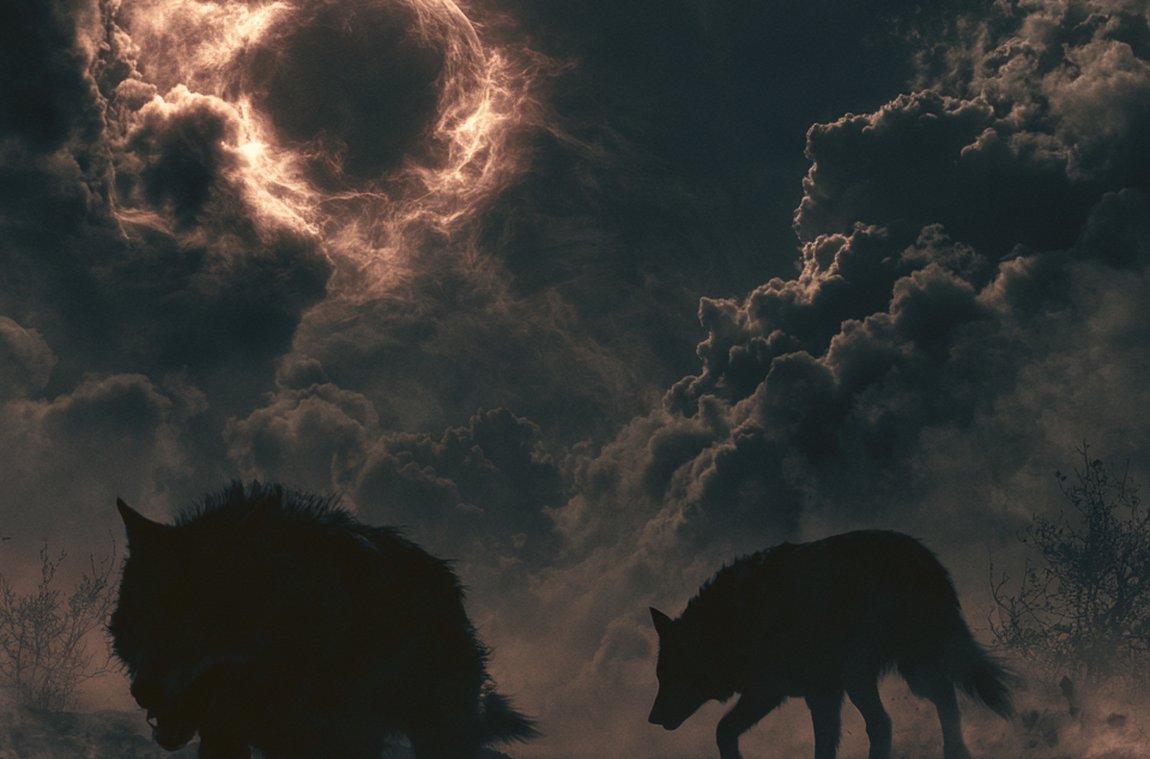
Two wolves race across the firmament – one after the sun, the other after the moon. It is the oldest chase in the world, and it ends only when time itself breaks apart: on the day of Ragnarök. These are Sköll and Hati.
Why do the sun and moon race so hurriedly across the sky? The North gave a dark, magnificent answer: they are fleeing. Always. From two wolves that never tire.
According to the Poetic Edda, Sköll – the name means „mockery" or „scorn" – follows the shining sun-chariot, while his brother Hati – „hatred" – runs ahead of the moon and drives it on. Day and night, summer and winter: the heavenly lights have no rest, because the jaws are at their heels. This chase also explains why Sól and Máni never stop – and why their horses must run so fast.
“Sköll is the wolf who follows the shining god / to the sheltering wood; / and Hati, the son of Hróðvitnir, / races ahead of the bright bride of heaven.”— Grímnismál 39, after Karl Simrock (public domain)
Here it gets complicated – and, honestly, even scholars cannot fully agree, because the two great sources say different things. In Snorri’s younger Prose Edda (c. 1220) the matter is neatly divided: Sköll hunts the sun, Hati the moon. That is the version you read almost everywhere today.
But the older poem Grímnismál – Snorri’s own source – says the exact opposite, if you look closely. There Sköll follows the „shining god" and Hati the „bright bride of heaven". The catch lies in grammatical gender: „god" is masculine, „bride" feminine. Since in the North the sun is female (Sól) and the moon male (Máni), in the Grímnismál it is Sköll who chases the masculine moon and Hati the feminine sun – the roles are swapped.
Where does the confusion come from? Snorri, writing as a Christian some two centuries after the conversion, probably „smoothed out" the old, inconsistent verses for his orderly retelling, fixed the assignment – and added a third name, Mánagarmr, on top. In short: the earlier source is the Grímnismál (which implies Sköll = moon); the more often quoted is Snorri’s „Sköll = sun, Hati = moon". The contradiction itself is typical of a myth that lived for centuries by word of mouth before anyone wrote it down.
Hati bears the patronymic Hróðvitnisson – „son of Hróðvitnir". Hróðvitnir („fame-wolf") is a byname of the Fenris-wolf. The two sky-hunters thus belong to the great, doom-laden wolf-kin of the North. In his Edda, Snorri Sturluson tells how an ancient giantess in Járnviðr, the „Iron-wood" east of Midgard, bore a whole pack of wolf-shaped giants – and from this brood come the wolves who will devour sun and moon.
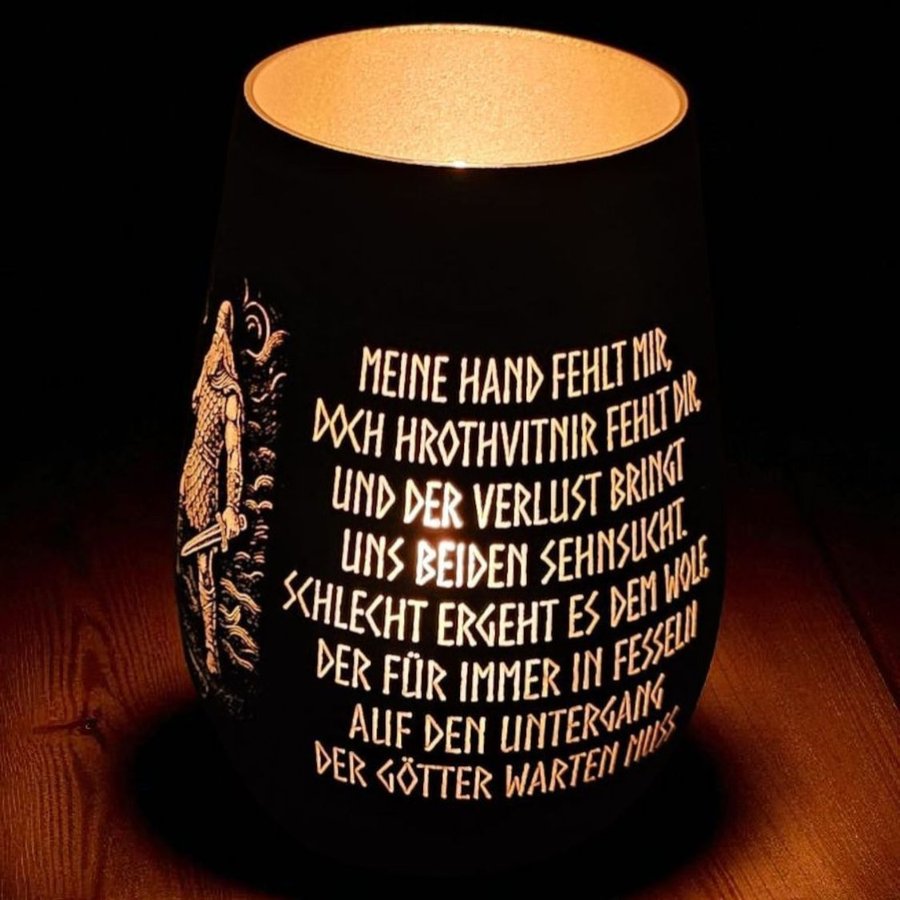
Hróðvitnir – „the famous wolf" or „fame-wolf" – is none other than the Fenris-wolf himself, the mightiest monster of the North, whom the gods could tame only with the magic fetter Gleipnir. So when Hati bears the name „Hróðvitnisson", son of Hróðvitnir, the two sky-wolves are children of the fettered Fenrir. No one came closer to this wolf than the one-handed war-god Týr: he alone dared lay his hand in Fenrir’s jaws as a pledge while the gods bound him – and lost it when the trick was revealed. Of that loss and the longing on both sides speaks the verse on our Týr lantern.
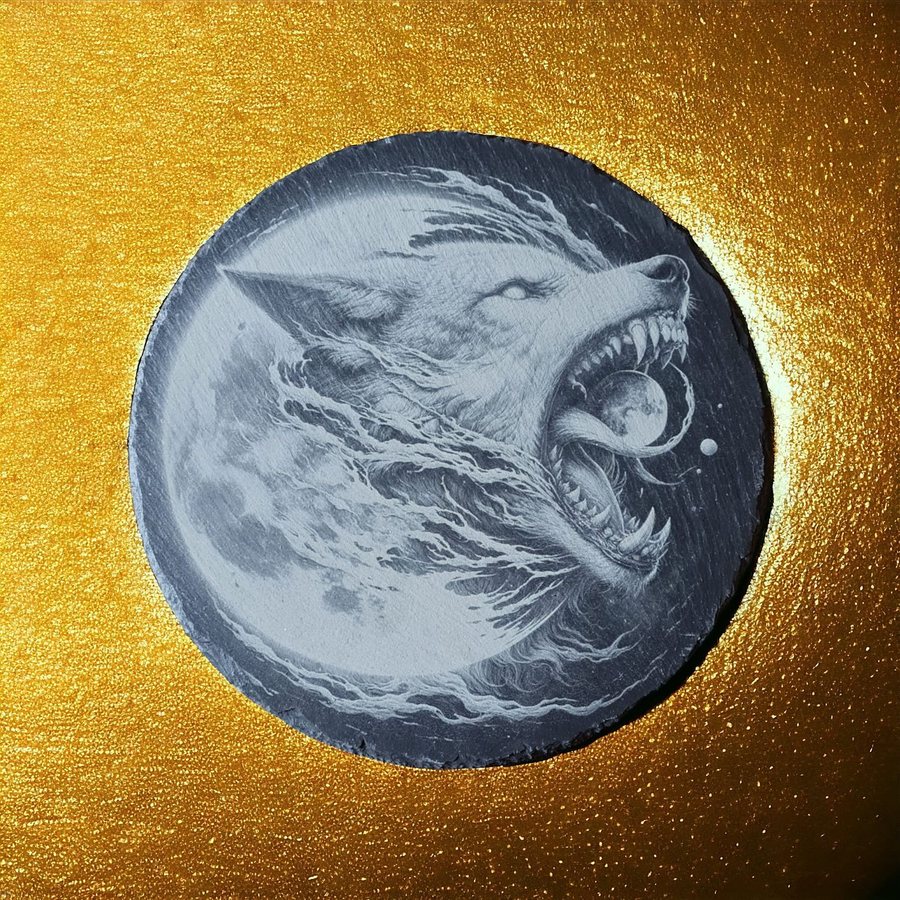
In one place Snorri gets even more specific: the mightiest of these wolves is called Mánagarmr, the „Moon-hound". He will gorge on the flesh of all the dying, swallow the moon and spatter the heavens with blood. Many scholars equate Mánagarmr with Hati – the sources do not fully agree here, and that is exactly what keeps the material alive. For the Norsemen the matter was concrete enough: during a solar or lunar eclipse, folk belief held, the wolf had almost caught its prey. People made noise, shouted and banged on pots to scare the beast away.
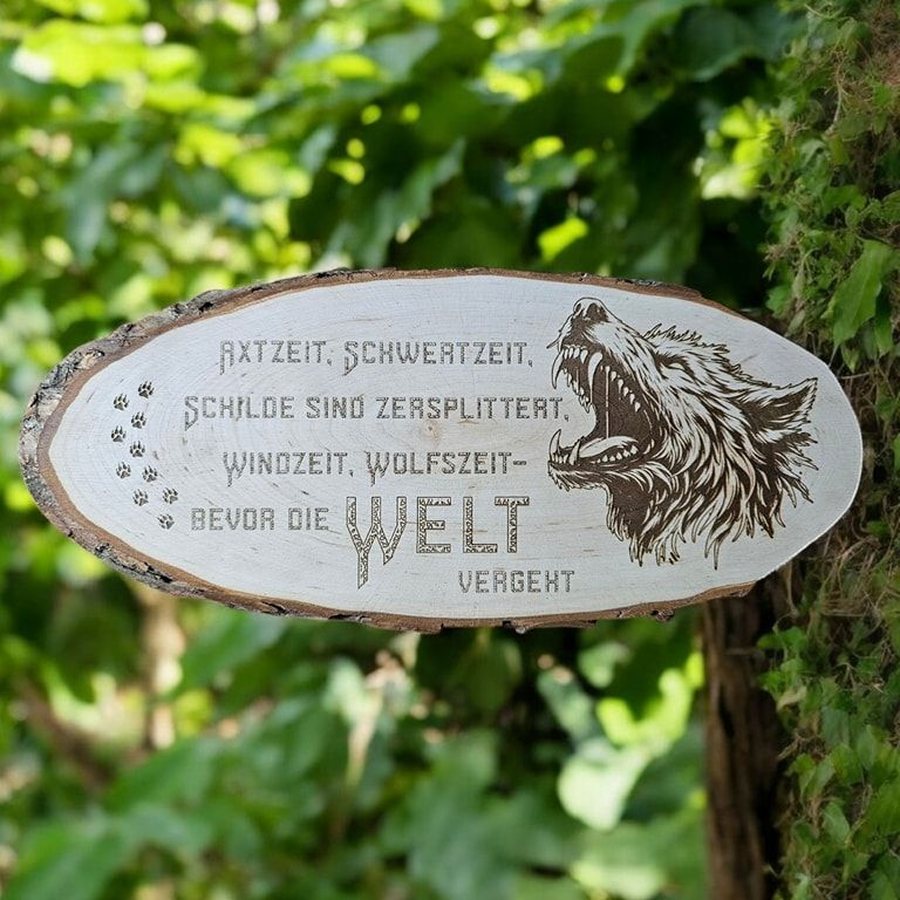
The eternal chase is also a ticking clock. When Ragnarök breaks in, the wolves finally catch what they drove so long: Sköll swallows the sun, Hati the moon. The Völuspá calls this end-time the wolf-age – „wind-age, wolf-age, ere the world falls". The sky darkens, the stars vanish. And yet not all is lost: before she dies, the sun bears a daughter who will rise over the new, green world. The wolves eat the old light – but a new one is born.
“Wind-age, wolf-age, ere the world falls; / no man will show mercy to another.”— Völuspá 45, after Karl Simrock (public domain)
Sköll and Hati are more than monsters. They are the North itself, which lived through the short winter days and the long darkness and forged a myth from it: light is precious because it is hunted. It runs for its life – and we with it. And yet there is comfort in it too: even if the wolves win, the light does not sink forever. It returns, younger and brighter. Hardly any image captures the Norse sense of life more beautifully than these two wolves beneath a burning sky.
Sunna / Sól – the sun · Máni – the moon · The Fenris-wolf · Ragnarök · What comes after Ragnarök.
Grímnismál, Völuspá, Vafþrúðnismál (Poetic Edda), English/German public domain: Karl Simrock (1851); Snorri Sturluson, Gylfaginning. Rudolf Simek, Dictionary of Northern Mythology; J. de Vries, Altgermanische Religionsgeschichte.
All Beings & Creatures articles →
Eight legs, a one-eyed rider and a road that leads all the way down into the realm of the dead: Sleipnir is no ordinary …
Read more →No horse draws the chariot of the strongest god, but two goats: Tanngrisnir („teeth-barer") and Tanngnjóstr …
Read more →Almost everything that makes the gods mighty comes from a single set of hands: those of the dwarves. Thor’s hammer …
Read more →Between gods and humans dwells a third, half-hidden race: the elves (Old Norse álfar). They are bright and beautiful …
Read more →