Sól, called Sunna in Old High German, is the personified sun of Norse and Germanic tradition: a female figure who, according to the Eddas, drives a horse-drawn chariot across the sky every day with a wolf at her heels. Her name survives in two very different places – the Old High German Second Merseburg Charm, written down in the tenth century, and the Icelandic Eddic texts of the thirteenth. Here is what those sources actually say, why the sun is feminine in the Germanic languages, and how the far older Trundholm sun chariot fits in – and where it doesn't.
If you grew up with English, the sun has no gender at all. If you grew up with Latin, it was a man: Sol, brother of the moon goddess Luna. German speakers, meanwhile, still say die Sonne and der Mond – she and he. That small grammatical habit is older than any story about it, and out of it grew a goddess who, in the Eddas, has a husband, a brother, two horses, a heat shield and a wolf on her trail.
We'll walk through the evidence piece by piece, and every time we'll say how old a source is and how much weight it can carry.
Start with the solid ground: grammar. Old High German sunna, Old English sunne and Old Norse sól, along with the poetic Norse sunna, are all feminine. The moon – Old High German māno, Old English mōna, Old Norse máni – is masculine. The picture isn't perfectly tidy: Gothic has a neuter word sauil alongside sunnō, and Old English has sigel next to sunne.
Why two forms at all – one with an l (sól, sauil, Latin sol) and one with an n (sunna, English sun)? Historical linguists reconstruct an Indo-European word for the sun that switched between l and n depending on its grammatical case. The Germanic languages kept both branches. Old Norse even used them side by side: sól as the everyday word, sunna as the elevated, poetic one.
The historian of religion John Lindow considers it likely that Sól is female and Máni male in the myths simply because of the grammatical gender of the nouns: the word came first, the figure second. Lithuanian has a sun goddess too, Saulė – but that doesn't add up to a universal "Indo-European sun woman", because in Greek and Latin the sun is male.
Almost everything we know about Norse gods comes from Iceland. Sunna's name, however, appears in one of the very few Old High German texts that mention pagan deities at all: the Second Merseburg Charm.
The two Merseburg Charms were written in the tenth century by a cleric onto the originally blank flyleaf of an older liturgical book. Today they are kept in the cathedral chapter library at Merseburg, Codex 136, folio 85 recto. The historian Georg Waitz found them in 1841 and passed them to Jacob Grimm, who presented them to the Berlin Academy of Sciences on 3 February 1842. The text is more than a thousand years old and in the public domain:
Phol ende uuodan uuorun zi holza.
du uuart demo balderes uolon sin uuoz birenkit.
thu biguol en sinthgunt, sunna era suister;
thu biguol en friia, uolla era suister;
thu biguol en uuodan, so he uuola conda:
sose benrenki, sose bluotrenki, sose lidirenki:
ben zi bena, bluot zi bluoda,
lid zi geliden, sose gelimida sin.Second Merseburg Charm, Merseburg, Domstiftsbibliothek, Cod. 136, fol. 85r (10th century)
In our own rendering: Phol and Wodan rode into the wood. Then Balder's foal sprained its foot. Then Sinthgunt charmed it, Sunna her sister; then Frija charmed it, Volla her sister; then Wodan charmed it, as well he knew how. Be it bone-sprain, be it blood-sprain, be it limb-sprain: bone to bone, blood to blood, limb to limbs, as if they were glued.
The structure is textbook healing magic: first a short story from the world of the gods as a precedent, then the formula itself. Whoever spoke the charm over a lame horse was calling up the mythical cure and transferring it to the animal in front of them. Strikingly similar "bone to bone" formulas survived into modern times in Christian horse charms, for example in Orkney and Shetland – with Christ in Wodan's role.
Sinthgunt appears nowhere else. No other text, inscription or legend knows the name. Linguistically it breaks down into sind ("way, journey") and gund ("battle"), a common element in women's names, which gives readings like "she who fights her way" or simply "the wanderer". Because Sunna is named as her sister, scholars have wondered whether Sinthgunt was another celestial body – the moon, perhaps, or the morning star. None of this is attested. These are guesses from a name and its neighbour.
Then the grammar: sinthgunt, sunna era suister literally reads "Sinthgunt, Sunna her sister". The usual reading is that Sunna is Sinthgunt's sister. The pattern repeats in the next line with Frija and Volla – and there, Norse tradition tells us that Fulla belongs to the closest circle around Frigg. Which of Sinthgunt and Sunna is the principal figure remains open.
Finally: is this really a sun goddess? Most specialists – including Rudolf Simek and John Lindow in their reference works – take Sunna to be the personified sun, which is hardly surprising, since the word simply means "sun". What the charm does not give us is a cult. No temples, no offerings, no priests. Only the fact that someone in the tenth century named her alongside Frija and Wodan as a healer who sings. And other names in the charm are equally contested – whether Phol is another name for Balder, as Jacob Grimm thought, is still unresolved.
Some three centuries later, in Iceland, the sun gets a family history. Snorri Sturluson tells it around 1220 in chapter 11 of Gylfaginning, the first part of his Prose Edda.
A man called Mundilfari, Snorri writes, had two children so fair and lovely that he named his son Máni (Moon) and his daughter Sól (Sun). He married the daughter to a man called Glenr, of whom we know nothing but the name. The gods took this naming as arrogance. They seized the siblings and set them in the sky. Ever since, Sól has driven the horses that pull the sun's chariot – a chariot the gods had made from the glowing sparks that flew out of Muspelheim. Máni steers the course of the moon and governs its waxing and waning.
So Sól is not the sun itself but its driver – not a primeval being but a human child doing service as a punishment for her father's pride. Snorri isn't entirely consistent, though. In chapter 35, where he lists the goddesses, he adds at the end that Sól and Bil are counted among the Ásynjur, the goddesses of the Æsir.
Snorri drew on older poems. In Vafþrúðnismál, the battle of wits between Odin and a giant, stanza 23 says that Mundilfari is the father of Máni and likewise of Sól, and that they must circle the heavens every day so that people can count the years. There is no punishment there. In this poem, the sun is above all a clock.
If you pull a blazing chariot, you need cooling. Grímnismál, the poem in which Odin, tortured between two fires, pours out his knowledge of the cosmos, has it covered.
Stanza 37 names the sun's horses: Árvakr ("Early-Awake") and Alsviðr ("All-Swift"). Under their shoulders the gods have hidden ísarnkol, literally "iron-cool". Nobody knows exactly what that means. Snorri, who picks up the passage, explains it his own way: the gods set two bellows under the horses' shoulders to cool them, and "in some records" this is called ísarnkol. In other words, Snorri found an old, obscure word and rationalised it with a piece of smithy equipment.
Stanza 38 names a shield, Svalinn, "the Cooling One". It stands before the sun, before the "shining god". Should it fall, mountains and sea would burst into flame. Svalinn turns up once more, in Sigrdrífumál (stanza 15), where the valkyrie lists the places runes were carved: on the shield that stands before the shining god, on Árvakr's ear and on Alsviðr's hoof. Snorri's prose, by contrast, never mentions Svalinn.
Horses with built-in cooling, a heat shield between sun and earth: whoever imagined this had seriously asked why the world doesn't burn. Anyone who works with a laser every day, as we do, can only nod.
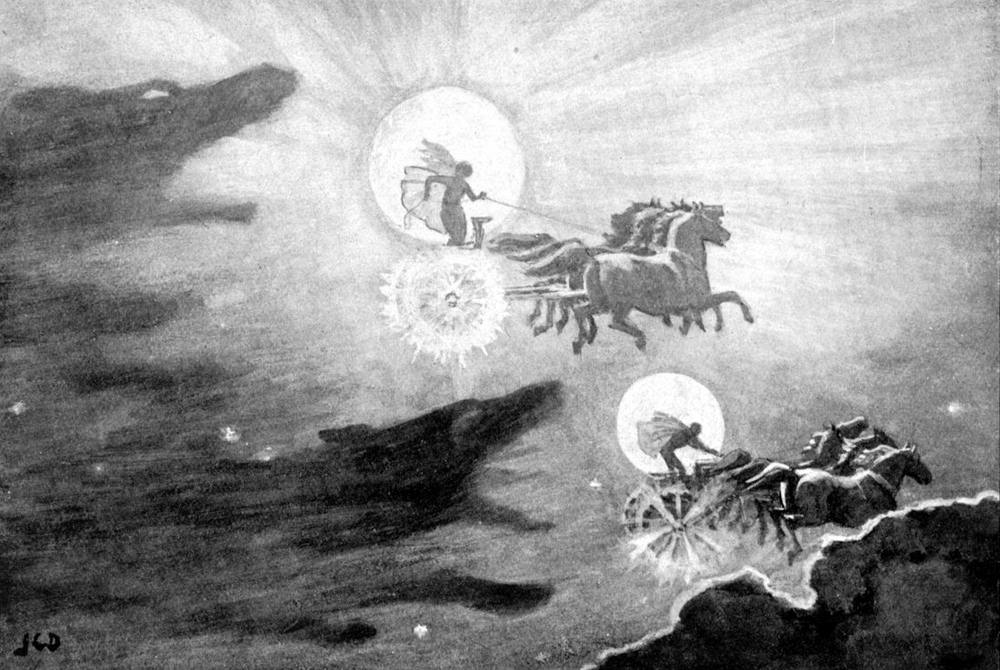
Why is the sun in such a hurry? Because her pursuer is close behind, says Snorri in chapter 12. There are two wolves. The one running behind her is called Skǫll; she fears him, and he will catch her. The one leaping ahead of her is Hati Hróðvitnisson, and he wants to seize the moon.
Snorri adds that a giantess in the Iron Wood (Járnviðr) gives birth to wolves; the mightiest of them, Mánagarmr ("Moon-Hound"), will swallow the moon and spatter the sky with blood, so that the sun loses its light.
Snorri leans on two poems. In Grímnismál 39, Skǫll follows the "shining god" to a sheltering wood, while Hati, son of Hróðvitnir, runs before the "bright bride of heaven". The poem never actually says "sun" or "moon" – the clean assignment comes from Snorri. Hróðvitnir ("Fame-Wolf") is usually taken as another name for Fenrir. And in Völuspá 40–41, an old woman in the Iron Wood in the east raises Fenrir's brood; one of them, in troll's shape, becomes the snatcher of the heavenly light.
There is even a third version. In Vafþrúðnismál 46 it is Fenrir himself who seizes the sun. Henry Adams Bellows suggested back in 1923 that the poet had confused father and son – or perhaps the tradition was never uniform to begin with.
At Ragnarök the sun goes dark. Völuspá 57 (Codex Regius numbering) says the sun begins to turn black, the earth sinks into the sea and the bright stars fall from the sky.
But the sun leaves an heir. In Vafþrúðnismál 47 the giant answers Odin, roughly: Álfrǫðull will bear a daughter before Fenrir catches her; when the gods die, the maiden will ride her mother's paths. Snorri quotes exactly this stanza in chapter 53 of Gylfaginning, where he describes the new world after Ragnarök, and adds that the daughter will be no less beautiful than her mother.
Worth stressing, because it's often misreported: the sun's daughter appears in Vafþrúðnismál and in Snorri – not in Völuspá.
Álfrǫðull is a lovely name in its own right. It means something like "elf-glow" or "elf-beam"; the second element, rǫðull, is a poetic word for the sun, probably related to "red". It also appears in Skírnismál 4, where the god Freyr complains that the sun shines every day and yet not to his liking. Why the sun is linked to the elves, no source tells us.
In Alvíssmál, the dwarf Alvíss wants to marry Thor's daughter. Thor tests him: for every thing in the world, the dwarf must say what it is called among the different races of beings (the full story is in our piece on Thrud and Alvíss).
Asked about the sun (stanza 15), Alvíss gives six names in stanza 16:
Of all beings, it's the gods who say sunna – the same word as the name from Merseburg. A charming coincidence, but no proof of a connection: in Old Norse, sunna was simply the more solemn word.
The dwarfs' name has a bitter joke built in. Dwarfs can't bear sunlight; it turns them to stone. That is precisely how Alvíss ends: Thor keeps him talking until the sun comes up. And the elves' "fair wheel" shows that poets, too, could think of the sun as a wheel.
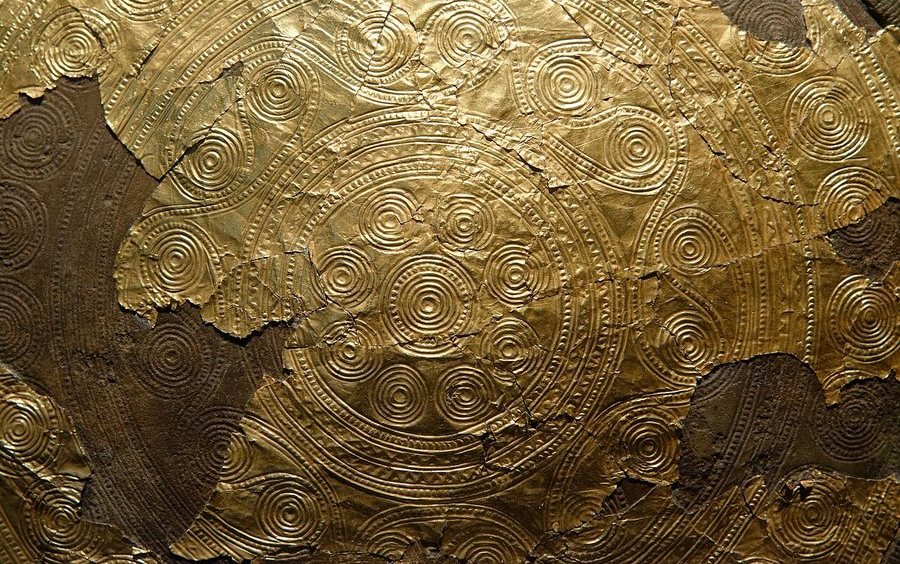
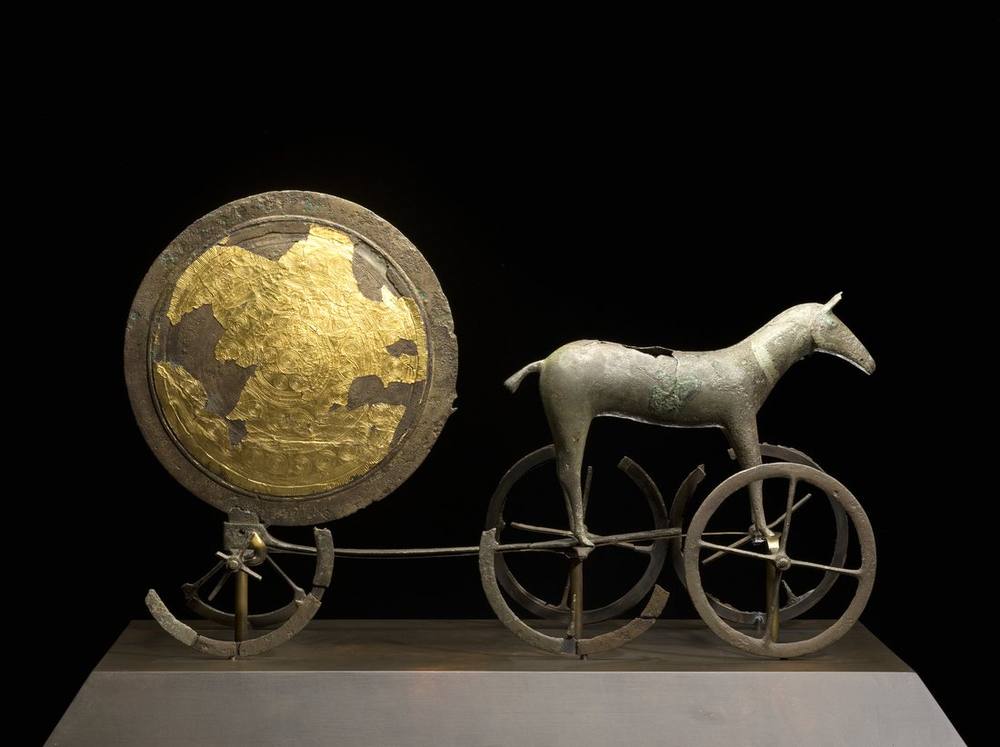
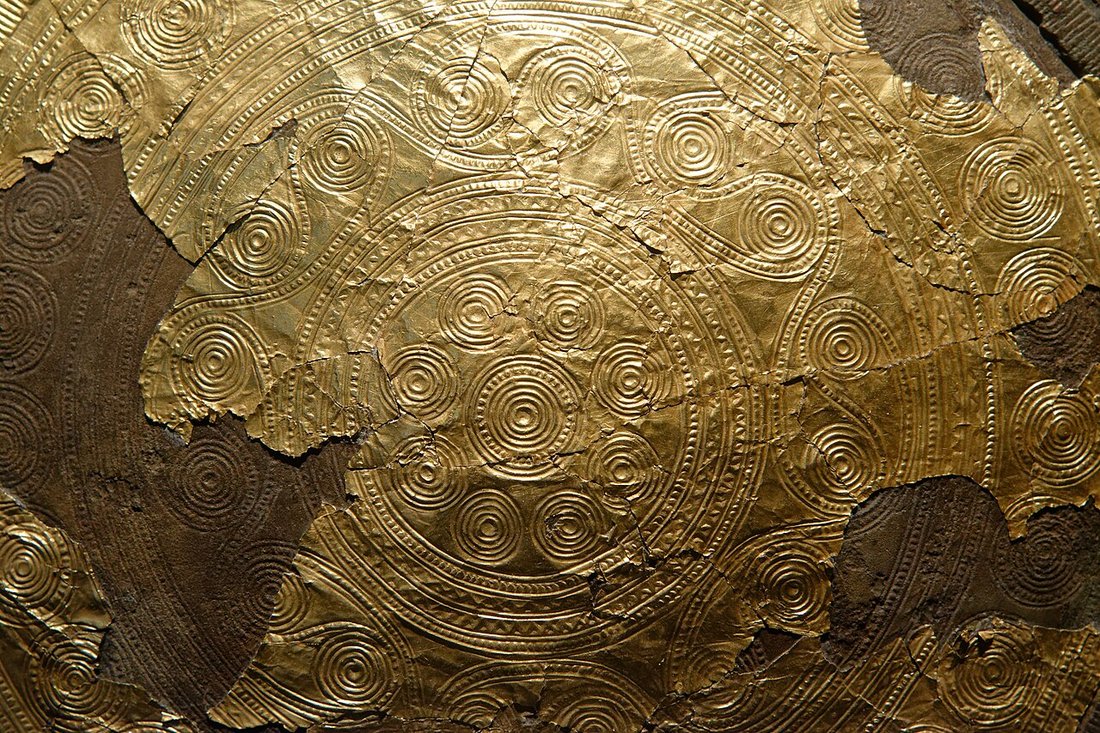
In 1902, a man ploughing in Trundholm bog in Odsherred, on the Danish island of Zealand, turned up a strange bronze object. According to the Danish reference work Den Store Danske, the finder's children played with the horse for a while before the National Museum heard about it. Pieced together, it became one of the most famous finds in Europe: a bronze horse on wheels, pulling an upright disc. The Trundholm sun chariot is about 60 centimetres long, the disc roughly 25 centimetres across. Only one side of the disc is covered in gold foil.
It dates to the early Nordic Bronze Age, the 14th century BC – around 1400 BC. Renewed fieldwork in the late 1990s recovered further fragments and showed that the chariot had been deliberately broken before it was deposited in the bog.
The standard interpretation: the gilded side shows the day sun, the plain bronze side the sun on its night-time return journey – or, alternatively, the moon. The Danish archaeologist Flemming Kaul built on this and many other finds to reconstruct a Bronze Age "sun journey": by day a horse draws the sun, by night a ship carries it back. It is a well-argued reconstruction – but there are no Bronze Age texts to confirm it.
Now the crucial point. Between Trundholm and Snorri lie roughly 2,600 years. The people who cast this chariot did not yet speak a Germanic language; we have no idea whether they imagined the sun as a woman, a man or not as a person at all. Rudolf Simek sees such finds as evidence of how ancient the idea of a horse-drawn sun is, while doubting that they prove a Germanic sun cult.
One symbol keeps coming up whenever the sun is discussed: the wheel. Circles with an inscribed cross – wheel crosses or sun crosses – are among the most common motifs on Scandinavia's Bronze Age rock carvings, for example around Tanum in Bohuslän. Whether every wheel cross means the sun, or sometimes just a wheel, is rarely decidable; and wheel crosses occur right across Europe.
In the 5th and 6th centuries AD, different discs appear on Gotland. The island's earliest picture stones, classified as Type A and dated to roughly 400–600, often carry a large, carefully carved disc with a whirl or rosette pattern in the upper field, frequently with two smaller discs below.
According to Gotland Museum, these discs are commonly interpreted as celestial bodies, and the Swedish archaeologist Anders Andrén has read them as evidence of sun worship. The museum also raises another line of inquiry: very similar spiral and rosette motifs appear on Roman grave monuments in the northern and western provinces, often together with a recumbent crescent moon – which Nordic stonemasons may have reinterpreted as a rowing boat.
The s-rune is reconstructed as *sōwilō in the Elder Futhark, called sól in the Younger Futhark and sigel in the Anglo-Saxon Futhorc (more in our guide to runes). The medieval rune poems gloss it: the Icelandic poem calls the sun the "shield of the clouds", the Norwegian one the "light of the lands", and the Old English poem a hope for seafarers. All three were written in Christian times – and none of them mentions a goddess.
Search for "Sól" and "Edda" and sooner or later you'll hit Sólarljóð, the "Song of the Sun". Don't expect a pagan sun hymn.
Sólarljóð is an Icelandic poem from the Christian period, probably composed around 1200 or in the 13th century; datings vary. It runs to 82 stanzas (83 in some manuscripts) in the Eddic metre ljóðaháttr. A dead father speaks to his son from beyond the grave. He offers advice in the manner of Hávamál, describes his own dying and then visions of hell and heaven – squarely in the tradition of medieval European vision literature.
Its most famous passage is stanzas 39 to 45, each opening with Sól ek sá, "I saw the sun". The dying man looks into the sun one last time, and under his gaze the earthly light turns into a divine one. The sun here is an image of God, not a goddess; a handful of old names and images doesn't change the poem's thoroughly Christian outlook.
Once a week, the sun's old word turns up in your calendar. English Sunday comes from Old English sunnandæg, "day of the sun". In Old High German it was sunnūntag (modern Sonntag), in Old Norse sunnudagr, in modern Danish søndag.
The name, though, is not a Germanic invention. It is a loan translation of Latin dies Solis, the "day of Sol" in the Roman planetary week. Germanic speakers adopted the seven-day week from the Roman world and translated the day names – for Tuesday, Thursday and Friday using their own gods. Exactly when this happened is debated. We tell the full story in our article on Germanic weekday names.
So Sunday doesn't honour Sunna; the Latin word was simply swapped for the native one. Icelandic still calls it sunnudagur – even though the Icelandic church replaced the pagan names of other days, such as Thursday, with neutral ones in the 12th century. The sun was allowed to stay.
Midsummer bonfires as a Germanic sun cult also lack pre-Christian evidence; what the sources really say about midwinter and midsummer is covered in our pieces on Yule and the solstice celebrations.
Sunna is no warrior. She conquers nothing and avenges nothing. She drives the same road every day with a wolf at her back, and she doesn't stop. And when she is finally caught, she has already made provision: a daughter takes up her road.
As a motif for slate or glass, she's a gift, because we don't have to invent anything: a stanza with six names, a healing charm from the tenth century – and a bronze disc older than all the words. A relative in imagery, not a sister in faith.
For courage. For remembrance. For legends that live on.
Who is Sunna in Germanic mythology? Sunna is the personified sun. Her name appears in the Old High German Second Merseburg Charm (10th century), where she helps heal an injured horse; her Old Norse counterpart is Sól.
Is Sól a goddess or just the sun? Both. In Snorri, Sól is Mundilfari's daughter who drives the sun's chariot, and in chapter 35 of Gylfaginning he counts her among the goddesses. No source records a cult for her.
Which wolf chases the sun in Norse mythology? According to Snorri, Skǫll, while Hati pursues the moon. In Vafþrúðnismál, however, it is Fenrir who swallows the sun.
What are the names of the sun's horses? Árvakr ("Early-Awake") and Alsviðr ("All-Swift"), named in Grímnismál 37 and in Snorri's Gylfaginning, chapter 11.
Does the Trundholm sun chariot show the goddess Sól? No. It dates from the Bronze Age, around 1400 BC, long before Germanic languages or the figure of Sól existed; it shows only how old the idea of a horse-drawn sun is.
Máni – the Moon · Sköll & Hati – the Eternal Chase · Ragnarök · The Norns · Kolovrat or Black Sun?.
All Gods & Goddesses articles →
He stood at the beginning and he stands at the end: Surtur, the fire giant, has guarded the border of the burning world …
Read more →No god was so beloved by ordinary people as Thor. With hammer, strength-belt and thunder-chariot he holds the powers of …
Read more →Tyr is the god who knew what order costs – and was willing to pay it with his own hand. Once perhaps the highest …
Read more →He is one of the best-known “unknown” gods: everyone who studies the mythology knows his name – and yet Ullr scarcely …
Read more →