Þrúðr ("Strength") is, according to Snorri Sturluson, the daughter of Thor and Sif – and the bride at the heart of Alvíssmál: the dwarf Alvíss ("All-Wise") arrives to take her home, Thor draws him into a question-and-answer game about what things are called in every world, and he drags it out until the sun shines into the hall. For the dwarf, that is the end. Here is what the poem actually says, what Snorri adds, and why the poem is above all a word-hoard for poets.
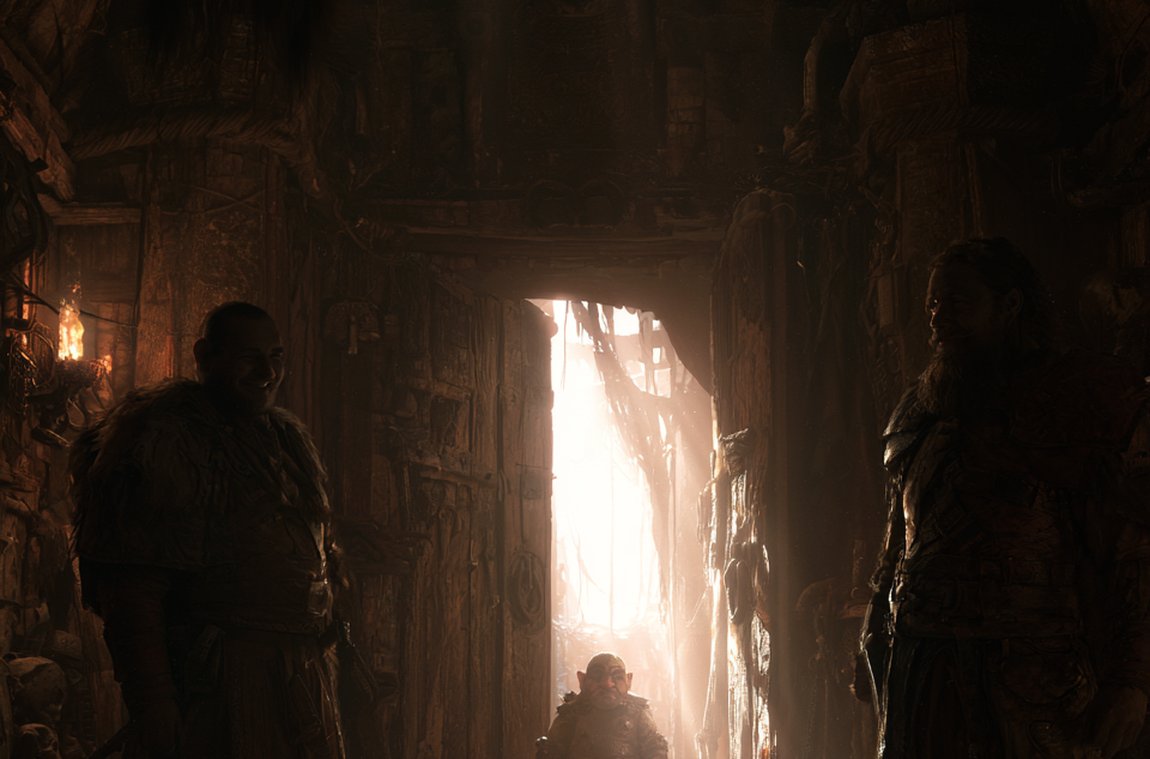
Picture a hall in the last hour before dawn. At the table sits a pale little figure who has been talking for hours without pausing for breath. Across from him, a red-bearded wanderer who still has another question. And another. And another. The pale one has no idea he is losing the game of his life – not because he doesn't know enough, but because he knows too much. This is Alvíssmál, one of the strangest poems of the Edda: a marriage proposal that turns into a vocabulary test, and a Thor story in which the hammer is never swung once.
Before we start, an honest note that many retellings skip: the name Þrúðr never appears in the poem itself. The dwarf wants "the bride", and Thor speaks of himself as her father. That this daughter is called Þrúðr we know from another source – from Snorri. That interplay of poem, handbook and skaldic verse is exactly what makes the figure so intriguing, and so thinly attested.
The name Þrúðr (roughly "Throoth", often anglicised as Thrud) means "power, strength". It belongs to the same word family as þrúðugr ("mighty") and as Thor's own realm, Þrúðvangr, the "Plain of Strength", named in the Edda as his home. A fitting name for a child of the strongest of the Æsir – almost too fitting, as we will see.
The solid evidence for Þrúðr as Thor's daughter comes from the Prose Edda, specifically Skáldskaparmál, the section in which Snorri Sturluson, writing around 1220–1240, teaches young poets how to refer to the gods. There, Thor may be called, among other things, "father of Magni and Móði and Þrúðr" – so Þrúðr stands as a sister next to the two sons you can read about in our article on Magni and Móði. Elsewhere in Skáldskaparmál, Sif appears as her mother. That is worth noting, because according to Snorri Magni's mother is a giantess, Járnsaxa. Þrúðr is therefore the only daughter of Thor whose name survives, and she comes from his marriage to Sif.
Alvíssmál ("The Sayings of All-Wise") is preserved in the Codex Regius of the Poetic Edda, the famous Icelandic manuscript from around 1270, now in Reykjavík. In standard editions the poem has 35 stanzas, almost all in ljóðaháttr, the "song metre" the Edda uses for dialogue poems. There is no narrative prose; everything happens in speech and counter-speech.
It opens with an impatient bridegroom. Alvíss arrives and announces that the bride is to come home with him now; the benches should be made ready for the wedding. The man he meets is Thor – but Alvíss does not recognise him. Thor looks the suitor up and down and mocks him. In our own translation of stanza 2:
"What sort of fellow are you? Why so pale about the nose? Did you spend the night among the dead?"Alvíssmál 2, own translation
Thor goes further: the visitor looks like a þurs, a giant, and was surely not born for a bride. Alvíss replies, unruffled, that his name is Alvíss and that he lives beneath the earth; his place is "under the stone". That establishes him as a dwarf – a creature of the rock that keeps away from daylight. The pallor is no accident. It already hints at the ending.
The real conflict is a legal one. Alvíss insists on a promise: the gods pledged him the bride, and gods do not break their word. Thor counters that the bride's father has the first say, and that he was away when this promise was given. What the gods promised her in exchange for, the poem does not say. Some commentators suggest a reward for smithing work, the kind of thing dwarves usually supply to the gods – but that is speculation, not text.
Alvíss takes the red-bearded stranger for a tramp and sneers at the idea that such a "hero" could claim any rights here. Thor then reveals himself: he is Vingþórr, far-travelled, son of Síðgrani – "Long-Beard", a byname of Odin. Without his consent, the dwarf will not have the girl.
Now Alvíss tries a gentler tone. He means to win Thor's consent quickly, for he desires the "snow-white" maiden. And Thor states his condition: if Alvíss can tell him, from every world, whatever he wants to know, the bride shall be his. What follows is not a fight but an examination.
A note on numbering: Karl Simrock's German translation of 1851 counts 36 stanzas, because like many older editors he inserts an extra stanza in which Alvíss boasts of having travelled through all nine worlds. That stanza is regarded as a late addition and does not stand at this point in the Codex Regius. Stanza numbers therefore differ by one between editions.
Thor now asks thirteen times, always to the same pattern: "Tell me, Alvíss … what is the earth called, which lies before men, in every world?" And each time Alvíss delivers a list: this is the word among men, this among the gods, this among the Vanir, this among the giants, this among the elves, this among the dwarves, this in Hel. The sequence of topics is cosmic and everyday at once: earth, sky, moon, sun, clouds, wind, calm, sea, fire, forest, night, seed – and finally beer.
Not every stanza names every group, and the assignments wobble. Sometimes "the high powers" (upregin) chime in, sometimes the "sons of the gods", and for beer even "Suttung's sons", the giants who, in myth, once guarded the mead of poetry. As early as 1923, Henry Adams Bellows warned against deriving a tidy cosmology from these lists. They are a catalogue of names, not an atlas of the worlds.
A few examples from the Old Norse text show how it works:
One word deserves a second look. The dwarves call the sun Dvalins leika. Dvalinn is one of the best-known dwarf names in the Edda: he appears in the dwarf catalogue of Völuspá and in Hávamál as the one who brought runes to the dwarves. Leika means "plaything, playmate". Simrock boldly rendered it as "the dwarf's deceiver", and that reading is often defended: the sun is the one who plays a cruel game with Dvalinn – because she destroys dwarves.
If that is right, the sun stanza is a piece of black humour in the middle of the poem. In his own dwarvish tongue, Alvíss spells out the word for the very thing that is about to kill him. He knows it, and still he doesn't notice. The other names fit the picture: what is a wheel of light for giants and elves is a danger for the people beneath the stone. For more on the sun in the North, see Sunna and Sól.
After the beer stanza, Thor drops the mask. Never, he says, has he found so much ancient lore in a single breast – and yet the dwarf has been tricked. Rendered closely from the Old Norse (own translation):
"In one breast I never saw more ancient lore. With great guile, I tell you, I have beguiled you: you are caught above ground at daybreak, dwarf, and now the sun shines into the hall."Alvíssmál 35, own translation
That is all. The poem never explicitly says that Alvíss turns to stone. It lets the line stand and leaves the rest to the audience. Most translators and commentators supply the petrification, and with good reason.
The strongest reason lies in another Eddic poem, Helgakviða Hjörvarðssonar. There Atli, one of the hero Helgi's men, keeps the giantess Hrímgerðr busy all night with a flyting until day breaks. Then he mocks her: she now stands there as a stone image, a laughable harbour-mark. The same pattern, then – conversation as a trap, sunrise as a weapon, stone as the result. Add the dwarf's home "under the stone" and the ominous sun stanza, and anyone who heard Alvíssmál in the thirteenth century will have understood what the day does to Alvíss.
The oddest thing about Alvíssmál is Thor himself. In nearly every other story he solves problems with Mjölnir – against giants, against the Midgard Serpent, against Hrungnir. Here he sits up all night asking questions. The poem does not explain why he doesn't simply strike the dwarf down. An obvious explanation is legal: the gods have given their word, and simply breaking a pledge by force would cost honour. By setting a condition that Alvíss freely accepts, Thor leaves the promise formally intact. The dwarf loses not through ignorance but through the clock.
Alvíssmál belongs to a group of Eddic poems usually called wisdom poetry: poems whose content consists mainly of knowledge being tested, wrapped in a contest. The most famous counterpart is Vafþrúðnismál, in which Odin wagers his head against the giant Vafþrúðnir and finally wins with a question only he himself can answer.
The comparison shows how unusual Alvíssmál is. Vafþrúðnismál is about the order of the cosmos: where do earth and sky come from, what happens at the end of the world? Alvíssmál is only about words. Alvíss knows nothing about origins or the future; he knows what things are called. And whereas in Vafþrúðnismál the loser is whoever fails to answer, Alvíss answers every question correctly – and loses anyway. His knowledge is not the solution but the trap. That makes the poem a kind of parody of its own genre, or, more kindly, a clever game with it.
To see what such a poem was for, you need to know how Norse poets worked. Skaldic verse thrives on substitute words. There are two kinds: the kenning, a multi-part circumlocution ("horse of the sea" for ship), and the heiti, a simple poetic synonym ("fold" instead of "jörð" for earth). Because skaldic stanzas followed strict rules of alliteration, internal rhyme and syllable count, poets needed a large stock of words with the same meaning but different sounds.
That stock is exactly what Alvíssmál supplies. For twelve basic things plus beer it offers five to seven alternatives each, neatly sorted and easy to memorise. This is closely related to the þulur, the versified name-lists preserved in manuscripts of the Prose Edda, which list hundreds of heiti for swords, ships, giants or horses. Snorri himself knew Alvíssmál: in Skáldskaparmál he quotes versions of the stanzas on wind and on night as evidence for poetic words. Edward Pettit, whose new edition of the Poetic Edda appeared in 2023, therefore considers it quite possible that the poem served poets as a reference work.
It gets more interesting when you look beyond the North. The idea that gods and humans have different words for the same things is also found in Homer. In the Iliad a river at Troy is Xanthos among the gods and Skamandros among men; a hundred-handed giant is Briareos to the gods and Aigaion to mortals. In a widely cited 1970 essay, the American linguist Calvert Watkins collected such evidence from Greek, Old Indic and Old Norse and interpreted it as the trace of an ancient Indo-European poetic tradition.
Dating Eddic poems is notoriously hard, and Alvíssmál is no exception. Finnur Jónsson wanted to place it in tenth-century Norway. Eugen Mogk and many after him thought instead of the twelfth century, the period when Icelanders were collecting and cultivating the heritage of skaldic verse as a learned art. Several observations support a late date: some of the heiti are otherwise attested only in younger skaldic poetry; the Vanir appear as one "speech community" among several, which sounds more like systematisation than living cult; and the poem's purpose, gathering synonyms, fits well into a milieu in which poetry was consciously taught and learned.
Rudolf Simek and Hermann Pálsson's Lexikon der altnordischen Literatur and most handbooks today follow this line: probably twelfth century, certainly before Snorri's quotations in the 1220s to 1240s. If you are looking to Alvíssmál for a window onto Viking Age belief, be careful. The poem is rather a window into the workshop of high-medieval Icelandic poets – and as such, pretty much unique.
Back to Þrúðr. Her name turns up in a second place in the Poetic Edda, in a completely different role. In Grímnismál, stanza 36, Odin lists thirteen valkyries who are to bring him the horn: Hrist and Mist, Skeggjöld and Skögul, Hildr and Þrúðr, Hlökk and Herfjötur, Göll and Geirölul, Randgríð, Ráðgríð and Reginleif. They, the stanza ends, carry ale to the einherjar. Snorri takes over this list in his Gylfaginning.
Is this valkyrie Þrúðr the same figure as Thor's daughter? The sources do not say. Both are possible. Many valkyrie names are "speaking" names that simply mean battle, noise or strength – Hildr is "battle", Hlökk "din", Herfjötur "army-fetter". Þrúðr, "strength", fits that series without anyone needing to think of Thor's family. Equally, a name belonging to Thor's daughter could have wandered into the valkyrie list. Here the evidence runs out.
A side note for rune enthusiasts: on the Karlevi runestone on Öland, from the late tenth century, which carries a complete skaldic stanza, a dead chieftain is described, on the usual reading, as a "tree of Þrúðr" – a kenning for a warrior in which Þrúðr probably stands for a valkyrie or for battle-strength. The name was therefore already poetic material in pagan times.
One last, puzzling trace remains. In Ragnarsdrápa by the skald Bragi Boddason, one of the oldest surviving skaldic poems, the giant Hrungnir is referred to as Þrúðar þjófr, "Þrúðr's thief". Yet no story in which Hrungnir abducts Thor's daughter is told anywhere. Snorri gives a completely different cause for the famous duel between Thor and Hrungnir, a drunken boast in Asgard. The scholar Margaret Clunies Ross has suggested that a lost myth glimmers through here, similar to the giant Þjazi's abduction of Iðunn. It cannot be proven.
The pattern is striking all the same: twice a being from outside the world of the Æsir wants Þrúðr, a dwarf and a giant, and twice it ends in death for the suitor – once by the sun, once by Thor's hammer. Thor's daughter is above all one thing: a reason for Thor to defend a boundary.
That brings us to the core question about Þrúðr. Was there, in Viking Age belief, a goddess of this name, with her own stories, perhaps her own cult? There is no evidence for it: no place names that clearly point to her, no mention in the sagas, no images. What we have is a speaking name in the family of a god who himself stands for strength. Thor's son Magni means "strength", Móði "courage, wrath", the daughter Þrúðr "strength" again. That looks very much like a family built out of their father's qualities – personifications grouped around a god by poets.
For us in the workshop, the poem has a special appeal. It is a poem about the power of words, and words are what we work with every day when we set runes, names and verses into slate, wood or glass. Alvíss knows seven words for the sun and not a single one that saves him. Thor probably knows fewer, but he knows when to ask. Perhaps that is the hidden moral: knowledge is worth a great deal, judgement even more.
And Þrúðr? She does not speak a single word in the whole poem. She is the bride being bargained over, and the name other poets use. That is exactly why a close look at the sources pays off: read them and you notice how little we know – and how much that little tells.
Who is Thrud in Norse mythology? Þrúðr ("Strength") is, according to Snorri Sturluson, the daughter of Thor and Sif, and so the sister of Magni and Móði. No stories of her own have survived.
What is Alvíssmál about? The dwarf Alvíss wants to marry Thor's daughter, whom the gods promised him. Thor quizzes him on the names of earth, sky, sun and other things in every world until the sun rises and destroys the dwarf.
Is Thrud named in Alvíssmál? No. The poem only speaks of Thor's daughter. The identification with Þrúðr rests on Snorri, who knows Þrúðr as Thor's daughter.
Does the dwarf Alvíss turn to stone? The poem only says the day has caught him and the sun shines into the hall. The petrification is usually supplied, supported by the giantess Hrímgerðr, who turns to stone at sunrise in Helgakviða Hjörvarðssonar.
Is Thrud a valkyrie? A valkyrie called Þrúðr appears in Grímnismál 36. Whether she is the same as Thor's daughter cannot be decided from the sources.
What are heiti in Old Norse poetry? Heiti are simple poetic synonyms, such as "fold" instead of "jörð" for earth. Alvíssmál collects such words in lists and probably also served poets as a word-hoard.
For courage. For remembrance. For legends that live on.
Thor · The Dwarves · Valkyries · Mjöllnir.
The funniest and at the same time most profound Thor story is a string of defeats – that are none at all. On his …
Read more →A poet who fears for his reward, and a lord who lets himself be celebrated: the Vellekla („gold-lack“) by the skald …
Read more →Valhalla is no resting-place for weary souls. It is a barracks of the fallen: a vast hall where the bravest dead fight …
Read more →They are far more than the winged warrior-maidens of the opera: the valkyries decide who falls in battle – and who is …
Read more →