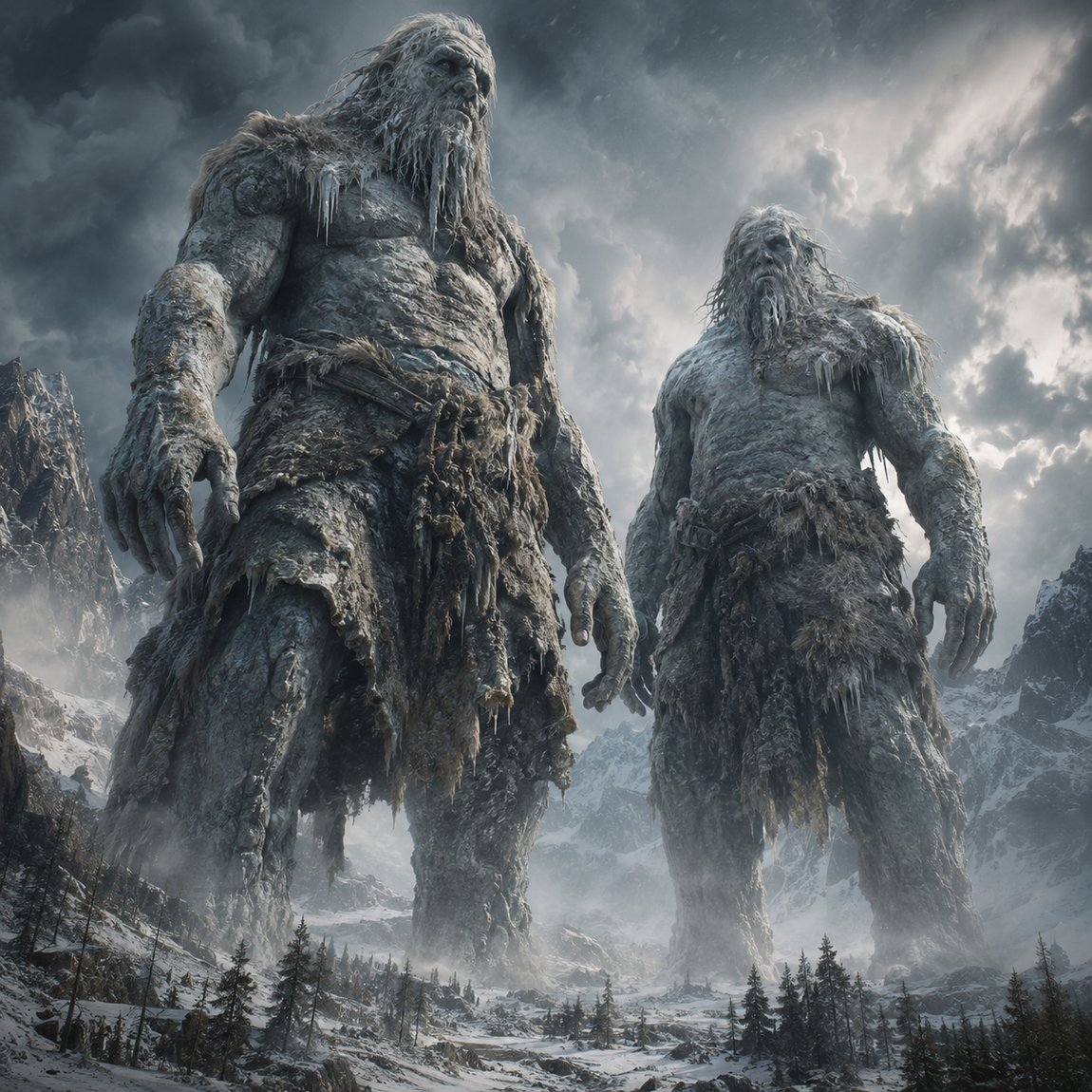
The giants of Norse mythology – in Old Norse jötnar or thurses – are the oldest beings in the world: the gods built earth, sea and sky from the body of the primeval giant Ymir, and the frost giants descend from him. Yet they are far more than monsters. Giantesses are the mothers and wives of gods, giants guard ancient knowledge, and Thor spends his life fighting them. Here is what the Edda actually says about them, where their names come from and how scholars read them today.
In Norse myth, every mountain you climb is a bone. Every sea you sail is blood. The ground under your feet was once a giant, and the sky above you is his skull. Open the Eddic poems almost anywhere and you will find a giant close by: at the fence as an enemy, at the feast as a host, at the wedding as a father-in-law, at the cradle as a mother, in the hall as a teacher. The giants are the great opposite of the gods – and their family. That contradiction is what makes them the most fascinating beings in the northern world.
This article is about the beings themselves: what they were called, where the sources say they came from, who the famous ones are and how scholars read them today. The place they live has its own article: Jötunheim.
Old Norse has no single word for "giant". It has several that overlap. The most common is jǫtunn (anglicised jötunn, plural jǫtnar). It has close relatives: Old English eoten – in Beowulf the eotenas appear beside elves and the walking dead as the brood of Cain –, Middle English etayn and the archaic English ettin. In modern Danish and Swedish the word survives as jætte and jätte. Linguists reconstruct a Proto-Germanic form *etunaz.
And here begins the best argument in the whole subject. Is *etunaz related to *etanan, "to eat"? If so, a jötunn is literally an "eater", a devourer. Vladimir Orel, in his Handbook of Germanic Etymology (2003), considers the link likely; others are more cautious because the word formation is not entirely smooth. So it is not certain. It is tempting all the same, because the stories seem to play with it. At Utgard-Loki's hall, Loki loses an eating contest to a certain Logi, who swallows meat, bones and trough alike – and Logi means "flame". In Þrymskviða, meanwhile, Thor, disguised as a bride, puts away a whole ox and eight salmon at the giant's wedding feast.
The second word is þurs (thurs, plural þursar). It matches Old English þyrs and Old High German duris, which in German leans towards "demon, evil spirit". Orel connects it to a root that may be related to Sanskrit turá-, "strong, mighty" – again a hypothesis, not a fact. Worth noting: þurs is also the name of the third rune of the Younger Futhark (ᚦ). In the compound hrímþursar, "rime-thurses", usually rendered as frost giants, it names the primeval giants born of ice.
The third word, risi, is related to Old High German risi/riso and thus to modern German Riese. In Old Norse it appears mostly in compounds such as bergrisi, "mountain giant", and in the later sagas, where the risi is often the big and sometimes even benevolent kind of giant.
That leaves troll. In Old Norse it has the widest range of all: it can mean giants, but also witches, revenants, berserkers or simply people who are uncannily strong or ugly. The Icelandic medievalist Ármann Jakobsson has shown how vague – and how menacing – the word is in the sagas. Its origin is unclear. How the Eddic term became the Scandinavian mountain spirit of later folklore is a story we tell in our article on trolls. Giantesses have their own words: gýgr, íviðja and trǫllkona.
Where do giants come from? The fullest answer is given by Snorri Sturluson in Gylfaginning, the first part of his Prose Edda (c. 1220). In the primeval void of Ginnungagap, rime from the north meets heat from the south, and from the thawing ice comes Ymir, whom the frost giants call Aurgelmir. From the sweat under his left arm a man and a woman grow, and one of his feet begets a son with the other. That is how the race of giants begins – older than any god.
Then Odin and his brothers Vili and Vé, the sons of Borr, kill the primeval giant. In chapter 7 of Gylfaginning Snorri tells what happened next, here in our own paraphrase: so much blood ran from Ymir's wounds that the whole race of frost giants drowned in it. Only one escaped with his wife, Bergelmir. He climbed onto his lúðr and was saved, and from him the later families of giants descend.
That lúðr is a small puzzle. Snorri apparently understood it as some sort of boat, which has made many readers think of Noah's ark – Snorri was, after all, a Christian-educated author. But the word can also mean the box of a mill, a trough or a cradle. In the older source, the Eddic wisdom poem Vafþrúðnismál (stanza 35), the giant Vafthrudnir says only that Bergelmir was á lúðr lagiðr, "laid on the lúðr". There is no flood there. Whether the flood of blood is old tradition or Snorri's own elaboration is therefore an open question among scholars.
One point matters for everything that follows: the gods are themselves descended from giants. According to Snorri, Borr marries Bestla, daughter of the giant Bölþorn, and their children are Odin, Vili and Vé. The chief of the gods is half jötunn on his mother's side – and the killing of Ymir is, genealogically speaking, a family affair.
The hrímþursar, the frost giants, are the first inhabitants of the world in the sources. In Skírnismál, Freyr's messenger Skírnir threatens the giantess Gerðr that she will end up with a three-headed thurs called Hrímgrímnir; in Vafþrúðnismál the frost giants are discussed as the oldest race of all. Their world is cold and stony but rich: Þrymr boasts of his gold-horned cattle.
Their counterpart lies in the south. There is Muspell, the world of fire, guarded by Surtr with his flaming sword. Whether Surtr is strictly a giant, the poems never say outright; Völuspá simply has him coming "from the south". Calling him a "fire giant" is understandable, but it is a modern label. His role, though, is clear: at the end he brings the fire that consumes the world.
Anyone who thinks the giants are simply the "evil" side of Norse myth should take a look at the giantesses. In the sources they are strikingly often the mothers and wives of gods.
Jörð, "Earth", is Thor's mother. Snorri calls her Odin's daughter and wife; her mother Nótt (Night) is, he says, of giant kin. Whether Jörð herself should be counted as a giantess is judged differently by scholars – Simek and Lindow both present it as an open question.
Gerðr, daughter of the giant Gymir, is so beautiful that, in Skírnismál, air and sea shine from her arms. Freyr falls helplessly in love and gives away his sword to win her – the sword he will lack at Ragnarök. The Norwegian historian of religion Gro Steinsland has read this marriage of god and giantess as a "sacred wedding" from which, according to Ynglinga saga, the Swedish royal house descends: kingship as the child of two worlds.
Skaði is the daughter of the giant Þjazi. After his death she marches into Asgard in full armour to demand vengeance – and is given a husband as compensation, Njörðr, whom she must choose by his feet alone. The marriage founders on where to live: he cannot stand the wolves in the mountains, she cannot stand the gulls by the sea. Ynglinga saga also knows of children Skaði bore to Odin.
Gríðr is a giantess with whom Odin fathers the silent god Víðarr – the god who avenges his father on the wolf Fenrir at Ragnarök. In Skáldskaparmál Snorri tells how she lends Thor, on his way to Geirrøðr, a belt of strength, iron gloves and her staff Gríðarvölr.
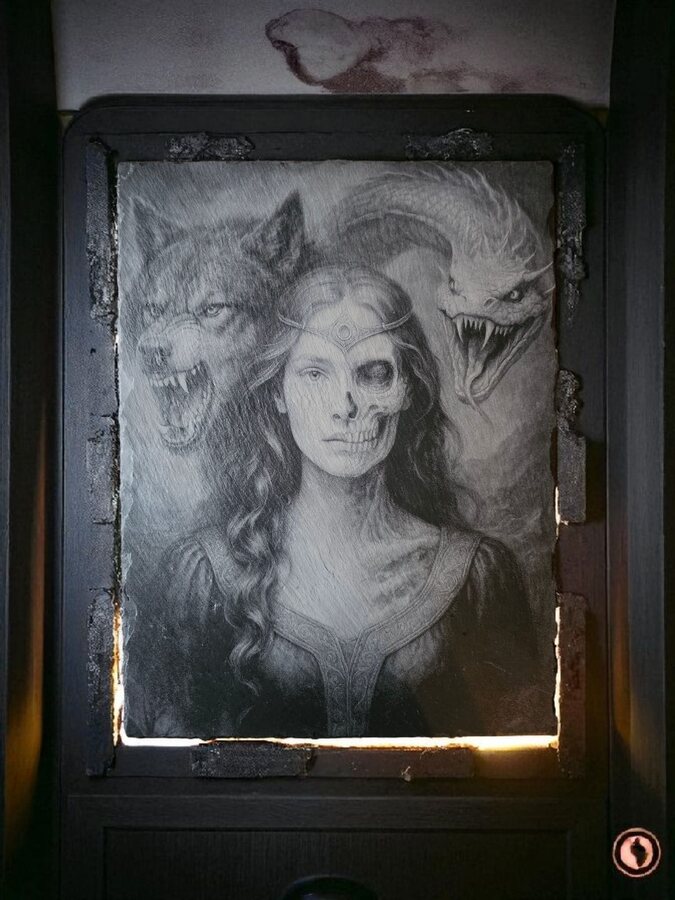
Finally, Angrboða shows the darker side of these unions. With Loki, says Snorri, she has three children: the wolf Fenrir, the Midgard Serpent and Hel. Loki himself, by the way, is a giant by birth, son of Fárbauti, and still lives among the Æsir.
In the Edda, giants are not just strong. They are wise. More precisely: they are old, and age is knowledge. The seeress of Völuspá opens her great vision of the world with a remarkable line – in our own rendering: "I remember the giants, born long ago, who once brought me up." The woman who explains the beginning and the end of the world to Odin was schooled by giants.
It gets clearer still in Vafþrúðnismál. Odin travels in disguise to the "all-wise" giant Vafthrudnir and challenges him to a contest of knowledge with their heads at stake. The two question each other through cosmology, the origin and the future of the world. Vafthrudnir knows everything, including the lineages of the giants, for by his own account he has travelled through all nine worlds. He loses only because Odin finally asks a question nobody but Odin himself can answer: what he whispered into the ear of his dead son Baldr. That is not a fair win. It is a trick.
The giantess Hyndla in Hyndluljóð also knows the pedigrees of heroes, and Freyja has to fetch her out of her cave for it. And Mímir, guardian of the well of wisdom where Odin pawns his eye? The sources never call him a jötunn outright. Some scholars still think of him as a giant, because according to Hávamál (stanza 140) Odin learned nine mighty songs from "the son of Bölþorn", that is, the brother of his mother Bestla – and this nameless uncle is often identified with Mímir. That is an interpretation, not evidence.
Katja Schulz summed up this picture in her study Riesen. Von Wissenshütern und Wildnisbewohnern in Edda und Saga ("Giants: Of Keepers of Knowledge and Dwellers in the Wild", Heidelberg 2004): giants are defined less by size than by unusual strength and magical skill. They guard knowledge and they inhabit the wilderness – two sides of the same strangeness.
When the gods have adventures, they usually have them with giants. Here are the main opponents, each with the source in which he appears.
Þrymr (Thrym) steals Thor's hammer, hides it eight leagues under the earth and demands Freyja as his bride. Instead the gods send Thor in a bridal veil with Loki as his bridesmaid. Þrymskviða is the funniest poem in the Edda – and it ends in bloodshed the moment Thor has his hammer back in his lap.
Hrungnir has, according to Snorri, a heart of stone with three sharp corners and a head of stone as well. After a horse race against Odin he gets drunk in Asgard and threatens to carry Valhalla off to Jötunheim. In the duel at Grjótúnagarðar, Thor's hammer shatters his skull, but a fragment of Hrungnir's whetstone lodges in Thor's forehead. The story is already alluded to in the skaldic poem Haustlǫng by Þjóðólfr of Hvinir, usually dated to around 900.
Þjazi, in the shape of an eagle, carries off the goddess Iðunn and her apples of youth. The gods begin to age until Loki, in falcon form, brings her back. Þjazi burns at the wall of Asgard, and Odin throws his eyes into the sky, where they shine as stars. Haustlǫng tells this story too.
Geirrøðr lures Thor to his home without hammer and without belt. On the way, Geirrøðr's daughter Gjálp makes the river Vimur swell; in the hall his daughters lift Thor's chair to the rafters; and at the end the giant hurls a lump of glowing iron. Thor survives thanks to Gríðr's equipment. Besides Snorri, the episode is attested in Þórsdrápa by Eilífr Goðrúnarson from the late tenth century.
Hymir owns the enormous brewing cauldron the gods need for Ægir's feast. Thor goes fishing with him and, with an ox head as bait, hauls the Midgard Serpent up from the deep. The giant panics and cuts the line. The story is preserved in Hymiskviða and in Snorri, and the motif also appears on picture stones such as the Altuna stone in Sweden.
Útgarða-Loki and Skrýmir turn out to be the same. Thor spends a night in the thumb of a gigantic glove and strikes the sleeping Skrýmir on the head three times with his hammer; the giant merely asks whether a leaf has fallen on him. In Utgard, Thor then loses every contest: drinking horn, cat, wrestling match with an old woman – nothing works. Only on leaving does he learn that the horn reached into the sea, the cat was the Midgard Serpent and the old woman was old age itself. The whole tale is in Thor and Utgard-Loki.
If any god stands for the fight against the giants, it is Thor. In Skáldskaparmál Snorri lists the poetic circumlocutions for him, among them "foe and slayer of giants and troll-women". More than once the sources say Thor has gone "into the east" to beat trolls – east being the direction of Jötunheim.
Snorri also quotes two skaldic stanzas that read like kill lists. Vetrliði Sumarliðason praises Thor for breaking Leikn's legs, striking down Þrívaldi, felling Starkaðr and killing Gjálp. Þorbjǫrn dísarskáld names Keila, Kjallandi, Lútr, Leiði, Búseyra, Hengjankjapta, Hyrrokkin and Svívǫr. Both poets belong to the late tenth century, the time when Iceland was converting to Christianity. For most of these names no story survives.
What is interesting is how this enmity works. Thor protects Asgard and Midgard, the worlds of gods and humans, against what lies outside. His hammer is the tool with which order is defended against the untamed. But he by no means always wins. Utgard-Loki makes a fool of him, at Geirrøðr's he needs a giantess's help, and Hrungnir leaves him with a wound for life. The Edda does not tell a polished hero myth; it tells of a constant, exhausting border war.
At the end, the giants return. Völuspá describes Ragnarök as an assault from every direction. Even before it begins, the giants' herdsman Eggþér sits on a mound playing his harp while the cock Fjalarr crows. Then, in stanza 48, roughly: what ails the Æsir, what ails the elves? All Jötunheim is roaring.
From the east comes the giant Hrymr with his shield raised, the Midgard Serpent writhes in giant fury, and a ship sails in carrying the people of Muspell – steered by Loki, according to Völuspá. Snorri arranges this differently: for him Hrymr steers Naglfar, the ship made of dead men's nails. From the south Surtr advances with fire. He kills Freyr, who once gave away his sword for the giantess Gerðr. In the end Surtr's fire swallows the world.
Notably, the giants do not win. Both sides perish, and in Völuspá a new green earth rises from the sea.
The oldest scholarly reading comes from the nineteenth century. In his Deutsche Mythologie (1835), Jacob Grimm read the giants above all as embodiments of raw natural forces: frost, rock, storm, sea. It is an obvious reading. Hrungnir has a heart of stone, the frost giants are born of ice, Ægir is the sea, Logi is fire, Þjazi and Skaði belong to the wintry mountains.
More recent scholarship has widened and qualified it. The American Germanist Lotte Motz published a whole series of articles on giants between 1979 and 1996 – on their names, their families and their relationship to kingship ("Kingship and the Giants", 1996). They showed how varied these beings are and how little they can all be reduced to a single force of nature. Katja Schulz showed in 2004 that giants in Edda and saga appear whenever fundamental questions are at stake: gender roles, the legitimacy of rulers, the way the Christian Middle Ages dealt with its pagan heritage. Giants explain storms or missing fish, but they are also a mirror in which a society negotiates its own boundaries.
This suggests a second reading: the giants as "the Others". They live outside the fenced world – útgarðr literally means "outer enclosure" – and they have their own farms, herds, daughters, feasts and alliances. Scholars have therefore often stressed that the line between gods and giants is social rather than biological: whoever lives with the gods counts as a god, even if, like Loki or Skaði, they are of giant birth.
Long after the Viking Age, the giants did not vanish from Scandinavia; they simply moved into the landscape. In modern folklore they are often merged with trolls, an overlap Motz pointed out as early as 1982. Countless legends explain conspicuous boulders as stones thrown by a giant – quite often at a church whose bells annoyed him.
Place names and technical terms bear witness too. In Danish, the Stone Age passage graves are called jættestuer, "giants' chambers". In Swedish, the potholes scoured out by glacial meltwater are jättegrytor, "giants' pots". And in northern Germany people speak of Hünengräber and Hünenbetten, "giants' graves" and "giants' beds". The German word Hüne goes back, according to the etymological dictionaries, to Middle High German hiune, which originally meant "Hun" and only later came to mean "giant". All these names share a simple logic: whoever could move such stones must have been a giant. In reality the graves are Neolithic, thousands of years older than the Vikings.
For us in the workshop, giants are a gift precisely because they come in so many forms. A design can show Ymir, the primeval giant, with the sky being vaulted from his skull. It can freeze Thor and Hrungnir at the moment of impact, show Skaði on skis in the mountains, or carry the line from Völuspá in which the seeress remembers the giants who raised her – in runes or in script. On rough slate this works especially well: stone, cold and age are the jötnar's element anyway. Giants are not comic-book monsters. They are the oldest beings in the northern world.
For courage. For remembrance. For legends that live on.
What is a jötunn in Norse mythology? A jötunn (plural jötnar) is a giant, a being from the world outside the gods' order. The jötnar are older than the gods, often hostile to them, and yet closely related to them by blood and marriage.
What is the difference between a jötunn and a thurs? In the Eddic poems both words are used largely interchangeably for giants. Þurs more often sounds contemptuous and appears in "rime-thurses", the primeval frost giants; the sources have no fixed system of giant types.
Does jötunn mean "eater"? Possibly, but not certainly. The word goes back to Proto-Germanic *etunaz, and some etymologists consider a link with *etanan, "to eat", likely, while others remain sceptical.
Are the giants in Norse mythology evil? Not as a rule. Many giantesses are mothers and wives of gods, and giants such as Vafthrudnir or Ægir are wise or hospitable. They are the gods' opposite, but not simply the embodiment of evil.
Where do the frost giants come from? According to Snorri's Prose Edda they descend from Ymir, who arose from melting rime in the void of Ginnungagap. When the gods killed Ymir, the frost giants drowned in his blood – only Bergelmir survived and became the ancestor of the later giants.
Who are the most famous giants in Norse mythology? Among the best known are Ymir, Þrymr, Hrungnir, Þjazi, Geirrøðr, Hymir and Útgarða-Loki, along with giantesses such as Skaði, Gerðr and Angrboða. Most of them appear in stories about Thor.
Ymir & the creation of the world · Surtur · Skadi · The dwarves · Jötunheim & the nine worlds · Ragnarök.
All Beings & Creatures articles →
In Valhalla an eternal feast holds sway – provided by a single animal that never runs out: the boar Sæhrimnir.
Read more →Two wolves race across the firmament – one after the sun, the other after the moon. It is the oldest chase in the …
Read more →Eight legs, a one-eyed rider and a road that leads all the way down into the realm of the dead: Sleipnir is no ordinary …
Read more →No horse draws the chariot of the strongest god, but two goats: Tanngrisnir („teeth-barer") and Tanngnjóstr …
Read more →