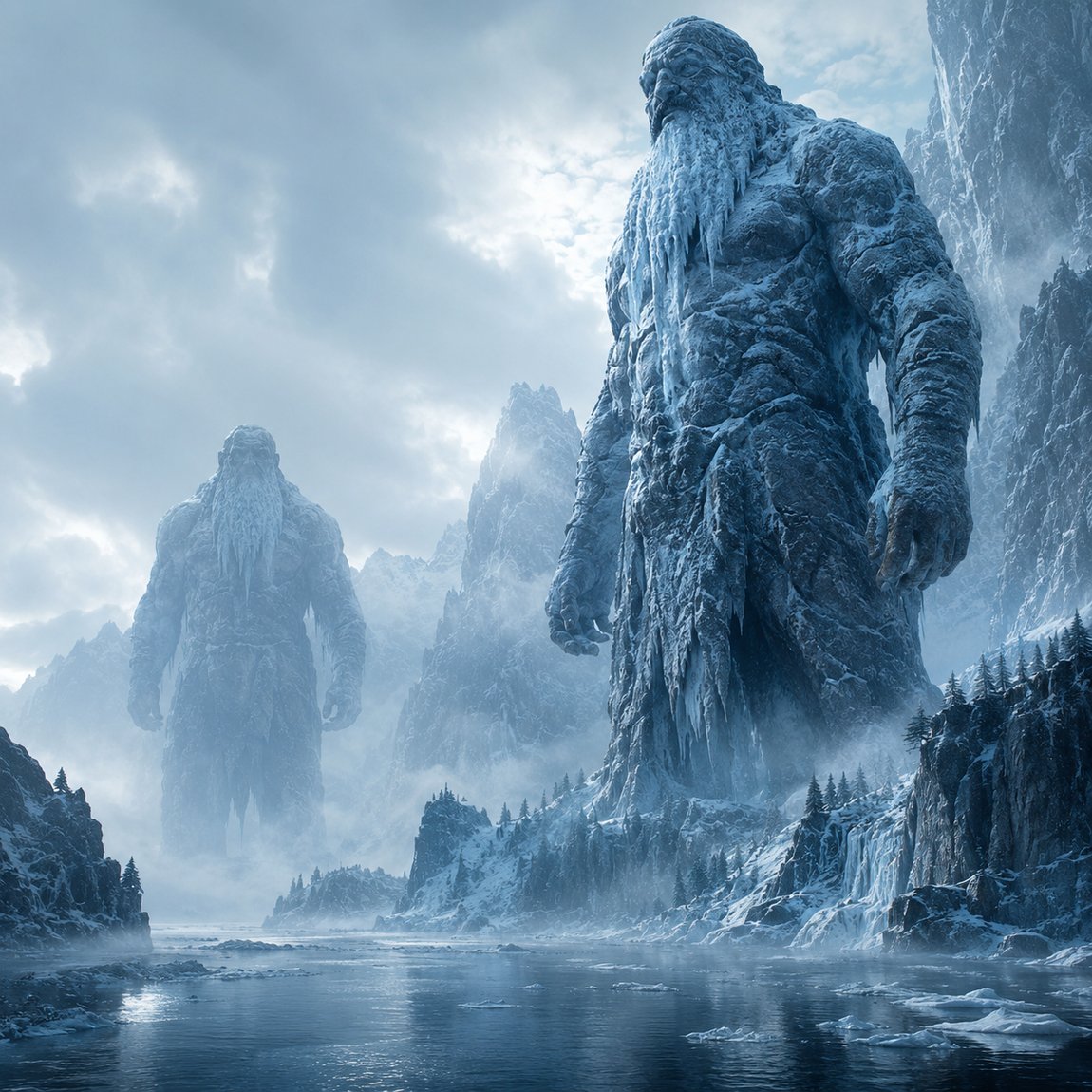
Jotunheim (Old Norse Jǫtunheimar, usually plural) is the land of the giants in Norse mythology – a wild borderland beyond rivers, forests and mountains, somewhere to the east or north of the human world. The Poetic Edda names it as early as Völuspá, and Snorri Sturluson pictures it as a coastal ring around Midgard. Thor, Odin and Skírnir all travel there to fight, to woo and to learn. Here is what the medieval sources actually say – and what later readers added.
Picture a map where the middle is neatly surveyed: farms, fields, a fence around the lot. Then, at the edges, the surveying simply stops. No scale, no roads – only a river that never freezes, mountains that crack open when Thor drives through, and halls whose owners keep stone heads and kettles a mile deep. That is where Jotunheim begins.
One thing up front: this article is about the place. Who the giants are – their origins, types, names and their tangled relationship with the gods – we cover in detail in our article on the giants (jötnar). Here we look at landscape, borders, routes and addresses. Where does this world lie, how do you get in, and who has already been?
The word combines jǫtunn, "giant", with heimr, "home, dwelling, world". Jǫtunn goes back to a Proto-Germanic *etunaz, and its English cousin is Old English eoten, which appears in Beowulf. Many philologists connect the root with the verb "to eat", which would make a giant originally a "devourer". It is a popular explanation, but not a certain one.
The grammar is more revealing. In the Eddic poems the word almost always appears in the plural: í Jǫtunheima, "into the giant-homes", ór Jǫtunheimum, "out of the giant-homes". The poets were apparently not thinking of a single kingdom with a capital and a customs post, but of several giant-lands – a whole zone. The tidy singular "Jotunheim" owes a lot to reference books, children's retellings and, eventually, film and games. We use it here because that is what people search for, but keep the plural in mind.
The singular does turn up, though, at one dramatic moment. In Völuspá the seeress says gnýr allr Jǫtunheimr, "all Jotunheim roars". When the world is ending, the land of the giants suddenly becomes one single, shuddering body.
Nobody ever wrote a travelogue of Jotunheim. All we have is poetry and learned retelling. The poems of the Poetic Edda survive mainly in an Icelandic manuscript from around 1270, the Codex Regius; many of them are probably older, but how much older is debated poem by poem. The Prose Edda was written by Snorri Sturluson around 1220–1230, a Christian Icelander who arranged the old myths into a handbook for poets. Add to that skaldic verse, some of it considerably older, which Snorri quotes.
The earliest moment in the world's story comes in Völuspá, the "Prophecy of the Seeress". In stanza 8 the gods sit in their golden age, cheerfully playing board games, short of nothing in gold – until three giant-maidens arrive, mighty indeed, "out of Jotunheim". Who these three are, nobody knows for certain; Norns, giantesses and other readings have all been proposed. Their job in the poem is clear enough, though: the first crack in the gods' perfect world comes from the giant-land.
Stanza 48 is the mirror image. Just before the end, the seeress asks: "What of the Æsir? What of the elves?" and answers: all Jotunheim roars, the Æsir are at their assembly. The beginning of the end came out of Jotunheim, and at the end Jotunheim itself is shaking. Between those two stanzas stretches the whole arc of Norse myth.
In Skírnismál, the poem of Freyr's wooing of Gerðr, the name appears in stanza 40. Skírnir has barely returned, he has not even taken the saddle off his horse, when Freyr pounces: what did you achieve in Jotunheim, for yourself or for me? The prose introduction adds that Freyr, sitting in Odin's high seat, looked "into Jotunheim" and saw Gerðr there.
The name appears most often in Þrymskviða – nine times, sometimes as jǫtna heimar, sometimes as Jǫtunheimar. The poem shuttles back and forth between Asgard and the giant-land, which is fitting, because it is essentially a road story.
There are no coordinates. The sources give directions, borders and images, and they do not fit together perfectly.
East. Most often the giants live in the east. When Thor is missing, he is "away in the east, battering trolls" (í austrvegi at berja trǫll) – that is how Snorri explains his absence while the wall of Asgard is being built. In Hárbarðsljóð Thor boasts: "I was in the east and fought giants." The giant Hymir, according to Hymiskviða 5, lives "east of Élivágar, at the edge of heaven". And in Snorri's account Thor sets out for Útgarða-Loki by travelling "east into Jotunheim".
North. Other texts push the giants into the cold north. Later Icelandic sagas and learned geographies like to place giant-lands at the far north-eastern rim of the known world, beyond Norway and Bjarmaland on the White Sea. That is younger, semi-geographical writing, though, and not on the same level as the Eddic poems.
Edge. Snorri's Gylfaginning (chapter 8) gives the clearest model. The sons of Borr – Odin and his brothers – build the world from the body of the primeval giant Ymir. The earth is round, and the deep sea lies around it. The land along the sea shore they give to the giant clans to live on. Further inland they raise a fortification against the giants out of Ymir's eyebrows: Midgard. In this picture Jotunheim is a ring around the human world, between the fence and the world-ocean.
In 2006 the Icelandic scholar Ármann Jakobsson published an article with the wonderful title "Where do the giants live?", showing that giants turn up in practically every direction in the sources. His conclusion: being a giant is less a location than a quality – otherness itself, which refuses to be pinned down. In 2014 the Norwegian scholar of religion Eldar Heide examined the apparently contradictory cosmology and suggested that such worlds are better understood as realms linked by special crossings than as countries on a flat map. In short: anyone who draws a precise map of Jotunheim is drawing a modern interpretation.
If Jotunheim has a border, it is made of water. In Vafþrúðnismál, the deadly contest of wisdom between Odin and the giant Vafþrúðnir, the giant asks for the name of the river that divides the earth between the sons of giants and the gods. Odin answers in stanza 16: it is called Ífingr; it shall run open for all time, and no ice ever lies on it.
"Ífing is the river that parts the ground between the giants' sons and the gods; open it shall flow through all the days, no ice lies ever on that river."Vafþrúðnismál 16, our own translation
That detail is cleverer than it looks. A river that freezes turns into a bridge every winter. A river that never freezes stays a border you cannot simply walk across. To get over it you need courage, strength or magic.
The Élivágar – "storm-waves" or "ice-waves"; the meaning of the first element is not entirely certain – are older and stranger. In Snorri they are streams that, at the beginning of time, flow so far from their source that they harden into ice; their venomous spray turns to rime and fills Ginnungagap. In Vafþrúðnismál 31 drops of venom spring from the Élivágar, and from them a giant grows. So the Élivágar are both the origin of the giants and, in Hymiskviða, the threshold beyond which Hymir lives. Cross them and you are not just entering another region, you are stepping into an older layer of the world.
Forests and mountains also mark the border. On his way to Útgarða-Loki, Thor crosses a vast forest. In Skírnismál, Skírnir rides over "wet mountains" and through the people of the thurses, and at Gerðr's home he has to pass through a flickering wall of fire. Jotunheim is never simply "over there". You have to get in.
Many books equate Utgard with Jotunheim: Midgard, the "inner yard", against Utgard, the "outer yard". It is an elegant formula, and we like it ourselves. But let us look closely.
In the sources, Útgarðr is first of all a very concrete place: the stronghold of the giant king Útgarða-Loki in Snorri's Gylfaginning. Thor, with Loki and his servants Þjálfi and Röskva, travels east into Jotunheim, across the sea, through an enormous forest, spends a night unknowingly inside the glove of the giant Skrýmir – and finally reaches a castle on a plain, so tall he has to crane his neck to see the top. What follows are the famous contests against fire, thought and old age that we retell in Thor and Utgard-Loki. Around 1200 the Danish historian Saxo Grammaticus also knows a figure called Utgarthilocus, visited on a grim otherworld voyage.
The big binary "inner enclosure versus outer enclosure", on the other hand, was popularised mainly by twentieth-century scholarship, notably the Russian medievalist Aaron Gurevich and the Danish anthropologist Kirsten Hastrup. They took the Icelandic pair innangarðs and útangarðs – inside and outside the fence – from law and daily life and applied it to the whole worldview. It is a useful lens. But it is a lens.
The contrast itself is real enough. Midgard is fenced, farmed and ordered; Jotunheim is untamed, ancient, dangerous and full of treasure. The gods spend their existence guarding that border – and crossing it again and again.
The giant-world is not empty space. The sources name a whole series of halls, farmsteads and strongholds. A selection, with the necessary small print:
Þrymheimr ("home of din" or "thunder-home"). In Grímnismál 11 it is the dwelling of the giant Þjazi, later occupied by his daughter Skadi. Snorri places it "on some mountains". This is where the marriage of Skadi and the sea god Njörðr falls apart: he cannot stand the wolves, she cannot stand the gulls. And from here Þjazi abducts Iðunn.
Útgarðr. Útgarða-Loki's stronghold, see above. Huge, full of illusions, and in the end it vanishes along with its lord just as Thor raises his hammer.
Geirrøðargarðar, the courts of the giant Geirrøðr. According to Snorri's Skáldskaparmál, Thor travels there without his hammer and his belt of strength, because Loki has manoeuvred him into it. The giantess Gríðr lends him a belt, iron gloves and a staff; in the river Vimur, which Geirrøðr's daughter Gjálp makes swell, he fights the flood. The same story is already told in the skaldic poem Þórsdrápa by Eilífr Goðrúnarson, probably composed around 1000 – one of the oldest narrative accounts of a journey into the giant-land we have. More in Thor at Geirröd's.
Grjótúnagarðar, the "stone-fence courts" on the border, where Thor meets the stone giant Hrungnir in single combat. Then there is Gymisgarðar, the home of Gerðr's father Gymir in Skírnismál, and Hymir's hall "at the edge of heaven", where the kettle stands that Thor fetches for the gods' feast.
Hnitbjǫrg, the mountain in which the giant Suttungr hides the mead of poetry and sets his daughter to guard it. Snorri names the place explicitly; you will find the story in Gunnlöd and the theft of the mead of poetry.
Gastropnir. A special case. The name comes from Fjölsvinnsmál, a late Eddic-style poem that is not in the Codex Regius and survives only in younger paper manuscripts. There, Gastropnir is the wall around the dwelling of the maiden Menglöð, which the watchman Fjölsviðr claims to have built from the limbs of a giant called Leirbrimir. Whether this place lies in Jotunheim, the poem does not actually say. Many modern lists include it – we would label that an interpretation, not evidence.
No god travels to Jotunheim as often as Thor. Nearly every major Thor story is a border crossing: to Hymir, to Útgarða-Loki, to Geirrøðr, to Hrungnir, to Þrymr. The thunder god is the border guard of the divine world, and he mostly works in the field.
Þrymskviða turns this into comedy. The giant Þrymr has stolen Mjölnir and wants Freyja as his bride. Loki flies "to Jotunheim" in Freyja's feather cloak and finds Þrymr sitting on a burial mound, plaiting golden collars for his dogs. In the end Thor goes himself, disguised as the bride, with Loki as his maid. Stanza 21 gives one of the most powerful images of the giant-land anywhere: the mountains burst, the earth burned with flame, as Odin's son drove into Jotunheim. The landscape itself reacts to the god forcing his way in.
In Hymiskviða, Thor and Týr travel to the giant Hymir to fetch a brewing kettle for Ægir's feast; in this poem Hymir is even Týr's father, which other sources do not say. Here Jotunheim lies beyond the Élivágar, at the edge of the world, and from there Thor rows out to sea to fish – and hooks the Midgard Serpent. The giant-land reaches the ocean, just as in Snorri's coastal model.
Thor goes in with a hammer. Others go in with words.
Skírnir, Freyr's servant, sets out on Freyr's horse and with Freyr's sword to win the giantess Gerðr. His journey in Skírnismál is perhaps the most atmospheric description of the road into Jotunheim: it is dark outside, the way leads over wet mountains and through the people of the thurses, chained dogs bark in front of the farmstead, flame flickers all around it. The wooing only succeeds after brutal threats and runic curses. The price is steep: Freyr gives away his sword – the sword he will be missing at Ragnarök.
Odin does not travel to fight but to know. In Vafþrúðnismál he visits the all-knowing giant Vafþrúðnir under a false name and stakes his head on a riddle contest. In Hávamál he remembers: I sought out the old giant, now I have come back – meaning Suttungr, from whom he wins the mead of poetry. For Odin the giant-land is an archive. The giants are older than the gods and remember things that came before the world. If you want to know how it ends, you have to ask them.
Traffic runs the other way, too. Brides and mothers come out of Jotunheim: Gerðr marries Freyr, Skadi marries Njörðr, Odin fathers children with giantesses. Builders, thieves and challengers come out of Jotunheim as well. The border is a river that never freezes – and still the crossings never stop.
Today Jotunheim is almost always presented as one of the "nine worlds" on the world tree Yggdrasil. Völuspá does mention nine worlds, but it never lists them. A neat list of Asgard, Midgard, Jotunheim, Vanaheim, Alfheim, Muspelheim, Niflheim, Svartalfheim and Helheim does not appear in any single medieval source – it is a later compilation. How that scheme came about is explained in our article on the nine worlds.
Grímnismál 31 does say that the frost giants live under one of Yggdrasil's three roots. Snorri turns this into a root that reaches the frost giants "where Ginnungagap once was", with Mímir's well, the spring of wisdom, beneath it. The same motif again: old knowledge lives with the giants.
Search for "Jotunheim" today and you soon end up in Norway. The Jotunheimen range between Gudbrandsdalen and the Sognefjord is the highest in Scandinavia. Its highest summit, Galdhøpiggen at 2,469 metres, is also Norway's highest mountain, with Glittertind close behind. Since 1980 a large part of the range has been protected as Jotunheimen National Park.
The name, however, is not ancient. In 1823 the geologist Baltazar Mathias Keilhau proposed Jotunfjeldene, "the giant mountains", modelled on the German Riesengebirge. The modern form Jotunheimen comes from the poet Aasmund Olavsson Vinje, who used it in 1862 in his travel book Fjøllstaven min; it caught on in the late nineteenth and early twentieth centuries. That fits the period: Norway was building a national identity of its own, and the Eddas supplied the imagery. A range full of glaciers, scree and fog as the home of the giants – it could hardly have been named better.
The best-known modern version is Marvel's. In the film Thor (2011), Jotunheim is a gloomy ice world ruled by frost giants under King Laufey, and Loki turns out to be his son. That is free invention with a mythological coat of paint: in the sources Laufey is Loki's mother, and Jotunheim is not a frozen planet but a land of halls, farms, herds and gold. What else Marvel shifts around is covered in our Marvel Thor fact-check.
The games God of War (2018) and God of War Ragnarök (2022) turn Jotunheim into the goal and longed-for destination of a journey and portray the giants as a largely displaced, rather sympathetic people. That is a modern reinterpretation too – though one that takes the giants' ambivalence more seriously than many comics do. Details in our God of War fact-check.
Every culture needs a place for what it cannot control. For people in the North that meant mountains, glaciers, winter storms and the open sea – places that could kill you, but that also supplied iron, furs, fish and game. Jotunheim packs that experience into a single image: dangerous, indispensable, older than any order.
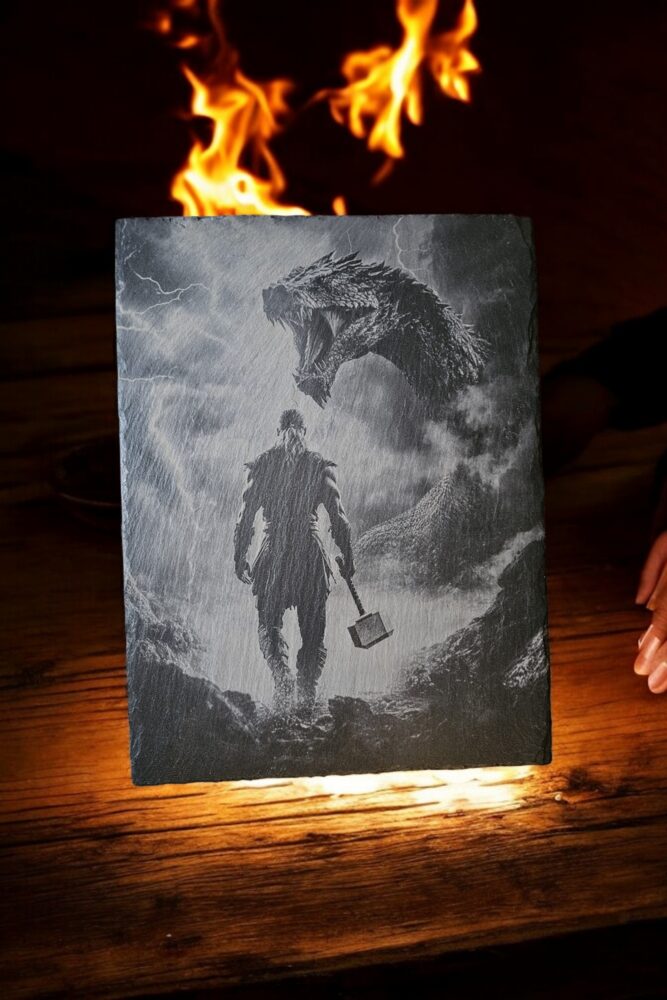
In our workshop in Alsdorf, Jotunheim feels most at home on natural slate. The dark, rough stone already looks like a piece of giant country. One motif we love: a mountain silhouette with a river in the foreground, and above it a line from Völuspá in the original language – gnýr allr Jǫtunheimr, "all Jotunheim roars". Or, for hikers coming back from Galdhøpiggen: the summit's name, its height and the date of the climb, framed by Norse knotwork. A gift that reminds you that you once stood at the edge of the world yourself.
What is Jotunheim in Norse mythology? Jotunheim (Old Norse mostly Jǫtunheimar, plural) is the land of the giants. The sources place it at the edge of the world, usually to the east or north, separated from the realms of humans and gods by rivers such as Ífingr.
Is Utgard the same as Jotunheim? Not exactly. In the Eddas, Útgarðr is the castle of the giant Útgarða-Loki inside Jotunheim. Treating Utgard as the entire giant world, the opposite of Midgard, is a modern interpretation.
Where is Jotunheim mentioned in the Edda? Among other places in Völuspá 8 and 48, Skírnismál 40, several times in Þrymskviða, and in Snorri's Gylfaginning and Skáldskaparmál.
What river separates Jotunheim from the gods? According to Vafþrúðnismál it is Ífingr, a river that never freezes. The Élivágar are also described as border streams at the rim of the giant world.
How did Jotunheimen in Norway get its name? The poet Aasmund Olavsson Vinje coined it in 1862, inspired by Norse mythology. Before that, the geologist Keilhau had proposed "Jotunfjeldene" in 1823.
Is Marvel's Jotunheim accurate to the myths? Hardly. Marvel's ice world ruled by King Laufey is invention; in the sources Laufey is Loki's mother, and Jotunheim is a land of farmsteads and halls.
For courage. For remembrance. For legends that live on.
Thor · Midgard · Muspelheim – the fire world · Ragnarök · The Nine Worlds.
All The Nine Worlds articles →
When the sun is devoured, when fire and flood have taken the world – then not all is over. Two humans survive Ragnarök …
Read more →At the centre of the nine worlds lies Midgard – the ‘middle enclosure’, the fenced homestead of humankind. Not a …
Read more →In the south of the world-order blazes Muspelheim – the world of fire. Embers, sparks and flames, so hot that only its …
Read more →Far in the north of the world-order, in icy remoteness, lies Niflheim – the ‘mist-home’. Here reign cold, frost and …
Read more →