The mead of poetry turns anyone who drinks it into a poet or sage. It lies deep in the mountain, guarded by the giant's daughter Gunnlod. But before Odin steals it, the drink has already made a bloody journey – born from a sign of peace between the gods, carried through two dwarf-murders into the rock. A tale of wisdom, greed, cunning and a broken oath, whose dark side the sources do not hide.
It does not begin with a murder but with a peace. The Aesir and the Vanir, the two families of gods, had long been at war. When they finally made peace, they sealed it in the oldest way in the world: both sides spat into a great vat. So that nothing of this token of reconciliation should be lost, the gods shaped a living being out of the spittle – and called it Kvasir.
Thus, in the Prose Edda, the wisest man who ever lived is born from what two enemies gave together. The quiet irony of the whole tale is already here: the most precious gift in the world begins as spit in a pot.
Kvasir travelled the world and taught people wisdom. There was no question he could not answer; wherever he appeared, the clever fell silent and listened. For a people who prized the well-aimed word above gold, he was the ideal made flesh: one who named things plainly and could settle any quarrel with a single sentence.
Yet his very openness became his undoing. Kvasir trusted people and went everywhere – including where he was not wished well.
The dwarves Fjalar and Galar invited Kvasir in, as though they wished to learn from his wisdom. No sooner was he in their cave than they killed him. They caught his blood in three vessels – the kettle Odrorir ("the stirrer of inspiration") and the two crocks Bodn and Son – and mixed it with honey. From this fermented the mead of poetry: the drink that turns anyone who tastes it into a poet or a scholar.
To the gods the dwarves said, cold as ice, that Kvasir had choked on his own wisdom – that no one had been clever enough to ask him the right questions. A lie as brazen as the deed. The wisdom of the world had become a drink, and it lay in the hands of murderers.
Fjalar and Galar did not stop at that one murder. They invited the giant Gilling and his wife, lured the giant out to sea and let the boat capsize; Gilling, who could not swim, drowned. When his wife wept for him, one of the dwarves killed her in the doorway with a millstone dropped from above. Dwarves, it seems, knew no limit in this story.
This time, though, revenge followed. Gilling's son, the giant Suttung, seized the pair, rowed them out to a skerry in the middle of the sea and left them there for the tide to drown. To save their lives the dwarves offered the one thing that could tempt a giant: the mead of poetry. Suttung took the drink, spared them – and carried the mead home into the mountain Hnitbjorg. There he set his daughter Gunnlod to guard the three vessels. So the wisdom of the gods, having wandered through blood and betrayal, came into the keeping of a giantess.
For the Norse this was no minor matter. Poetry counted as a gift of the gods, the tool with which one created fame beyond death – and so power over the afterlife of one's name, the only immortality this people believed in. Little wonder that of all the gods it was Odin, god of wisdom and of poetry, who wanted it. And little wonder that he was ready to pay almost any price for it.
The Allfather sets out, but not in his divine shape. He calls himself Bolverk, roughly meaning worker of ill, and comes first to Suttung's brother Baugi. There he finds nine thralls sharpening their scythes. Bolverk offers to whet them, and does it so well that the nine fight over the whetstone and slay one another with the scythes. It is a cold, calculated opening.
Now Bolverk hires himself out to Baugi and does the work of nine men all summer long. As his wage he asks for no hoard of silver but a single drink of his brother Suttung's mead. Baugi agrees, but Suttung yields nothing. So the two must resort to trickery.
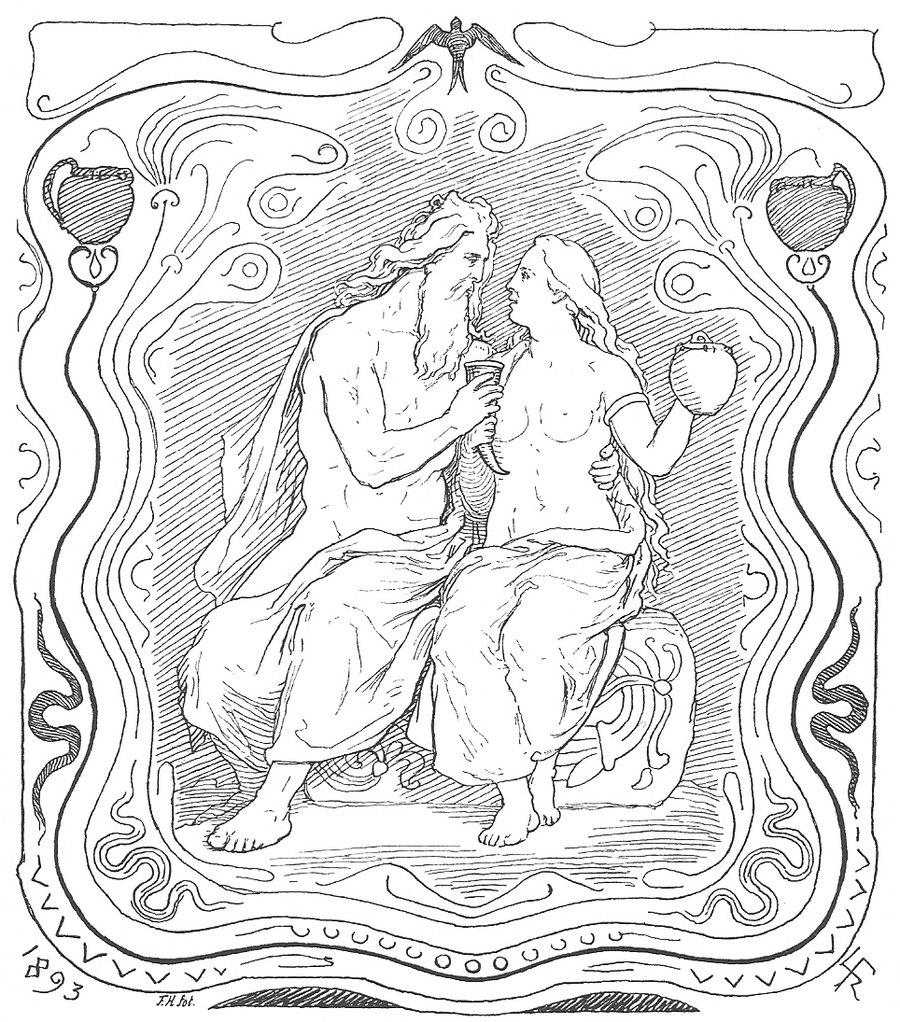
Baugi takes the auger called Rati and bores a hole into the rock of Hnitbjorg. Odin turns himself into a serpent and creeps through the narrow opening into the heart of the mountain. There, deep in the stone, he meets Gunnlod, the keeper of the mead. He stays with her for three nights.
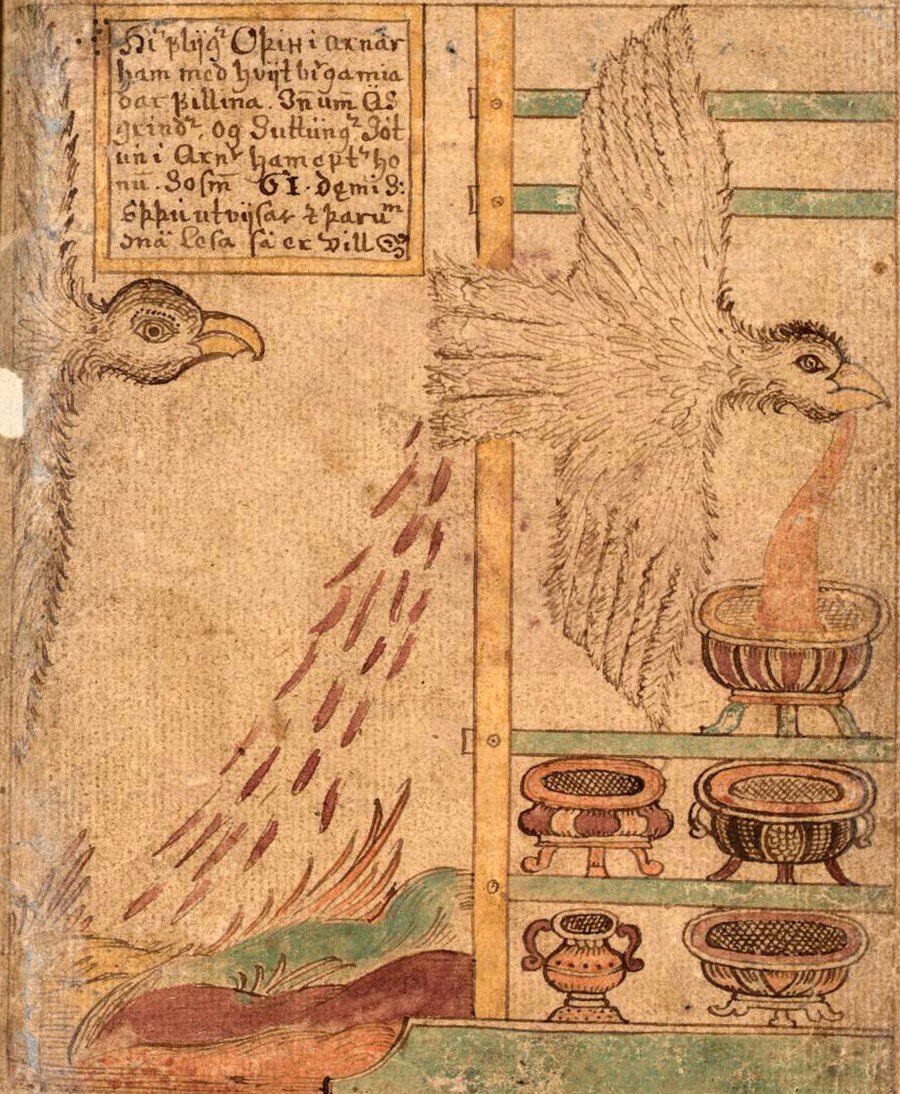
For these three nights she grants him three sips. But with each sip Odin empties a whole vessel. In three draughts he drains Odrorir, Bodn and Son dry. Then he changes into an eagle and flies away with all the mead in his body. Of the seduction by which he won Gunnlod the old poem speaks without gloss.
Her heart I betrayed, the good maiden, and ill repaid her trust.after Havamal, public-domain translation tradition
Suttung notices the theft, takes eagle shape himself and gives chase. It becomes a race for the most precious thing the world knows. When Odin reaches Asgard, the gods have set out vessels, and he spits the mead into them.
In his haste, though, a little goes out the back way. This unworthy remnant, so the tale says with a wink, may be taken by anyone who wants it - it is the share of bad poets. The great, true mead stays with the gods and is dealt out to humans who deserve the gift of poetry. That is how the Norse explain why some verses soar to heaven while others remain mere stammering.
One could celebrate the theft as a heroic deed, and for a long time it was read that way. But the source itself is more honest. In the Havamal Odin admits that he abused Gunnlod's trust and rewarded her badly. He broke an oath, seduced a giantess and stole the mead - and he knows it. The god of wisdom is at the same time the god of cunning, and the old texts do not conceal it.
Anyone who wants to know more about this double nature will find it again in our portrait of Odin. It makes him more human and more dangerous at once. The price of poetry, it seems, was not only Kvasir's blood but also Gunnlod's disappointed heart.
The basic outline - Odin wins the mead of poetry from Gunnlod in the mountain, spends three nights, empties three vessels and flees as an eagle, pursued by Suttung - stands in the Havamal (stanzas 104 to 110) and more fully in Snorri's Skaldskaparmal. The Havamal itself admits that Odin repaid Gunnlod badly. Public-domain tradition.
The names Kvasir, Fjalar and Galar and the mead's origin from blood and honey are largely Snorri's elaboration in the Skaldskaparmal; the older Havamal only hints at the theft. Odin's conduct is not morally clean - oath-breaking and seduction belong to the story, not as later criticism but within the text itself.
Kvasir & the mead of poetry · Odin · Bragi – god of poetry · Mead – the drink of gods · The Edda.
The valkyries are seen as cold directors of battle. The story of Helgi and Sigrún shows the other side: love, loyalty …
Read more →When Baldr is dead, one dares the most perilous ride of all the myths: Hermod, a son of Odin, rides into the underworld …
Read more →There are scenes in Norse poetry that take your breath away. Hervör’s night walk to the grave-mound of her dead father …
Read more →When the shining god Baldr dies, the Æsir give him the most splendid funeral of the North – upon Hringhorni, the …
Read more →