Bragi is the Norse god of poetry: in the 13th century Snorri Sturluson describes him as renowned for wisdom and above all for eloquence, the greatest expert in the art of verse and the husband of the goddess Iðunn. Yet behind the long-bearded god there may stand a real man – Bragi Boddason, the earliest skald whose verses survive. Here we lay out what the Eddas, the Viking-age praise poems and the sagas actually say about Bragi, what the bragafull cup was, and where scholars still disagree.
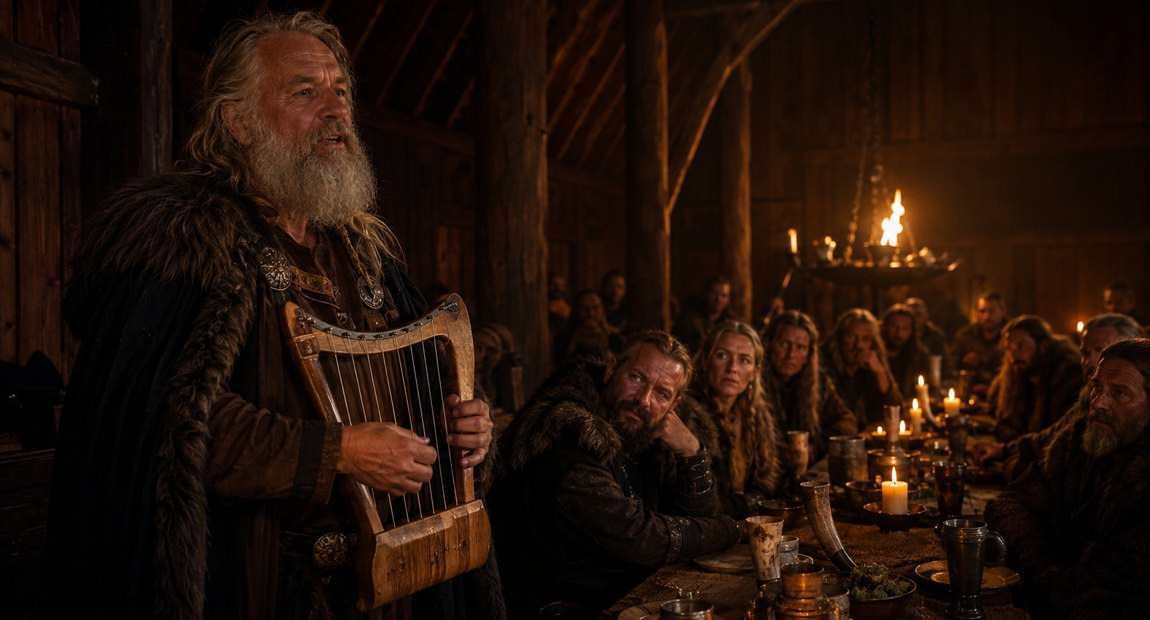
Picture a hall full of smoke and noise, packed with men wearing scars and arm-rings. Then one of them stands up, clears his throat – and the room goes quiet. He holds no sword, only a poem. Eight lines later everyone present knows who the greatest king alive is, and their grandchildren will still know it a century on.
In the North, that power had a name: Bragi. He is the god of poetry, and one of the oddest cases in the whole pantheon, because hardly any other god has such a concrete human double. Which raises the question running through this article: did a poet become a god?
Our main source is the Prose Edda written by the Icelander Snorri Sturluson around 1220. In Gylfaginning ("The Deluding of Gylfi"), chapter 26 in the usual modern numbering, Snorri introduces the Æsir one by one. Of Bragi he says, in our own rendering: one is called Bragi; he is famous for wisdom and most of all for eloquence and skill with words. He knows most about poetry, and after him poetry is called bragr. From his name, a man or woman who surpasses others in eloquence is called bragr karla or bragr kvenna – the foremost of men or of women. His wife is Iðunn.
The second part of the Prose Edda, Skáldskaparmál ("The Language of Poetry"), adds a little colour. In true textbook style Snorri asks how a poet should refer to Bragi. The answer: as Iðunn's husband, as the first maker of poetry, and as the long-bearded god. After his name, a man with a great beard is called a skeggbragi, a "beard-Bragi". And Bragi, Snorri adds, is a son of Odin. Hence the familiar image of the old, bearded god of eloquence.
Snorri keeps it simple: poetry is called bragr after Bragi. Linguists are more careful. The Old Norse word bragr has two meanings: "poetry, verse" and "the first, the noblest, the best". The second meaning is already there in Snorri's own phrase bragr karla.
Which sense lies behind the god's name is uncertain. It could mean "the poet", or "the noble one, the chief"; some have compared Old English brego ("lord, prince"), though that link remains doubtful. Rudolf Simek regards Snorri's derivation of bragr from Bragi as a secondary connection – one that may even have helped turn Bragi into a god of poetry in the first place. And one more detail matters a great deal: Bragi was an ordinary man's name in the Norse world. Keep that in mind; it is the key to the big debate further down.
Bragi's wife is Iðunn, keeper of the apples the gods eat to stay young. The couple is attested in several places: in Snorri, in Lokasenna and in a skaldic stanza preserved in Grettis saga. What the sources never give us is a story in which the two act together.
So why this pairing? Jan de Vries saw in Bragi and Iðunn a link to fertility and vital force and even compared Bragi with Freyr. Heinz Klingenberg called that speculative and read the marriage as a poetic complement instead: Iðunn preserves life through rejuvenation, Bragi through the word that carries fame beyond death. Both are modern interpretations, not statements from the sources – but the second one fits rather neatly with what a Viking praise poem was meant to do.
Bragi's biggest role is as narrator. Skáldskaparmál opens with a feast: the sea-giant Ægir (also called Hlér) travels to Asgard and is entertained by the gods. Bragi sits beside him and talks. This section is known as the Bragaræður, "Bragi's Speeches".
Among other things Bragi tells how Iðunn was abducted by the giant Þjazi and brought back, how the giantess Skaði came to marry Njörðr, and above all where the mead of poetry came from. Brewed from the blood of the wise Kvasir, the mead ends up with the giant Suttungr, whose daughter Gunnlöð guards it – until Odin seduces her, drinks the mead and escapes in the shape of an eagle.
The division of labour is striking. Odin steals poetry; Bragi explains it, including how the language of poetry acquired its circumlocutions. The frame is very probably Snorri's own composition: Bragi was simply the obvious choice of speaker for a handbook of poetics. Ægir, incidentally, later hosts the very feast at which Loki insults the gods.
The briefest – and perhaps oldest – mention comes in the Eddic poem Grímnismál. In stanza 44 Odin, disguised as Grímnir, lists the best of every kind. In our own rendering: Yggdrasil is the best of trees, Skíðblaðnir of ships, Odin of the Æsir, Sleipnir of horses, Bifröst of bridges, Bragi of skalds, Hábrók of hawks and Garmr of hounds.
Notice that Bragi appears as the best of poets, not of gods. Is the god meant here, or the famous human skald Bragi, who would sit just as comfortably on a list of champions? The stanza allows both readings – and that is exactly where the debate begins.
Bragi's liveliest scene comes in Lokasenna ("Loki's Flyting"), a poem of the Poetic Edda. At the feast in Ægir's hall, Loki has killed a servant, been thrown out, and now comes back demanding a seat and a drink.
It is Bragi who turns him away in stanza 8: the gods will never give him a place at the feast, they know too well what sort of guest he is. Loki reminds Odin of their sworn blood-brotherhood, and Odin has him served. Loki toasts all the gods and goddesses – except Bragi, sitting there on the bench (stanza 11).
In stanza 12 Bragi tries to buy peace, offering Loki a horse, a sword and a ring from his own goods. Loki sneers back in stanza 13: Bragi will always be short of rings, and of all the gods and elves he is the most wary in battle and the shyest of arrows. Bragi loses his temper (stanza 14): if he were outside the hall, he would be holding Loki's head in his hand. Loki presses on (stanza 15): Bragi is brave on the bench, a bekkskrautuðr – roughly a "bench-ornament" – and should go outside and fight if he is so angry.
Then Iðunn steps in (stanza 16) and asks Bragi not to trade insults with Loki in Ægir's hall. Loki snaps at her, claiming she once embraced her own brother's killer (stanza 17); no other source tells us anything more about this. Iðunn answers calmly in stanza 18: she will not abuse Loki, she is only soothing Bragi, who is heated with beer.
The point is clear: Bragi is eloquent but no warrior, and that is exactly where Loki strikes, for a charge of cowardice cut deep in the North. The date of Lokasenna is uncertain; suggestions range from late pagan times to the 12th century.
A horse and a sword I will give you from my goods, and Bragi will make it good with a ring, so that you bring no hatred to the gods.Lokasenna 12, our own rendering
In the Eddic poem Sigrdrífumál, the valkyrie Sigrdrífa teaches the hero Sigurd the wisdom of runes. In a long list (stanzas 15–17, numbered slightly differently in different editions) she names the places where runes were carved: on the shield that stands before the shining god, on a horse's ear and hoof, on the bear's paw – and on Bragi's tongue.
No one knows exactly what this means. The obvious reading: the tongue is the tool of poetry, and wherever runes sit, there is power. The poem itself is available under read Sigrdrífumál.
Two 10th-century praise poems give Bragi the most fitting job imaginable: he welcomes dead kings to Valhalla.
Eiríksmál was composed after the death of Eric Bloodaxe, who fell in England in 954. According to tradition his widow Gunnhild commissioned it; the poet is unknown, and only the opening survives, in the kings' saga Fagrskinna. Odin wakes and has the einherjar prepare the hall, for a king is coming. Bragi hears the din and asks what is thundering, as if thousands were on the move – the benches creak as though Baldr were returning to Odin's halls. Odin tells him not to talk foolishly: it is Eric who comes. Bragi then asks why Odin expects more of Eric than of other kings. He comes across almost like a master of ceremonies.
Hákonarmál by the skald Eyvindr skáldaspillir follows this model about seven years later. It mourns King Hákon the Good, who died around 961 after the battle of Fitjar. In stanza 14 Odin sends Hermóðr and Bragi to meet the king. Hákon is suspicious and fears Odin's intentions; Bragi reassures him that he will find peace among the einherjar.
Both poems matter because they are older than Snorri and already know Bragi as a resident of Valhalla in the 10th century. At the same time they are works by skalds for kings – and having a god of poets greet the king is a little bit of professional self-promotion.
Now to the man. Bragi Boddason, called inn gamli, "the Old", is regarded as the earliest skald whose verses survive. The nickname separates him from Bragi Hallsson, an Icelandic poet of the 12th century. According to tradition Bragi the Old came from south-western Norway and was active in the 9th century. His exact date is disputed: the first half of the 9th century was long the standard view, others have suggested roughly 835–900, and the dating of his poetry has been reopened in recent research.
Skáldatal, a medieval list of court poets, names him as skald to Ragnar Lodbrok, Eysteinn Beli and Björn at Haugi. Landnámabók, the Icelandic Book of Settlements, gives him a wife, Lopthœna, daughter of the skald Erpr lútandi, and tells an anecdote in which Bragi persuades a queen to take back her own sons, whom she had swapped for a slave's child. Egils saga recalls that Bragi once saved his head before King Björn with a poem composed in a single night – the very precedent Egill Skallagrímsson follows when he composes his "Head-Ransom" for Eric Bloodaxe.
Much of this is legend, as is a verse exchange between Bragi and a troll-woman in a dark forest. But it shows that medieval Icelanders already saw Bragi as the founding father of their art.
Bragi's chief work is Ragnarsdrápa, a so-called shield poem. A drápa is a long, formal praise poem with a refrain. According to Snorri, a king named Ragnarr gave Bragi a splendidly painted shield, and Bragi thanked him by putting its pictures into verse. Snorri had Ragnar Lodbrok in mind; many scholars suspect a different Ragnarr.
Some twenty stanzas and half-stanzas survive, almost all as quotations in Snorri's Edda; their order has been reconstructed by modern editors. Four scenes can be made out:
The mix is remarkable: two heroic legends, two scenes of the gods. The poem proves that the myths of Gefjon and of Thor's fishing were being told – and painted – as early as the 9th century.
Two things are worth knowing about skaldic poetry. The first is the kenning: a figurative circumlocution of at least two parts. A ship is the "horse of the sea", blood the "dew of wounds", gold "Ægir's fire" or "fire of the sea", and Odin can be "Gunnlöð's lover". If you do not know the myths, you will not get the allusion – which is exactly why Bragi tells them in Skáldskaparmál.
The second is the metre dróttkvætt, literally "retinue metre". A stanza has eight lines of six syllables each, with three stressed positions. Alliteration links pairs of lines, and internal rhymes called hendingar sit inside the line: half-rhymes in odd lines, full rhymes in even ones. It is precision work, closer to goldsmithing than to improvisation.
Bragi Boddason is traditionally regarded as the inventor, or at least the earliest master, of this metre. His internal rhymes are not yet as strictly regular as those of later skalds. Yet because his verse is already so polished, many scholars assume an older tradition that has been lost: Bragi was probably not the first skald, only the first whose verses survived. For the background to the words themselves see our article on skål and skald – what the words mean.
A god of poetry and a man regarded as the first great poet, sharing one name – coincidence?
Most scholars – among them Margaret Clunies Ross, Heinz Klingenberg, Rudolf Simek, Andy Orchard and John Lindow – think it likely that the god grew out of the skald. After his death the revered poet would have been imagined in Valhalla, first in Odin's retinue and later as a god in his own right. In favour of this view: the god is not found in any cult site, place-name or sacrificial formula. He lives only in poetry. Klingenberg stresses that Bragi is securely attested as a god only in sources from after the pagan period.
The other side is smaller but not weak. Jan de Vries thought the span between a 9th-century skald and the 10th-century poems too short to turn a man into a god, particularly in the last decades of paganism. He saw the god as an independent figure for the formal, life-affirming word. Opinions on the timing of any deification differ anyway: Eugen Mogk thought of the late 9th century, Clunies Ross and Klingenberg rather of the late 10th. John Lindow points out that the relative chronology of the Eddic poems cannot be fixed with certainty.
A word often linked to Bragi is bragafull or bragarfull – literally "Bragi's cup" or "cup of the best". It was a ceremonial drink over which vows were made. Three sources stand out.
In Ynglinga saga (Heimskringla, chapter 36; numbered differently in some editions) Snorri describes the funeral ale, the erfi. The heir sat on the step before his late father's high seat until the bragafull was carried in. Then he stood, made a vow, drained the cup, and only afterwards took the high seat. King Ingjaldr did just that, swearing to enlarge his realm by half in every direction or die – and the evening ended with the hall burning and the invited petty kings dying in the flames.
In Hákonar saga góða (chapter 14 in the Íslenzk fornrit edition, chapter 16 in older translations such as Laing's) Snorri describes a sacrificial feast in Trøndelag: first Odin's cup was drunk for victory and power for the king, then the cups of Njörðr and Freyr for good harvests and peace. After that many were accustomed to drink the bragafull, and finally the memorial cup, the minni, for departed kinsmen.
And in the Poetic Edda, in the prose of Helgakviða Hjörvarðssonar, men lay their hands on a sacrificial boar on Yule Eve and swear vows "at the bragarfull". Heðinn rashly swears to win his brother's beloved.
Does the cup have anything to do with the god? Possibly, but not certainly. The word may just as well contain bragr in the sense of "the best, the chief" – making it simply the "chieftain's cup", the most solemn toast of the night. Snorri himself draws no link to the god. For the drink and the toast, see our articles on mead and on "skål".
Bragi fights no giants and carries no hammer. He stands for something else: a king was only as great as the song about him. Hávamál puts it in its famous stanza: "Cattle die, and kinsmen die, and so one dies one's self; but a noble name will never die, if good renown one gets" (trans. Bellows, 1923). That is also what an engraving is for: holding on to a word so it outlasts the moment. A few ideas that stay historically sound:
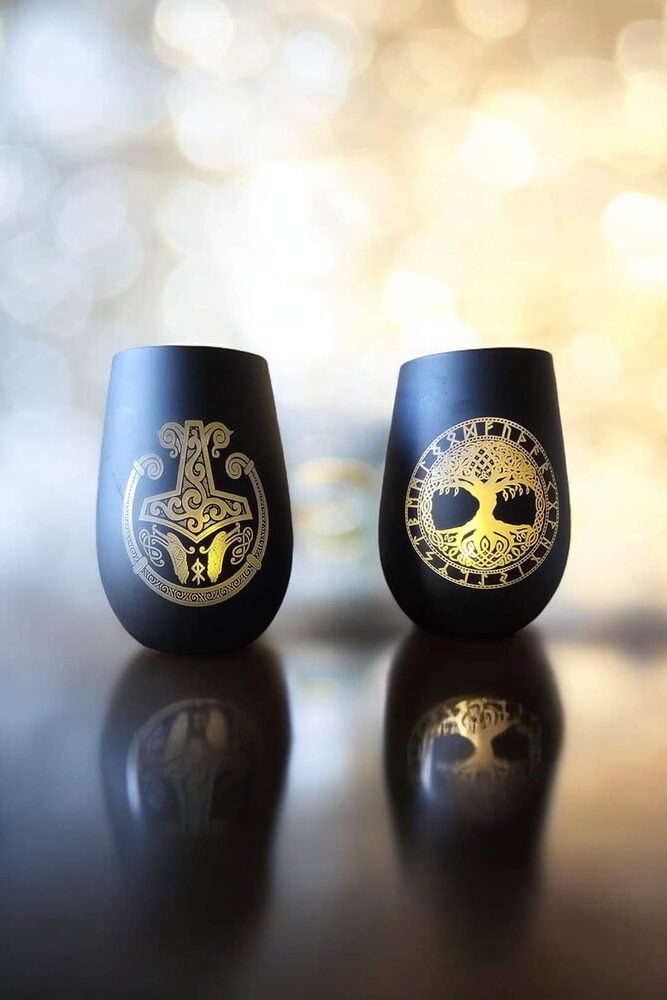
A bragafull vow gift: a drinking horn or glass engraved with a personal promise – for a wedding, a company founding, a milestone birthday. The custom of vowing over a cup is attested, so the motif rings true without inventing anything.
Grímnismál 44 on slate: the line "Bragi, best of skalds" – in Old Norse en Bragi skálda – suits a plaque for people who work with words: writers, musicians, teachers, speakers. On request we set the text in runes of the Younger Futhark, the script Bragi Boddason himself would have known.
A scene from Ragnarsdrápa: Thor's fishing trip or Gefjon at the plough – images that were already painted on a shield in the 9th century. Rendered in a fitting animal style on wood or slate, it is a piece of picture history you can hold in your hands.
And if you have verses of your own, or a saying your grandfather always used: that is exactly what engraving is for. Bragi would have understood.
Who is Bragi in Norse mythology? Bragi is the god of poetry and eloquence and the husband of the goddess Iðunn. He is known mainly from Snorri's Prose Edda, Lokasenna, Grímnismál and the praise poems Eiríksmál and Hákonarmál.
Is Bragi a son of Odin? Only Snorri Sturluson says so, in Skáldskaparmál. No older source names Bragi's parents, so this parentage is not otherwise supported.
What is the difference between the god Bragi and Bragi Boddason? Bragi Boddason was a historical Norwegian skald of the 9th century and author of Ragnarsdrápa. Many scholars think the god is that poet, deified after his death, but this cannot be proven.
What does bragafull mean? The bragafull or bragarfull was a ceremonial cup at funeral feasts, sacrifices or Yule, over which vows were sworn. Whether the name comes from the god Bragi or from the word bragr ("the best") is disputed.
What does the name Bragi mean? It is related to Old Norse bragr, which can mean both "poetry" and "the best, the foremost". Bragi was also an ordinary man's name in Scandinavia.
Why does Loki call Bragi a coward? In Lokasenna Loki mocks Bragi as the most wary of all the gods in battle and brave only on the bench. The taunt hits the god of words where a warrior society was most sensitive: courage.
For courage. For remembrance. For legends that live on.
Idun & the apples of youth · Odin · Gunnlöd & the theft of the poetic mead · The Edda · The Norse pantheon.
All Gods & Goddesses articles →
Every great deity of the North has a dwelling. That of Frigg, the highest of the goddesses, is called Fensalir – „the …
Read more →Where there is strife, one is needed who settles it. The North gave that idea a face: Forseti, the god of law. Whoever …
Read more →Freyja is far more than the „Norse goddess of love" she is often reduced to. She is a war-mistress, a master of magic …
Read more →Freyr is the god the Vikings offered to for good weather, rich harvest and peace – the „foremost of the Æsir", as …
Read more →