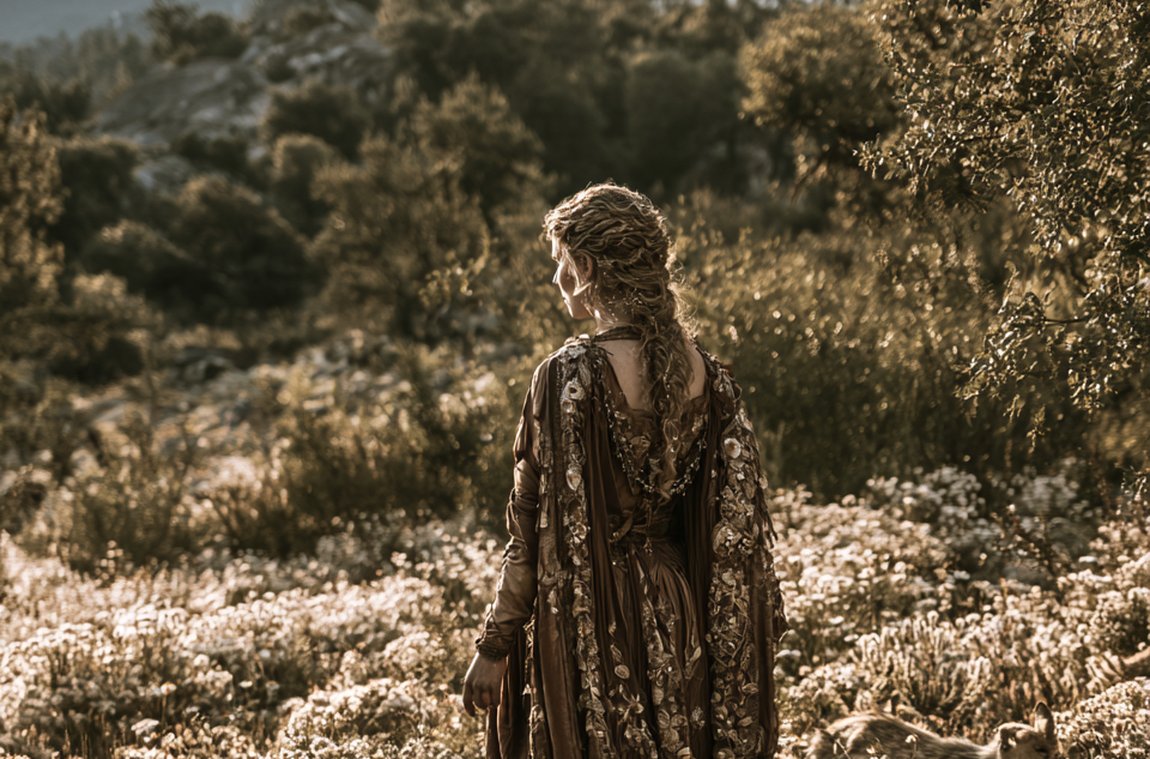
Fensalir is the dwelling of the goddess Frigg in Norse mythology – Odin's wife and, according to Snorri, the highest of the goddesses – and its name literally means “Fen Halls”. Only a handful of passages mention it: in the Völuspá Frigg weeps there for the woe of Valhalla, in Snorri's Gylfaginning it is called “very splendid”, and it is here that Loki, disguised as a woman, tricks her into revealing the secret of the mistletoe. Here are all the sources, the theories, and the places where the record falls silent.
Picture yourself hunting for the home of the most powerful goddess in the North – and finding three sentences, one stanza and a name that sounds like wet boots. That is what happens to anyone who goes looking for Fensalir. Valhalla gets rafters made of spear shafts and a roof tiled with shields. Frigg's hall gets a single adjective. And yet this barely described place is the setting for one of the most consequential conversations in all of Norse myth: the moment a mother, without knowing it, explains how her son can be killed.
In this article we go through the evidence passage by passage, look at what scholars have made of it, and mark clearly where the line runs between source and attractive speculation. If you want to meet Frigg herself first, we have a full portrait of the highest goddess of the North.
Fensalir is the name of Frigg's residence in Asgard, the stronghold of the gods. It is recorded in two thirteenth-century works: the Poetic Edda, specifically the poem Völuspá, and the Prose Edda of the Icelandic scholar Snorri Sturluson. There are no more than four mentions in total. Not one of them tells us what the hall looked like, where exactly it stood, or who lived there besides Frigg.
That sounds thin, and it is. But the few passages we have carry real weight, because they all circle the same core: Frigg as Baldr's mother, and the catastrophe that begins with his death. In the sources, Fensalir is less a building than a place of worry.
The oldest mention comes from the Völuspá, the “Prophecy of the Seeress”. The poem is usually dated to around the year 1000, though that dating is debated. It survives in two manuscripts: the Codex Regius (about 1270) and Hauksbók (early fourteenth century). The stanza naming Fensalir appears only in the Codex Regius; Hauksbók lacks it.
The seeress has just described Baldr's death: the mistletoe, slender and seemingly harmless, becomes a deadly missile, and Höðr shoots. Then she turns to the avenger, a brother of Baldr who is only one night old and will neither wash his hands nor comb his hair until he has brought Baldr's killer to the pyre. And then, set against this raw tale of vengeance, come three short lines. In Old Norse: en Frigg um grét / í Fensǫlum / vá Valhallar.
“But in Fensalir did Frigg weep sore / For Valhall's need”Völuspá, translated by Henry Adams Bellows (1923), who numbers it stanza 34
Notice what the stanza says – and what it does not. Frigg does not explicitly weep “for her son”, as so many retellings put it. She weeps for vá Valhallar, the “woe” or “calamity of Valhalla”. Baldr's death is obviously meant, but the wording widens the lens: with Baldr dies not only a child but the security of the entire divine world. The seeress's refrain – roughly, “do you know yet, or what?” – signals that a chapter of the world's end has just opened. We tell the full story in The Death of Baldr.
There may also be a sound-based reason the hall's name made it into these lines: Frigg and Fensǫlum alliterate, and Old Norse verse is built on alliteration. That does not mean the name was invented to fill a line. It simply sat easily in a poet's ear.
Some two centuries after the Völuspá was probably composed, Snorri Sturluson sat down in Iceland around 1220–1225 and wrote a handbook for young poets: the Prose Edda. In its first part, Gylfaginning (“The Beguiling of Gylfi”), a Swedish king called Gylfi quizzes the gods about how the world works. For more on Snorri and his methods, see our portrait of Snorri Sturluson.
In chapter 35 Snorri lists the Ásynjur, the goddesses of the Æsir. The list opens with a drumroll: Frigg er æðst, “Frigg is the highest”. Then comes the sentence that matters to us: she owns a dwelling called Fensalir, ok er hann allvegligr – “and it is very splendid”. That is all. No gold, no pillars, no comparison with any other hall.
The choice of word is revealing. Snorri calls Fensalir a bær, a farmstead, exactly the word an Icelandic farmer would use for his own place. The name itself is plural: salir are “halls”, not one hall. Snorri imagines the homes of the gods in terms of his own world: as farmsteads.
The order of the list is telling too. Right after Frigg comes Sága, who lives at Sökkvabekkr. Then Eir, Gefjon and, in fifth place, Fulla. We will come back to that sequence, and to the question of whether Sága might simply be Frigg under another name.
The best-known scene set in Fensalir is told by Snorri in chapter 49. Baldr has been having ominous dreams, the gods hold council, and Frigg makes everything in existence swear an oath not to harm him: fire and water, iron and every metal, stones, earth, trees, diseases, beasts, birds, poison and serpents. Afterwards it becomes the gods' favourite sport to throw things and shoot at Baldr. Nothing hurts him.
Loki does not like this at all. He goes to Fensalir, to Frigg, and takes on the likeness of a woman. Frigg asks her visitor whether she knows what the Æsir are doing at their assembly. The stranger replies that they are all shooting at Baldr and he remains unharmed. Frigg says that neither weapons nor wood will hurt him, for she has taken an oath from them all. The woman presses her: have all things really sworn?
And Frigg tells her. West of Valhalla grows a young shoot called mistletoe. It seemed too young to her to demand an oath from. That is all Loki needs. He leaves, pulls up the mistletoe, takes it to the assembly and puts it into the hand of blind Höðr.
In this scene Fensalir is a place of confidence. Frigg is not speaking before the assembled gods but in her own home, to a woman she takes to be harmless. That is what makes it so bitter: the hall where the goddess feels safe becomes the scene of betrayal. And the protection she devised for her son fails on the one exception she names herself.
After Baldr's death it is Frigg again who acts. She asks which of the Æsir wants to win all her love and favour by riding to Hel and trying to bring Baldr back. Hermóðr volunteers. When he returns he carries gifts from the realm of the dead: Baldr's wife Nanna sends Frigg a linen garment and more besides, and Frigg's handmaid Fulla a golden finger-ring. Where Frigg receives these gifts, Snorri does not say. Setting the scene in Fensalir is a perfectly reasonable thing to imagine, but it is imagination.
The fourth passage is the least conspicuous, yet for specialists perhaps the most important. In the second part of the Prose Edda, Skáldskaparmál (“The Language of Poetry”), Snorri explains how poets refer to the gods. These circumlocutions are called kennings: figurative stand-ins, such as “steed of the sea” for a ship.
For Frigg, Snorri lists among others: daughter of Fjörgynn, wife of Odin, mother of Baldr, mother-in-law of Nanna, queen of the Æsir and Ásynjur – and lady of Fulla, of the falcon-cloak and of Fensalir. Fensalir, then, was so firmly tied to Frigg that a poet could name the goddess through her home, something like “lady of Fensalir”. That suggests the name was not Snorri's invention but part of the inherited vocabulary of poetry. No surviving skaldic stanza actually uses this kenning, however.
The name has two parts. Salir is the plural of salr, “hall, room”, related to German Saal. The first part is the interesting one: Old Norse fen means “fen, marsh, bog, mire”. It goes back to Proto-Germanic *fanja- and has relatives across the Germanic languages: Gothic fani (“mud”), Old High German fenna, Dutch veen – and, of course, English fen, as in the Fens of eastern England.
For us in Alsdorf the word is almost on our doorstep. The same root lives in the name of the Hohes Venn (the High Fens), the great upland bog on the German–Belgian border, less than an hour from our workshop. Walk its boardwalks and you are, linguistically speaking, standing in a fen. Frigg's hall is quite literally the “Fen Halls”. That makes it no less divine, but rather damper than you might expect for a queen of heaven.
The reading is not entirely beyond dispute. Back in the nineteenth century Paul Henri Mallet and Walter Scott suggested that fen could also mean the watery deep, the sea. From “Sea Halls” some scholars went on to make Frigg a sun goddess whose home stood for the sun sinking into the ocean. That speculation is now regarded as outdated. The basic sense “marsh, bog” is linguistically secure. What it meant for the myth is the real open question.
A goddess who lives in “fen halls” invites interpretation. Three lines of thought run through the scholarship. All three are hypotheses, not established findings.
Hypothesis 1: springs and bogs as places of worship. In 1882 the Germanist Anton Edzardi proposed that the name reflected cult practices at springs and waters. He also linked Fensalir with folk traditions in which marshes and ponds were entrances to the realm of Frau Holle, whom he identified with Frigg. That Holle-equals-Frigg equation is itself an old and unprovable assumption of Romantic-era mythology. The historian of religion Rudolf Simek considers the question of a bog or spring cult unanswerable, and John Lindow is sceptical.
Hypothesis 2: a water and fertility goddess. The Swedish historian of religion Britt-Mari Näsström sees the name Fensalir as a pointer to Frigg's role as a fertility goddess. Together with Sökkvabekkr, Sága's home, it suggests a goddess who dwells by or in water – reminiscent, she argues, of Nerthus. The Roman historian Tacitus described that goddess around AD 98 in his Germania: after her procession, her wagon was washed in a hidden lake, and the slaves who helped were then swallowed by the same lake. More in our article on Nerthus.
Hypothesis 3: an echo of the sacrificial bogs. This is where archaeology enters. For thousands of years, wetlands in northern Europe were places where people handed things over to the powers – weapons, jewellery, vessels, wooden figures, animals, and sometimes people. The great war-booty deposits of the Roman Iron Age in Denmark, the cult site at Oberdorla in Thuringia, and the wooden figures from the Braak bog all belong to this world. We give an overview in Sacrificial Bogs and Bog Finds. Is it not tempting to see a goddess with “bog” in the name of her house as a memory of such places?
Tempting is not the same as proven. Most bog finds lie many centuries before Snorri's text. No bog find bears Frigg's name, and no source names Frigg as the recipient of bog offerings. Nor were offerings in water reserved for female deities: the weapon deposits in particular are usually read as thanks to powers of war. Linking Fensalir with the sacrificial bogs draws an attractive line, but a dotted one.
Snorri never says outright that Frigg's attendants live in Fensalir. But he describes three goddesses who belong to Frigg, and it is natural to picture them in her house. Together they form a small court.
Fulla is the closest confidante. Snorri describes her as a maiden who goes with her hair loose and a gold band round her head. She carries Frigg's ash-wood box, looks after her footwear and shares her secrets. In the prose introduction to the Eddic poem Grímnismál, Frigg sends her “box-maid” Fulla to King Geirröðr to warn him against a sorcerer – a ruse in a contest with Odin. Fulla is also the only one of the three with an echo outside Scandinavia: in the Second Merseburg Charm, written down in the tenth century, “Friia” and “Volla” appear as sisters. Whether Volla is the same figure as Fulla is not certain, but it is widely assumed. More in our article on the Merseburg Charms.
Gná is the messenger. Frigg sends her into various worlds on her errands. Gná rides the horse Hófvarpnir (“Hoof-Tosser”), which runs through the air and over the sea. Snorri preserves a little verse exchange about her: some Vanir see her in the sky and ask what is flying there. Gná replies, in substance, that she is not flying but riding through the air on Hófvarpnir, foaled by Hamskerpir and Garðrofa.
Hlín is the protector. Her task is to watch over the people whom Frigg wishes to save from danger. Intriguingly, in Völuspá 53 “Hlín” seems to stand for Frigg herself: as Odin goes out to fight the wolf, the poem says, “Hlín's second grief” arrives. The first grief was Baldr's death; the second is the death of her husband at Ragnarök. Whether Hlín was originally a separate goddess or simply a by-name of Frigg remains an open question.
Turning Fensalir into a “court of women” and a female counterpart to Valhalla makes a lovely picture. But it is a modern reading. No line in the sources sets Fensalir against Valhalla.
Asgard is full of named dwellings. The key source for them is the Eddic poem Grímnismál, in which a disguised Odin lists hall after hall of the gods. Fensalir is missing from that list. That is striking, since Grímnismál names even minor figures. Instead it gives a place that looks suspiciously like Fensalir.
Sökkvabekkr, the “sunken bank” or “sinking bench”, is the fourth dwelling in Grímnismál stanza 7. Cool waves murmur over it, and there Odin and Sága drink gladly every day from golden cups. A house in the water, a goddess drinking with Odin – it is easy to suspect that Sága is just another name for Frigg and Sökkvabekkr a poetic variant of Fensalir. Lindow treats this as the majority view; Stephan Grundy explains Sága and Sökkvabekkr as by-forms that gave poets different alliteration. Simek, by contrast, groups Sága with other less clearly defined protective goddesses without equating her with Frigg. Snorri himself lists Frigg and Sága as two separate goddesses. The question cannot be settled.
Breiðablik, “broad gleaming”, is Baldr's hall. Grímnismál lists it as the seventh dwelling, in a land where the fewest baleful things are found. Snorri adds in Gylfaginning 22 that nothing unclean can be there. The contrast with Fensalir is remarkable: the son lives in bright, pure “Broad-Gleam”, the mother in the damp “Fen Halls”. Whether the poets set up this opposition on purpose we cannot know. But lay the two names side by side and you see light and depth, surface and ground. Read more about Baldr and his home in Baldr – the bright god who had to die.
Two more places are worth a glance. According to Snorri, Freyja lives at Fólkvangr, and her hall Sessrúmnir is large and fair. And in Gylfaginning 14 the goddesses as a group have their own sanctuary, Vingólf, described as very beautiful. Valhalla, by contrast, is described in rich detail; see Valhalla – the hall of the slain. Throughout the sources the halls of the goddesses stay paler than those of the gods – which probably says more about the interests of poets and scribes than about how much the goddesses mattered.
Fensalir is a textbook case of how thin the evidence for Norse mythology can be. Here, soberly, is what remains open:
Then there is the question of how much of Snorri's picture goes back to old tradition. Snorri was a Christian writing some two centuries after Iceland's conversion. He knew the Völuspá, quotes it often and expanded much of it. The scene of Loki in Fensalir survives in no Eddic poem. It may rest on a lost source, or it may be Snorri's own narrative bridge, explaining how Loki learned about the mistletoe. Honestly: we cannot tell.
For us, that is precisely the appeal of this hall. Fensalir is not a fully painted palace but a name with a mood: marsh, stillness, a mother who knows fate and cannot stop it. In the Lokasenna, Freyja says of Frigg that she knows all fates, though she speaks none of them herself. And in the same poem Loki boasts that it is his doing that Frigg will never again see Baldr riding home to the halls. The halls where she waits stay empty.
In modern retellings and fantasy, Fensalir often becomes a lavish palace, sometimes by the sea, sometimes wrapped in mist. All of that is embellishment. If you want an overview of the goddesses of the North and how they come down to us, see our feature on The Goddesses of the North.
In our workshop, Fensalir is a quiet motif. It does not stand for battle and glory but for care, for watching over your own people, and for the grief that comes with love. A house name, a line above the door, an engraving for someone who has lost someone – Frigg's hall fits there better than any warrior's hall. And next time you walk across the High Fens, you will know you are walking through a word the Edda already knew.
What does Fensalir mean? Fensalir is Old Norse for “Fen Halls” or “Marsh Halls”: fen means marsh or bog, salir means halls. The older reading “Sea Halls” is considered unlikely.
Who lives in Fensalir? Fensalir is the home of the goddess Frigg, Odin's wife and Baldr's mother. Snorri names her attendants Fulla, Gná and Hlín alongside her, but never says explicitly where they live.
Where is Fensalir mentioned in the Edda? In Völuspá stanza 33, where Frigg weeps in Fensalir for the woe of Valhalla, and in Snorri's Prose Edda: Gylfaginning chapters 35 and 49, and Skáldskaparmál, where it appears in a kenning for Frigg.
What happened in Fensalir? According to Snorri, Loki visited Frigg there disguised as a woman and learned that only the mistletoe had not sworn an oath to spare Baldr. That knowledge let him bring about Baldr's death.
Is Fensalir the same as Sökkvabekkr? That is debated. Many scholars treat Sága as another name for Frigg and Sökkvabekkr as a poetic variant of Fensalir, but it cannot be proved.
Was Fensalir a sacrificial bog? There is no evidence for that. The name points to a marsh or bog; a link to real bog sacrifice sites is a scholarly hypothesis, not a finding.
For courage. For remembrance. For legends that live on.
Frigg · Freya or Frigg? · Baldr’s Death · Seiðr & fate.
All Gods & Goddesses articles →
Where there is strife, one is needed who settles it. The North gave that idea a face: Forseti, the god of law. Whoever …
Read more →Freyja is far more than the „Norse goddess of love" she is often reduced to. She is a war-mistress, a master of magic …
Read more →Freyr is the god the Vikings offered to for good weather, rich harvest and peace – the „foremost of the Æsir", as …
Read more →Above all the goddesses of the Æsir stands one: Frigg, Odin’s wife and queen of Asgard. She knows the fate of all …
Read more →