Loki is the giant's son who lives among the Æsir in Norse mythology: Odin's blood brother, a shape-shifter and trickster who wins the gods their greatest treasures and then causes their greatest loss, the death of Baldr. He fathers the wolf Fenrir, the World Serpent and Hel, ruler of the dead, gives birth to the horse Sleipnir, and leads the enemies of the gods at Ragnarök. Here is what the sources actually say about him, where his name might come from, and why scholars still cannot agree on what he is.
Picture a hall full of gods who keep a man at their table even though every one of them knows he brings trouble. They laugh at his ideas, they rely on his schemes, they curse him when things go wrong again – and still nobody throws him out. That man is Loki. No other figure in Norse mythology turns up so often at the decisive moment, and none is harder to pin down. If you came here looking for "Loki the god", there is a catch right away: in the usual sense he hardly is one. As far as we know he had no temples, no sacrifices and no worshippers. And yet the myths would collapse without him.
So let's look at who Loki is according to the medieval sources, which stories are told about him, what his children have to do with the end of the world, and what carved stones and modern scholarship add. We'll also tell you plainly where the evidence runs thin.
The fullest introduction to Loki comes from Snorri Sturluson, the Icelandic scholar and politician who wrote the so-called Prose Edda around 1220. In Gylfaginning ("The Deluding of Gylfi"), the mythological handbook section of that book, Snorri describes him roughly like this: Loki is handsome and fair to look at, but evil in character and very changeable in his behaviour. He surpasses everyone in the kind of cleverness called cunning, and has a trick for every situation. Again and again he gets the Æsir into serious trouble – and often gets them out of it again with his schemes.
His father is the giant Fárbauti; his mother is called Laufey or Nál. Snorri gives both names side by side without explaining why. "Nál" means "needle"; the other names have tempted scholars into colourful guesses, but they remain guesses. What stands out is something else: Loki is often named after his mother, as Laufeyjarsonr, "Laufey's son". That is unusual in Old Norse, where people normally carried their father's name. Snorri also names two brothers, Býleistr and Helblindi, about whom we learn almost nothing.
On his father's side, then, Loki is a giant, a jötunn – one of the beings who are usually the gods' adversaries. Even so, Snorri counts him among the Æsir. The key lies in an Eddic poem, the Lokasenna, where Loki reminds the father of the gods of an old pact:
"Remember, Othin, in olden days / That we both our blood have mixed; / Then didst thou promise no ale to pour, / Unless it were brought for us both."— Lokasenna 9, translated by Henry Adams Bellows (1923, public domain)
Blood brotherhood with Odin is why Loki can claim a seat at the gods' feasts. No surviving source tells us when or why the bond was sworn. The motif is powerful all the same: the highest god has tied himself to an outsider, and the tie cannot simply be undone.
The honest answer is that nobody knows for sure. Since the nineteenth century, several explanations have competed.
The oldest popular theory links Loki to logi, the Old Norse word for "flame". Jacob Grimm made him a fire god in 1835, and the idea still circulates widely. It has two problems. Linguistically, Loki with a k and logi with a g do not match cleanly. And the connection largely rests on a mix-up. In Snorri's tale of Thor's journey to Útgarða-Loki, Loki takes part in an eating contest against someone called Logi. Logi devours not just the meat but the bones and the trough as well – and at the end we learn that he was wildfire itself. In other words, Loki loses to fire. Útgarða-Loki, the giant king who stages the whole illusion, is a separate figure again.
A second line of explanation connects the name to a Germanic root *luk-, associated with loops, knots, hooks and fastenings. The Old Norse verb lúka, "to close, to finish", belongs to the same family. Loki would then be "the closer" or "the one who ends" – a name that would suit his part in the end of the world. That is an interpretation, not a proof.
In 1961 the Swedish folklorist Anna Birgitta Rooth took a third route. Pointing to Scandinavian dialect words for spiders and to Snorri's claim that Loki invented the fishing net, she argued that Loki began as a spider figure. The idea is original but has not won general support. Standard reference works such as Rudolf Simek's dictionary take the sober line: the etymology is unresolved.
Loki goes by several names. The most common alternative is Loptr (or Lopt), usually derived from lopt, "air" – perhaps a nod to his flights in borrowed feather shapes, perhaps to his slipperiness. In the Eddic poem Hyndluljóð, Loptr eats a half-burnt woman's heart and becomes pregnant by it; from this, the poem says, all troll-women descend. It is one of the strangest passages in the whole Edda.
The second important by-name is Hveðrungr, often rendered as "roarer", though that is not certain. It appears almost only in family references. In Völuspá, Odin's son Víðarr avenges his father on "Hveðrungr's son" – meaning Fenrir. In the skaldic poem Ynglingatal, Hel is called "Hveðrungr's maid". Such poetic circumlocutions are called kennings: images that name a person through their relationships or deeds. Snorri lists many more for Loki, such as "thief of Sif's hair" and "slanderer of the gods". Read together, they make a short biography.
Few gods have offspring with such consequences. With the giantess Angrboða, "she who bodes sorrow", Loki fathers three beings who will doom the gods. Snorri says the gods learned from prophecies that great harm would come to them from these siblings, so Odin had them brought to him.
The gods raised the wolf Fenrir themselves and finally bound him with the magic fetter Gleipnir; Týr lost his hand in the process. Odin threw the serpent Jörmungandr into the sea, where it grew until it encircled the whole earth – hence the name World Serpent or Midgard Serpent. The daughter, Hel, he sent down to Niflheim and gave her power over everyone who dies of sickness or old age.
Then there is a child Loki bore not as father but as mother: the eight-legged horse Sleipnir, best of all horses and Odin's mount. How that happened is told in the story of the wall of Asgard below.
With his wife Sigyn, finally, Loki has one or two sons, and here the tradition gets tangled. Snorri first mentions a son "Nari or Narfi", but in the account of Loki's binding two sons appear: Váli and Nari or Narfi. The prose at the end of Lokasenna says Loki was bound with the guts of his son Nari, while his son Narfi was turned into a wolf. Whether Nari and Narfi are one person or two cannot be settled from the sources.
A master builder offered to raise a stronghold for the gods that no giant could break. His price: the goddess Freyja, plus the sun and the moon. The Æsir struck a bargain they thought impossible to meet: he had to finish in a single winter, without anyone's help. On Loki's advice, though, they let him use his stallion, Svaðilfari.
That was the mistake. The stallion hauled enormous rocks by night and did twice the work of his master. Three days before summer, the wall was almost done. The gods asked who had talked them into this, and the answer came quickly. Threatened with death, Loki promised to fix it. He turned himself into a mare and whinnied in the woods, and Svaðilfari broke loose. The horses ran about all night, the work stalled, and the builder flew into a giant's rage, revealing himself as a mountain giant. Thor killed him with his hammer.
Some time later Loki gave birth to a grey foal with eight legs: Sleipnir. Snorri tells the story in full; Völuspá alludes in two stanzas to broken oaths and a deal involving Freyja without naming Loki or Sleipnir. Whether the poet had the same story in mind is debated. The pattern, though, is classic Loki: he causes the problem, and he solves it with his own body as the stake.
Loki's most famous story starts with a nasty prank. In Skáldskaparmál, the second part of the Prose Edda, Snorri tells how Loki, out of mischief, cut off all the hair of Sif, Thor's wife. Thor grabbed him and would have broken every bone in his body had Loki not sworn to get the dark elves to make Sif new hair of gold that would grow like real hair.
Loki went to the sons of Ívaldi. They forged the golden hair, the ship Skíðblaðnir for Freyr and the spear Gungnir for Odin. Then Loki bet his own head with the dwarf Brokkr that Brokkr's brother could not make three treasures as good. Snorri calls the brother Eitri here; the name Sindri, familiar from many retellings, comes from other contexts.
While the dwarfs worked, a fly stung Brokkr, finally on the eyelid; the story strongly implies it was Loki. Even so, three marvels came out of the forge: the golden boar Gullinbursti for Freyr, the ring Draupnir for Odin and the hammer Mjölnir for Thor. Only the hammer's handle turned out a little short, because Brokkr had let go of the bellows for a moment.
The gods judged Mjölnir the finest treasure, so Loki had lost. He ran, Thor fetched him back, and Loki pulled his famous lawyer's trick: Brokkr could have the head, but not the neck. Brokkr gave up on the head, took an awl and sewed Loki's lips shut. Keep that scene in mind – we will meet it again on a stone from Denmark.
The story of Iðunn and her apples of youth also begins with Loki in a fix. Odin, Loki and Hœnir were travelling and tried to cook an ox, but the meat would not cook. An eagle in a tree claimed the blame and demanded a share, then grabbed the best pieces. Loki struck it with a pole, the pole stuck to the eagle and Loki's hands stuck to the pole, and the bird dragged him over rocks and scrub. The eagle was the giant Þjazi. Loki was released only after swearing to lure Iðunn and her apples out of Asgard.
He kept his word. Without the apples the gods grew old and grey, and once again Loki was threatened with death. Borrowing Freyja's falcon shape, he flew to giant country, turned Iðunn into a nut and carried her home. Þjazi chased him as an eagle, flew over the walls of Asgard and burned in the fire the gods had lit there.
This episode matters because Snorri is not our only source. The Norwegian skald Þjóðólfr of Hvinir described it around 900 in Haustlöng, a poem about the scenes painted on a shield. That makes it one of the earliest witnesses to Loki at all, composed before Norway became Christian. The sequel has a crude punchline: when Þjazi's daughter Skaði demanded compensation, Loki made her laugh with the help of a goat and a rope. We will spare you the details.
Loki travels with Thor surprisingly often, and here he shows his useful side. In the Eddic poem Þrymskviða, the giant Þrymr has stolen Thor's hammer and wants Freyja as his bride. Loki borrows Freyja's feather cloak, flies to the giants and learns the terms. Then Thor sets off for the wedding dressed as the bride, with Loki along as his maid. When the "bride" puts away a whole ox, eight salmon and three casks of mead, Loki explains that Freyja has eaten nothing for eight nights out of longing. When Þrymr peeks under the veil and sees burning eyes, Loki has another excuse: she hasn't slept for eight nights either. The poem's age is disputed; some scholars consider it a thirteenth-century composition.
Less flattering is the tale of Geirröðr, which the skald Eilífr Goðrúnarson already treated around the year 1000 in Þórsdrápa. Caught by the giant, Loki buys his freedom by promising to bring Thor to him without his hammer. Once again he saves his skin at someone else's expense.
Up to this point Loki's pranks could be repaired. With the death of Baldr, that changes. Snorri tells how Frigg, after her son's bad dreams, made all things swear not to harm him – except a young mistletoe shoot, which she thought too young to take an oath. The gods turned it into a game to throw things at the invulnerable Baldr.
Loki did not like it. Disguised as a woman, he visited Frigg and coaxed the secret of the mistletoe out of her. He pulled up the shoot, went to the blind god Höðr, who was standing apart, and offered to guide his aim. Höðr threw, and Baldr fell dead.
Hel promised to release Baldr if everything in the world wept for him. Everything did – except a giantess called Þökk, "Thanks", sitting in a cave, who said in effect that she would weep dry tears and Hel should keep what she had. Snorri adds that people believed this giantess was Loki. He presents it as a belief, not as established fact.
Outside Snorri, Loki's part is thinly attested. Völuspá tells of Baldr's death by mistletoe and of Höðr's shot without mentioning Loki. Only in Lokasenna does Loki boast to Frigg that he is the reason she will never again see Baldr ride to the halls. Whether Loki's role belongs to the old core of the myth or is a later sharpening is still debated. For the full story, see our article on Baldr's death.
Lokasenna, "Loki's quarrel", is set at a feast held by the sea giant Ægir. Loki kills a servant, is thrown out, comes back and demands a seat on the strength of his blood brotherhood. Then he takes the gods apart one by one: he calls Bragi a coward, accuses goddesses of affairs, mocks Odin for unmanly sorcery and Týr for his lost hand – often alluding to stories we otherwise do not know. Only when Thor returns and raises his hammer does Loki leave, with a final curse on Ægir.
The poem shows a divine world whose dignity is already cracking. The punishment follows, told at length by Snorri: Loki hides as a salmon in the waterfall Fránangr, and the gods catch him in a net – his own invention. He is bound with his son's guts, a venomous snake hangs over him, and Sigyn catches the poison in a bowl. When she goes to empty it, the venom hits him, and his convulsions shake the earth. The whole story, with all its source variants, is in our article on Loki's punishment.
Loki stays bound until the end of the world. In Völuspá, the seeress sees a captive lying under the grove of hot springs, "like Loki" in shape, with Sigyn sitting beside him, taking little joy in her husband. At Ragnarök he breaks free.
Here a close reading pays off, because the two main sources tell the end differently. Völuspá says that Naglfar is loosed and Hrymr comes driving – and in the next stanza a ship crosses the sea with the people of Muspell, "and Loki steers". In Snorri, by contrast, the giant Hrymr steers the ship Naglfar, made from dead men's nails, while Loki arrives with all of Hel's followers. The popular summary "Loki captains Naglfar" therefore blends the two. What is certain is that in both versions Loki brings the gods' enemies to the field.
His children play the deadly roles. Fenrir swallows Odin; Thor and the World Serpent kill each other. Loki's own end is known only from Snorri: he fights Heimdall, and each kills the other. Völuspá knows nothing of this duel. Their rivalry, however, is older: in Húsdrápa, composed by Úlfr Uggason around 985, Heimdall already wrestles with "Laufey's son" – over Freyja's necklace Brísingamen, according to Snorri.
So what is Loki, really? Scholars have argued about it for nearly two centuries.
The Dutch scholar of religion Jan de Vries devoted a study to him in 1933, The Problem of Loki, and later saw him above all as a trickster: a figure known from many cultures who breaks rules, deceives, changes shape and sex, and often brings useful things into the world along the way. The label fits – but it does not explain his dark role at the end of the world.
The French comparativist Georges Dumézil, in his 1948 book Loki, compared him with Syrdon, a figure from the Nart sagas of the Ossetians in the Caucasus: a malicious outsider who brings about a hero's death. Dumézil saw this as a shared Indo-European inheritance. The Swede Folke Ström argued in 1956 that Loki was a "hypostasis" of Odin, the dark side of the father of the gods split off into a separate character. Each theory illuminates something; none has convinced everyone.
One sober point is missing from many popular accounts: there is no evidence of a cult of Loki. No place names, no sacrificial sites, no dedications, no reports of rituals. The Danish historian of religion Jens Peter Schjødt concluded that Loki was never a much-venerated god, if he was venerated at all. Loki belongs to storytelling, not to the altar – which does not make him young, since the skalds knew him around 900.
The Snaptun Stone was found in 1950 on the beach at Snaptun on Horsens Fjord in Jutland. It is a flat piece of soapstone, worked around the year 1000 from material that came from Norway or Sweden. It served as a bellows shield in a smithy: the air from the bellows was blown through the hole in its centre into the fire. Carved on it is a face with a curling moustache, and lines that look like stitches run across the mouth. As early as 1961, Gísli Gestsson identified it in the Danish journal Kuml as Loki with his lips sewn shut after the dwarfs' wager. The reading is tempting – a smithy stone for the god of the smithing bet – but it cannot be proven, because the stone bears no name. It is now on display at Moesgaard Museum near Aarhus.
The second example stands in northern England. The Gosforth Cross in Cumbria, a red sandstone cross 4.4 metres tall from the first half of the tenth century, shows the Crucifixion alongside scenes that recall Ragnarök. On its west face lies a bound figure with a woman kneeling above him, holding a bowl. Since the late nineteenth century this has been read as Loki and Sigyn. The reading is widely accepted, but it remains an interpretation. You'll find more about these monuments in our article Gosforth and Thorwald's Cross.
Most people today meet Loki not in the Edda but on screen. In 1962 Stan Lee, Larry Lieber and Jack Kirby introduced him to Marvel Comics in Journey into Mystery #85 as the adversary of their Thor. Since 2011 Tom Hiddleston has played him in the Marvel films, and since 2021 in his own series. This adopted son of Odin and tragic antihero is a modern creation; he shares the shape-shifting and the wit of the Loki of the sources, and little else.
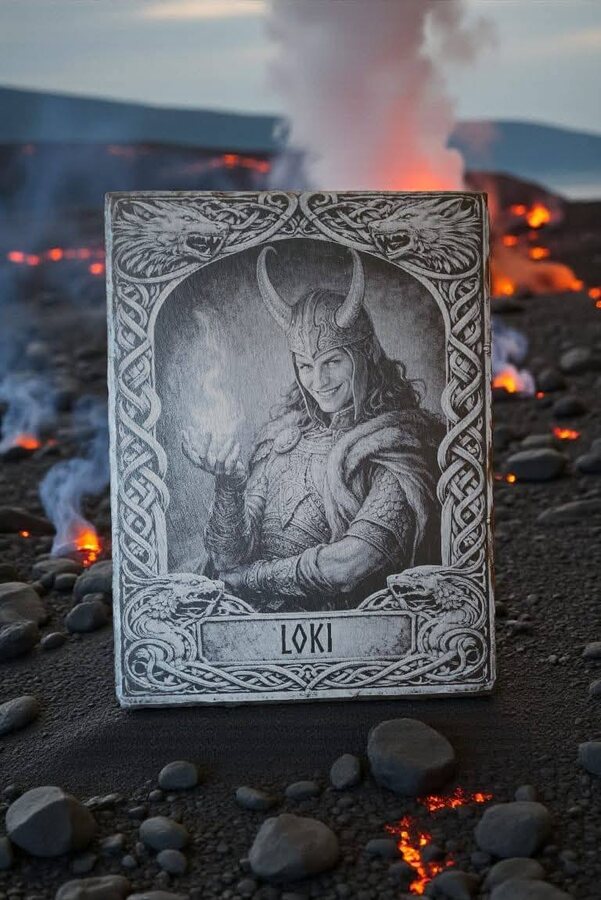
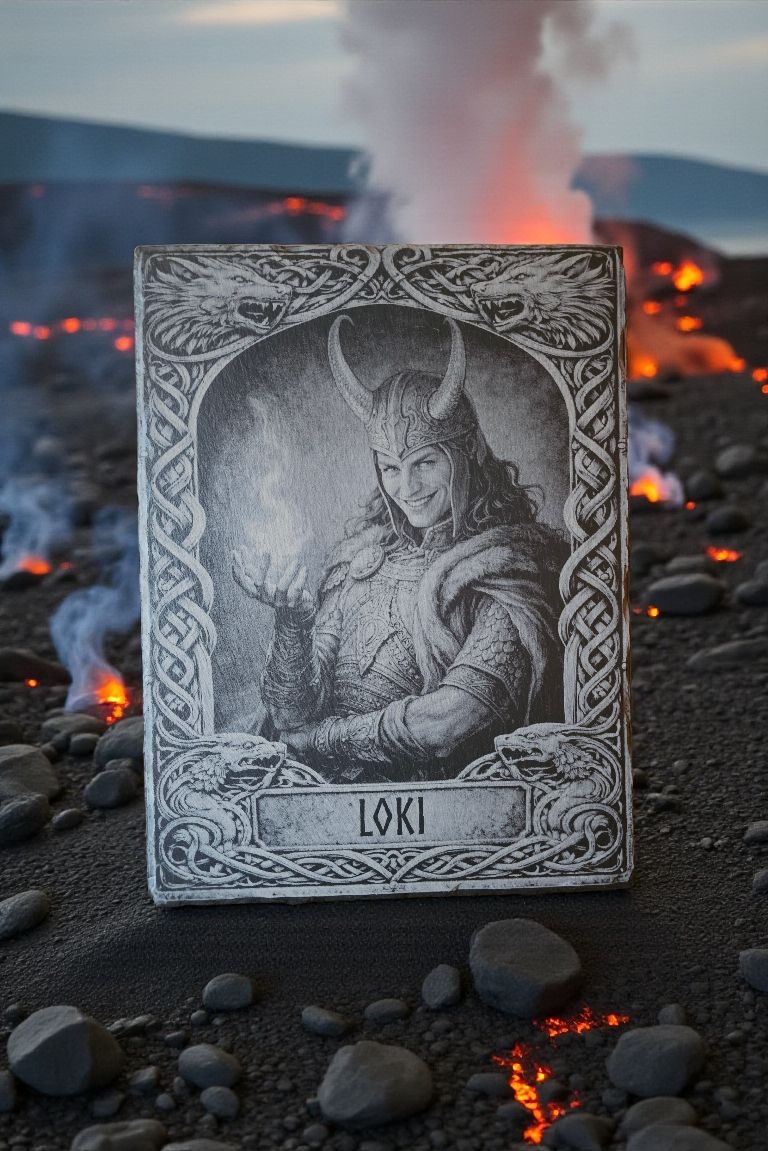
That tension is exactly what draws us to Loki. When someone has a Loki motif engraved in slate, they rarely want a villain on the wall; they want the sharp mind that bends the rules. Without Loki, no Mjölnir, no Sleipnir, no rescue of Iðunn, no Þrymskviða. And, admittedly, no Ragnarök either.
Is Loki a god or a giant? Both. His father Fárbauti is a giant, but Loki lives among the Æsir and Snorri counts him as one of them. He owes his place to his blood brotherhood with Odin.
Who are Loki's children? With the giantess Angrboða he fathered the wolf Fenrir, the World Serpent Jörmungandr and Hel, ruler of the dead. As a mare he gave birth to Sleipnir. With Sigyn he has the sons Váli and Nari or Narfi.
Is Loki Thor's brother? No, that comes from Marvel. In the sources Loki is Odin's blood brother and Thor's travelling companion, not his sibling.
Is Loki the god of fire? Probably not. That idea rests on the similar word logi, "flame", and on confusion with the fire-being Logi at Útgarða-Loki's hall. Linguistically it is weak.
Was Loki worshipped? There is no evidence for it. No place names, cult sites or written reports point to a cult of Loki.
Why was Loki punished? According to Snorri, for Baldr's death; in Lokasenna the binding follows his insults at Ægir's feast. He is tied with his son's entrails while a snake drips venom on him.
For courage. For remembrance. For legends that live on.
Fenrir · The Midgard Serpent · Idun · Thor · Ragnarök · The Norse pantheon.
All Gods & Goddesses articles →
The strongest god has two sons: Magni („the mighty") and Modi („the brave / wrathful"). They are more than minor …
Read more →In the North, the moon is a man. Máni, brother of the sun, steers his heavenly body across the sky night after night …
Read more →Few figures in Norse myth are as puzzling and as important as Mimir. Sometimes he is a being at the well of wisdom …
Read more →Some figures of Norse mythology stand in the bright spotlight, others in the shadow of the great ones. Nanna belongs to …
Read more →