
Heimdall is the watchman of the Norse gods: he sits at the edge of heaven by the bridge Bifröst, needs less sleep than a bird, hears grass grow and will blow the Gjallarhorn when Ragnarök begins. That is how Snorri Sturluson describes him in the thirteenth century. Behind the tidy picture, though, stands one of the strangest figures in the Eddas – son of nine mothers, Loki's sworn enemy, perhaps the forefather of humankind. Here we separate what the sources say from what scholars have made of them.
Picture a sentry post that is never relieved. Since the world began, someone has been sitting there listening – listening so closely that he can hear the blades of grass pushing up out of the earth and the wool thickening on the backs of sheep. He is waiting for one single moment. When it comes, he will raise a horn to his lips, and every world will hear it.
This is Heimdall, in Old Norse Heimdallr. Few gods are so easy to describe and so hard to pin down. Nearly everything we know about him comes from a handful of stanzas, a few lines of Snorri and the scraps of poems that are otherwise lost. Which makes him a perfect case study in how a god's portrait is pieced together from fragments.
The fullest account sits in Gylfaginning ("The Deluding of Gylfi"), the first major part of the Prose Edda written by the Icelander Snorri Sturluson around 1220. In chapter 27 he says, in our own rendering: one of the Æsir is called Heimdall; he is known as the white god. He is great and holy. Nine maidens bore him as their son, and all of them were sisters. He is also called Hallinskíði and Gullintanni, for his teeth were made of gold. His horse is called Gulltoppr. He lives in a place called Himinbjörg by Bifröst.
Then comes the job itself. Heimdall is the watchman of the gods and sits at the end of heaven guarding the bridge against the mountain giants. He needs less sleep than a bird. He sees as well by night as by day, a hundred leagues off – the Old Norse unit is the röst, roughly the distance between two rest stops. He hears grass growing on the earth and wool on sheep, and everything louder than that. He owns a trumpet, a lúðr, called Gjallarhorn, whose blast is heard in all worlds. And Snorri closes with an odd remark: Heimdall's sword is called "Head", höfuð. We will come back to that.
Heimdall's hall is Himinbjörg, "heaven's mountains" or "heaven's shelter" – björg can mean crags as well as protection. In Grímnismál, the poem in which a disguised Odin lists the dwellings of the gods, it is the eighth hall. Stanza 13 says, roughly: there, men say, Heimdall rules over the sanctuaries; there the gods' watchman drinks good mead, glad, in his comfortable house.
Notice what is missing. The stanza says nothing about vigilance or a bridge. Heimdall "rules over holy places" (valda véum) – which sounds more like a god with shrines than a gatekeeper – and he enjoys his mead in peace. The tight link with the rainbow bridge Bifröst is mostly Snorri's work. There is one older hint, however: the skaldic poem Húsdrápa describes Heimdall as defender of the "gods' road", which many read as Bifröst.
As storytelling, the post makes perfect sense. In Snorri's cosmos Bifröst links the realm of the gods to the world of humans. Whoever stands guard there stands at the seam between order and threat – and Snorri already knows the bridge will break beneath the sons of Muspell when the end comes.
Heimdall's senses are among the best-known images in all of Norse myth. Hearing the grass grow sounds like a figure of speech, but in his case it is a plain statement: nothing escapes that ear.
The choice of examples is telling, though. Grass and wool: pasture and sheep. Some scholars think this is no accident. Rudolf Simek and others point out that in the þulur – rhymed lists of poetic names attached to Snorri's handbook for poets – both heimdali and hallinskíði appear as words for a ram. A ram guards the flock, carries curved horns and eats grass. Golden teeth? Older sheep can have yellowish teeth – an observation that gets quoted a lot in the literature, but obviously proves nothing.
Heimdall's birth from nine mothers is not a late invention. Snorri quotes two lines from the lost Heimdalargaldr in which the god speaks for himself: "Níu em ek mæðra mögr, níu em ek systra sonr" – in our rendering: I am the offspring of nine mothers, I am the son of nine sisters.
Probably older still is the allusion in Húsdrápa by the Icelandic poet Úlfr Uggason, composed towards the end of the tenth century. There Heimdall is "son of eight mothers and one" – a typically riddling skaldic phrase that disguises the nine mothers but clearly confirms them.
Only one source names them: the so-called "Short Völuspá", a passage embedded in the Eddic poem Hyndluljóð. It lists nine giantesses who bore a god "at the edge of the earth": Gjálp, Greip, Eistla, Eyrgjafa, Úlfrún, Angeyja, Imðr, Atla and Járnsaxa. The child, the poem says, was strengthened with the might of the earth, the ice-cold sea and the blood of Són – whether that means a sacrificial boar or the mead vessel from the myth of the poetic mead is disputed. Heimdall is not named in these stanzas; the identification rests on the nine mothers and is generally accepted.
So who are the nine? The favourite reading sees them as waves of the sea, making Heimdall a god born from the surf at the rim of the world. Names like Angeyja or Eistla are sometimes explained in that direction, though their meanings are themselves uncertain. Against a simple equation stands the fact that Snorri names the nine daughters of the sea giant Ægir – explicitly waves – quite differently. And Gjálp and Greip are known elsewhere as daughters of the giant Geirröðr, Járnsaxa as Thor's lover. At the very least the mothers are giantesses, which gives the "white god" a remarkably giant-heavy pedigree.
Snorri also makes Heimdall a son of Odin: in Skáldskaparmál, his treatise on poetic diction, he notes briefly that Heimdall is "also Odin's son". No story goes with it, and how nine mothers and one father fit together is left open.
Heimdall's name appears in the very first stanza of the Völuspá, "The Seeress's Prophecy". The seeress asks for a hearing: "Hljóðs bið ek allar helgar kindir, meiri ok minni mögu Heimdallar." In our rendering: I ask a hearing of all the holy kindreds, the greater and the lesser sons of Heimdall.
The "sons of Heimdall" here are evidently humankind, high and low. Völuspá never explains why Heimdall should be their ancestor. The obvious bridge is Rígsþula, which we will get to shortly.
Even more intriguing is stanza 27 (in the Neckel/Kuhn numbering). The seeress knows that Heimdallar hljóð lies hidden beneath the bright, holy tree – that is, under Yggdrasil. She sees a stream pouring from Odin's pledge. The next stanza turns to Odin's eye in the well of Mímir.
The puzzle hangs on a single word. Hljóð can mean "sound, noise", but also "hearing, attention" – in stanza 1 it clearly means "a hearing, silence". Two readings compete:
There is no way to settle it. But a watchman who gave up his hearing in order to hear more would be a true kindred spirit of the god who gave an eye to see more.
Stanza 46 of the Völuspá brings the big entrance. Mímir's sons are stirring, fate is kindled "at the ancient Gjallarhorn". Then, roughly: loud blows Heimdall, the horn is aloft. Odin speaks with Mímir's head, the ash Yggdrasil trembles. This is the signal: Ragnarök has begun.
Snorri turns it into a clear scene in Gylfaginning 51: Heimdall stands up and blows the Gjallarhorn with all his strength and wakes all the gods so that they hold council. Then Odin rides to Mímir's well.
The name Gjallarhorn is usually explained as "yelling, resounding horn", from gjalla, "to scream, resound". The scholar Andy Orchard has suggested another possibility: "horn of the Gjöll", the river at the border of the underworld. Both are linguistically possible.
And what kind of horn is it? Snorri calls it a lúðr, a wind instrument, yet elsewhere has Mímir drink from it. A drinking horn that doubles as a signal horn? For a myth, that is no contradiction at all.
Heimdall gets one proper part in the Poetic Edda – and it is in a comedy. In Þrymskviða the giant Þrymr has stolen Thor's hammer and demands Freyja as his bride. Freyja refuses so furiously that her necklace bursts. The gods hold council, and in stanza 15 we read: then spoke Heimdall, whitest of the Æsir; he knew the future well, like the other Vanir.
His suggestion: dress Thor in the bridal linen, hang the Brísingamen around his neck, tie keys to his belt and send him veiled to giant-land. Thor is not amused, but the plan works, and the wedding ends badly for the giants.
Two things stand out. First, hvítastr ása, "whitest of the Æsir". "White" can mean bright, shining, gleaming – whether purity, light or simply a fair appearance is meant remains open. Second, "like the other Vanir". Suddenly Heimdall is counted among the Vanir, the second family of gods alongside the Æsir, to which Njörðr, Freyr and Freyja belong. The American scholar John Lindow notes there is no other sign of this. It might be a poetic slip, a remnant of a different tradition, or vanir used in a looser sense. The gift of foresight, at any rate, suits the god who hears everything.
Rígsþula ("The List of Rígr") is not preserved in the famous Codex Regius but in the Codex Wormianus, a fourteenth-century manuscript of Snorri's Edda; its ending is lost. It tells how a wanderer called Rígr visits three houses in turn. Each time he eats with the couple, sleeps three nights between husband and wife, and moves on. Nine months later three sons are born: Þræll, the thrall, in the poor cottage; Karl, the free farmer, in the tidy farmstead; Jarl, the nobleman, in the splendid hall. Jarl later learns the runes from Rígr himself, and his youngest son Konr ungr – a pun on konungr, king – outdoes them all.
And Heimdall? He is not named in the poem itself. Only a short prose introduction says: people tell in old stories that one of the Æsir, called Heimdall, went on a journey and called himself Rígr.
Perhaps the oldest Heimdall story is also the one with the fewest details. Around 985 the Icelandic poet Úlfr Uggason performed Húsdrápa ("House Poem") at a feast at Hjarðarholt. According to Laxdæla saga, it described scenes carved into the wooden panelling of Óláfr pái's new hall. Only the stanzas Snorri quotes survive.
One of them shows Heimdall wrestling with Loki at Singasteinn ("singing stone", an otherwise unknown place, perhaps a skerry). The "son of eight mothers and one" is first to win a precious "sea-kidney" – a kenning for a gem, here the necklace Brísingamen. Snorri adds in Skáldskaparmál that both were in the shape of seals, which is why Heimdall is also called "visitor of Vágasker and Singasteinn" and "recoverer of Freyja's necklace".
How Loki came to have the necklace no early source tells. The elaborate tale of the theft from Freyja's bedchamber comes from Sörla þáttr, a much later fourteenth-century story in which Heimdall does not appear. What remains is an image: two gods as seals in the sea, grappling over a jewel – and once, apparently, carved in wood on the walls of an Icelandic hall.
The enmity between Loki and Heimdall also shows in Lokasenna, the flyting in which Loki insults every god at the sea giant Ægir's feast. Heimdall tells him he is drunk and out of his wits. Loki fires back (stanza 48, roughly): in ancient days an ugly life was laid on you; with a muddy back you must always stand and keep watch for the gods.
In his list of poetic names, Snorri simply calls Heimdall "Loki's enemy".
At the end of the world the circle closes. Gylfaginning 51 says: Loki fights Heimdall, and each becomes the other's slayer. Völuspá itself does not mention this duel – it is found only in Snorri. Whether he took it from a lost source or brought the feud to a neat symmetrical close remains open. The one who hears everything and the one who twists everything fall together.
Now for the strangest line. Gylfaginning says Heimdall's sword is called "Head". In Skáldskaparmál Snorri explains that a sword is called "Heimdall's head", because it is said that Heimdall was pierced through by a man's head. This is told in Heimdalargaldr, and ever since, a head has been called Heimdall's mjötuðr – a word that can mean "fate, doom" or "measurer".
What does it mean? A god killed by a head? We do not know, because Heimdalargaldr is lost. Exactly two of its lines survive – the ones about the nine mothers. Scholars have tried various bridges. If Heimdall was originally linked to the ram, the "head" as a weapon would be the horned skull a ram charges with. Others think of a lost narrative, perhaps even of Loki's death or Heimdall's own at Ragnarök. All of this is speculation, and we label it as such.
The name has no secure explanation. The first element, heimr, means "world, home". The second, -dallr, is the problem. A common derivation links it to a poetic word for a splendid, flourishing tree and to Old English deall, "proud, shining". That yields readings such as "the one who illuminates the world" – or "world tree". The latter has led some to see Heimdall as an embodiment of the world axis itself, which would fit a god whose hearing lies beneath Yggdrasil. There is no firm ground for that.
Notably, Mardöll, one of Freyja's names, seems to contain the same element and is often read as "the one who brightens the sea". Rudolf Simek considers a connection possible.
The other names:
Unlike Thor, Odin or Freyr, Heimdall has practically no secure place-names and no Viking Age dedications. He seems to have been a god of poetry rather than of widespread worship – or the traces have simply vanished.
One small find deserves a mention all the same: the Saltfleetby spindle-whorl from Lincolnshire, found by a metal detectorist in 2010. The lead whorl bears a runic inscription that archaeologist John Hines in 2017 read as an invocation of Óðinn, Heimdallr and a third figure (Þalfa) to help someone. Runologist Judith Jesch has questioned the reading of the first name and dates the inscription to the twelfth century. If the reading "Heimdallr" holds, it would be one of very few mentions outside Icelandic literature.
If you want Heimdall on slate, wood or glass, it pays to stay close to the sources. The strongest motifs are the ones that are actually attested:
What we will not do: Heimdall in a horned helmet or as a gold-armoured film character. The Heimdall of the Eddas is a watchman with golden teeth and a horn – that is plenty. For a custom design, just get in touch; we are happy to look at the source and the exact line together with you.
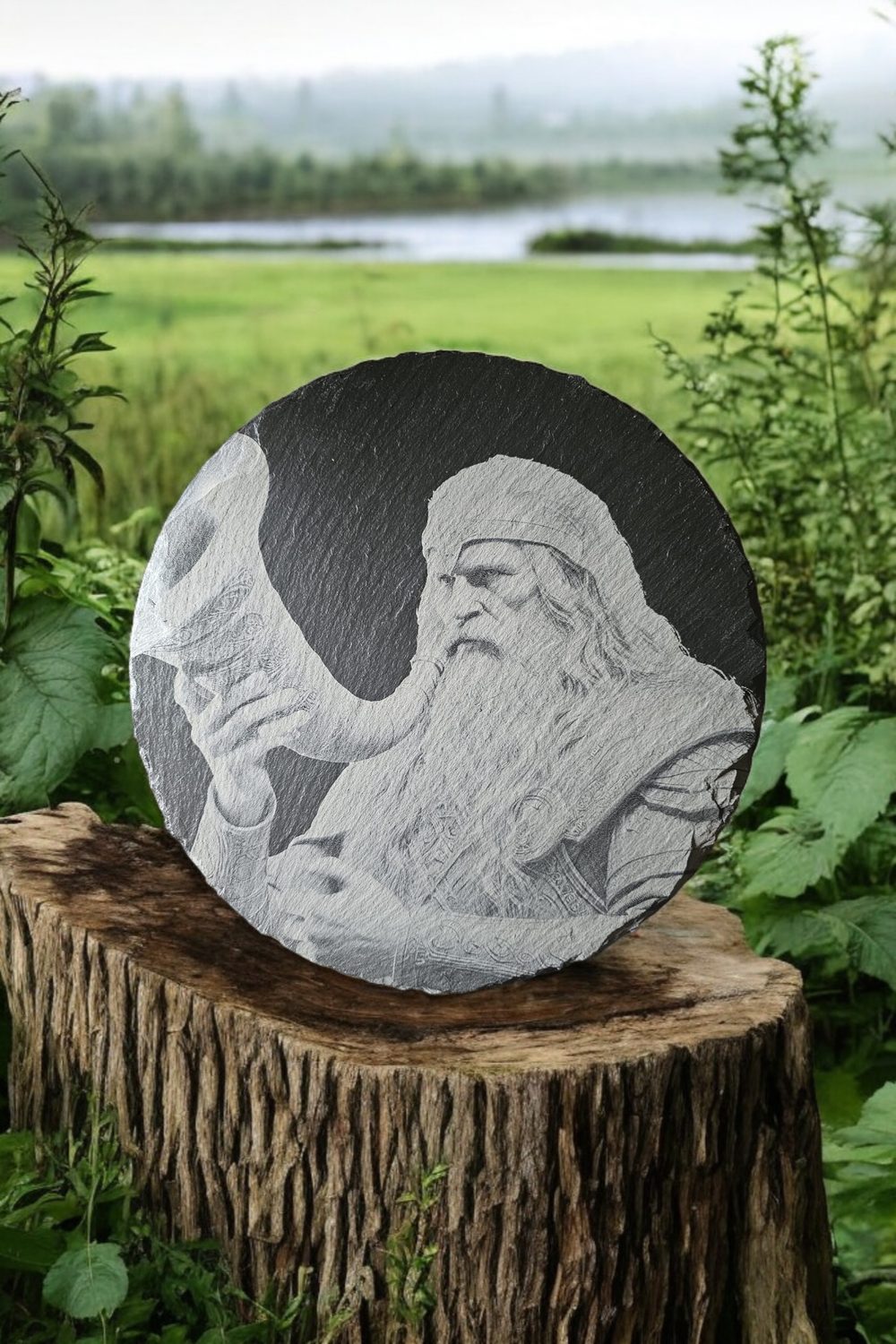
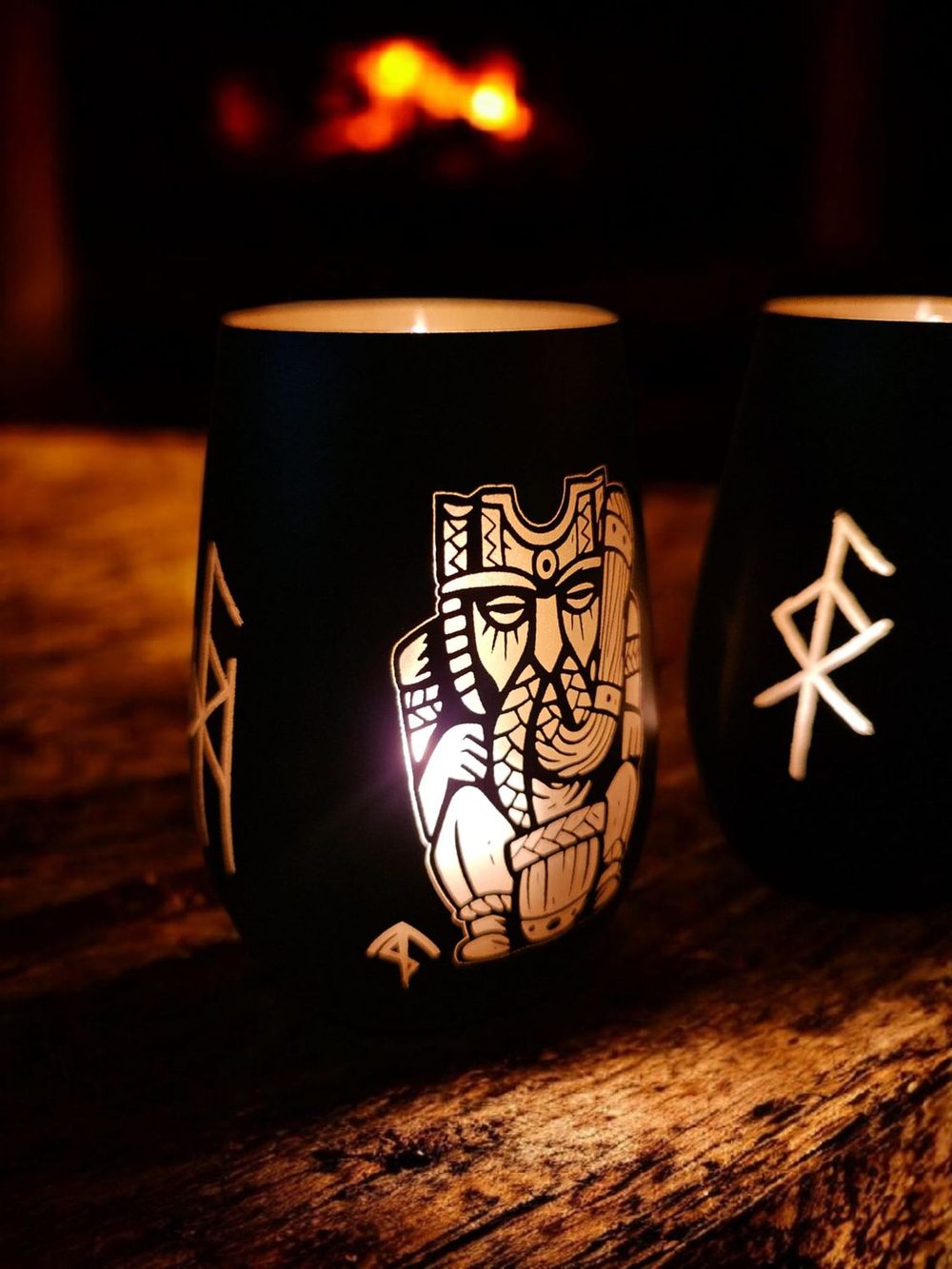
What is Heimdall the god of? Heimdall is the watchman of the Æsir in Norse mythology. He lives in Himinbjörg by the bridge Bifröst, has superhuman senses and announces Ragnarök with the Gjallarhorn.
What is the Gjallarhorn? Heimdall's "resounding horn". According to Snorri its blast is heard in all worlds; at Ragnarök Heimdall blows it to wake the gods. Elsewhere Mímir drinks from it at his well.
Why does Heimdall have nine mothers? The lost Heimdalargaldr, Húsdrápa and Hyndluljóð all agree on it, but none explains it. The mothers are often read as waves of the sea, though their recorded names point rather to giantesses.
Who kills Heimdall at Ragnarök? According to Snorri's Gylfaginning, Loki and Heimdall fight and kill each other. Völuspá itself does not mention the duel.
Is Heimdall the father of humankind? Völuspá 1 calls humans the "sons of Heimdall", and the prose introduction to Rígsþula equates Heimdall with Rígr, father of thrall, farmer and earl. The poem itself, however, never names Heimdall.
What does the name Heimdall mean? Nobody knows for sure. The first part means "world"; the second is often linked to "shining" or to a word for "tree" – giving something like "the one who illuminates the world".
For courage. For remembrance. For legends that live on.
Loki · Ragnarök · Yggdrasil · The Norse pantheon.
All Gods & Goddesses articles →
Not every dead man came to Valhalla. Most people – all who died of sickness and age – went to Hel. She is the mistress …
Read more →Loki fits no box. Now he saves the gods with a trick, now he plunges them into ruin. It is exactly this doubleness that …
Read more →The strongest god has two sons: Magni („the mighty") and Modi („the brave / wrathful"). They are more than minor …
Read more →In the North, the moon is a man. Máni, brother of the sun, steers his heavenly body across the sky night after night …
Read more →