
Hel is both the Norse goddess of the dead and the name of her realm, later also called Helheim: according to Snorri Sturluson she is the daughter of Loki and the giantess Angrboða, half blue-black and half flesh-coloured, and Odin gave her power over everyone who dies of sickness or old age. Yet the older poetry knows Hel mostly as a place, the word itself means “the hidden”, and she has far less to do with the Christian hell than the name suggests. Here we separate source, interpretation and legend.
Picture a bridge thatched with glittering gold. A river roars beneath it, and across it thunder the hooves of an eight-legged horse. At the bridgehead a guardian frowns. Yesterday, she says, five whole troops of dead men rode over, and the bridge rang less under all of them than under this one rider. And besides: he does not have the colour of the dead.
That is the opening of the most famous journey to Hel. And Hel herself, when we finally meet her, is strangely calm. No demon, no torturers, no flames. A ruler who sets a condition and keeps her word. To understand her, we will walk the road backwards: from word to place, from place to person, and on to what Snorri made of her in the thirteenth century.
Before Hel was a person, she was a place. Before she was a place, she was a word.
Old Norse hel goes back to Proto-Germanic *haljō, usually glossed as “concealed place, underworld”. Behind it lies the verb *helan, “to hide, to cover”, and further back the Indo-European root *ḱel-, “to conceal, to protect”. English still has a cousin in the dialect word hele, “to cover over”, and German in hehlen, “to conceal”. The first meaning was simply whatever receives the dead and hides them from the living: the grave, the earth, the deep.
The word is common Germanic: Gothic halja, Old English hel(l), Old High German hella. When missionaries carried Christianity into Germanic languages, they took the existing word for the abode of the dead. Wulfila's Gothic Bible of the fourth century already uses halja where the Greek New Testament says Hades. From hel(l) came English hell.
Icelanders took an interesting detour. For the Christian hell they soon said helvíti, roughly “Hel-punishment”. In other words, they had to add a word for punishment to turn Hel into a place of torment. On its own, the old word apparently did not carry that sense.
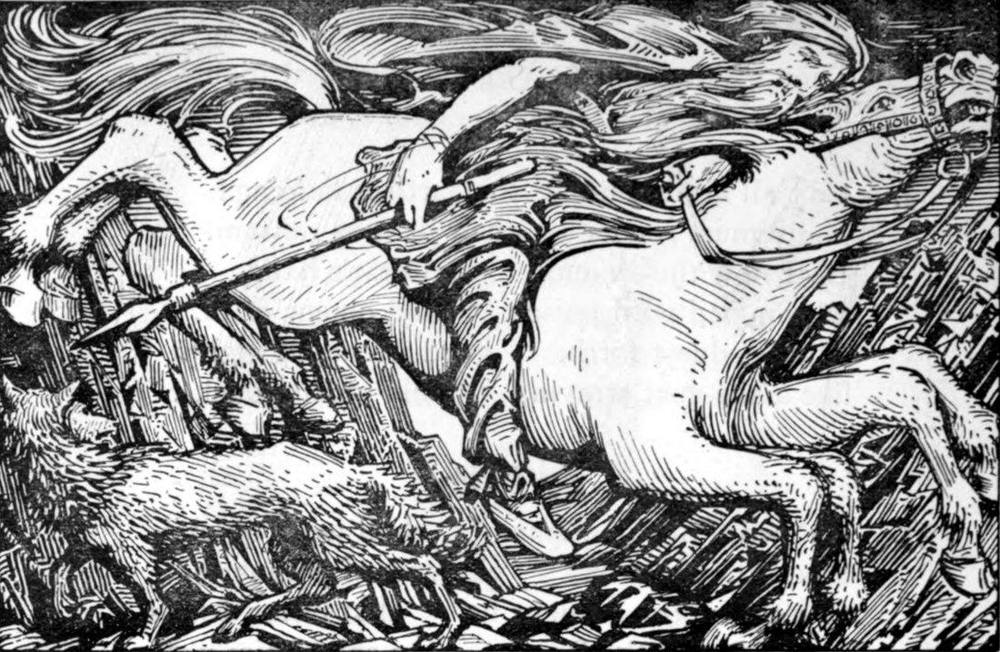
Read the poems of the Edda and you meet Hel constantly, but rarely as a character. Mostly the word sits in fixed phrases: til heljar, “to Hel” (that is, to death), í helju, “in Hel”. This is language about dying, not theology.
Some passages give the place an outline. In Grímnismál (st. 31) the three roots of the world tree Yggdrasil reach in three directions: Hel lives under one, the frost giants under the second, humankind under the third. In Vafþrúðnismál (st. 43) the giant boasts that he has passed through nine worlds, down below Niflhel, “where men die out of Hel”. A death after death, a deeper level still. In the Völuspá (st. 43 in the usual numbering) a soot-red rooster crows shortly before the end of the world, “beneath the earth, in the halls of Hel”.
“The halls of Hel” – here a mistress of the house begins to show. More clearly in Baldrs draumar, “Baldr's Dreams”: Odin rides down to Niflhel, a dog comes out of Hel to meet him, its breast bloody, and Odin rides on until he reaches “the high hall of Hel”. Whoever owns a hall is somebody. But a face, a shape, a character are still missing in these poems.
Most scholars read the evidence this way: first Hel was the place, then the place became a person. John Lindow and Rudolf Simek both treat the personification as a younger layer; Hilda Ellis Davidson later considered an older death goddess behind it possible. One thing is certain: the younger the text, the clearer the woman.
The image almost everyone has of Hel comes from a single pen. Snorri Sturluson wrote his Prose Edda around 1220, a handbook for poets, and in the section called Gylfaginning (“The Deluding of Gylfi”), chapter 34, he tells of the three children of Loki and the giantess Angrboða: the wolf Fenrir, the Midgard Serpent and Hel.
Prophecies warn the gods that these siblings will bring disaster, so Odin has them fetched. The serpent he throws into the sea, where it grows until it encircles the world. The wolf stays with the gods until they have to bind him. And Hel he casts into Niflheim, giving her power over nine worlds: she is to give lodging to all who are sent to her, which Snorri defines as sóttdauðir menn ok ellidauðir, “men dead of sickness or of old age”.
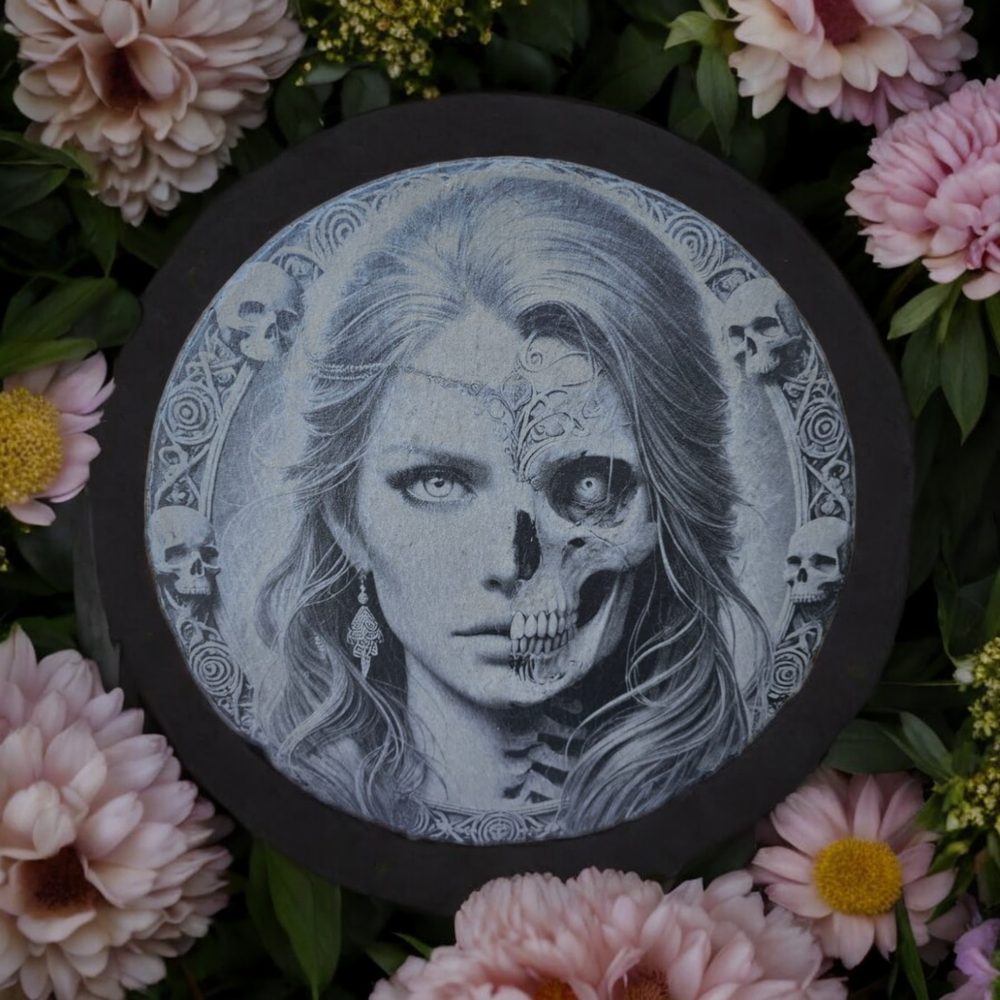
Then the famous description. In Arthur Brodeur's public-domain translation of 1916: “She is half blue-black and half flesh-color (by which she is easily recognized), and very lowering and fierce.” Old Norse blár means a dark blue-black, the colour of livor mortis and frozen skin. How the halves are divided Snorri never says; the neat line down the middle of the face in modern art is interpretation, not tradition.
Snorri gives Hel a great estate with very high walls and huge gates. Her hall is called Éljúðnir. The name occurs only here and is uncertain; it is usually translated as “sprayed with snowstorms” or “damp with sleet”. A cold, wet hall, like a longhouse at the end of winter.
Then Snorri lists the furnishings, each with a speaking name. Brodeur again:
Her hall is called Sleet-Cold; her dish, Hunger; Famine is her knife; Idler, her thrall; Sloven, her maidservant; Pit of Stumbling, her threshold, by which one enters; Disease, her bed; Gleaming Bale, her bed-hangings.Gylfaginning 34, trans. Arthur G. Brodeur (1916, public domain)
It is beautifully constructed. Every object is an image of slow dying: the hunger of the old, the shuffling gait, the sickbed. Hel's household is not a torture chamber but an allegory of wasting away. Whoever dies of sickness and old age enters a house that looks exactly like their last weeks.
This is also where Snorri's own hand shows. Personified household goods are a learned, almost medieval-allegorical device. Whether a tenth-century farmer pictured Hel like this, we cannot know; there is no older source.
This question carries most of the misunderstandings. The popular formula runs: die in battle and you go to Valhalla; die in bed and you go to Hel. The “straw death”, as it is sometimes called, after the straw of the deathbed.
Snorri does support that formula in chapter 34. But the same Snorri says something quite different in chapter 3 of Gylfaginning: good men will live with the All-Father in Gimlé or Vingólf, “but evil men go to Hel and thence down to the Misty Hel; and that is down in the ninth world” (Brodeur). That is a division by merit, not by manner of death, and it sounds very much like Christian teaching.
So Snorri set two systems side by side without reconciling them. Anyone who claims that morality plays “no role” for Hel in the Norse sources has overlooked chapter 3. Anyone who claims Hel is the punishment for cowards has overlooked chapter 34, and Baldr.
And then there are the many voices that fit neither system:
The strongest single piece of evidence against the punishment idea remains Baldr. The best of the gods dies by a sprig of mistletoe, not in battle, and goes to Hel. Not as one of the damned: he sits there in the high seat.
The older evidence for Hel as an acting figure comes not from the Edda but from the skalds, the court poets. The key text is Ynglingatal, a genealogy of Swedish and Norwegian kings traditionally ascribed to Þjóðólfr of Hvinir in the ninth century. That dating is disputed; some scholars place the poem much later. Snorri quotes it stanza by stanza in his Ynglinga saga.
In Ynglingatal a king rarely just dies. He is taken. Of King Dyggvi, who died in his bed, the poem says that Loki's girl, the wolf's sister, has chosen him and now holds the dead prince for her pleasure. Laing's old translation puts the king “in her house” with “Loke's daughter”. Here the ruler of the dead appears almost as a lover who picks out a king, an erotic colouring you would never expect from Snorri's grim housekeeper. For other kings of the line, such as Eysteinn and Hálfdan the Mild, death is likewise phrased as Hel's grip or Hel's summons.
If the ninth-century date holds, Hel was known in pagan times as a person with a family: Loki's daughter, Fenrir's sister. Snorri would then be the elaborator, not the inventor. If the poem is later, that argument falls away. The question is open, and we leave it open.
A second witness is Egill Skallagrímsson. At the end of his lament Sonatorrek, for his drowned son, a figure described through her kinship with Odin's enemy, the wolf, already stands on the headland; most editors take her to be Hel. Egill says he will wait for Hel calmly and with good will. It is one of the most moving images in Old Norse poetry.
Norse tradition is strikingly interested in the road to the dead, the helvegr or Hel-way. In Völuspá (st. 47) “all on the Hel-ways” tremble at the end of the world, and in st. 52 men “tread the Hel-way”. Snorri turns geographic: niðr ok norðr liggr Helvegr, “downward and northward lies the Hel-way”. Down and north, where it is cold and dark. More in our article The road to Hel.
A long road calls for good shoes. Gísla saga Súrssonar (ch. 14) describes a custom that takes this literally. After Vésteinn's murder, Þorgrímr the chieftain-priest ties the hel-shoes (helskór) on the dead man, with words that George Webbe Dasent's 1866 translation renders: “'Tis the custom, brother-in-law, to bind the hellshoe on men, so that they may walk on them to Valhalla.”
A neat example of how untidy the systems are: hel-shoes for the walk to Valhalla. Here “hel” evidently just means death. And the scene has a double edge, since the course of the saga suggests Þorgrímr himself is the killer. Whether the custom really existed or the thirteenth-century saga author used it for the scene cannot be proven; as a distinct grave good, “hel-shoes” cannot be clearly identified archaeologically.
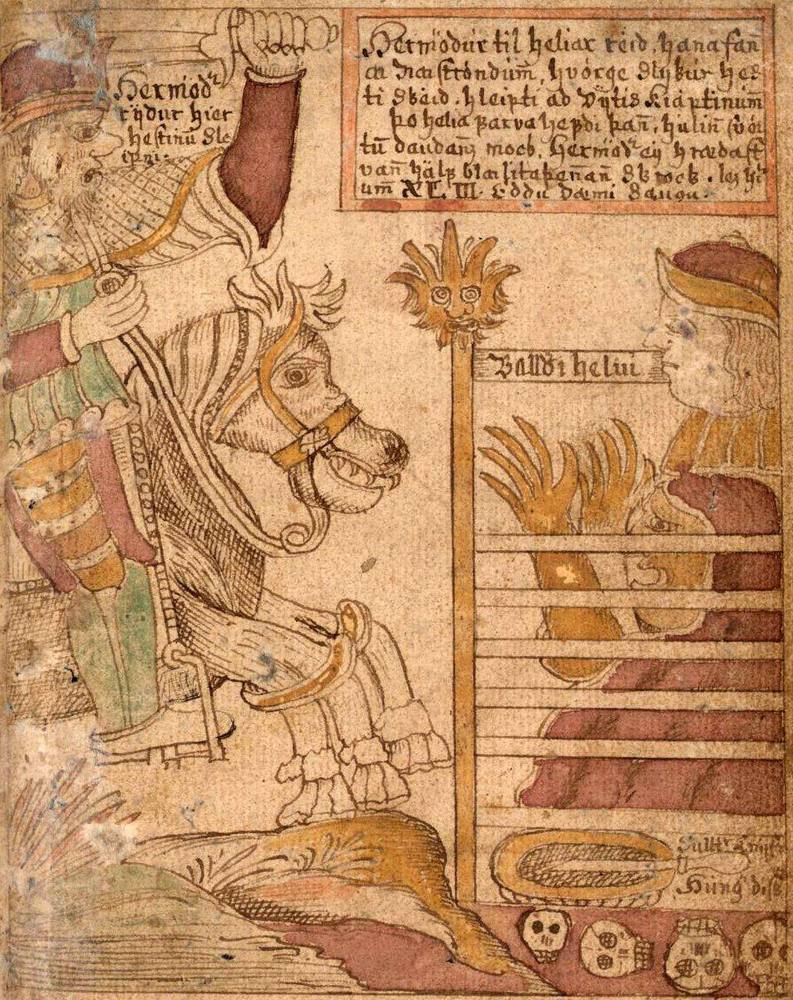
Back to the golden bridge. Chapter 49 of Gylfaginning tells of Baldr's death and its aftermath. Frigg asks which of the gods will win her love and favour by riding to Hel to ransom Baldr. Hermóðr the Bold, Odin's son, volunteers and is given Sleipnir, Odin's eight-legged horse.
For nine nights he rides through dark, deep valleys until he reaches the river Gjǫll and the Gjallarbrú, the Gjöll-Bridge, “thatched with glittering gold”. The maiden Móðguðr guards it. She asks his name and kin, and then says the line that carries the whole scene: the day before, five troops of dead men rode across, yet the bridge thunders no less under him alone. And he does not have the colour of dead men.
She shows him the way, down and north, to Helgrind, the gate of Hel. Hermóðr tightens the girth, and Sleipnir leaps so high that he clears the gate without touching it.
Inside, Baldr sits in the seat of honour. In the morning Hermóðr asks for his return. Hel answers with a test, in Brodeur's words: “if all things in the world, quick and dead, weep for him, then he shall go back to the Æsir”; but he “shall remain with Hel if any gainsay it or will not weep”.
Before Hermóðr leaves, Baldr sends Odin the ring Draupnir, and Nanna, Baldr's wife who was burned with him, sends Frigg a linen cloth. In Hel there is property, gift-giving, courtesy. A household among kin.
The gods send messengers across the world. People, animals, earth, stones, trees and every metal weep – just as, Snorri drily explains, such things “weep” when they come out of the frost into the warmth. Only in a cave sits a giantess who calls herself Þǫkk, “Thanks”. Her answer, in our own rendering:
Þǫkk will weep dry tears for Baldr's pyre. Living or dead, I had no joy of the old man's son: let Hel keep what she has.Gylfaginning 49 (our own translation)
Snorri adds that people suppose this was Loki. Suppose – even Snorri does not present it as certain. Hel herself bears no blame for Baldr staying. She set a condition, and the condition was not met.
If anything in the Norse afterlife smells of the Christian hell, it is this. Völuspá (st. 38–39) describes a hall far from the sun on Nástrǫnd, the “Shore of Corpses”. Its door faces north, poison drips through the roof-holes, its walls are woven of serpents' spines. There, wading through heavy streams, are oath-breakers, murderers and the man who whispers in another man's wife's ear. There Níðhǫggr sucks the corpses of the dead.
This is plainly a place of punishment, sorted by deeds, not by manner of death. But the poem does not call it Hel. Only Snorri builds Nástrǫnd, Niflhel and Hel into one multi-storey system.
In fairness: many scholars suspect Christian influence in precisely these stanzas. Völuspá is usually dated around the year 1000, the time of Iceland's conversion, and survives only in manuscripts from about 1270 onward. The influence cannot be proven, nor disproven.
At the end of the world the dead come back. Völuspá says tersely: Naglfar losnar, “Naglfar breaks loose”. A ship sails from the east, over the sea come the people of Múspell, “and Loki steers”. By then the rooster in Hel's halls has already crowed.
Snorri expands this too. Naglfar, he writes in chapter 51, is built from dead men's nails, which is why no one should be buried with untrimmed nails. Whether such a custom really existed is unknown. In Snorri the helmsman of Naglfar is the giant Hrymr, not Loki, a contradiction with Völuspá that he leaves standing.
Loki comes all the same, and with him allir Heljar sinnar, “all the people of Hel”. Hel herself appears on the battlefield in no source. She gives up what she holds. The hound Garm, howling before the cave Gnipahellir (Völuspá st. 44), fights Týr in Snorri's account; both die. The full sequence is in our article on Ragnarök.
Are there depictions of Hel from the Viking Age or earlier? The honest answer: none that are certain.
The debate centres on gold bracteates of the Migration Period (roughly 5th–6th century), coin-like pendants with images of gods. Karl Hauck interpreted the so-called three-god bracteates, such as the one from Fakse on Zealand, as scenes from the Baldr myth; Loki or Hel have been proposed for one of the side figures. On two further pieces (IK 14 and IK 124) a rider descends a slope towards a woman with a staff, read as a ride into the realm of the dead. Simek mentions Hauck's Hel reading; it is not proven. The images carry no names.
The Gotland picture stones often show a woman with a drinking horn greeting a rider. These scenes are usually read as arrivals in Valhalla, not in Hel's realm. If you read online about a “picture stone showing Hel”, ask for the source.
Because the word is the same, the two often end up in the same box. A point-by-point comparison:
The influence also ran the other way. In 1983 Michael Bell pointed to a “Queen Hel” in Old Norse Christian texts such as Bartholomeus saga postola. Whether she is pagan heritage or a Christian emblem of death remains debated. In thirteenth-century Iceland, where Snorri wrote, those lines were fluid.
Sorted soberly by type of source: archaeologically, Hel cannot be grasped. Linguistically, the word is ancient but everywhere means a place. Skaldic verse, if its dating holds, offers the oldest personified Hel: Loki's daughter, who takes kings. The Poetic Edda knows mainly the place, with its “halls”. Snorri, around 1220, gives her a body, an estate, furnishings and her role in the Baldr myth.
None of this yields a verdict of “genuine” or “invented”. It calls for respect for the layers. The Hel we know is a joint work of a thousand years of language, poetry and scholarship. For us she stands not for punishment but for the border every one of us will ride across one day, hel-shoes or not.
How the realm of the dead itself was imagined, level by level, is the subject of our article on Helheim.
Who is Hel in Norse mythology? Hel is the ruler of the dead and also the name of her realm. In Snorri's Prose Edda she is the daughter of Loki and the giantess Angrboða, sister of Fenrir and the Midgard Serpent.
Is Hel good or evil? Neither. In the sources she tortures no one; she houses the dead in a meagre hall. With Baldr she sets a fair condition and keeps to it.
Who went to Helheim? According to Snorri, chiefly people who died of sickness or old age. Elsewhere, though, Snorri says evil men go to Hel and on to Niflhel, and the older sources know other afterlives too.
Why is Hel half blue? Snorri describes her as half blue-black and half flesh-coloured, an image of her place between life and death. Older sources do not describe her appearance.
Does the word hell come from Hel? Both come from the same Germanic word *haljō, “hidden place”. Christian missionaries applied it to hell; the Norse Hel was originally not a place of punishment.
What happens to Hel at Ragnarök? The sources only say that her people sail with Loki and the ship Naglfar against the gods. No fight or death of Hel herself is ever told.
For courage. For remembrance. For legends that live on.
Loki · Fenrir · Valhalla · Ragnarök · The Norse pantheon.
All Gods & Goddesses articles →
Loki fits no box. Now he saves the gods with a trick, now he plunges them into ruin. It is exactly this doubleness that …
Read more →The strongest god has two sons: Magni („the mighty") and Modi („the brave / wrathful"). They are more than minor …
Read more →In the North, the moon is a man. Máni, brother of the sun, steers his heavenly body across the sky night after night …
Read more →Few figures in Norse myth are as puzzling and as important as Mimir. Sometimes he is a being at the well of wisdom …
Read more →