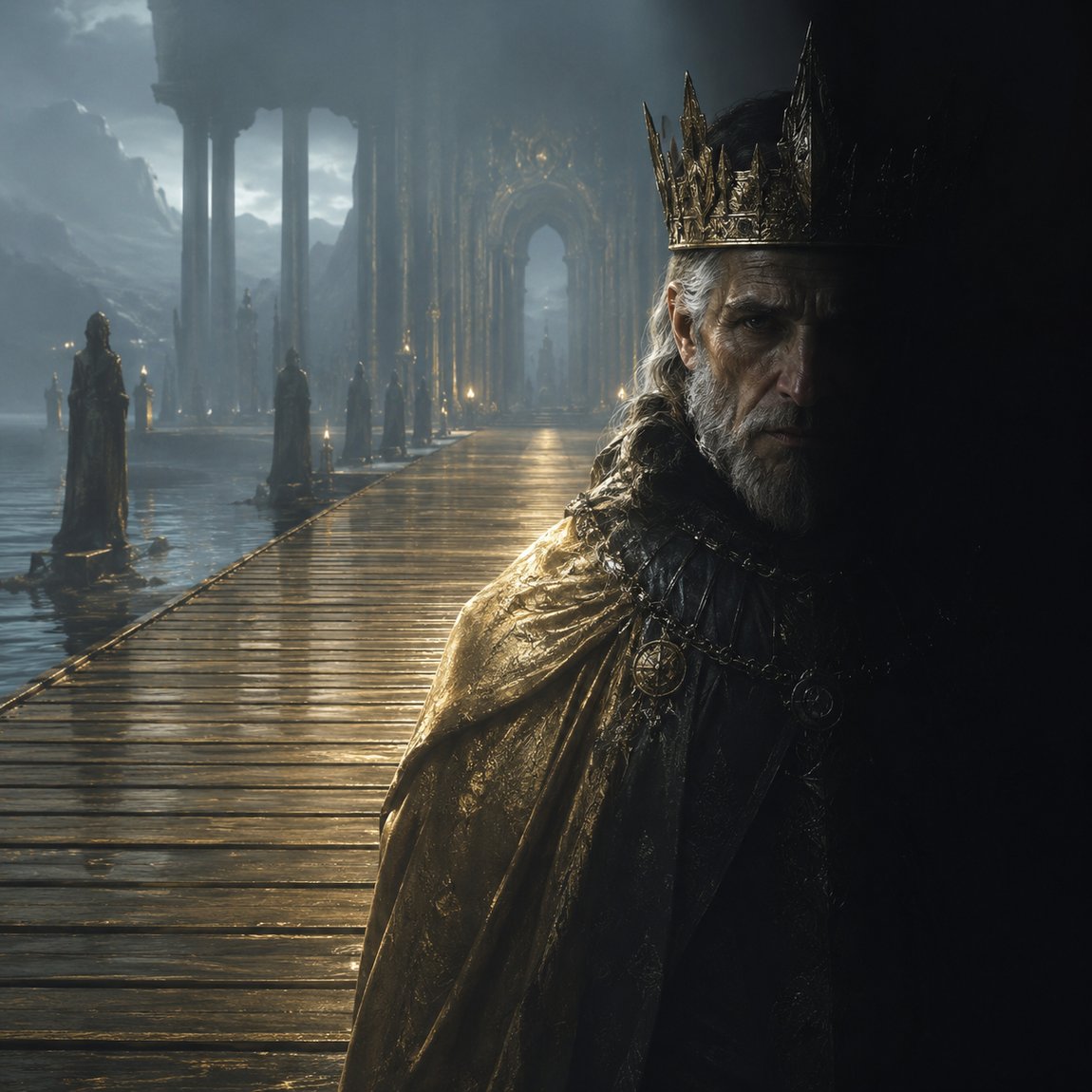
Helheim – in the sources usually just “Hel” – is the realm of the dead in Norse mythology: a dark place beneath the earth, “down and north”, which Snorri Sturluson located in or beside Niflheim. To get there you ride nine nights through lightless valleys, cross the gold-roofed bridge Gjallarbrú and arrive at the Hel-gate. We follow Hermóðr and Odin on their rides, step into Snorri’s hall Éljúðnir, look out over the Corpse-Shore of Náströnd – and keep a clear line between what the old poems say and what was added in the thirteenth century.
Start with the word, because it carries half the story. Old Norse hel goes back to Proto-Germanic *haljō, from the verb *helan, “to hide, to cover”. Hel is, at root, the covered place – the one under the ground, out of sight. The same root is usually traced in “helmet”, the thing that covers your head.
The word was shared across the Germanic languages. Gothic had halja, and Bishop Wulfila used it in the fourth century to render Greek hádēs in his Bible translation. Old English had hel, Old High German hella. Christian missionaries borrowed the familiar term and filled it with their own idea of a place of punishment. That is how a Germanic realm of the dead became English “hell” and German “Hölle”.
So when modern readers see “Hel”, they think fire, devils and eternal torment. The Eddic poems mostly mean something far plainer: the place the dead go. Dark, cold, quiet – and the destination of almost everyone. In the poems it is nearly always just hel; one travels til heljar, “to Hel”. The compound “Helheim” has become standard mainly in modern books, games and films, and it is handy because it separates the place from the goddess. That is how we use it here.
In Old Norse the ruler of the realm of the dead has the same name as her realm. The philologist Christopher Abram showed in his Cambridge doctoral thesis (2003) that skaldic poetry knows Hel almost only as a person, while the Eddic poems mostly treat her as a place. In both genres “Hel” often works simply as a poetic word for death. It was Snorri Sturluson who fused the two into one coherent picture: a goddess ruling a kingdom.
The goddess herself – Loki’s daughter, half dark blue, half flesh-coloured – has her own article: Hel, goddess of the dead. This one is about the place: the map, the road, the gate, the hall. And about what is old tradition and what Snorri built on top of it in the thirteenth century.
The direction is surprisingly clear. In Snorri’s account Hermóðr is told that the road to Hel runs niðr ok norðr – “down and north”. Down, because Hel lies beneath the earth. North, because in Norse thinking the north is the quarter of cold, darkness and giants.
In Snorri’s cosmology Hel lies in or beside Niflheim, the primeval world of mist and ice that existed before creation. His Gylfaginning, the first part of the Prose Edda written around 1220, says that Odin cast Hel down into Niflheim and gave her power over nine worlds, so that she should assign lodgings to all who are sent to her: those who die of sickness or old age.
The poems put it a little differently. In Grímnismál the world tree has three roots; Hel lives under the first, the frost giants under the second, humankind under the third. Snorri, retelling the same image, puts Niflheim and the spring Hvergelmir under that root, where the dragon Níðhöggr gnaws. For him, Hel and Niflheim are close to interchangeable.
And there is a deeper level still: Niflhel, “Mist-Hel”. In Vafþrúðnismál the giant Vafþrúðnir boasts that he has passed through nine worlds, down to Niflhel, where men die out of Hel. You can, it seems, die a second time, from Hel into an even deeper dark. Snorri turns this into a moral order: wicked men go to Hel and from there to Niflhel, “down into the ninth world”. Whether that tiering is old or learned tidying cannot be decided. For how much “system” the nine worlds really have, see our separate article.
If you want to know how to get to Helheim, there is exactly one detailed description. It comes from Snorri’s Gylfaginning and belongs to the story of Baldr’s death. After the shining god has fallen to the mistletoe, Frigg asks who will ride to Hel and offer a ransom for Baldr. The volunteer is Hermóðr the Bold, a son of Odin. He is lent the fastest horse in the world: Sleipnir, Odin’s eight-legged stallion.
For nine nights Hermóðr rides through valleys so dark and deep that he sees nothing. Then he reaches the river Gjöll – roughly “the Roaring One”. Across it runs the bridge Gjallarbrú, and Snorri tells us it is roofed with shining gold. The road into the gloomiest realm runs over gold.
A maiden named Móðguðr guards the bridge. Her name is usually read as something like “furious battle”, though that is not certain. She asks Hermóðr his name and family, and then says one of the eeriest things in the whole Edda, paraphrased here: yesterday five troops of dead men rode across this bridge, yet it booms no less under you alone. And you do not have the colour of dead men. Why do you ride the road to Hel?
That exchange holds a whole theory of the dead. They have their own pallor, and they are light; a living man makes the bridge thunder. And they come in numbers: five troops in a day. Hel is not a prison for a few damned souls but the ordinary destination of ordinary people. Móðguðr confirms that Baldr has ridden past – and then gives the famous directions: down and north.
At the end of the road stands a gate or fence, the Helgrindr, “Hel-gate”. Hermóðr dismounts, tightens the girth, remounts and spurs Sleipnir on. The stallion leaps the gate so high that he comes nowhere near touching it. The living cannot pass through the gate, only over it.
The image of a gate of the dead is older than Snorri. In Lokasenna Thor threatens Loki that Hrungnir’s slayer – his hammer – will send him to Hel, “beneath the corpse-gate” (fyr nágrindr neðan). Snorri adds that Hel’s walls are exceedingly high and her gates huge.
Inside, Hermóðr finds his brother in the seat of honour. He stays the night and in the morning makes his request. Hel names her famous condition: if everything in the world, living and dead, weeps for Baldr, he may return; if a single thing refuses, he stays. Before Hermóðr rides back, Baldr gives him the ring Draupnir to take to Odin – the ring that had been laid on his pyre. Baldr’s wife Nanna, who followed him into death, sends Frigg a linen robe and gives the handmaid Fulla a gold finger-ring.
The scene is remarkably undramatic. No torture, no flames. Baldr sits in a place of honour and sends gifts home. Helheim here is a place of absence, not punishment. You know how it ends: a giantess called Þökk refuses to weep – and Snorri hints that she was Loki in disguise.
Underworld guardians tend to be dogs, and the North has one. In Völuspá, the great poem of the seeress, a refrain returns again and again. Bellows translated it in 1923:
Now Garm howls loud before Gnipahellir.Völuspá, trans. H. A. Bellows, The Poetic Edda (1923)
Gnipahellir means something like “cliff-overhang cave”. The hound is bound there, and when he breaks loose, Ragnarök begins. Snorri has Garmr fight the god Týr in the last battle; each kills the other.
Whether Garmr is the watchdog of Helheim, the sources do not actually say. In Baldrs draumar Odin, riding to Hel, meets a nameless hound “that came from Hel”, bloody on its breast, which bays at him from afar. Commentators such as Bellows identify it with Garmr. The three-headed Cerberus, at any rate, should not be imported from Greece.
The most colourful description of Helheim again comes from Snorri. In his chapter on Loki’s children he lists the furnishings of Hel’s hall, with obvious delight in wordplay. The hall is called Éljúðnir. Its meaning is not settled; it is usually linked with él, “sleet, snow shower”, and taken as something like “damp with sleet”.
Then it turns allegorical. Her dish is called Hungr, Hunger. Her knife is Sultr, Famine. Her manservant is Ganglati and her maid Ganglöt – both meaning “slow-walker”. The threshold you step over is Fallanda forað, “falling peril” or “pitfall”. Her bed is Kör, “sickbed”, and its hangings Blíkjanda böl, “gleaming bale”.
It is wonderful writing, but it is not an inventory of pagan belief. The names personify want, sickness and sluggishness – exactly what, by Snorri’s account, Helheim’s residents died of. None of these names is attested in older poetry. Hilda Ellis Davidson, in The Road to Hel, thought it likely that Snorri’s picture of the underworld was largely his own work.
So where is the punishment? It exists – but in a place of its own, and not quite where you would expect. Völuspá describes a hall “far from the sun” on Náströnd, the “Corpse-Shore”. Its doors face north, venom drips through the roof-vents, and its walls are woven of serpents’ spines.
A hall I saw, far from the sun, / On Nastrond it stands, and the doors face north.Völuspá, trans. H. A. Bellows, The Poetic Edda (1923)
There the seeress sees oath-breakers and murderers wading through heavy streams, and the dragon Níðhöggr sucking the corpses of the dead. This is the only image in the Eddic poems that really comes close to a Christian hell: punishment for specific offences – perjury and murder, crimes against the social order.
But Völuspá never says that Náströnd lies in Hel. It names the place on its own. Snorri, for his part, moves Náströnd to the time after Ragnarök. In his version the renewed world has good and bad dwellings: Gimlé, Brimir and Sindri for the righteous, Náströnd for evildoers – and, he adds, worst of all is Hvergelmir. How that fits the new world is covered in What comes after Ragnarök?
Many scholars see Christian influence precisely here. Völuspá is usually dated to around the year 1000, the very time of Iceland’s conversion, and its poet probably knew Christian ideas of the afterlife. Others think that punishment for oath-breakers was perfectly conceivable in pagan terms. The sources do not allow a verdict. You can read the stanzas in context here: Völuspá to read.
A second ride to Hel appears in the poems themselves. Baldrs draumar (“Baldr’s Dreams”) is a short poem preserved not in the Codex Regius but in another manuscript, AM 748 I 4to. Baldr is tormented by evil dreams and the gods hold council. Odin saddles Sleipnir and rides down to Niflhel.
Odin meets the bloody hound from Hel and rides on, the earth resounding, until he reaches the “high house of Hel”. Then he rides to the eastern door, where he knows a seeress lies buried, and raises her with spells for the dead. Her first words are bitter: she has been snowed on, beaten by rain, drenched with dew; long has she been dead.
Odin calls himself Vegtamr, “the Way-Wont”, and asks for whom the benches are decked with rings and the floors with gold. The seeress answers, in Bellows’ public-domain translation:
Here for Baldr the mead is brewed, / The shining drink, and a shield lies o’er it.Baldrs draumar 7, trans. H. A. Bellows (1923)
A feast is being prepared in Hel’s hall: mead brewed, benches adorned, the newcomer awaited like an honoured guest. Hel here is not a dungeon but a hall with the rules of hospitality – a dark mirror of the halls of the living. Note the geography, too: the seeress lies outside the eastern door, on the border. Opinions on the poem’s date differ; Bellows thought it old, others see it as later verse in the style of Völuspá.
Helreið Brynhildar, “Brynhild’s Ride to Hel”, stands in the Codex Regius among the poems about Sigurd. After her death Brynhild and Sigurd are burned – on two pyres, according to the prose introduction. Brynhild is drawn in a wagon and, travelling the road to Hel, passes a homestead where a giantess lives.
The giantess blocks her way: she would do better to stay at her loom than to follow another woman’s husband. Brynhild answers with a defence of her whole life and ends defiantly: she and Sigurd will live their lives together. “Sink down, giantess!”
Three things matter for our question. A valkyrie of royal blood goes to Hel, not to Valhalla. The road to Hel is a real highway, with encounters along the way. And the journey is made by wagon. Bellows and other editors date the poem late, to the eleventh century or after, and see Christian influence in the lovers’ hope of a shared life to come. More on the heroine in Brynhild.
Put the sources side by side and a pattern appears. The Eddic poems paint Hel as the ordinary home of the dead. Baldr goes there, though he is a god. Brynhild goes there, though she was a valkyrie. In Völuspá everyone trembles “on the Hel-roads” as the end approaches. And Egill Skallagrímsson closes his lament Sonatorrek by saying he will wait for Hel gladly and without grief. Hel is simply what waits for everyone in the end.
Snorri sorts. In his scheme those who fall in battle go to Odin in Valhalla, those who die of sickness and old age go to Hel. Elsewhere he sorts by morals: good people go to Gimlé or Vingólf, the wicked to Hel and on into Niflhel. The two schemes do not even fit together – dying peacefully in bed does not make you wicked.
And not all the dead go to one of two places anyway. According to Grímnismál, Freyja receives half of the slain. The sea goddess Rán takes the drowned. The sagas know dead who live on in their burial mounds or pass into mountains. “Valhalla for heroes, Helheim for the rest” is a simplification that goes back mainly to Snorri. For the full range of ideas, see Death and the afterlife in the North.
Snorri was a learned Christian Icelander writing a handbook for poets some two centuries after the conversion. He preserved wonderful material, but he also arranged and filled gaps. More on him in Snorri Sturluson.
How much Christianity is in Helheim? There is no final answer, but a few points stand out. Because “hel” also became the Christian word for the place of punishment, later scribes and readers inevitably saw the old texts through that lens. The sorting into good and evil, and the punishments on Náströnd, echo Christian teaching. And Christopher Abram has argued that Snorri’s account of Hermóðr’s ride has more in common with medieval Christian vision literature than with native sources – texts in which the living cross otherworldly landscapes, pass perilous bridges and rivers, and return with messages.
A comparison shows how tangled things are. Around 1200, in the first book of his Gesta Danorum, the Danish historian Saxo Grammaticus tells how King Hadingus is led beneath the earth by a woman who appears in midwinter carrying fresh green herbs. They pass through mist, cross a river full of weapons by a bridge, see two armies of fallen warriors fighting endlessly, and finally stand before a high wall they cannot cross. The woman wrings the neck of a cock and throws it over – and on the far side it crows again.
River, bridge, wall, a leap across the boundary: the parallels with Gjallarbrú and Helgrind are obvious. Whether Saxo and Snorri drew on a shared Scandinavian tradition or worked independently with learned models is disputed. From Holstein comes the Visio Godeschalci of the late twelfth century: a peasant sees in the otherworld a heath of thorns, a river of iron spikes and a linden tree hung with shoes for those who were merciful in life. Christian vision and folk motif can hardly be pulled apart. On how old ideas lived alongside the new faith, see The Christianisation of the Germanic peoples.
Archaeology cannot answer one question: which of the dead were meant to go where. A grave shows how someone was buried, not whether the mourners pictured them in Hel, in Valhalla or in the mound itself. Even so, Viking Age burials point to an idea that sits well with the texts: death is a journey.
The dead were buried with ships, horses, dogs and wagons. In tenth-century Denmark there are women’s graves in which the body of a wagon served as a coffin – for instance at Fyrkat, where a richly equipped woman lay in a wagon body with henbane seeds (see Henbane). Brynhild’s wagon ride comes to mind, but a wagon body may also have been a status marker or simply a coffin. And in the tenth century Ibn Faḍlān describes a ship cremation among the Rus on the Volga, where a slave girl, before her death, sees her master seated in a beautiful green paradise – Hel is never mentioned (Ibn Fadlan among the Rus).
What remains is a cautious picture. Viking Age people equipped their dead as if they were setting out. Thirteenth-century texts tell of a long, dark road down and north, over a roaring river and a golden bridge to a high gate. Whether a ninth-century farmer pictured exactly that road, we cannot know. That he pictured a road at all is very likely.
In our Alsdorf workshop this idea comes up often, on memorial plaques with Norse motifs. Death as a journey rather than an end still moves people.
What is Helheim in Norse mythology? Helheim is the realm of the dead beneath the earth, usually just called “Hel” in the sources. According to Snorri Sturluson it lies in Niflheim and receives those who die of sickness and old age; in the Eddic poems it is the ordinary home of all the dead.
How do you get to Helheim? In Snorri’s story of Hermóðr, the road runs nine nights through dark valleys, down and north, across the river Gjöll by the gold-roofed bridge Gjallarbrú, guarded by Móðguðr, to the gate called Helgrind.
Is Helheim the same as the Christian hell? No. The words are related, but in the Eddic poems Hel is not a place of punishment, just a dark abode of the dead. Only the Náströnd stanzas of Völuspá describe punishment – and that is exactly where many scholars suspect Christian influence.
Who guards Helheim? The maiden Móðguðr guards the bridge Gjallarbrú. The hound Garmr before the cave Gnipahellir is often seen as a hellhound, but no source explicitly calls him the guardian of Helheim.
What is the difference between Helheim and Niflheim? In Snorri, Niflheim is the primeval world of mist and ice; Hel lies within it or next to it. Niflhel is a still deeper level, to which, according to Snorri, the wicked pass on from Hel.
Did only cowards go to Helheim? No, that is a modern cliché. The god Baldr and the valkyrie Brynhild both go to Hel. The split “heroes to Valhalla, everyone else to Hel” goes back mainly to Snorri’s later systematisation.
For courage. For remembrance. For legends that live on.
Valhalla & the Einherjar · What comes after Ragnarök? · Niflheim · The Nine Worlds · The Norse pantheon.
All The Nine Worlds articles →
Beyond the wall, beyond the roaring rivers, lies Jötunheim – the land of the giants. It is the world of the untamed …
Read more →When the sun is devoured, when fire and flood have taken the world – then not all is over. Two humans survive Ragnarök …
Read more →At the centre of the nine worlds lies Midgard – the ‘middle enclosure’, the fenced homestead of humankind. Not a …
Read more →In the south of the world-order blazes Muspelheim – the world of fire. Embers, sparks and flames, so hot that only its …
Read more →