In a ring fortress of the Danish king Harald Bluetooth lies a woman, richly furnished, with an iron staff and a pouch full of henbane seeds. Few finds link the Viking Age so directly to a highly poisonous plant. We keep a clear line between what archaeology proves and what popular retellings have made of it.
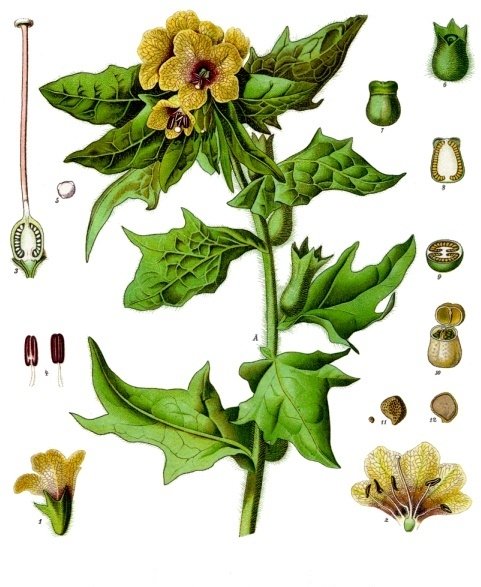
Black henbane (Hyoscyamus niger) is an inconspicuous, stickily hairy herb of the nightshade family, related to deadly nightshade, thorn apple and mandrake. It grew, and still grows, on disturbed ground: along roadsides, on rubble, at the edges of farmsteads and around ramparts – exactly where people settled. Its funnel-shaped flowers are a dirty yellow with dark, net-like veining and a purple throat; the seed capsules open with a little lid and release countless tiny, pitted seeds. It is precisely these seeds that survive and can be identified so well in archaeological soil samples.
For the people of the Viking Age, henbane was no stranger. It belonged to the weed flora of their villages; it could be gathered, dried and stored. And it was, and this must be said at the outset, poisonous in every fibre – not a herb for the cooking pot, but a plant one knew how to handle, or better did not handle at all.
Henbane's effects come from so-called tropane alkaloids, chiefly hyoscyamine and scopolamine (with smaller amounts of atropine). These substances block the action of the neurotransmitter acetylcholine in the nervous system. In poisoning cases the result is dry skin and mucous membranes, wide pupils that no longer react to light, a racing pulse, confusion, hallucinations and a delirium that can dissolve any grip on reality. Higher amounts lead to seizures, respiratory paralysis and death. The old mnemonic of emergency medicine – hot as a hare, red as a beet, dry as a bone, blind as a bat, mad as a hatter – describes exactly this clinical picture.
The crucial point is that with such plants there is no reliable line between an effect and a lethal dose, because the alkaloid content varies greatly with the individual plant, its location and the season. This is not a marginal detail but the very reason why any notion of a routine, precisely controlled use must be treated with great caution. What follows is history and archaeology – explicitly not a guide to use.
Fyrkat near Hobro in northern Jutland is one of the geometrically perfect ring fortresses raised around 980 under Harald Bluetooth. Outside the rampart lay a cemetery, and within it one of the most famous women's graves of the Viking Age: grave 4. The dead woman had been laid in the body of a wagon – a form of burial that signals high rank and importance. Her furnishings set her clearly apart.
Among her possessions were two silver toe rings (a distinctly unusual custom in the North), a dress with gold thread, pendants and amulets, drinking-horn mounts, an imported bronze bowl from Central Asia, and a long iron staff with bronze fittings. It is this staff above all that has earned the dead woman her reputation in scholarship as a practitioner of magic, for the Old Norse word for the seeress, völva, literally means staff-bearer. Neil Price drew on this grave in his study of seidr as one of the key examples of the material world of Norse ritual specialists.
The find that matters most to us is unassuming: at or near the woman's belt lay a small pouch, and in it were hundreds of seeds of black henbane. This is not a chance intrusion from the surrounding soil. A deliberately gathered, stored quantity of a highly poisonous plant, kept on the body of a particularly well-furnished woman, is strong evidence that this plant held meaning for her.
What meaning – that is the decisive, open question. The find proves possession and esteem. It does not prove how the herb was used: whether smoked, in drinks, as an ointment, as an amulet, or not in the sense of ingestion at all but as a meaning-bearing object. It is exactly here that the boundary between evidence and interpretation begins, and anyone who blurs it tells a story the ground does not support.
Evidence: In the richly furnished wagon grave 4 at Fyrkat (Denmark, late 10th century), a pouch containing hundreds of seeds of black henbane (Hyoscyamus niger) was found at the belt of the buried woman. The find is published (Roesdahl) and counts as one of the clearest archaeological testimonies to the significance of this plant in the Viking Age. What is secure is the deliberate possession of a highly poisonous plant by a high-ranking woman – no more and no less.
Fyrkat is the most spectacular but not the only piece of evidence. Henbane seeds turn up at various Viking Age and early medieval sites in settlement layers, for example in storage pits, refuse deposits and wells. This is not in itself surprising: the plant is a typical camp-follower of human settlement and grew of its own accord at the edges of farmsteads. A single seed in a cultural layer says, on its own, only that the plant grew nearby.
It becomes telling where seeds occur in concentration and in a context that points to gathering and storage – as in the Fyrkat pouch. Botanical research therefore distinguishes carefully between the chance presence of a wild plant and indications of its deliberate use. For henbane there is both: much inconspicuous weed flora, and a few but all the more significant concentrations.
That we can speak of henbane in a thousand-year-old grave at all we owe to archaeobotany. Plant remains survive only under particular conditions: charred by fire, permanently waterlogged in bogs and wells, or mineralised. The hard, densely patterned seeds of henbane are among the most identifiable remains of all – a specialist recognises the species under the microscope from the surface structure of the seed coat. This is why henbane is so present in the find literature: not necessarily because it was more common than other herbs, but because it survives so well and can be identified so unambiguously.
This state of the sources has a flip side that must be kept in mind. Well-preserved, conspicuous seeds distort the picture: plants with soft petals, roots or leaves leave almost no trace and are all but absent from the statistics. What we read from the ground is therefore a filtered image – rich in durable seeds, poor in everything that decays quickly. At Fyrkat there is the added stroke of luck that the seeds lay not scattered but bundled in a pouch. Only that context turns botanical noise into an interpretable testimony.
One particularly persistent motif links henbane with beer. Before hops became dominant, beer was flavoured with herb mixtures known as gruit – typically bog myrtle, yarrow, wild rosemary and similar plants. It is repeatedly claimed that henbane too belonged to these brewing herbs, sometimes backed up by the resemblance between the German name Bilsenkraut and the beer city of Pilsen.
This derivation is uncertain and disputed by specialists. The name link to Pilsen is regarded as folk-etymological play without solid support, and the idea that brewers routinely added such an unpredictably dosed, lethal plant to an everyday drink is more popular tale than established knowledge. Gruit brewing with harmless herbs is well attested; the henbane beer remains a fringe claim, worth knowing but not worth passing on as fact.
The connection that makes Fyrkat so fascinating is the one between the plant and seidr – that Norse ritual practice of prophecy and influence, attributed above all to women, the voelur. The written sources (for instance the famous session of a seeress in the Saga of Erik the Red) describe trance, chanting and altered states of consciousness, but they name no specific plants.
It is tempting to think the iron staff, the rich furnishings and the henbane pouch of Fyrkat together, and to see in them the equipment of a ritual specialist for whom a mind-altering plant seems plausible. But plausible is not the same as proven. That the woman ingested the herb in rituals is a well-founded assumption – not a proof. The seeds say: significant, stored, valued. They do not say: ingested, and least of all how.
No subject is linked to intoxicating plants as eagerly as the berserkers – those warriors said to have fought in a wild, fearless battle-fury, the berserksgangr. Since the late 18th century the idea has circulated that some intoxicant triggered this state. In 1784 the Swedish theologian Samuel Oedmann proposed the fly agaric mushroom (Amanita muscaria); in the 20th century this suggestion was popularly passed on. More recently a variant appeared that proposes henbane rather than the mushroom as the trigger.
Both are speculation. There is no Viking Age source that attributes a plant or a mushroom to the berserkers. The fly agaric idea rests on an 18th-century after-the-fact interpretation; the henbane idea is younger still and equally unproven. There is also a practical problem: the delirium of tropane-alkaloid poisoning, with confusion, visual disturbance and impaired movement, is just about the opposite of what a warrior can use in a fight. The berserksgangr can be explained just as well in cultural, psychological and religious terms. The plant may fit the picture – but the picture comes from later centuries, not from the Viking Age.
Myth check: The claim that berserkers put themselves into a battle-frenzy with fly agaric or henbane is not supported by evidence. It goes back to a conjecture by Samuel Oedmann in 1784 (fly agaric); the henbane variant is younger still. No contemporary source names such a substance. And the seeds in the Fyrkat grave prove possession of the plant – not the manner of its use. The widespread readings of henbane as an ingredient of witches' flying ointments likewise come from the early modern period (16th–17th centuries) and cannot be projected back into the Viking Age.
A large part of what is told today about henbane and intoxication comes not from the Viking Age at all but from the early modern period. In the witch trials of the 16th and 17th centuries, reports appear of flying ointments to which nightshade plants such as henbane, deadly nightshade and mandrake were attributed. This notion – that, rubbed on the skin, the ointment induced a state of flight or journeying – is an interpretation of its own time, shaped by demonological literature and court records taken under torture.
It is tempting to carry this early modern idea backwards onto the Norse seeress and to make the völva of Fyrkat a forerunner of the witch. But centuries lie between them, along with different sources and different world-views. The connection is a construction of hindsight, not a continuous thread. Anyone who wants to understand the woman of Fyrkat should leave her in her own time.
Beyond all readings of ritual and intoxication, henbane had a sober, practical side: for centuries it was a known remedy. The classical authors already describe it as a pain-relieving and sleep-inducing herb to be used with great caution. Medieval recipe books list henbane against toothache, as a sleeping draught and externally for pain – always aware that the line to poisoning was near. The very substances that kill in excess can dull pain and cramp in a tiny amount; this is the old, dangerous double face of many poisonous plants.
For the Viking Age itself we lack written recipes – the Norse sources are largely silent on concrete plant medicine. Yet it is not far-fetched that a woman of rank with knowledge of such plants also knew their healing and pain-relieving side. That shifts the image of Fyrkat: away from the merely dark, towards a woman who commanded dangerous, ambiguous knowledge – knowledge that could mean healing as much as harm, and which for that very reason conferred standing.
Henbane is of the nature of wine and therefore hostile to the understanding; it confuses the head and disorders the senses. It should be counted among the remedies only with caution, for its power is dangerous.after Pliny the Elder, Natural History, Book 25 (public domain, freely rendered)
Let us draw the line cleanly. What is proven: henbane was familiar to the people of the Viking Age, it grew around their farms, and in at least one outstanding grave – that of the woman of Fyrkat – it was deliberately gathered, stored and carried into the afterlife on the body. Together with the iron staff and the elaborate furnishings, this yields a strong image of a woman of rank for whom this plant held a special meaning.
What is not proven is everything beyond that core: the concrete manner of use, a henbane beer, a berserker frenzy, an unbroken line to the early modern witch. This is not a weakness of the story but its honesty. The woman of Fyrkat remains one of the most striking figures of the Viking Age precisely because we do not know everything about her. The ground has handed us a pouch full of seeds – and the wisdom not to overwrite it with our own tales.
Herbs & healing of the Vikings · Viking medicine · Berserkers · Seiðr – the magic · Angelica.
All Festivals & Belief articles →
Scarcely an image is so bound up with the Vikings as the burning ship drifting out to sea with the dead. The ship was …
Read more →