 No operating theatre, no antibiotics, no anaesthetic — and yet people of the Viking Age survived astonishingly severe injuries. Their healing craft blended sharp observation, herbal knowledge, handiwork and sorcery. We separate what is documented from what is modern legend.
Picture Viking-Age medicine and you probably imagine raw force: a hot iron, a swig of mead for the pain, teeth gritted against the worst. Some of that is even true. But the picture is incomplete. Behind the healing craft of the North lay a surprisingly practical system of experience, passed down over generations — woven together with prayers, formulas and the firm belief that word and herb work as one.
The Viking Age was an age of blades, and blades leave wounds. Skeletons from mass graves such as Repton or Weymouth make it plain: sword cuts to skull, arms and legs, often several, sometimes healed. And that is the crucial point — healed. People survived blows that at first glance look fatal.
Treatment was robust and pragmatic. Bleeding was stopped with pressure bandages, sometimes with cauterisation. Open wounds were cleaned, rinsed and — where possible — stitched. Broken bones were splinted with wooden rods and bindings. Wine, strong herbal decoctions and probably honey served as wound dressings; honey draws out moisture and is mildly antibacterial, even though no one then knew of germs. Anyone who got through the first days without the wound festering had a good chance.
The true enemy was seldom the blade itself but what came after: wound fever. An infection could carry off a warrior who had come through the battle unscathed, days later. Removing arrowheads was an art of its own — barbed points sat fast, and a clumsy wrench could be deadlier than the strike. Some sagas describe pushing arrows through or gripping them with tongs. Where no tool helped, the blade stayed in the body — and the wounded man lived or died with it.
The most striking scene in medieval wound-craft appears in Snorri Sturluson’s Heimskringla, in the account of the Battle of Stiklestad in 1030. A healer boils a porridge of crushed leeks and herbs in a stone kettle and feeds it to the wounded. Why? So that afterwards she could smell the wound: if a belly wound smelled of leek, the blade had pierced the abdominal cavity — an all but certain death sentence at the time.
Then the woman went to Thormod and looked at his wound … She took a kettle and stirred in it a porridge of leeks and other herbs, boiled it and gave it to the wounded men to eat, so as to learn whether they had deep wounds; for she could smell the leek out of a wound that went into the body cavity.Snorri Sturluson, Heimskringla, Óláfs saga helga (Laing, 1844, public domain)
The skald Thormod Kolbrúnarskáld, gravely hit himself, refused the porridge — with the dry remark that he was “not porridge-sick.” He pulled the arrow from his own chest shortly after and died. Whether the leek test really works medically is disputed; the idea that the smell carries out through a perforated abdomen is at least plausible. But something else matters more: it shows diagnostic thinking — an attempt to gauge the severity of an injury methodically.
The Old Norse word læknir (healer, related to English leech in the old sense of physician) does not mean a trained doctor but someone with healing skill. Strikingly often, the sources show women tending wounds. In the Stiklestad scene it is a woman who holds kettle, herbs and diagnosis in her hands. The Laxdæla saga and other Icelandic sagas mention women renowned for their healing knowledge.
That fits the roles of the Viking-Age household: women ran the inner domain of the farm, knew the stores, the herbs in the garden and along the wayside. Healing was part of this household knowledge — not a separate profession but everyday competence that, in an emergency, decided between life and death.
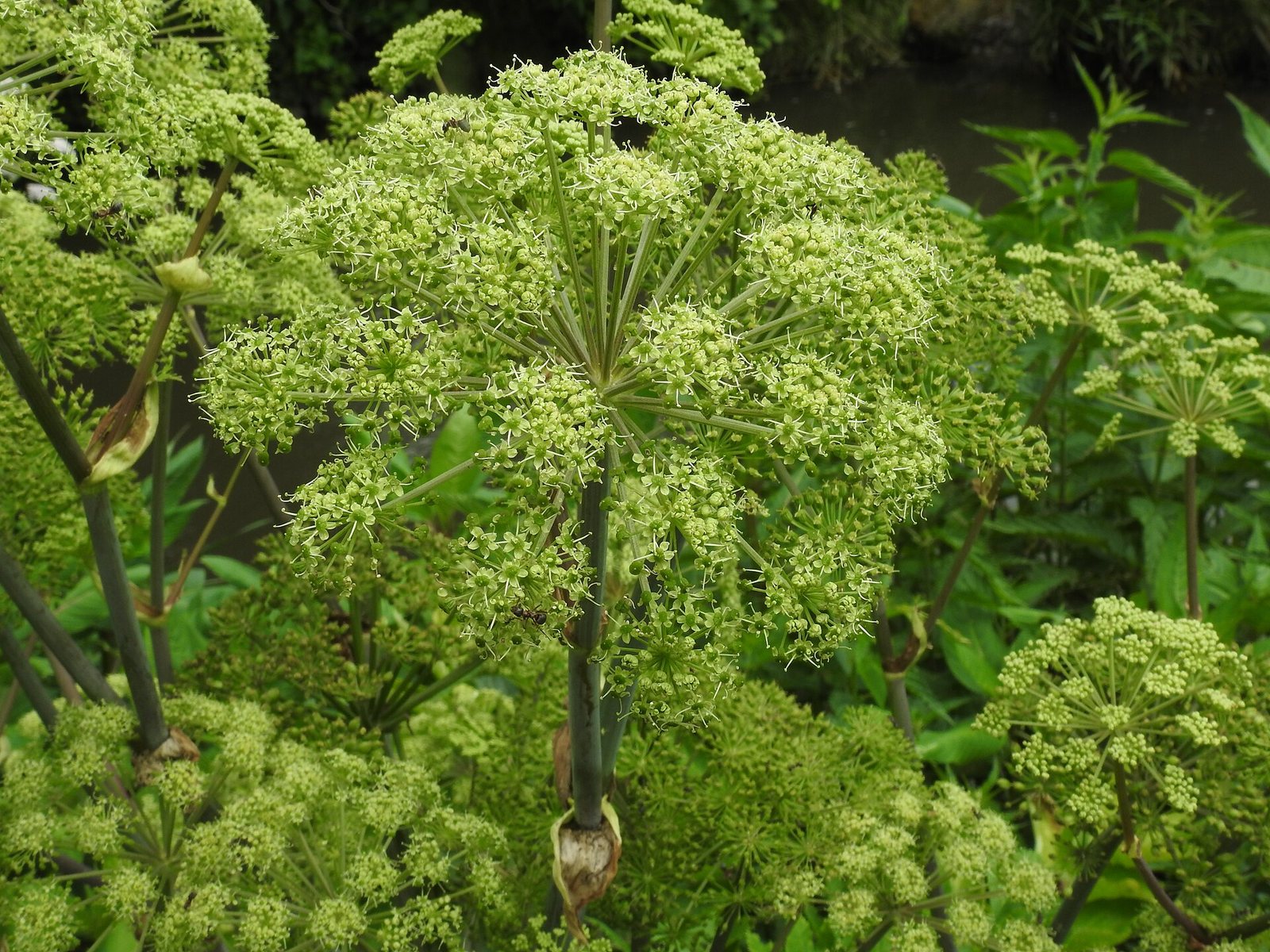
From archaeobotanical finds — seeds, pollen, plant remains in settlements and graves such as Oseberg — we know the Viking-Age plant world quite well. Mugwort, yarrow, leek and onion, horseradish, mustard, henbane, juniper, hemp and many kitchen and wild herbs are documented. Yarrow (Achillea) does not bear its scientific name after the wounded hero Achilles by chance: across Europe it counted as a wound herb that staunches blood. Leek and onion played — see Stiklestad — a special role; the rune word laukaʀ (“leek”) even appears on amulets and evidently stood for thriving and protection.
But one should view the effect soberly: much of it was pain-relieving, wound-cleansing, digestion-aiding or simply nourishing. A herbal draught could ease complaints and support recovery — it replaced neither surgery nor the antibiotics that simply did not exist.
Some plants worked powerfully, and in both directions. Henbane and hemlock, for instance, are poisonous; correctly dosed they could numb or dull pain, wrongly dosed they killed. Such knowledge was precious and dangerous at once — it lay exactly on the line where healing craft and what outsiders felt to be sorcery flowed into one another. Whoever mastered the herbs of the wild held power over life and death, and that made healers respected, and occasionally feared, figures.
How closely herb and word belonged together is shown by the Old English Nine Herbs Charm (Nigon Wyrta Galdor) from the Lacnunga collection. In it the god Woden invokes nine herbs against poison and disease — mugwort, plantain, nettle and others. Important for honesty: this is Old English, not Old Norse. It comes from Anglo-Saxon England, culturally related to but not identical with the Scandinavian world. Even so, the charm reveals a shared Germanic pattern: a formula was spoken over the herb to “activate” its power. Healing was deed and word at once.
Bloodletting — the deliberate release of blood — was known across Europe and was likely practised in the North too, to draw off “bad humours.” Evidence for actual surgery is rarer but present: healed fractures show that breaks were successfully set and splinted. Skulls with trepanations — deliberate openings in the cranial bone, some with signs of healing — prove that people even survived such interventions. Whether every one of these particular finds belongs to the Viking Age must be checked case by case, yet the skill to set bones and stitch wounds was undoubtedly present.
The teeth reveal much too. On Viking-Age skeletons one finds teeth with deliberately filed grooves — a puzzling custom whose meaning (ornament? a group marker?) is disputed to this day. Caries and worn chewing surfaces tell of hard fare with grains of sand from the hand-mill. Of “dentistry” in the modern sense there can be no talk; where a tooth ached, in the end only pulling helped. It is a sober but honest view: much of what we treat as a matter of course today, people back then simply had to endure.
For Viking-Age people, illness often had a cause beyond the body: a curse, a hostile being, an imbalance. So protective sorcery belonged to the treatment. The Sigtuna amulet, a copper plate from the Christianised Swedish town, bears a runic inscription that conjures and drives off a fever- or wound-thurs (a sickness-bringing fiend). Rune poems and sagas speak of bótrúnar — “healing runes” to be carved to bring about recovery.
This should not be imagined as the opposite of “real” medicine. For the healer the charm belonged with the herbal porridge as naturally as the splint belonged with the broken leg. Sorcery and healing craft were not separate worlds — they flowed into one another.
The line between healer and völva, the seeress and worker of magic, was fluid too. Whoever could close a wound was often also credited with reading fate or turning away misfortune. In a world without modern medicine this was not superstition in the condescending sense but a coherent worldview: if a sickness comes from outside, it must also be fought from outside — with herb, blade and word at once.
A stubborn cliché holds that the Vikings were filthy barbarians. The opposite is better documented: combs, ear spoons, tweezers and razors are mass finds. The English chronicler John of Wallingford even complained that the Danes bathed on Saturdays (hence Old Norse laugardagr, “bath day”) and combed their hair — and thereby outshone English suitors with the women. Warm baths, some sweat-bath-like, are attested. Clean bodies lower the risk of infection, even without germ theory. Prevention through grooming was part of the health culture — though in clean bodies, not necessarily clean towns, where finds like the famous York coprolite testify to plenty of parasites.
Skeletons with healed cut injuries and set fractures prove successful wound care. The leek test is recorded in the Heimskringla. Herbs such as yarrow, mugwort, leek and onion are attested archaeobotanically, and the rune word laukaʀ on amulets. The Sigtuna amulet shows runic healing sorcery. Combs, tweezers and the laugardagr (bath day) document grooming.
There was no “secret Viking medicine” and no lost miracle knowledge. Much of it was practical experience and herb-craft; sorcery and healing merged into one another. The sagas are literary texts of the 13th century, not medical manuals. Life expectancy and child mortality were high. Claims that “the Vikings deliberately healed with honey or moulds” are overblown — honey could help, but no one knew of bacteria or antibiotics.
Herbs & healing of the Vikings · Everyday Viking life · Seiðr – the magic · Viking women · Viking leatherwork.
All Everyday Life & Craft articles →
Viking jewellery was rarely just decoration. A pair of brooches held the dress, an arm-ring was status symbol and …
Read more →Barely an image of the „real Viking“ reaches us today without dark runic and knotwork tattoos. But how do we actually …
Read more →Most Vikings were not raiders but farmers, traders and craftspeople. A look inside the long house where their lives …
Read more →An entire heroic epic on a single teak panel: rider, ship and figures. Our Atli motif stands in an ancient Norse …
Read more →