Viking daily life was, above all, farm work set to the rhythm of the seasons: sowing in spring, haymaking in summer, slaughter in autumn, and weaving, carving and storytelling through the long winter. Most people in the North between the 8th and 11th centuries were farmers, craftswomen, fishers and traders, not full-time warriors. Walk through their year with us – and at every step we tell you whether the knowledge comes from the soil, from an eyewitness or from a saga written down centuries later.
Before we put a spade into the ground, an honest word up front. What we know about everyday life in the Viking Age comes from three very different kinds of evidence, and now and then they disagree.
First, archaeology: house plans, wells, rubbish pits, latrines, tools, loom weights, animal bones, plant remains and skeletons. It does not lie, but it is silent on a great deal – who did which job, for example, or what they thought while doing it. Second, contemporary written sources: accounts by outsiders such as the Arab envoy Ibn Faḍlān, the north Norwegian trader Ohthere, who described his homeland at the court of Alfred the Great around 890, or runic inscriptions from the North itself. They are close to the events but often brief or biased. Third, later tradition: Icelandic sagas, Eddic poems and law books, mostly written down in the 12th and 13th centuries. They are full of everyday detail, yet partly mirror the world of their Christian authors.
We keep these three levels apart throughout. That does not make the story drier – quite the opposite. The best moments come when a bone find confirms or contradicts a saga.
Life centred on the farm: a dwelling, often a longhouse with living quarters and a byre, plus sunken huts for weaving and craft, storehouses, fences and wells. How such a house was built and where hearth, benches and stalls lay is covered in our article on the Viking longhouse. Here we care about what happened inside.
A good example is Vorbasse in central Jutland, one of the most completely excavated villages in Scandinavia. Over many seasons Steen Hvass and his team uncovered a settlement that shifted its position across the centuries. In the early Viking Age the village consisted of only a handful of farms – Hvass counts six. The wells are especially revealing: in the waterlogged soil, wooden objects survived that would normally rot away. Among them were spades, ladders, wagon axles, a stave-built bucket, a handled bowl, a trough, a baking peel and a wooden hayfork. No gold, no swords – just the kit you needed to get through a year on the land.
And one more contemporary voice. Ohthere, a man from far northern Norway, told King Alfred that he owned only about twenty cattle, twenty sheep and twenty pigs, and that the little land he ploughed, he ploughed with horses. His real wealth lay in reindeer and in the tribute the Sámi paid him in furs, feathers and walrus hide. His account shows how differently "farming" looked across the North: grain fields in Denmark, livestock and fishing on the Norwegian coast, sheep and hay in Iceland.
People in the North divided the year not into four seasons but into two halves: summer and winter, in Old Norse misseri. Winter began with the Winter Nights (vetrnætr) around mid-October, summer around mid-April. Iceland still remembers this: the "first day of summer" (sumardagurinn fyrsti) is a public holiday there in April.
In the 13th century, Snorri Sturluson listed month names in his handbook of poetic language (Skáldskaparmál) that betray the farming rhythm. Among them are gormánuðr, probably the slaughter month, sáðtíð, seed-time, eggtíð and stekktíð, egg-time and the time when lambs were penned apart from the ewes, selmánuðr, the month of the summer pastures, and heyannir, haymaking. One caveat: this list is Icelandic and some two centuries younger than the Viking Age. That 9th-century Danes counted their months in exactly this way is not attested.
"Early shall rise who has few workers, and go himself to his work. Much is missed by him who sleeps in the morning; half of wealth lies with the brisk."Hávamál 59, our own translation
This line from Odin's sayings could have hung over any farm gate. It comes from a collection written down only in the 13th century, though its content is probably older.
When the ground thawed, the hardest stretch began. The winter stores were running low, the animals were thin, and at the same time the fields had to be ploughed and sown. Much ploughing was done with the ard (árðr), which scratches the soil rather than turning it; its criss-cross furrows survive in places under burial mounds. The main crops were barley, oats and rye, along with flax for linen and some pulses. In Iceland the climate usually allowed for little more than a bit of barley.
Lambs and calves arrived at the same time. The animals had often come through the winter on scant fodder, and a late spring could push a farm to the brink. Spring hunger is a recurring theme in the sagas, and zooarchaeology confirms that fodder shortage was a real problem.
Spring was also the season for leaving. Those who went abroad – to trade, to fish or to raid – set out after sowing and ideally came home for the harvest. The expeditions the Vikings are famous for therefore fitted into the farming calendar. Many of the men on board were farmers first.
Summer belonged to fodder. Without enough hay the livestock would not survive the winter, and without livestock there was no milk, no wool, no meat. Grass was cut with scythes and sickles, turned and loaded with rakes and forks like the one from Vorbasse. In Norway people also cut leafy branches and dried them as winter feed, a practice traceable through pollen analysis and pollarded trees right into modern times.
In Norway and Iceland part of the household moved up to distant summer pastures, the sel or shielings, with cows, sheep and goats. There they milked, churned butter and made cheese. Archaeologists have found such shieling sites with small huts and pens, and the month name selmánuðr shows how firmly they belonged to the year.
Late summer brought the grain harvest, then threshing and drying. What came to the table in those weeks, and how grain became porridge, flatbread and ale, is explained in detail in our article What did the Vikings eat?.
With the Winter Nights came the hard arithmetic: how many animals could the hay carry through? Everything beyond that was slaughtered. The Icelandic name gormánuðr is usually linked to gor, the half-digested stomach contents of slaughtered animals – a month name you can smell.
Meat was salted, smoked, dried or soured in whey; fish was air-dried into stockfish. Blood, offal, tallow and hides were all put to use. Slaughter time was also feasting time: when fresh meat was plentiful, you invited guests. The great sacrificial feasts at the start of winter and at Yule belong in this context. How a blót worked and what the sources really tell us is in our article on Viking customs and rituals.
In winter the work moved indoors, but it did not stop. The livestock had to be fed, watered and mucked out every day. On top of that came wood and peat for the fire, water from the well, and repairs to tools, boats and fences.
Above all, textiles were made. Spindle whorls and loom weights are among the commonest finds in any settlement. The warp-weighted loom produced cloth for clothing, blankets, sacks and sails. How much work went into a single garment and which colours people wore is shown in our article on Viking clothing. Men carved, forged, wove baskets and built; that this division of labour was not rigid we will see in a moment.
Winter was also the season of stories, visits and feasts, with midwinter Yule as its high point. Those who had to travel often preferred to do it now rather than in autumn, because frozen ground and frozen water were far easier to cross than mud.
On many farms the basic split was probably similar: women were responsible for the house, stores, dairying, textiles and children; men for the fields, fishing, wood and metalwork, voyages and legal business at the assembly, the thing. Later Icelandic law distinguishes between what lies "inside the threshold" (innan stokks) and the world outside, and scholars have often used this as shorthand for gender roles. Whether that held for the Viking Age itself can only be inferred indirectly.
What is clear is that the mistress of the house (húsfreyja) was no servant but the manager of an operation with maids, farmhands, children and livestock. When her husband was away, she ran the farm alone. Graves and runestones show women with property, status and a voice of their own. More on inheritance, divorce and the limits of their power can be found in our article on women in the Viking Age.
Few objects are as closely linked to the Viking woman as the key on her belt. The best text is the Eddic poem Þrymskviða: when Thor dresses up as the bride Freyja to win back his hammer, Heimdall suggests letting keys jingle from his belt. Keys were evidently part of the picture of a high-status woman.
This is where interpretation starts, and it is disputed. Older scholarship saw the key as the badge of the housewife who controlled chests and stores. More recent work partly disagrees. In a study of south-east Norway only about 117 out of several thousand excavated graves contained a key at all, and keys also turn up in men's graves, for instance at Repton in England. Decorated bronze keys, on the other hand, really are almost exclusively found with women. Some researchers therefore read keys more as signs of property and status – if you had something to lock away, you were well off – or even as ritual objects, perhaps connected with childbirth.
Our take: the key as the emblem of the housewife is a well-founded but modern interpretation, supported by one Eddic poem and later laws. It was not the badge of every farmer's wife.
Childhood was short, but it existed. Children herded geese and lambs, fetched water, picked berries and learned by watching and joining in. Girls began spinning early, boys helped with livestock and boats. There were no schools in our sense; knowledge, law and stories were passed on by word of mouth.
They also played, and archaeology shows it beautifully. From settlements and towns such as Hedeby, Trondheim and York we have wooden swords, little horses, spinning tops and toy boats. In 2016 archaeologists from the NTNU University Museum found a carved wooden boat with a hole for a mast in an abandoned well at Ørland, west of Trondheim, roughly a thousand years old. You can almost see the child who floated it down a stream.
The sagas paint a rougher picture. According to Egil's saga, Egill Skallagrímsson was in his seventh winter when he killed an older boy with an axe after a ball game – and his mother praised him as a future Viking. That is the literary exaggeration of a hero, not a parenting manual. Fostering (fóstr), on the other hand, was widespread: children often grew up with another family, which strengthened alliances. More in our article on childhood in the Viking Age.
Many farms also held people who were not free: thralls, Old Norse þræll (plural þrælar, a female slave was an ambátt). Many had been captured on raids, others were born into slavery or lost their freedom through debt. The Vikings were slave traders too, and it would be dishonest to leave that out.
The Eddic poem Rígsþula, whose date is disputed, describes three ranks: thrall, free farmer and jarl. The thrall's children bear mocking names and do the dirtiest jobs: building fences, manuring fields, herding pigs and goats, cutting peat. It is a poem about social order written from above, but it shows who did which work.
What a person cost is told in Laxdæla saga (13th century): at a market in Norway, Höskuldr buys an Irish woman for three marks of silver, three times the price of the other women on offer. She turns out to be Melkorka, a king's daughter. Whether the figure is historical we cannot say – but that people were sold on markets for weighed silver is confirmed by contemporary sources as well.
Release was possible. The Danish Hørning stone names one Toki, a smith, who raised a stone for his former master, who had given him gold and freedom. More on the lives of the unfree is in our article on slavery among the Vikings.
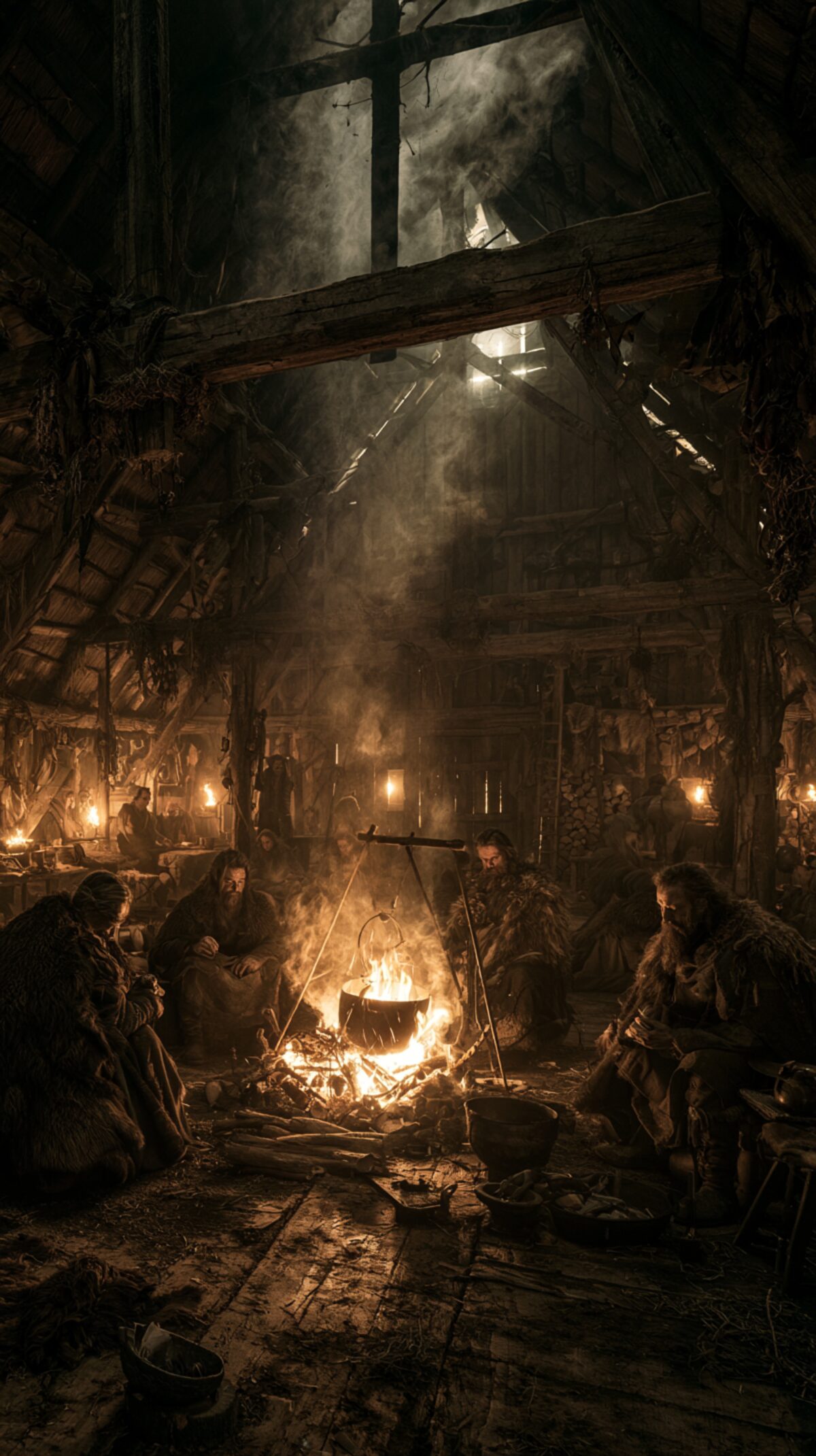
A Scandinavian winter means many hours of darkness. The main source of light and heat was the hearth in the middle of the house. Smoke escaped through openings in the roof, though not always completely – soot-blackened beams and respiratory problems were the result.
There were lamps as well: bowls of soapstone or clay, and iron lamps on a spike that could be stuck into a beam or the floor. They burned fish oil or animal fat with a wick. Beeswax candles were a luxury. In the richly furnished grave at Mammen in Jutland, dug in the winter of 970/71, the National Museum of Denmark reports a large wax candle standing on the coffin lid – a mark of wealth, and perhaps already of Christian influence.
Besides the fire, warmth came from the animals in the byre, from thick walls of turf or wattle and daub, and from people themselves. They slept close together, on the wall benches or in partitioned bed closets, under furs and woollen blankets. Hávamál says, roughly, that someone who comes in with frozen knees needs fire. Hospitality was also frost protection.
The image of the filthy Viking dies hard. The finds tell a different story. Antler combs are among the most common objects of the Viking Age; Ribe and other towns had specialist comb-making workshops. Then there are tweezers, ear spoons and nail cleaners, often carried as a small set on a ring.
Two texts are regularly quoted here, and both need context. The first is Ibn Faḍlān, who observed Rus traders on the Volga in 921/922. He writes that every morning they washed from one shared bowl, into which each man spat and blew his nose – a horror for a Muslim scholar bound by strict purity rules. You can read his account on our site.
The second is a chronicle circulating under the name of John of Wallingford, written at St Albans in the 13th century. It claims that the Danes in England were in the habit of combing their hair daily, bathing on Saturdays and changing their clothes often – and so seduced the Englishmen's wives. It was written more than 200 years after the events and is plainly meant as a put-down. As proof of exceptional cleanliness it is weak; as a hint of a well-groomed appearance, it fits the combs nicely.
Hávamál, for its part, says that a guest arriving for a meal needs water, a towel and a friendly welcome. Washing was part of arriving.
People travelled more than you might think. In summer they went by water – the North was a land of coasts, fjords and rivers. In winter they went on runners, under their sledges and under their feet: sledges, skis and skates made of horse or cattle bone, found in large numbers at Hedeby, Birka and York. The Oseberg burial of 834 contained several sledges and a richly carved wagon.
There were plenty of reasons to go: visiting kin, feasts, lawsuits at the thing, the assembly of free men, and above all the market. Trading places such as Ribe, Hedeby, Kaupang and Birka drew farmers from the surrounding country, who swapped wool, furs, butter or iron for salt, glass beads, quernstones, pottery or silver. Payment was in hacksilver, weighed on small folding scales. How the network of trade routes worked is described in our article on Viking trade.
An outsider's view of such a town comes from Ibrāhīm ibn Yaʿqūb, a traveller from al-Andalus who visited Hedeby around 965. His account survives only in a later excerpt by al-Qazwīnī (13th century). Among other things he reports that women could divorce, that men and women alike wore eye make-up, and that the inhabitants' singing reminded him of dogs howling. How reliable this is we discuss in our piece on Ibrāhīm ibn Yaʿqūb in Hedeby.
If you work all day, you need a break. Gaming pieces of glass, bone or amber, dice and fragments of gaming boards are known from many graves and settlements. The best-known game is hnefatafl, a siege game in which a king and his retinue must break out against superior numbers. How it was played and how much of the modern rules is genuinely attested is explained in our article Hnefatafl – Viking chess.
Outdoors, people played ball. The sagas mention knattleikr, a game with a bat and ball, often played on ice, which could get rough. Then there was wrestling, swimming contests – in Laxdæla saga Kjartan takes on King Olaf Tryggvason in the river Nid – and horse fights, in which stallions were set against each other. We know the rules only from the sagas, that is, from the 13th century.
And then there was the word. Long evenings were filled with stories, riddles, recited genealogies and verse. Skaldic poetry was highly complex, with internal rhyme, fixed syllable counts and coded circumlocutions called kennings. It flourished at princely courts, but the delight in a clever verse reached down to the farm. How a court poet worked is shown by the example of Eyvindr skáldaspillir. The sagas themselves are a product of this storytelling culture: what had been passed on by the fire for generations, Icelanders wrote down in the 13th century.
Caution is needed here, because numbers are easily misread. A low "average life expectancy" mainly means that many children died. Anyone who survived childhood could well reach 50, 60 or more. There is also a methodological problem: the age at death of older people is hard to estimate from skeletons and is often underestimated. That is why we deliberately do not give a fixed average for "the Vikings".
What the bones do show is striking. Osteoarthritis in spines, knees and hands speaks of heavy physical labour. Teeth are heavily worn by gritty flour; caries, abscesses and tooth loss were common. A pilot study from the University of Gothenburg (BDJ Open, 2025) used CT scans to examine 15 adult skulls from Varnhem in Sweden and found, alongside dental disease, traces of sinus and ear infections and osteoarthritis of the jaw joint – in people who had died between roughly 20 and 60.
Epidemics struck too. A study published in Science in 2020 identified the smallpox virus in skeletons from eleven Viking Age sites in Denmark, Norway, Russia and Britain, as well as in several individuals from Öland. How people tried to cure illness, with herbs, wound care and charms, is described in our article on Viking medicine.
When we engrave a piece of slate in our workshop in Alsdorf, we often think of these people. Their daily life was hard and full of duty, and still they decorated their combs, ornamented spindle whorls and spoon handles, and carved boats for their children. Beauty was not a luxury for feast days; it belonged in everyday life. We take that attitude seriously – not as a costume, but as craft.
What was a typical day like for a Viking? For most it began early with tending the livestock, followed by field, house or craft work depending on the season. According to the sagas there were two main meals, one in the morning and one in the evening.
What did Vikings do in winter? They looked after the animals in the byre, spun and wove, repaired tools and boats, celebrated Yule and told stories. Travel by sledge and ski was often easier than in muddy autumn.
Were Vikings dirty? Not according to the finds: combs, tweezers and ear spoons are very common. Worms and parasites were still widespread, because water and food were often contaminated.
How long did Vikings live? Many people died as children. Those who reached adulthood often lived to 40 to 60, some longer; fixed averages are uncertain because ageing skeletons is difficult.
Did Vikings have slaves? Yes. Thralls (þrælar) worked on many farms and were sold at markets; release was possible, as runestones show.
What toys did Viking children have? Finds include wooden swords, toy horses, spinning tops and wooden boats; adults and children played board games such as hnefatafl.
For courage. For remembrance. For legends that live on.
All Everyday Life & Craft articles →
An entire heroic epic on a single teak panel: rider, ship and figures. Our Atli motif stands in an ancient Norse …
Read more →A stone that is warm rather than cold, light as wood, honey-gold in the light – and sometimes carrying within it an …
Read more →When we think of Vikings, we often see grey-brown figures in undyed wool. That is a mistake. Whoever could afford it …
Read more →They ran the farm, could inherit and divorce – and yet the truth about the Viking woman is more nuanced than modern …
Read more →