Yes, the Vikings dyed their clothes – with plants, lichens and imported insect dyes: blue from woad, red from madder or bedstraw, yellow from weld and related herbs, violet from lichens. We know this not from novels but from laboratory analyses of real textiles from graves such as Mammen and Gokstad and from the harbour of Hedeby. The same analyses also show that not everyone wore colour. Rich shades cost time, skill and often imported goods – which is exactly why colour became a language of rank.
Picture a harbour on the Schlei inlet some time in the tenth century. Between barrels and boat planks, old scraps of clothing lie in the mud – torn, faded, some of them smeared with tar. A thousand years later, archaeologists lift exactly these rags out of the harbour basin at Hedeby and send samples to the lab. The question behind it sounds almost trivial: what colour was this cloth once?
Film and television love to dress Vikings in grey, brown and mud. The finds tell a different story – but not the exact opposite. Colour was available, but colour meant labour, and labour had a price. Here we look at which plants are actually proven, how people fixed colour in wool without a chemistry set, what came from Byzantium – and what the sagas say about colour and intent. If you would like an overview of cuts and fabrics first, see our article on Viking clothing.
Most Viking Age textiles look brown today – not because of their wearers' taste, but because soil, tannins and metal corrosion stain everything. The naked eye is a poor judge of the original colour.
Since the 1980s, researchers have extracted dyes from archaeological fibres and analysed them chromatographically, today mostly with HPLC (high-performance liquid chromatography, a method that separates a mixture into its individual components). Each dye leaves a kind of chemical fingerprint: indigotin points to blue from woad or indigo, alizarin and purpurin to red from madder root, luteolin to yellow from weld and related plants. Insect dyes such as kermes have their own markers.
A pioneer of this work was the British textile archaeologist Penelope Walton (now Walton Rogers). Her 1988 summary drew on samples from Dublin, York and some twenty sites in Norway and Denmark. Far from every sample still held dye, but where colour survived, the same sources kept recurring.
One caveat matters. Finding no dye does not automatically mean the cloth was undyed. Some dyes break down in the ground, some yellows are light-sensitive, and tannins mask a great deal. Conversely, a single detection proves nothing about how common a colour was in daily life.
Excavations in the harbour of Hedeby (Haithabu) produced thousands of textile fragments. The Swedish textile scholar Inga Hägg published them in a major volume in 1984. Most are remains of discarded everyday clothing – not the festive dress of the dead but the wardrobe of a trading town.
The dye analyses carried out at the time by Helmut Schweppe gave a sobering result: in most of the pieces tested, no dye could be detected any more. Hägg did describe cloth deliberately dyed very dark, almost black-brown – with walnut shells and iron. The evidence was juglone, a typical walnut compound.
Here a second look pays off. A new study by Ina Vanden Berghe, Ulla Mannering and Charlotte Rimstad (2023) could confirm only tannins for Hedeby, not juglone. Tannins occur in walnut shells but also in oak bark, alder bark and many other plants. That dark shades were dyed in the North is plausible – that walnut was the source can no longer be considered certain.
Two Danish princely graves tell a very different story. At Bjerringhøj near Mammen in Jutland, a man was buried with exceptionally rich equipment in the winter of 970/71 – a date derived from the tree rings of the burial chamber. The grave is best known for the silver-inlaid axe that gave the Mammen style its name. For us the cloth matters: embroidered wool, silk trim, tablet-woven bands.
Walton analysed the Mammen textiles back in 1991, and the follow-up study of 2023 has widened the picture. The wool samples contained woad, weld or another luteolin-bearing plant, and madder; the silks mostly madder, plus lichen dye. Particularly striking is a fragment of samite (a heavy, patterned silk weave) in which a red from scale insects was found. In a project report, the National Museum of Denmark identifies it as cochineal probably from Poland or Armenia – not to be confused with American cochineal, which only reached Europe after 1500.
The second grave, Hvilehøj near Randers, belonged to a woman of the late tenth century. Here kermes was detected in a red woollen tabby – a dye made from scale insects living on oaks around the Mediterranean. Long-distance trade could hardly be written more clearly into a single fabric.
Both graves were re-examined in the National Museum of Denmark's project “Fashioning the Viking Age” (2018–2023); two reconstructed high-status outfits are now on display in its Viking Age exhibition. For more on the loom itself, read our article on Viking weaving and textile craft.
In Norway, the great ship burials are the most important textile archives. The Oseberg burial of 834 contained tapestry fragments, wool and linen and more than a hundred pieces of silk. In “Silk for the Vikings” (2014), textile archaeologist Marianne Vedeler showed that they include patterned silks from Byzantium, Persia and Central Asia – often deliberately cut into narrow strips and sewn onto garments as trim. In the North, silk was not worn by the bolt but as a precious accent.
A botanical find is relevant too: the Oseberg ship held seeds of woad. That alone does not prove cultivation in Vestfold, but it fits the idea that the blue-dye plant was known and used in Norway. The tapestries themselves have darkened badly.
The neighbouring Gokstad grave gives a clearer result. In 2021, Jeannette Łucejko, Marianne Vedeler and Ilaria Degano analysed four samples: a striped wool fabric interpreted as tent cloth, and silk embroidery threads. All contained madder-type dyes, in the authors' view most probably from true dyer's madder.
At Birka on Lake Mälaren, finally, the chamber graves published by Agnes Geijer as early as 1938 produced a wealth of silk, tablet weaving and metal thread. That early publication says little about dyes; Birka mainly shows what the elite wore: silk trim, gold braid, the finest cloth.
If one colour stands out in Scandinavian finds, it is blue. Walton found indigotin in Scandinavian wool more often than any other dye. The source was almost certainly woad (Isatis tinctoria), a yellow-flowered member of the cabbage family used in Europe since prehistory.
Working woad is a small piece of magic. The blue is not sitting ready in the leaves; it exists as a colourless precursor. Only through fermentation, crushing and contact with air does indigotin form – and indigotin will not dissolve in water. To dye with it, you have to reduce it chemically in an alkaline vat (a fermenting dye bath). The wool comes out yellow-green and turns blue in the air.
Woad holds far less dye than tropical indigo. For a deep navy, the wool has to be dipped and aired many times. Pale blue was relatively cheap; deep blue was a sign of effort. Green was usually made by overdyeing: blue first, then yellow, or the other way round.
Woad was an economic good in the Frankish realm as well. In the Capitulare de villis, the Carolingian estate ordinance of around 800, chapter 43 orders that the women's workshops be supplied with linen, wool, waisdo (woad), vermiculo (kermes) and warentia (madder), among other things. The great dyes were on Charlemagne's shopping list too.
Red is the colour that sparks the most debate. The classic source is dyer's madder (Rubia tinctorum), whose roots contain alizarin and purpurin. Madder originally comes from the eastern Mediterranean and western Asia and is not native to Scandinavia. Yet madder-type dyes appear in Denmark as early as the turn of the era, and by the Migration Period madder red had become common there.
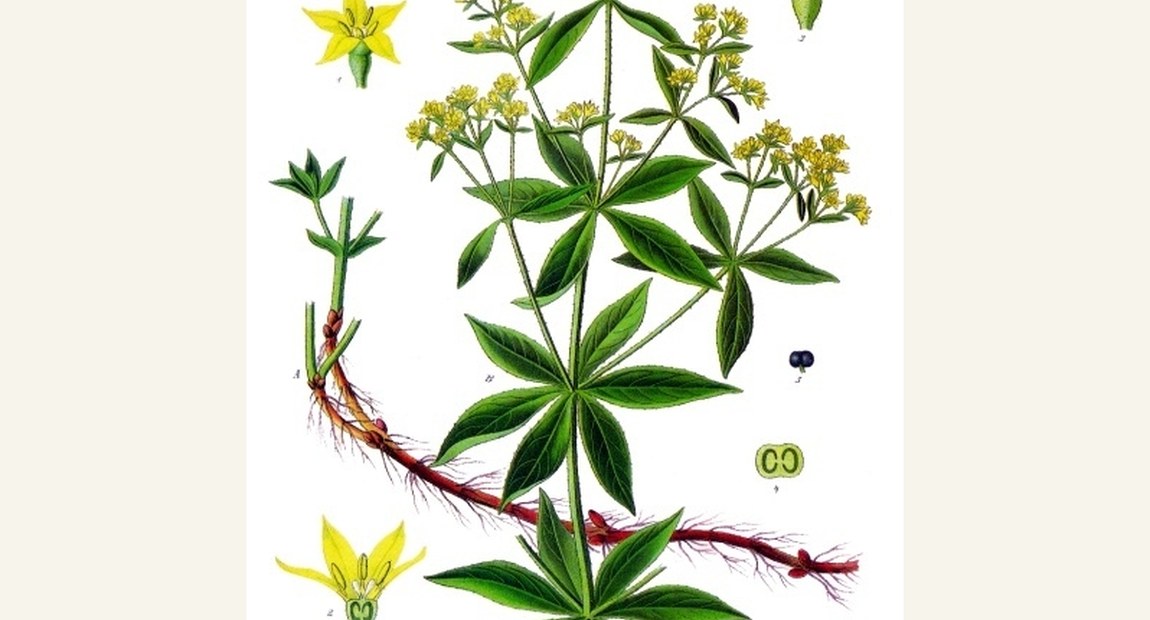
That leaves two possibilities that do not exclude each other. First, madder root or madder-dyed cloth reached the North as trade goods, for example from the Frankish realm where the plant was grown. Second, people used native relatives. Bedstraws (Galium), such as lady's bedstraw or northern bedstraw, contain similar dyes in their thin roots and give a softer red. That is why Walton chose her words carefully: red “from madder or bedstraw”. Chemically the two cannot always be told apart; the ratio of the compounds gives hints, not certainty.
What is clear: red needs a mordant, and madder is temperamental – let the bath get too hot and the red slides towards brown. A clear, glowing red was a masterpiece.
Insect reds were more precious still. Kermes, made from the dried females of a scale insect living on the kermes oak around the Mediterranean, gave the most expensive red in Europe. Via Arabic it is the root of our words “crimson” and “carmine”. In the North, kermes turns up at Hvilehøj, a related insect dye at Mammen, and it was suspected in a few samples from York.
Yellow is the poor relation of dye analysis. Europe's most important yellow plant was weld (Reseda luteola), which yields luteolin. But luteolin also occurs in other plants, such as dyer's greenweed or saw-wort. That is why reports often cautiously say “a luteolin-bearing plant”. In York, archaeobotanists found remains of dyer's greenweed, bog myrtle and heather in ninth- and tenth-century deposits in quantities that suggest dyeing. Yellow also survives poorly in the ground.
Violet and purple-red came from lichens. Certain crustose lichens contain colourless acids that turn into violet dye only after weeks in a fermenting, ammonia-rich bath – traditionally stale urine. In English it is called orchil or cudbear, in Norway “korkje”. For the Viking Age, lichen purple has been identified in York, in late Anglo-Saxon London and in silks from Mammen. The catch: lichen colours fade fast in light. A bright violet was a promise with an expiry date.
Brown, grey and black often came free – straight off the sheep. Northern sheep breeds gave wool in white, grey, brown and near-black. Add the tannin dyeing with bark and iron mentioned above. A good share of “earthy” Viking clothing was therefore not dyed at all but naturally coloured. That is exactly what separates everyday wear from festive dress.
Most plant dyes will not hold on wool by themselves. They need a mordant – a metal salt that binds to the fibre and locks the dye in place. In medieval Europe this was above all alum (an aluminium sulphate salt). Alum does not occur naturally in the North, and in the High Middle Ages it was traded on a large scale from the Mediterranean. Whether it already reached Scandinavia regularly in the Viking Age is not proven. For York, the chemist G. W. Taylor suggested in 1983 that alum was imported, but clear evidence for the Viking period is lacking.
There was, however, a brilliant alternative: clubmoss. Some clubmoss species, above all flat-branched clubmoss (Diphasiastrum complanatum), accumulate aluminium in their tissue. Boil them and you get a plant-based alum mordant. In 1988, D. G. Duff and R. S. Sinclair confirmed in the lab that clubmoss liquor combined with alizarin produces usable reds. In Scandinavian folk dyeing, clubmoss was used this way into modern times.
The Viking Age evidence comes, of all places, from England. Flat-branched clubmoss turned up in the deposits at Coppergate in York – a species not native to Britain. Archaeobotanists therefore consider it likely that Scandinavian settlers brought or imported it. Remains of woad and madder confirm that dyeing went on in York in the tenth century.
Nothing was as coveted in the North as silk. It arrived by two main routes: along the rivers of Eastern Europe from Byzantium and the Islamic world, and through Western Europe. The treaties between the Rus and Byzantium in the tenth century regulated, among other things, how much silk northern traders could buy in Constantinople. According to the Russian Primary Chronicle, purchases were capped and the goods had to be sealed by imperial officials.
Byzantium treated certain silks as an instrument of power. The finest purple-dyed fabrics were reserved for the imperial court. The envoy Liudprand of Cremona learned this the hard way in 968: shortly before his departure, officials confiscated five costly purple cloths he had bought. Such goods, he was told, were forbidden to all nations except the “Romans” – the Byzantines themselves.
“Purple” does not always mean the famous dye from murex sea snails. Byzantine luxury silks were also dyed with madder, kermes, indigo and lichens. In Old Norse, words such as pell and purpuri refer to costly silk cloth rather than a specific hue. True shellfish purple has not, as far as we know, been securely identified in any Scandinavian find.
Silk reached Norse hands in many ways: as merchandise, as a diplomatic gift, as pay for men who served in the Varangian Guard in Miklagard. The Arab envoy Ibn Fadlan describes how, around 922 on the Volga, a dead Rus chieftain was dressed for his funeral in a brocade kaftan with gold buttons and a brocade cap trimmed with sable. More in our article on Ibn Fadlan among the Rus.
The evidence gives a fairly clear social picture. Naturally coloured wool was the norm. Vaðmál, the coarse everyday homespun, even served as currency in Iceland. Dyed clothing was called litklæði in Old Norse, literally “colour clothes” – the very word shows these were the exception that needed a name of its own.
Among dyed fabrics there was a hierarchy. Woad blue was the most common in the North and therefore within reach of more people, especially in lighter shades. Red required madder or bedstraw, a mordant and plenty of experience. Insect reds and patterned silk came from far away and stayed with the elite. Regional preferences show too: more red in the Danelaw, more purple in Ireland, more blue and green in Scandinavia.
Who did the dyeing is barely recorded in writing. Textile work in the Viking Age was closely tied to women, as spindle whorls, loom weights and weaving swords in women's graves show. That dyeing on the farm was largely in women's hands too is a reasonable assumption and widely accepted by scholars – while towns like York probably also had specialised workshops. For a glimpse of such a production site, see our article on the textile workshop at Søften; for the wider role of women, read Women in the Viking Age.
The Icelandic sagas were written down in the thirteenth century, some two to three hundred years after the events they describe. They show not how things were, but how colour worked in storytelling.
In Njáls saga, Njáll's sons set out to kill Þráinn Sigfússon. Skarphéðinn walks in front in a blue cape with his axe on his shoulder; his brother Helgi wears a red kirtle, Kári a silk jerkin. In Dasent's translation, they are all “in bright holiday clothes”. In Hrafnkels saga, too, Hrafnkell puts on blue clothes before riding out to kill a man, and similar scenes appear in other sagas.
“Skarphedinn was foremost. He was in a blue cape, and had a targe, and his axe aloft on his shoulder.”Njáls saga, ch. 91 in George W. Dasent's numbering, The Story of Burnt Njal (1861)
From this grew the popular idea that blue was the saga “colour of vengeance”. That is a modern interpretation, not a recorded rule. The textile historian Thor Ewing has pointed out that blue is simply the most common clothing colour in the sagas. In his reading, the men wear their best clothes because a killing was not meant to be a secret murder: the killer wanted to be recognised. Colour was a stage, not a code.
There is also a linguistic trap. Old Norse blár covers a range from dark blue to black. A “blue” cloak may well have been very dark, almost black. Menace hangs over some scenes – but it is no fixed rule.
Red, by contrast, almost always signals splendour in the sagas. In Laxdæla saga, King Óláfr Tryggvason gives young Kjartan a whole set of new clothes cut from scarlet cloth. And when Bolli Bollason returns from Constantinople, he will wear nothing but scarlet and fur, carries a red shield and gilded weapons, and his whole retinue rides in scarlet. Old Norse skarlat meant a fine imported woollen cloth, usually dyed red – often with kermes. For an overview of these texts, see our guide to the Icelandic sagas.
For the reconstructed outfits from Mammen and Hvilehøj, a dedicated textile dyer was part of the project team – the dye analyses provided the template, the dyeing trials the proof.
Some results of such work are now common knowledge among natural dyers. For a strong madder red, modern recipes often use roughly as much root as wool, by weight. Woad blue deepens with every dip but needs a carefully tended, warm vat that ferments for days. Lichen violet needs weeks of preparation. Add washing, mordanting and drying – plus shearing, spinning and weaving – and it is obvious why a coloured garment could be worth a small fortune.
Light tests also show how quickly lichen dye fades, while woad and madder are stable. A violet missing today may once have been there.
So how colourful was the North? More colourful than the cinema thinks, and less garish than some re-enactment camps. The farmer in natural grey wool and the jarl's wife in kermes red with silk trim lived in the same world – colour set them visibly apart.
That clears away both clichés, the grubby barbarian and the candy-coloured fantasy warrior. We tackle more popular misconceptions in our fact check Typically Viking?. And if you want to know where kermes, silk and alum came from, carry on with our article on Viking trade.
In our Alsdorf workshop this strikes a chord: we too know how much patience goes into a piece that in the end simply looks “beautiful”.

What colours did the Vikings wear? Proven colours include blue (woad), red (madder, bedstraw, more rarely kermes), yellow (luteolin plants such as weld), violet (lichens) and naturally coloured wool in white, grey, brown and black. Blue is the dye most often detected in Scandinavia.
How did Vikings dye cloth red? Mostly with the root of dyer's madder or with native bedstraws that contain similar dyes. The costly insect red kermes has been found in rich graves such as Hvilehøj.
Did the Vikings use alum as a mordant? Regular alum imports are not securely proven for the Viking Age. Aluminium-rich clubmoss served as a substitute and has been found in Viking Age layers in York.
Did Vikings wear purple and silk? Silk is well attested at Oseberg, Gokstad, Birka and Mammen, mostly as narrow trim. True Byzantine imperial purple was forbidden to foreigners; the reds and violets on silks found so far come from madder, lichens and insect dyes.
Was blue the colour of revenge in the sagas? That is a modern reading. Blue or dark clothing appears strikingly often before killings, but it is also the most common clothing colour in the sagas overall.
For courage. For remembrance. For legends that live on.
Viking clothing & fashion · The Mästermyr tool chest · Viking jewellery · Herbs & healing of the Vikings · Hacksilver – silver as currency.
All Everyday Life & Craft articles →
They ran the farm, could inherit and divorce – and yet the truth about the Viking woman is more nuanced than modern …
Read more →A stone that burns like coal, charges electrically when rubbed like amber, and polishes to a deep black shine: jet is …
Read more →How do you pay when there is no money of your own? The Vikings had a simple answer: with silver, weighed on the scales …
Read more →Long before chess came to the North, people sat on the long winter evening over a different board: Hnefatafl, the …
Read more →