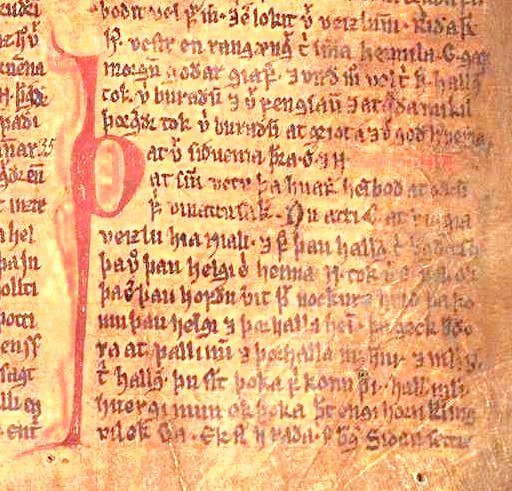
It begins with petty theft and ends with eleven people dead under a burning roof. In between lie fifty years, two dozen killings and a great many lawsuits. Njáls saga is the longest of the sagas of Icelanders, the most widely read and the best preserved – and it is not a heroic epic. It is the story of a society that wants to settle its conflicts through law and money, and fails again and again because one man values an insult more highly than a settlement. Anyone who wants to know how a commonwealth without a king works, and what breaks it, should read this book.
Its full Icelandic name is Brennu-Njáls saga, the saga of Burnt Njáll. The epithet gives away the ending. The text runs to some one hundred and sixty chapters and covers events it places roughly between 960 and 1020. No other work of the genre survives so richly: about sixty manuscripts and fragments, twenty-one of them medieval. In Iceland the Njála is still school reading.
The first third belongs to Gunnarr Hámundarson of Hlíðarendi. The saga describes him as the finest fighting man of his day: he leaps his own height in full armour, hits with the bow whatever he can see, and is good-natured to the point of blindness. Judging people is the one thing he cannot do.
He marries Hallgerðr langbrók. The saga marked her long before: as a child she sits on her uncle Hrútr's knee, and he looks at her and says he does not know where thief's eyes came into the family. Years later Hallgerðr has food stolen for Gunnarr's household. Gunnarr strikes her in the face. One slap, one sentence – and the saga forgets nothing.
Two killings later Gunnarr is sentenced to three years' exile. Njáll had warned him: kill twice within the same family and then break the settlement, and it will cost you your life. Gunnarr rides towards the ship. On the way his horse stumbles, he comes off, and as he gets up he sees the slope of his own farm.
Fǫgr er hlíðin, svá at mér hefir hon aldri jafnfǫgr sýnzk, bleikir akrar ok slegin tún, ok mun ek ríða heim aftr ok fara hvergi.
"Fair is the slope, fairer than it has ever seemed to me, pale cornfields and mown meadows – I shall ride home again and go nowhere."Brennu-Njáls saga, ch. 75; English rendering our own
That makes him an outlaw. His enemies surround the house; he fights from the loft with his bow until someone cuts the string. He asks Hallgerðr for two locks of her long hair to twist a new one. She asks whether anything depends on it. He says his life. She reminds him of the slap and gives him nothing. Gunnarr falls.
Njáll Þorgeirsson lives at Bergþórshvoll, a farm in the Landeyjar of southern Iceland. He is no fighter. He knows the law better than anyone, he foresees things, and he grows no beard – which his enemies turn into a jibe that pursues him and his sons to their deaths. His wife Bergþóra is harder than he is.
A quarrel over a seat at table sets Bergþóra and Hallgerðr against each other, and out of it grows a chain: each has a man of the other household killed, and each new victim stands one rung higher than the last. What is remarkable is what Gunnarr and Njáll do with it. They meet, fix the compensation, pay each other across the table – by turns, depending on whose turn it is – and stay friends. That is not the saga being ironic. That is its model: money works as long as both sides want it to.
Then it tears. Njáll's sons kill Þráinn Sigfússon; Njáll takes in Þráinn's son Höskuldr as foster-son and makes him a chieftain. The man is blameless. That is precisely his problem. Mörðr Valgarðsson, envious and patient, persuades the Njálssons that Höskuldr is plotting against them. They cut him down early one morning in his field, sowing, and he has done nothing. For this killing there is no case to be made. The machinery is broken.
Flosi Þórðarson, uncle of the widow, takes on the prosecution. Hildigunnr receives him, seats him in the high seat and throws her husband's bloody cloak over his shoulders, clotted blood upward. An image that leaves no choice.
At the Althing the case is negotiated anyway. Arbitrators award three times the usual man-price, a very large sum, and it is piled up on the assembly ground. Njáll lays a silk garment on top. Flosi asks who gave it. Nobody answers. He takes it as a slur on his manhood, throws it back, and the settlement collapses over a piece of clothing.
The following autumn – the saga's internal chronology points to 1011 – Flosi rides to Bergþórshvoll with about a hundred men. Inside are some thirty. Njáll advises defending the house from within rather than outside; his son Skarphéðinn contradicts him openly and obeys anyway. It is the wrong decision, and the saga says so itself.
Flosi has fire set. Women, children and servants are let out. Bergþóra refuses: she was given to Njáll young, she says, and promised that one fate would fall on them both. Njáll, Bergþóra and their small grandson Þórðr lie down in the chamber and pull an ox-hide over themselves. Eleven people die. One gets out: Kári Sǫlmundarson, Njáll's son-in-law, runs along a crossbeam with his hair on fire, through the smoke into the open, and puts himself out in a stream.
What follows is the longest lawsuit in Old Norse literature. The case against the burners is argued at the Althing, ground down on a procedural error, and in the end the parties fight on the assembly ground itself.
Kári refuses every settlement and hunts the burners for years, in Iceland, in Orkney, in Wales. Flosi goes to Rome, confesses and is absolved; Kári takes the same road. Right at the end Kári is shipwrecked on the south coast in winter, walks to the nearest farm – it is Svínafell, Flosi's farm – and steps inside. Flosi springs up, goes to meet him and kisses him. Kári marries Hildigunnr, widow of the man whose death started it all. The saga ends not with a victory but with a settlement.
Before that, though, it jumps to Ireland. The last chapters tell of the Battle of Clontarf outside Dublin on Good Friday 1014: King Brjánn, Earl Sigurðr of Orkney with his raven banner, the viking Bróðir. Some of the burners fight there. Scholars assume an older, lost narrative was worked in, usually called Brjáns saga; Einar Ólafur Sveinsson reconstructed it, Donnchadh Ó Corráin has argued for an origin in Dublin around 1100. It does not survive. Chapter 157 also contains the Darraðarljóð, eleven stanzas in which valkyries weave the outcome of the battle on a loom strung with entrails and weighted with men's heads. The poem is probably older than the saga.
Read the Njála only as a feud story and you skip its centre. Chapter after chapter turns on summonses, witnesses, panels of neighbours, jurisdiction, deadlines, objections. The saga quotes procedural formulas as though someone were reading aloud from a law book. Its most famous sentence occurs not in a battle but in a legal argument:
Með lǫgum skal land várt byggja, en með ólǫgum eyða.
"With law shall our land be built up, and with lawlessness laid waste."Brennu-Njáls saga, ch. 70; English rendering our own
The Icelandic Commonwealth had no king, no police, no executive. Judgment was given at the assembly; enforcing it was the business of whoever had won it. That is exactly why the saga circles so stubbornly around arbitration, settlement and compensation. They are not the trimmings around the violence, they are the alternative to it – and every time they fail on an insult that cannot be paid for.
The saga credits Njáll with an achievement history does not give him. It has him establish the Fifth Court, the Commonwealth's highest tribunal. Ari Þorgilsson, writing around 1130 in the Íslendingabók, names the lawspeaker Skapti Þóroddsson, who held the office from 1004 to 1030. The author of the Njála handed his hero a real reform.
The law itself we know from Grágás, the collection of Commonwealth law, preserved above all in Konungsbók (GKS 1157 fol, c. 1260) and Staðarhólsbók (AM 334 fol, c. 1280). Saga and Grágás agree on much and differ in the details – the text was written when the Commonwealth was already history. More on chieftains, Althing and settlement in our piece on the Icelanders.
The author is unknown, as with all sagas of Icelanders. Scholarship dates the writing to between 1270 and 1290. Over the centuries Sæmundr fróði, Snorri Sturluson, Brandr Jónsson and Þorvarðr Þórarinsson have all been proposed; none of these names can be proved. Whoever wrote it knew the law from practice and other sagas from reading – borrowings from Laxdæla saga, Eyrbyggja saga and Ljósvetninga saga are demonstrable.
The main medieval vellums: Gráskinna (GKS 2870 4to, c. 1300), Þormóðsbók (AM 162 b fol, c. 1300), Reykjabók (AM 468 4to, c. 1300–1325), Möðruvallabók (AM 132 fol, c. 1330–1370) and Kálfalækjarbók (AM 133 fol, c. 1350). Not one of them survives complete. Möðruvallabók also contains Egils saga and Laxdæla saga, which makes it the largest medieval collection of sagas of Icelanders we have.
The manuscripts are similar but not identical. Some carry stanzas others lack; wording and chapter divisions vary. Einar Ólafur Sveinsson sorted the material in 1953, and his 1954 edition in the Íslenzk fornrit series is still the standard. Anyone reading "the" Njála is always reading an editor's decision.
The farm exists. Bergþórshvoll lies on a low rise in the Landeyjar and is still worked today. It has been excavated three times.
At the end of the nineteenth century Sigurður Vigfússon cut shallow trenches there for the Icelandic Archaeological Society. He found charred wood and a whitish mass he took for skyr – the saga says there was whey in the house and that they tried to douse the fire with it. A lesson in how you find what you are looking for.
Matthías Þórðarson dug on a large scale in 1927, 1928 and 1931. Around eight hundred finds came to light and some fifty structures ranging from the Viking Age to the nineteenth century. A burnt layer that could be tied to the burning was not among them.
In the early 1950s Kristján Eldjárn and Gísli Gestsson worked at the site. They uncovered the burnt remains of a large building, which they interpreted as a byre and placed in the Viking Age, and they summarised the earlier work.
What does that tell us? That a farm stood on this mound from the settlement period onward, rebuilt many times over, and that buildings there burned down. Fire in houses of turf, timber and sod was not an exception, it was an occupational hazard. No find can be pinned to one particular night around 1011, and none gives a name. Archaeology confirms the stage, not the play.
Contemporary evidence for the plot is essentially nil. No eleventh-century source describes the burning or Gunnarr's death. The Battle of Clontarf in 1014 is well attested – but by Irish annals, not by the Icelandic version of it.
Archaeological evidence covers settlement and building phases at Bergþórshvoll since the Viking Age, traces of fire without a matching date, and Þingvellir as the assembly site.
Later tradition is the saga itself: written some two hundred and seventy years after the events, out of oral tradition, older texts and the head of a very good author. Landnámabók knows some of the people and differs from the saga in the genealogies – which shows the names are not invented, and that the text handles them freely.
Modern interpretation covers every proposed author, the dating to within a decade, the question whether the saga preaches fate or Christianity, and the now common reading that it is a critique of an honour code which forces men to get themselves killed over a remark.
What we like about this text is that it needs no heroes to be great. Its best man is a beardless lawyer who dies in the end because he guessed wrong once. For courage. For memory. For legends that live on.
The Battle of Clontarf 1014 · The Thing · The Icelanders · The Icelandic Sagas · Snorri Sturluson · Egill Skallagrímsson.

