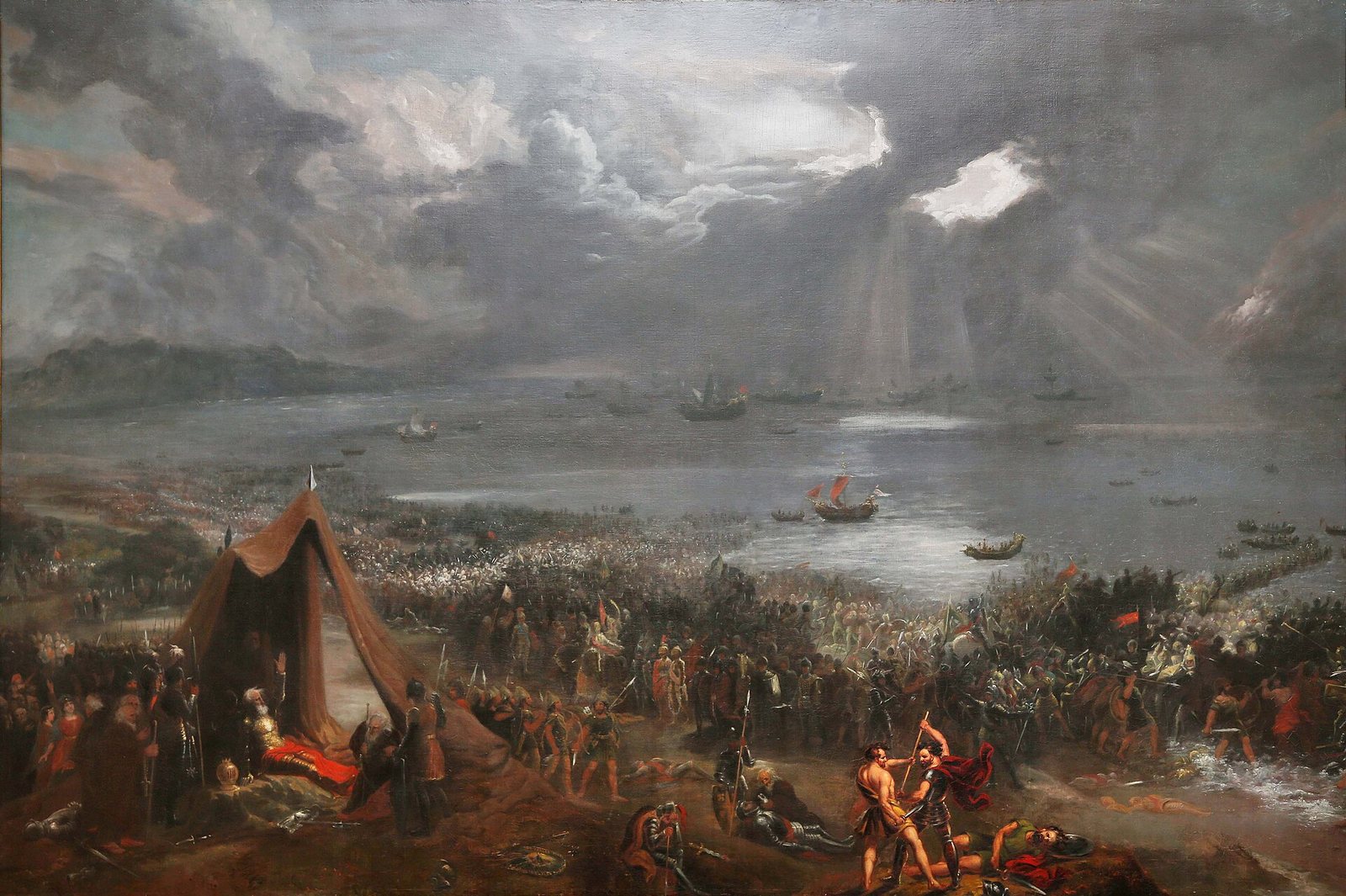
 On Good Friday, 23 April 1014, two armies clashed before the gates of Dublin. The aged High King Brian Boru won – and died in the same moment. Clontarf is remembered as the end of great Viking rule in Ireland. Yet the famous "Irish versus Vikings" story does not survive sober scrutiny.
The 23rd of April 1014 fell on a Good Friday – and that fact gave the battle its legendary ring. At Clontarf, north of the Viking town of Dublin, two great alliances faced each other that day. On one side stood Brian Boru, High King of Ireland, already in his seventies. On the other a coalition of the Kingdom of Leinster, the Norsemen of Dublin, and warriors from the islands across the sea.
The battle lasted, tradition holds, from sunrise to sunset and ended in blood. Between 7,000 and 10,000 men are said to have fallen – the sources' figures must be taken with caution, but they hint at the day's ferocity. Brian's army carried the victory. Yet the price was immense.
Brian mac Cennétig, called Boru, was no born High King but a self-made man. From the kingship of Munster in southern Ireland he worked his way over decades to become the most powerful figure on the island, until contemporaries even called him imperator Scotorum, "emperor of the Irish." He was the first man in a long time to claim something like an all-Ireland supremacy.
This very supremacy was the cause of Clontarf. It was no struggle for Ireland's survival but a power struggle: Leinster and Norse Dublin rebelled against Brian's overlordship. At the start, as so often, stood a shattered web of alliances.
Brian had tried to secure his power through marriages. He gave his daughter to the Dublin Viking king Sigtrygg Silkbeard and himself married Sigtrygg's mother Gormlaith, who was at the same time the sister of the Leinster king Máel Mórda. A dense web of in-law bonds, then – and a brittle one.
When the alliance broke, kinsmen suddenly faced one another. Sigtrygg recruited reinforcements from across the sea: Sigurd, Jarl of Orkney, and Brodir of Man with their warriors. And so it came to pass that on this Good Friday Irishmen and Norsemen stood on both sides of the field.
Gormlaith herself plays a key role in the tales. She had been Brian's wife, but the marriage broke, and saga tradition turns her into a driving force behind the alliance against him – a clever, proud and vengeful queen who spurs her son and brother against her former husband. How much of this is history and how much a literary pattern is hard to separate: the powerful, trouble-stirring woman is a favourite figure of the Icelandic storytellers. All that is certain is that the ties of kinship meant to make peace ended up running along the battle lines.
Irish annals and the later Icelandic Njáls saga report the course of events in their own colours. What they share is the image of a day-long, bitter struggle. Sigurd of Orkney fell, saga tradition says, beneath his own raven banner – that ominous standard said to bring death to whoever carried it. Brodir of Man and the Leinster king Máel Mórda also perished.
In the end the Leinster-Dublin alliance collapsed. Many of the fleeing drowned, the accounts say, in the incoming tide when they could no longer reach their ships. Brian's army had won.
This detail of the tides is telling. Clontarf lay on the shore before Dublin, and the sea was part of the battlefield. The Norsemen had landed with their ships; the beaten had to make it back to the water. As the tide rose, the retreat became a trap. Whether the ebb and flood of that day really unfolded as the sources paint it can no longer be proven – but the image fits a battle in which ships, coast and sea helped decide victory and ruin.
The most famous scene, though, plays out away from the melee. Brian, too old to fight, is said to have prayed in his tent while the battle raged. There the fleeing Brodir found him and slew the aged king. With Brian fell his son Murchad and his grandson Toirdelbach.
That the victorious king should die praying on Good Friday of all days electrified the chroniclers. Brian was swiftly turned into a martyr who had – Christ-like – sacrificed himself for Ireland. Good Friday transformed a political power struggle into a story of salvation. Historically Brian's death was simply the day's greatest disaster: the victory also destroyed the dynasty that had won it.
The Icelandic Njáls saga painted Clontarf most vividly. It contains the grim Darraðarljóð, the "Song of the Spear": a man sees in a vision twelve valkyries weaving the fate of the battle at a ghastly loom – with men's entrails as warp, swords as beaters, heads as weights. It is one of the darkest images in all Old Norse poetry.
Wide is the warp / of the coming slaughter, / the cloud of the loom / drips down with blood; / grey is the web / that the spears weave, / and the valkyries cross it / with crimson weft.Darraðarljóð, from Njáls saga, after the translation by G. W. Dasent (1861), public domain
Beautiful as this image is, one must know what it is: great poetry of the 13th century, written down some two hundred years after the battle and hundreds of kilometres away in Iceland. Priceless as atmosphere, worthless as a factual report.
For centuries Clontarf was glorified as the day the Irish finally threw the Vikings back into the sea and freed Ireland. That story is catchy – and false. It was no national war of "Irish against foreigners." On both sides fought Irishmen and Norsemen. Brian's opponent Máel Mórda was Irish; his ally came from Orkney. It was about supremacy within Ireland, not Irish against Vikings.
The main source for the heroic picture, the Cogadh Gáedhel re Gallaibh ("The War of the Irish against the Foreigners"), is moreover propaganda: it was composed later in the circle of Brian's descendants to underpin their claim to kingship. It celebrates Brian as a national liberator – that is partisanship, not chronicle.
And Norse Dublin? It was not wiped out. Sigtrygg Silkbeard even survived the battle – he had watched it from the city – and remained king for a long time. Dublin lived on as a wealthy, Scandinavian-flavoured trading town and went on minting its own coins. The Viking culture of Ireland did not vanish in 1014; over generations it merged with the Irish.
What Clontarf actually ended was less "Viking rule" than Brian's dream of a united Ireland under a strong dynasty. With the High King and his heir fell the order he had built. Ireland fragmented once more into its rival kingdoms. The great victory was at the same time the end of the man who had won it – a point as bitter as the darkest verse of saga.
But why does the myth cling so stubbornly? Because it was needed. For later generations Clontarf was a founding moment, an image of national unity against a foreign enemy – precisely in times when Ireland really did lie under foreign rule. The historical Brian, an Irish power politician in a tangle of Irish-Norse alliances, served that purpose less well than the martyr who dies for his people on the day of the Cross. It is worth knowing both: the beautiful legend and the sober finding. For the Viking Age was almost never as simple as the later storytellers wanted it to be – and that is exactly what makes it so interesting.
The Battle of Clontarf took place on Good Friday, 23 April 1014, north of Dublin. It is established that an army under High King Brian Boru defeated an alliance of the Kingdom of Leinster (under Máel Mórda), Norse Dublin (under Sigtrygg Silkbeard) and outside warriors from Orkney (Jarl Sigurd) and Man (Brodir). Brian's side won, but Brian himself fell, as did his son Murchad and grandson Toirdelbach; on the opposing side Máel Mórda, Sigurd and Brodir were killed. It is reported in Irish annals and – at length and literarily elaborated – in the Icelandic Njáls saga (13th c.) with the embedded Darraðarljóð.
Clontarf was NOT an "Irish versus Vikings" national war that freed Ireland from foreign invaders. Irishmen and Norsemen fought on both sides; at its core it was about Brian Boru's supremacy, against which Leinster and Dublin rebelled. The famous heroic source Cogadh Gáedhel re Gallaibh is later propaganda by Brian's descendants, not a neutral account. And Ireland's Viking Age did not end in 1014: Dublin lived on as a Scandinavian-flavoured trading and minting town, and its king Sigtrygg survived the battle. What really ended was Brian's united kingship – the victory destroyed the very dynasty that had won it.
The Great Heathen Army · Stamford Bridge 1066 · Ragnar's sons · Alfred the Great · The shield wall.
All History & Finds articles →
Sometimes a war is won not with the sword but with the purse. In 991 the English ealdorman Byrhtnoth faced a Viking …
Read more →