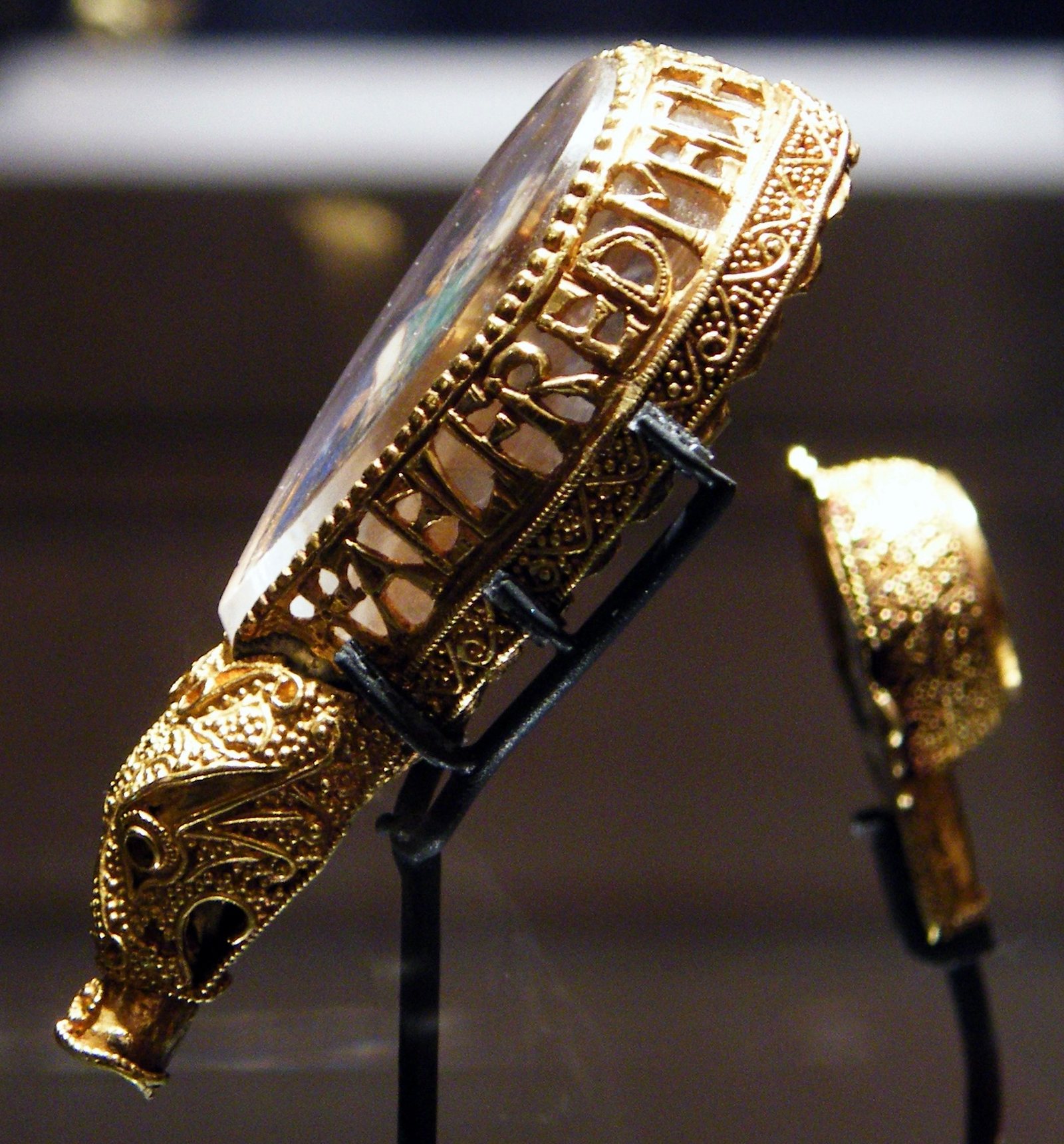
 In the winter of 878, Anglo-Saxon England was a stone's throw from collapse. That it survived is owed to a king who withdrew into a marsh hideout – and struck back a few months later. Alfred of Wessex is the only English ruler posterity called „the Great“. Let us look at what is documented – and what is legend.
If the Viking Age in England has a name, it has two: the „Great Heathen Army“ and the man who stopped it. Alfred of Wessex (871–899) is the only king in English history with the epithet „the Great“ – and unlike many figures of saga, we have contemporary sources for him. Yet the image of the wise father of the nation has been painted over heavily across the centuries. Let us separate the documented from the invented.
Alfred was born around 849, the youngest son of King Æthelwulf of Wessex. That he became king at all was a product of the crisis: one brother after another died while Scandinavian armies had already overrun Northumbria, East Anglia and Mercia. When Alfred took the throne in 871, Wessex was the last of the great Anglo-Saxon kingdoms still standing. Already as a king's son he had fought at the side of his brother Æthelred; the Anglo-Saxon Chronicle records a whole chain of engagements for the year 871 – among them the West Saxon victory at Ashdown and heavy reverses at Reading and Wilton. It was a year of war the Chronicle works through almost back to back. It ended not in a lasting victory but in a peace Alfred bought with silver. For a young king whose realm stood on the brink, buying time was already a success – and that became his strategy: endure, regroup, and wait for the right moment.
The „Great Heathen Army“ (Old English micel hæðen here) was not a raiding party but a force that operated for years, landing in East Anglia in 865 and eating its way through England ever after. It was not a people on the move but a mobile military enterprise with changing leaders and aims. York fell in 866, King Edmund of East Anglia was killed in 869, the kingdom of Mercia broke apart in 874. Wessex was caught in the middle. The winter campaign of 878 was the most dangerous moment: instead of retiring to winter quarters as usual, part of the army under Guthrum struck in the depth of the cold season.
This year about mid-winter, after twelfth-night, the Danish army stole out to Chippenham, and rode over the land of the West-Saxons, where they settled, and drove many of the people over sea; and of the rest the greatest part they subdued, except the king Alfred, who with a little band made his way with difficulty through the woods and fen-fastnesses.Anglo-Saxon Chronicle, entry for 878 (public-domain translation)
The surprise attack on Chippenham after Twelfth Night struck Wessex to the core. Alfred lost control of his heartland and had to flee. He withdrew into the marshes of Somerset, to the barely accessible island of Athelney amid bogs, watercourses and reeds. From there he waged a hit-and-run war and had a fortified base built. What sounds like hopeless misery was in fact a shrewd retreat: the marshes protected him, gave him time and a rallying point. Into these weeks falls the most famous Alfred myth of all – but more on that below.
In the spring of 878 Alfred achieved what almost nobody still believed possible: seven weeks after Easter he rode out of the marshes, gathered the levies of Somerset, Wiltshire and Hampshire at an agreed meeting place (at „Egbert's Stone“, according to the Chronicle) and confronted Guthrum's army at Edington in Wiltshire. That the farmers and warriors turned out in such numbers at all was already a victory in itself – it showed that Alfred still counted as king despite everything, and that men would follow him. The Anglo-Saxons won the battle, pursued the fleeing men to their stronghold and shut them in. After a two-week siege, without supplies or hope of relief, Guthrum surrendered. Edington was not a battle of annihilation, but it was a turning point: for the first time in years an Anglo-Saxon king dictated the terms to the Danes, not the other way round.
The peace Alfred negotiated was unusual. Guthrum had to be baptised – Alfred stood beside him as godfather and gave him the Christian name Æthelstan. Anyone who takes this baptism for a mere formality underestimates its political weight: it bound the former enemy into a shared religious and legal order and turned a heathen warlord into a Christian neighbouring king with whom one could make treaties. Guthrum withdrew with his army to East Anglia, where many of the warriors settled as farmers. Raiders became settlers. The often-cited „Treaty of Wedmore“, incidentally, is a later umbrella term – what survives is a separate, somewhat later treaty text between Alfred and Guthrum that fixes a boundary.
The treaty between Alfred and Guthrum drew a line across England – roughly from London north-westwards along the old Roman road of Watling Street. North and east of it lay the region in which Scandinavian law and Scandinavian settlement held sway; later scholarship calls it the „Danelaw“. Importantly, the Danelaw was not a state and not a fixed national border, but a legal and settlement zone whose extent shifted over the decades. To this day you can trace it in place-names ending in -by and -thorpe and in hundreds of Scandinavian loanwords in English – everyday words like they, egg and knife go back to Old Norse. Language and map both still carry the marks of this boundary. Alfred had not reconquered the north – but he had secured the core of Wessex and set a limit to the advance.
Alfred drew a lesson from the near-catastrophe: a land without strongpoints is defenceless. He had a network of fortified places laid out, the burhs (Old English for „fortress“, later „borough“). An administrative list, the „Burghal Hidage“, records how many men each burh had to provide according to the length of its rampart – a considered system in which the garrison was calculated from the surrounding land and no place lay more than a day's march from the next fortress. A Viking army could no longer ride unpunished through open country: it met resistance everywhere and risked being trapped itself. Many of these burhs became towns that still exist today: Winchester, Oxford, Wallingford. Alfred also reorganised the levy so that only half the fighters were ever in the field while the other half held farms and fortresses – a standing defence rather than a one-off mass muster that dispersed after the harvest. And he began to have larger ships of his own built, to intercept the attackers at sea. Not the single battle at Edington but this lasting, unspectacular reform made Wessex impregnable – and later helped his son Edward and his daughter Æthelflæd win back the Danelaw piece by piece.
Alfred was convinced that the Viking raids were also a punishment for the decay of learning – too many churches and monasteries had been plundered, too few people could still read Latin. So he launched an education programme remarkable for a warrior-king: he brought scholars to his court, among them the Welshman Asser, and had works he thought „most necessary to know“ rendered into Old English – among them Gregory the Great's Pastoral Care, Boethius' Consolation of Philosophy and the world history of Orosius. By tradition he took a hand himself. He also had a law code (the domboc) compiled that gathered older Anglo-Saxon legal collections. His Welsh biographer Asser recorded his life in the Vita Ælfredi – one of the most important and, at the same time, most debated sources of the age, since its transmission raises questions of its own. The epithet „the Great“, by the way, is not contemporary; it only took hold centuries later, when Alfred was stylised into the founding figure of an English nation – in the 19th century he was built up into an outright national hero. Historically he was neither a demigod nor a saint, but the king who saved Wessex and laid the foundation on which his successors built a united England.
For Alfred there are near-contemporary sources: the Anglo-Saxon Chronicle (whose compilation itself falls within his reign) and the Vita Ælfredi of the monk Asser. Documented are the winter attack on Chippenham in 878, the retreat to Athelney, the victory at Edington, Guthrum's baptism with Alfred as godfather, the treaty with its boundary line, the burh system and the translation programme. The Anglo-Saxon Chronicle, however, is a West Saxon source with a clear perspective – it tells Alfred's war from Alfred's side.
The famous anecdote that Alfred, unrecognised at Athelney, took service with a peasant woman and absent-mindedly let her loaves (often „cakes“) burn is not in the Anglo-Saxon Chronicle and not in Asser – it appears only about a century later in appendices and is an edifying legend. And one more point: „England“ did not yet exist in Alfred's day. He was king of Wessex and is called „king of the Anglo-Saxons“ in his own time – not „king of England“. A united England was created only by his successors in the 10th century.
The Great Heathen Army · Ragnar's sons · Stamford Bridge 1066 · The Lindisfarne Raid of 793 · Danegeld & the Battle of Maldon.
Anglo-Saxon Chronicle (incl. entries for 871, 878); Asser, Vita Ælfredi regis Angul Saxonum; Treaty of Alfred and Guthrum; „Burghal Hidage“. Secondary literature: R. Abels, Alfred the Great; S. Keynes/M. Lapidge, Alfred the Great: Asser's Life; The British Library; The Royal Household (royal.uk). Quotation: public-domain translation of the Anglo-Saxon Chronicle.