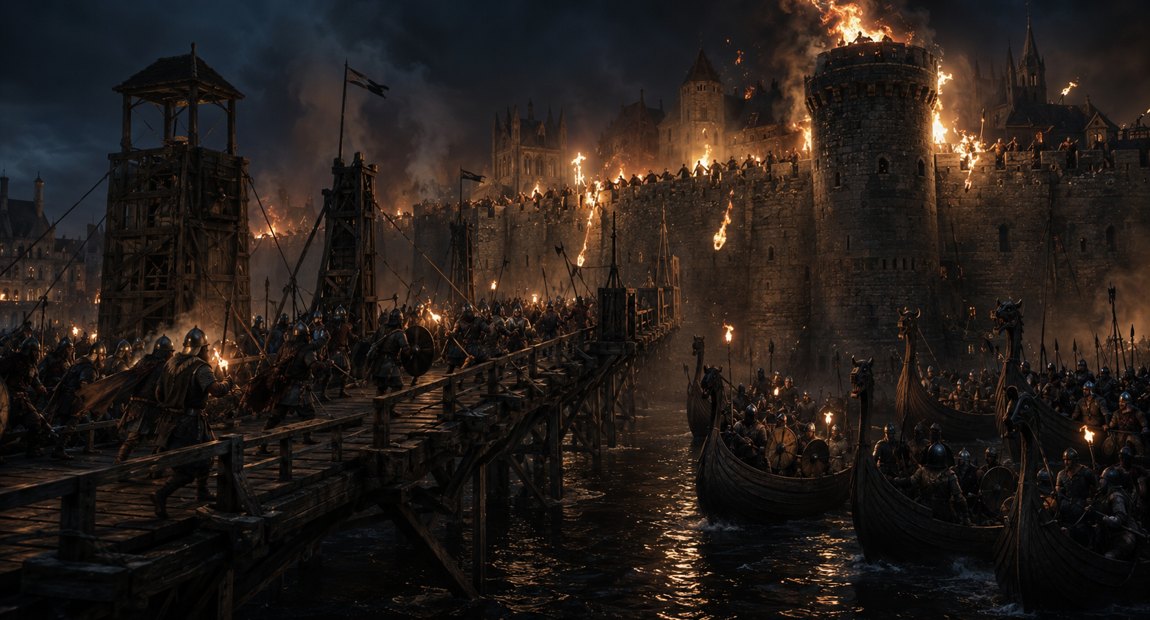
The sons of Ragnar Lothbrok – Ivar the Boneless, Ubba, Halfdan, Björn Ironside, Sigurd Snake-in-the-Eye and Hvitserk – are partly real ninth-century warlords: Ivar, Halfdan and a third brother led the Great Heathen Army across England from 865, and contemporary chronicles say so. That they were all brothers, and that Ragnar Lothbrok was their father, appears only in texts written two to four centuries later. Here we separate chronicle from saga and grave from legend, one brother at a time.
The saga has Ragnar Lothbrok die in a pit full of snakes, thrown there by King Ælla of Northumbria. As the vipers strike, he speaks the line that sets his sons in motion. In our own rendering from Ragnars saga loðbrókar:
“The piglets would grunt now if they knew what the old boar suffers.”Ragnars saga loðbrókar (our own translation)
The old boar is Ragnar, the piglets are his sons – and they come. It is superb storytelling, but it is storytelling from the thirteenth century. Set beside it a dry entry in the Anglo-Saxon Chronicle for 865/866: a “micel here”, a great army, came into the land of the English and took winter quarters in East Anglia. No revenge, no Ragnar. Between those two texts lies the whole story of Ragnar Lothbrok and his sons – several of whom are far easier to pin down in history than their supposed father.
Anyone writing about Ragnar’s sons has to sort the evidence first, into three layers of very different weight.
Layer one: contemporary sources. The Anglo-Saxon Chronicle was compiled around 890 at the court of Alfred the Great, only a few years after the events of 865–878. Asser, a Welsh cleric, wrote his Life of Alfred in 893 and largely followed the Chronicle for these years. In Ireland, monks kept the Annals of Ulster year by year, and they know a Viking king called Ímar. On the Continent, the Annals of St-Bertin and the Annals of Fulda recorded the Viking leaders the Carolingians fought or bargained with.
Layer two: the tenth to twelfth centuries. Abbo of Fleury wrote his Passio Sancti Eadmundi about the slain King Edmund around 985. William of Jumièges composed his history of the Norman dukes around 1070, Adam of Bremen his history of the archbishops of Hamburg around 1075. The so-called Annals of St Neots were put together at Bury St Edmunds in the early twelfth century. This is where the name Lothbrok first gets attached to the brothers.
Layer three: Saxo and the sagas. Saxo Grammaticus wrote his Gesta Danorum around 1200 (see our piece on Saxo Grammaticus). The Icelandic Ragnars saga loðbrókar dates from the thirteenth century, the short Ragnarssona þáttr (“Tale of Ragnar’s Sons”) from around 1300. These texts give us the vivid nicknames, the mother Áslaug, the snake pit and the revenge – but they are 350 to 450 years younger than the army they describe.
The surprising answer: for two of them there is genuine contemporary evidence of brotherhood. Under 878 the Anglo-Saxon Chronicle reports that a force was defeated in Devon, led by the brother of Inwær and Healfdene – the brother of Ivar and Halfdan. Asser repeats it. So according to the oldest English source, Ivar and Halfdan were brothers, and there was at least a third, whom the Chronicle leaves unnamed.
There is no father anywhere in it. The link to Lothbrok only appears in the eleventh century: William of Jumièges calls Björn “Bier Costae ferreae” a son of Lothbrok, and Adam of Bremen calls Inguar “filius Lodparchi” and the cruellest of the Northmen. The Annals of St Neots then tell how three sisters of Hinguar and Hubba, daughters of Lodebroch, wove the army’s raven banner in a single day. From here on the family grows with every new text.
Ragnar himself remains elusive. A Viking called Reginheri who attacked Paris in 845 is recorded in Frankish annals, but whether he is the Ragnar of the sagas is an open question. Rory McTurk showed how the Ragnar figure grew together from several strands of tradition. It is therefore more likely that real leaders were later assigned to a famous legendary father than the other way round.
There is even a hard contradiction. The Irish Fragmentary Annals make Ímar of Dublin – whom many identify with Ivar – the brother of Amlaíb (Olaf the White) and the son of a certain Gofraid. If Ivar and Ímar are one man, he had a very different father from Ragnar. The mother Áslaug is a literary construction too: she is made the daughter of the dragon-slayer Sigurd and the valkyrie Brynhild, which plugs Ragnar’s house into the Völsung legend. More on her in our article on Aslaug.
Ivar is the brother with the most names: Inwær or Ingwær in the Chronicle, Inwar in Asser, Inguar in Abbo, Ímar in Ireland, Ívarr inn beinlausi in the sagas. The same name – but the same man?
What is secure: Ivar was among the leaders of the army that landed in 865. In Abbo’s Passio he is the one who has King Edmund of East Anglia killed in 869, together with Hubba (Ubba). A late twelfth-century manuscript of the Chronicle likewise adds, under 870, that the leaders who slew the king were Ingware and Ubba. After 870 Ivar vanishes from English sources. The chronicler Æthelweard, a kinsman of Alfred’s, has him die in 870.
Then there is Ireland. The Annals of Ulster know Ímar from 857 as a Viking leader alongside Amlaíb. Between 864 and 870 they fall silent about him – exactly the years in which Ivar was campaigning in England. In 870 Amlaíb and Ímar besieged Dumbarton Rock, the fortress of the Strathclyde Britons, for four months, and in 871 they returned to Dublin with 200 ships and a great haul of captives – Angles, Britons and Picts. Under 873 the annals record his death and grant him a title no other Viking receives there: “rex Nordmannorum totius Hiberniae et Britanniae”, king of the Northmen of all Ireland and Britain.
And the nickname? “Inn beinlausi”, the Boneless, first appears in the Icelandic sources. Ragnars saga blames a curse: Ragnar ignored Áslaug’s plea to wait three nights, so Ivar was born with gristle instead of bone; he is carried on shields and fights with a bow. Modern explanations range from a hereditary disorder such as brittle bone disease, to impotence, to a scribe misreading Latin “exosus” (hated). None of these is proven.
Ubba (Ubbe, Hubba) is the brother whose name turns up latest. The original entries of the Anglo-Saxon Chronicle never mention him. The earliest source to name him is Abbo’s Passio of around 985 – more than a century after Edmund died. Northern English texts from the cult of St Cuthbert, such as the Historia de sancto Cuthberto, call him a “dux” of the Frisians. That is an intriguing lead: several ninth-century Viking leaders held benefices in Frisia from the Carolingians. Whether Ubba was a Scandinavian with a Frisian base or a Frisian himself remains open.
Ubba is famous above all for his supposed death. Under 878 the Chronicle says that the brother of Ivar and Halfdan landed in Devon with 23 ships and fell there with 840 men; some manuscripts add that the banner they called “Hræfn”, the Raven, was captured. Asser places the fight at the fortress of Cynuit, probably Countisbury on the north Devon coast. Neither source names the leader. Only in the twelfth century does Geffrei Gaimar, in his Estoire des Engleis, identify him as Ubba, buried under a mound called Ubbelawe. That may be genuine memory – or a deduction from the Edmund legend. Tellingly, the Scandinavian Ragnar sagas have no son who clearly corresponds to Ubba; Saxo lists an Ubbe but never sends him to England.
Halfdan (Old Norse Hálfdan, Old English Healfdene) is the best attested of them all. The Chronicle names him in 871, together with Bagsecg, as one of the “heathen kings” in the battles against Wessex, where the young Alfred the Great also fought. In the winter of 871/872 the army lay at London, and silver pennies bearing Halfdan’s name were struck there.
In 874 the army split. Halfdan took one part north to the Tyne, wintered there and in 875 ravaged the lands of the Picts and the Strathclyde Britons. The entry for 876 is one of the key sentences in the history of Vikings in England. In our own rendering: Halfdan shared out the land of the Northumbrians, “and they were ploughing and providing for themselves”. The army became farmers. This is where Scandinavian settlement begins, the root of the later kingdom of York and the Danelaw – see our article on the Norse of Jórvík.
Halfdan’s end lies in Ireland. The Annals of Ulster report under 875 that an “Albann” treacherously killed Oistín, son of Amlaíb, and under 877 a battle at Strangford Lough in which Albann fell fighting other Norsemen. Most scholars identify Albann with Halfdan. If Ivar is also Ímar, this is a family feud in its purest form: Halfdan kills Ivar’s nephew while fighting for Ivar’s inheritance in Dublin.
One more trail leads to the Continent. The Annals of Fulda record under 873 two Danish brothers, Sigifrid and Halbdeni, sending envoys to Louis the German to make peace on the border. Some scholars see Sigurd Snake-in-the-Eye and Halfdan here. Whether this Halbdeni is the same man who was fighting in England at the time is doubtful, though – Halfdan was a common name.
“Great Heathen Army” is our modern label for the force the Chronicle simply calls a “micel here”. What was new was not the violence but the intent: this army stayed. It took horses from East Anglia and moved into a new winter camp each year – York in 866, Nottingham in 867, East Anglia in 869, Reading in 870/871, London in 871/872, Repton in 873/874, then the split. One part under Guthrum fought Alfred until 878 and was beaten at Edington. We follow every stage in The Great Heathen Army.
In November 866 the army took York. Northumbria was paralysed by a dispute over the throne: Osberht had been driven out and Ælla had taken power. Facing a common enemy, the rivals joined forces and attacked York in spring 867 – on 21 March, according to later northern English tradition. The Chronicle reports that the attackers broke into the city, that both kings were killed and that great slaughter was made of the Northumbrians.
The sagas turn this into revenge for Ragnar. Around 1038 the skald Sighvatr Þórðarson composed a verse in his Knútsdrápa that, in our own rendering, runs roughly: Ivar, who sat in York, had Ælla’s back cut with the eagle. From this, Ragnars saga and other late texts developed the “blood eagle”, a gruesome execution in which the victim’s ribs were supposedly opened from the back.
In the winter of 869/870 the army returned to East Anglia and camped at Thetford. King Edmund fought the Danes, the Danes won and killed the king – that is all the Chronicle says. Abbo of Fleury tells the story at length around 985: Edmund refused to submit to a heathen overlord, was tied to a tree, shot with arrows and beheaded. Abbo claims the account came from Archbishop Dunstan, who had heard it from an aged armour-bearer of Edmund’s.
Abbo’s text is a martyr’s legend with a clear purpose, not a battle report. That Edmund fell is certain; the arrows and the tree deliberately evoke St Sebastian. Still, the Passio matters for our story: it is the oldest source naming Ivar and Ubba together as the killers. Around Edmund’s tomb grew the abbey of Bury St Edmunds – and that is precisely where the annals were later written that first made Ivar and Ubba sons of Lothbrok.
In autumn 873 the army moved to Repton on the Trent, a Mercian royal centre with a monastery and royal burials. The Chronicle says it wintered there and drove King Burgred of Mercia overseas; Burgred went to Rome and died there. The Vikings installed Ceolwulf as a client king.
From 1974 to 1988 Martin Biddle and Birthe Kjølbye-Biddle excavated at Repton. They found a D-shaped ditch that turned the church of St Wystan into part of a fortification, and a series of burials with Scandinavian features. The most famous is Grave 511: a man buried beside the church with a sword, a Thor’s hammer pendant, other grave goods and a boar’s tusk between his thighs. He died violently – two spear wounds above one eye and a deep cut to the left thigh that may have severed his genitals. The tusk is often read as a replacement for what he had lost, for the afterlife; that is an interpretation, not a finding. Beside him lay a younger man, Grave 295, and ancient DNA shows the two were closely related on the father’s side – father and son, or half-brothers.
A few metres away, in the vicarage garden, a mound covered a charnel deposit holding the bones of at least 264 people, roughly four-fifths men and one-fifth women, along with silver pennies of 872 to 874. As early as 1686 a labourer named Thomas Walker had opened a mound there; a later account tells of a large skeleton in a stone coffin with the other bones laid around it.
Björn Járnsíða belongs not to the English army but to the world of the Frankish kingdom. The Annals of St-Bertin know a Viking leader “Berno” between 855 and 858 who operated on the Seine, fortified himself on the island of Oissel near Rouen and in 858 swore an oath of loyalty to Charles the Bald at Verberie. After that he disappears from contemporary texts.
The Mediterranean expedition of 859 to 861/862 with Hasting (Hástein) is attested in Frankish and Arabic sources, but Björn’s role in it only from William of Jumièges around 1070 – together with the legend that the raiders mistook Luni for Rome and took it through Hasting’s faked deathbed baptism. Saxo then makes Björn king of the Swedes. More in Björn Ironside – the son who sailed south and The Vikings in the Mediterranean.
Sigurðr ormr í auga, Sigurd Snake-in-the-Eye, is above all a figure of genealogy. In Ragnars saga, Áslaug announces before his birth that the boy will bear a sign: a snake in his eye, proof that she truly is the daughter of the dragon-slayer Sigurd. A literary certificate of authenticity, not the memory of a real face.
Later family trees make Sigurd the father of Hörða-Knútr (Harthacnut) and so, through Gorm the Old, the great-grandfather of Harald Bluetooth; Norwegian genealogies also trace Harald Fairhair back to him on his mother’s side. Adam of Bremen, however, names Gorm’s father as Hardegon, son of a certain Sven – so the line through Sigurd is far from secure. A historical Sigurd surfaces only perhaps: as the Sigifrid who appears with his brother Halbdeni in the Annals of Fulda in 873, and possibly as the Danish king Sigfrid killed in the Frankish realm in 887. Both are hypotheses.
Hvítserkr, “White Shirt”, is the brother with no trace in contemporary sources. Ragnars saga counts him among Áslaug’s sons, and the Ragnarssona þáttr gives him a grim end: raiding in the east, in Garðaríki, the land of the Rus, he is overwhelmed by a larger force and allowed to choose how he dies. He has himself burned on a pyre of human skulls. Saxo, too, knows of a fiery death for Hvitserk in the east.
Because Hvitserk never appears in a source alongside Halfdan, and Halfdan never alongside Hvitserk, some scholars have suggested that “White Shirt” was simply Halfdan’s nickname. Elegant, but unprovable. Hvitserk is the figure we know least about – and for that very reason the one modern storytellers shape most freely.
Most people today know Ragnar’s sons from the TV series “Vikings” (2013–2020). There Björn, Ivar, Ubbe, Hvitserk and Sigurd are brothers and half-brothers in a single household, living at the same time, quarrelling with each other and sailing to England together.
It makes good television, but it has little to do with the Chronicle: Halfdan, historically the most important brother, does not appear as a son of Ragnar at all, and the timeline is heavily compressed. We look at what is real and what is invented in our fact check of the series “Vikings”.
The result is almost a paradox. Ragnar, the famous father, can hardly be grasped as a historical person. His sons, by contrast, left traces in the Anglo-Saxon Chronicle, the Annals of Ulster, on coins, in graves and on the map of northern England. According to the oldest English source, Ivar and Halfdan were brothers; whether Ubba was their brother, whether Björn and Sigurd belonged to the same family, whether Hvitserk existed at all – we do not know. The shared father was given to them by a later age that turned a chain of campaigns into a family saga.
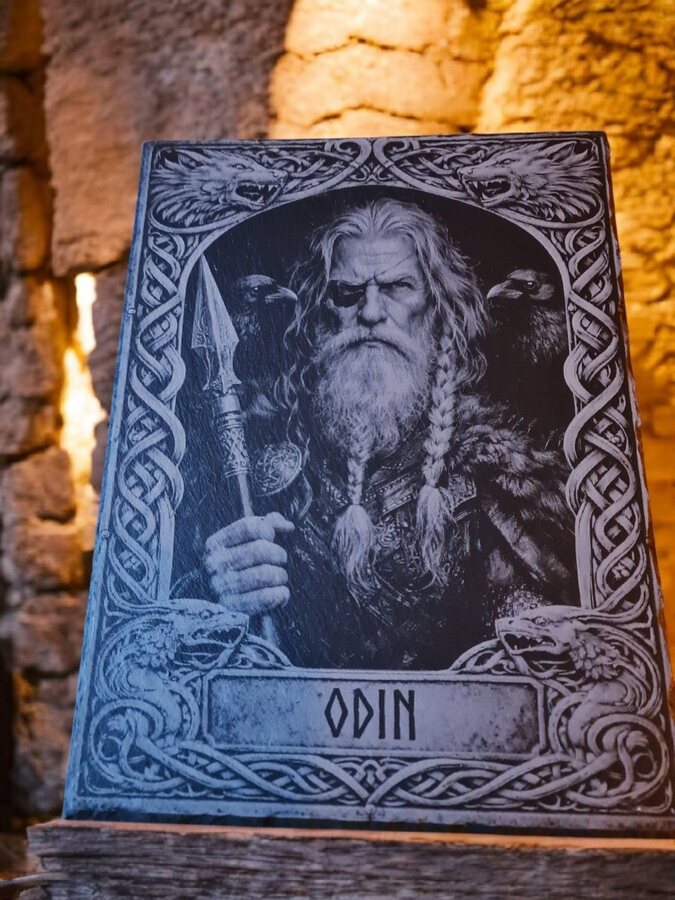
Sagas do not simply lie; they remember – in their own way, for their own audience. When you have a name like Ivar or Björn engraved on slate or wood today, you carry both forward: the chronicle and the legend. To see how Ivar’s presumed descendants built their power, read The Vikings in Ireland, Scotland and the Isles.
For courage. For remembrance. For legends that live on.
What were the names of Ragnar Lothbrok’s sons? The sagas mainly name Ivar the Boneless, Björn Ironside, Sigurd Snake-in-the-Eye and Hvitserk, plus Rögnvald, and Saxo adds further names. English tradition adds Ubba, while Halfdan comes from the Anglo-Saxon Chronicle.
Were Ragnar’s sons really brothers? For Ivar and Halfdan, yes: under 878 the Anglo-Saxon Chronicle mentions “the brother of Ivar and Halfdan”. For the others there is no contemporary evidence.
Was Ivar the Boneless a real person? An Ivar is attested by contemporary sources as a leader of the Great Army. Many historians identify him with Ímar of Dublin, who died in 873; the view is widespread but not undisputed.
Is Ivar the Boneless buried at Repton? That is the excavators’ hypothesis about the Repton charnel mound, not established fact. According to the Irish annals, Ímar died in 873, presumably in Dublin.
Did Ragnar’s sons kill King Ælla with the blood eagle? Ælla fell in 867 fighting for York. The blood eagle comes from a skaldic verse and later sagas and is strongly disputed by historians.
Ragnar Lodbrok · The Great Heathen Army · The shield wall · The longships · Berserkers.
A dwarf's curse, a re-forged sword and a thrust from below: how young Sigurd slew the gold-greedy dragon Fafnir …
Read more →It is the most famous smithing scene of the North: two dwarf brothers, a wager on Loki’s head, and a fly that stings at …
Read more →Some heroes set out with a sword. Svipdagr sets out with the protective charms of his dead mother – and with a task he …
Read more →Among all the gods, giants and dwarves there are two who are different: Thjálfi and Röskva, a pair of farmer's children …
Read more →