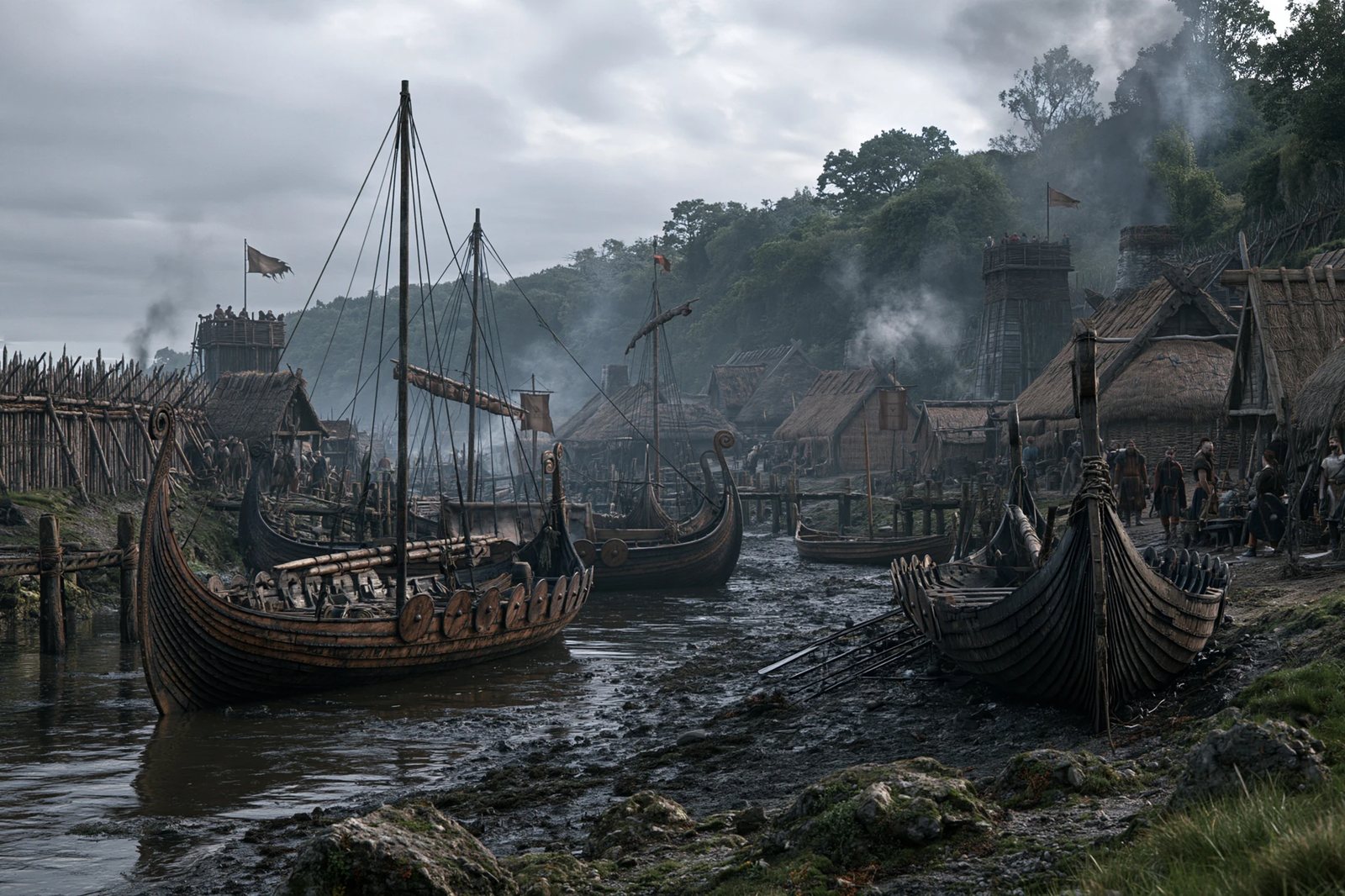
Olaf the White is the Viking leader the Irish annals call Amlaíb: in 853 he arrived in Ireland as the "son of the king of Laithlind", the Norse already there submitted to him, and for almost twenty years he ruled from Dublin alongside Ímar and Auisle. He raided Meath and Armagh, campaigned among the Picts and, in 870, took Dumbarton Rock after a four-month siege. Whether he is the same man as Óláfr hvíti, husband of Aud the Deep-Minded in the Icelandic sagas, is likely – but not proven.
Picture a monk in an Irish monastery around the year 853, adding the year's events to the community's chronicle. An abbot dies. A king is killed by his kinsmen. And then one line that would change the history of the Irish Sea: a foreigner has come, the son of a northern king, all the foreigners of Ireland have submitted to him, and he takes tribute from the Irish. No portrait, no nickname, no speech. Yet this terse entry is the birth certificate of a dynasty that would shape Dublin for more than two centuries.
The annals call him Amlaíb, the Irish form of the Old Norse name Óláfr. Most people today know him as Olaf the White. The catch: no Irish scribe ever called him that. The nickname comes from Iceland, from texts written roughly 350 years later. To understand Olaf, you have to work like a detective with three separate case files – the contemporary Irish annals, the later Icelandic tradition, and the reconstructions of modern historians.
The backbone is the Annals of Ulster. Annals are year-books: short entries recorded year after year, often close to the events. For the ninth century the Annals of Ulster are regarded as broadly contemporary, even though the surviving manuscripts were copied in the fifteenth century. Their tone is dry, almost bookkeeping.
The Fragmentary Annals of Ireland (also known as the "Three Fragments") are a different animal. They survive only in a seventeenth-century copy of an older compilation, probably of the eleventh century, and they tell stories: dialogue, intrigue, miracles. For Olaf they are indispensable, because only they name his father – but they are later tradition.
The third file lies in Iceland: Landnámabók (the "Book of Settlements", a register of Iceland's first settlers, surviving in thirteenth-century versions) and sagas of Icelanders such as Laxdæla saga and the Saga of Eirik the Red. Here he is Óláfr hvíti, Olaf the White. To them he is an ancestor, not a protagonist.
The Annals of Ulster entry for 853 runs, in our own rendering: Amlaíb, son of the king of Laithlind, came to Ireland, and the foreigners of Ireland submitted to him, and he took tribute from the Irish. So Amlaíb is a king's son, the Norse in Ireland had to submit to him, and he collected tribute – more than a raider.
What "Laithlind" (later usually Lochlann) means is one of the great debates of the period. For a long time it was simply equated with Norway. In 1998 the Irish historian Donnchadh Ó Corráin argued instead that in the ninth century it more likely referred to Norse lordships in Scotland – the Hebrides, the Northern Isles and the Scottish seaboard. Others still prefer Norway or treat the term as vague. Olaf's father's kingdom could thus have lain in Norway or in the Scottish isles.
Dublin itself predates him. As early as 841 the Annals of Ulster record a Norse ship-camp – in Irish a longphort, a fortified anchorage where fleets could overwinter – at Duiblinn, the "black pool" where the Poddle met the Liffey. In the nineteenth century, finds at Kilmainham and Islandbridge revealed one of the largest Viking-Age cemeteries outside Scandinavia, with swords, spearheads and oval brooches. So Olaf did not found Dublin. But with him begins the line of kings who ruled there with a dynastic claim. For the town's later Norse population, see our piece on the Ostmen of Dublin, Waterford and Limerick.
Olaf did not rule alone. In 857 the annals name him together with Ímar: the pair routed Caitil the Fair and his Gall-Goídil in Munster. The Gall-Goídil – literally "foreign Gaels" – were war bands of mixed Norse and Gaelic background, probably from the Scottish isles. Some scholars have equated Caitil the Fair with Ketill Flatnose, Aud's father in the Icelandic tradition. That would make a neat twist – Olaf fighting his future father-in-law – but it is pure conjecture and widely rejected.
By 863 a third name appears: the annals speak of "three kings of the foreigners", Amlaíb, Ímar and Auisle. Ímar is today usually identified with the Ívarr whom English sources know as a leader of the Great Heathen Army, and by some with the legendary Ivar the Boneless. The historian Clare Downham has made the strongest case for that identification; the link to Ragnar Lodbrok, by contrast, belongs to the saga literature of the twelfth and thirteenth centuries.
The Annals of Ulster never say the three were brothers. Only the Fragmentary Annals make them the three sons of a king of Lochlann, and only they name the father: Gofraid, Old Norse Guðrøðr. Whether this Gofraid has anything to do with the Guðrøðr kings of Norwegian tradition is an open question. It is striking that Landnámabók also places a Guðrøðr in Olaf's ancestry – though the name was common in Scandinavian royal families.
If you imagine Olaf as the enemy of "the Irish" as a single people, think again. Ninth-century Ireland was a patchwork of dozens of kingdoms that fought each other constantly, and the Norse were quickly drawn into the game. In 859 Amlaíb, Ímar and Cerball mac Dúnlainge, king of Osraige, led a great army into Mide (Meath) together. Cerball fought with or against the Vikings as it suited him – a pattern you will find throughout the history of the Vikings in Ireland, Scotland and the Isles.
The entry for 863 is remarkable. The annals report that "the caves" of Achad Aldai, Cnodba and Dubad were searched – "something which had never been done before". These are generally identified with the great Neolithic passage tombs of the Boyne valley: Newgrange, Knowth and Dowth. On the same expedition the three kings plundered the land of Flann son of Conaing, and an Irish king, Lorcán of Meath, rode with them. Vikings and an Irish king treasure-hunting together in 5,000-year-old burial mounds – not a fantasy plot, but an annal entry.
These alliances were short and bloody. In 864 Amlaíb had Conchobar son of Donnchad, one of the two kings of Meath, put to death in water at Cluain Iraird (Clonard) – drowned at one of Ireland's most famous monasteries. The Fragmentary Annals add that Olaf was married to a daughter of Áed Findliath, king of Tara, and campaigned in Meath with his father-in-law. That cannot be checked; the more reliable Annals of Ulster say nothing about it.
In 867 the pendulum swung back. The annals record that "Amlaíb's fort" at Cluain Dolcáin (Clondalkin), a few miles west of Dublin, was burned by Irish leaders, who killed about a hundred Norse leaders there on the same day. A year later Áed Findliath defeated a coalition of Brega, Leinster and the Norse at Cell Ua nDaigri (Killineer, near Drogheda). The late Annals of the Four Masters (seventeenth century) list among the dead "Carlus, son of Amhlaeibh" – quite possibly Olaf's son. Carlus is the Latin form of Charles, as in Charlemagne: a Viking prince bearing a Frankish emperor's name.
In 869 the blow fell on Ireland's spiritual heart. Amlaíb plundered Armagh (Ard Macha), seat of the successors of Saint Patrick, and burned it with its oratories. According to the annals, a thousand people were carried off or killed. Carried off usually meant sold into slavery: Dublin grew into a major slave market, as we explore in our article on slavery in the Viking world.
Under 867 the Annals of Ulster note tersely that Auisle, "one of three kings of the heathens", was killed by his kinsmen in guile and parricide. Nothing more. The Fragmentary Annals turn it into a scene worthy of a saga. In John O'Donovan's 1860 translation, Auisle, the youngest and bravest of the brothers, asks Olaf to give him the daughter of Cináed – Olaf's own wife. Olaf flies into a rage, draws his sword and kills his brother in his own house.
Who this daughter of Cináed was is disputed. If she was a daughter of the Pictish king Cináed mac Ailpín (Kenneth MacAlpin, died 858), Olaf would have been brother-in-law to the very Constantine who later became his enemy. Others think of an Irish Cináed. All the contemporary source guarantees is the bare outcome: one of the three kings was dead in 867, killed by his own family.
Olaf's reach did not end at the Irish coast. In 866 Amlaíb and Auisle went to Fortriu, the heartland of the Picts, with the foreigners of Ireland and Scotland, plundered the whole Pictish country and took hostages. The Scottish tradition remembers this too. The Chronicle of the Kings of Alba, a short Latin king-list with notes, says that under Constantine son of Cináed, Amlaíb and his heathens wasted Pictland and stayed there from 1 January until the feast of Saint Patrick (17 March).
An army that spends a whole winter in a king's territory is no longer raiding; it is occupying – the same pattern as the Great Army's winter camps in England from 865.
The high point of Olaf's career is also his last great securely dated appearance. The Annals of Ulster report for 870, in our own rendering: The siege of Ail Cluaithe by the Norsemen, Amlaíb and Ímar, two kings of the Norsemen; they besieged the fortress and at the end of four months destroyed and plundered it.
Ail Cluaithe, the "Rock of the Clyde", is today's Dumbarton Rock west of Glasgow: a volcanic plug rising some 70 metres from the Clyde estuary. It was the royal seat of the Britons of Strathclyde, a Brittonic-speaking kingdom that had held its own for centuries against Picts, Scots and Anglo-Saxons. You do not storm a rock like that. You starve it out – or wait for it to run dry.
That is precisely what the Fragmentary Annals say happened: the defenders held out until their well failed – miraculously, in the chronicler's telling. Without water they had to surrender, and the Norse took great plunder and many captives. The miracle belongs to the storytelling of a late text; running out of water after four months under siege is simply plausible.
Archaeology has a voice here as well. Leslie Alcock excavated on the Rock in the 1970s and combined finds, radiocarbon dates and written sources into a chronology of the early medieval stronghold. His conclusion: the fortress of Alt Clut ended in a destruction that he attributed to the attack of 870. Text and soil meeting like this is a rare stroke of luck for the Viking Age.
In 871 came the homecoming, and it reads like a balance sheet of terror. Amlaíb and Ímar returned to Áth Cliath from Alba with two hundred ships, bringing "a great prey" of people into captivity in Ireland: Angles, Britons and Picts. Even if the number of ships is rounded, it describes a fleet only a powerful king could command. For how such ships were built, see our article on Viking dragon ships.
The kingdom of Strathclyde survived, but weakened. In 872 its king Artgal was killed "at the instigation of Constantine son of Cináed", as the Annals of Ulster record. Whether Olaf and Ímar had a hand in it we do not know.
After 871 Amlaíb falls silent in the record. In 873 the Annals of Ulster report the death of Ímar, now styled "king of the Norsemen of all Ireland and Britain" – and Olaf is no longer mentioned. Three explanations for his disappearance exist, and they come from three very different sources.
One: he went home. The Fragmentary Annals state under 871 that Amlaíb left Ireland for Lochlann to fight the Norsemen and help his father Gofraid, who had sent for him. The chroniclers then explicitly skip the war itself because it does not concern Ireland – an honest admission from a medieval writer, and a frustrating one for us.
Two: he died in Scotland. The Chronicle of the Kings of Alba records that Amlaíb was killed by Constantine. The Latin is corrupt at this point; a widely accepted reading has him slain while collecting tribute. The dating is the problem: the chronicle places his death in Constantine's third year, around 865 – when the Irish annals show Olaf still alive. Many historians therefore assume an error in the order of entries and date his death to around 872–874. That is not certain.
Three: he died in Ireland. The Icelandic tradition says simply that Olaf fell in battle in Ireland. No Irish annal supports this. Some historians explain the conflict by suggesting that Icelandic storytellers three centuries later did not sharply distinguish Ireland from Gaelic Scotland.
The versions can be partly combined – a return to Lochlann in 871, a later comeback, death in Scotland – but no combination can be proven. All we can say for certain is that after 871 the man disappears from the contemporary sources.
The Annals of Ulster add one epilogue. In 875 Oistín son of Amlaíb, "king of the Norsemen", was deceitfully killed by Albann. Albann is usually identified with Hálfdan, Ívarr's brother and a leader of the Great Army.
Now we switch files. In J. Sephton's 1880 translation of the Saga of Eirik the Red, "Olaf, who was called Olaf the White, was styled a warrior king". He "conquered Dublin, in Ireland, and Dublinshire, over which he made himself king", and "married Aud the Deep-minded, daughter of Ketil Flatnose". Their son was Thorstein the Red. Then, tersely: "Olaf fell in battle in Ireland, and then Aud and Thorstein went into the Sudreyjar (the Hebrides)." Landnámabók tells the same story in almost the same words.
The genealogies diverge. Landnámabók makes Olaf a son of Ingjald and traces his line through several generations of Norwegian petty kings back to Halfdan Whiteleg. Laxdæla saga, in Muriel Press's 1899 translation, calls Unn (Aud) "the wife of Olaf the White, son of Ingjald", and traces him back to Frodi the Valiant, slain by the Svertlings. Later genealogies even tie him to the house of Ragnar Lodbrok. Such pedigrees were built to confer prestige; as evidence for the ninth century they are of little use.
Why would Icelanders care about a king in Dublin at all? Because of his wife. Aud the Deep-Minded (Unn in Laxdæla saga) is one of Iceland's great founding figures. According to the sagas, after her son's death she had a ship built in secret, sailed via Orkney and the Faroes to Iceland and took land in Breiðafjörður. Through her, Olaf became the ancestor of leading Icelandic families. More than that: Ari Þorgilsson, the father of Icelandic history-writing, ends his Íslendingabók with a pedigree that includes Óláfr hvíti and Þorsteinn rauðr. Olaf is part of the family tradition of Iceland's first historian – one reason his name survived at all. For the society Aud helped to build, see our piece on the Icelanders, their chieftains and the Althing.
The nickname "the White" remains a puzzle. Fair hair? Clothing? Something else entirely? The sources do not explain it – and we are not going to invent an answer.
According to the sagas, Thorstein the Red went raiding and allied himself with Earl Sigurd the Mighty of Orkney. Together they won Caithness, Sutherland, Ross and Moray and more than half of Scotland, until the Scots betrayed him and he fell; according to Ari, this happened in Caithness. For the background to that alliance, see our article on the Earls of Orkney.
Is Thorstein the same person as Oistín, the son of Amlaíb who died in 875? The Irish scholar James Henthorn Todd suggested so in the nineteenth century; later historians are sceptical. Linguistically, Oistín corresponds more naturally to the Norse name Eysteinn than to Þorsteinn. And the sagas have Thorstein killed by Scots in Scotland, not by a Norse rival. The identification is possible but weak. Put cleanly: the Irish sources give Amlaíb the sons Carlus and Oistín, the Icelandic sources give Óláfr hvíti a son Þorsteinn.
Now to the heart of the matter. Much speaks in favour. Both are Norse kings named Olaf. Both rule in Dublin. The Icelandic Olaf marries into a family with a power base in the Hebrides; the Irish Amlaíb operates in Ireland and Scotland and fights Gall-Goídil. The timing works: Aud's voyage to Iceland falls in the settlement period from around 870. Benjamin Hudson argued for the identification in the Oxford Dictionary of National Biography, and many handbooks follow him.
Much speaks against it, too. The pedigrees do not match: the Irish name his father Gofraid, the Icelanders Ingjald. The endings do not match: death in Scotland or a voyage home versus death in Ireland. And it is methodologically risky to lay a thirteenth-century saga over a ninth-century annal figure just because name and place agree. Olaf was a common name, and Icelandic families may have remembered more than one Norse leader of that name in Dublin. Some historians have explicitly rejected the equation.
Our verdict: the identification is the most economical explanation, but it remains a reconstruction. Careful writing says "Amlaíb of Dublin, often identified with Olaf the White of the sagas" – not simply "Olaf the White captured Dumbarton".
Olaf's real legacy is not a person but a structure. With him and Ímar begins the rule of the family historians call the Uí Ímair, the "descendants of Ívarr". This dynasty ruled Dublin, at times York and the Isles, into the eleventh century. The ship-camp grew into a trading town with a silver economy, its own coinage from the late tenth century and sea routes reaching far afield. Even after the Battle of Clontarf in 1014, Dublin remained a Norse-flavoured town.
One curious detail to finish: the Annals of the Four Masters record under 994 that the Irish king Máel Sechnaill carried off from the foreigners of Dublin "the ring of Tomar and the sword of Carlus". Some scholars wonder whether that sword went back to Olaf's son Carlus, who fell in 868. It cannot be proven.
What draws us to Olaf is exactly this gap: hard annals on one side, a saga on the other that turns a warlord into the ancestor of an island nation. We work with the same tension between record and remembrance whenever we engrave names and runes into slate.

Who was Olaf the White? A Norse king called Amlaíb in the Irish annals, who ruled from Dublin from 853. His identification with Óláfr hvíti of the Icelandic sagas, husband of Aud the Deep-Minded, is likely but not proven.
Did Olaf the White found Dublin? No. A Norse ship-camp on the Liffey is recorded in 841. Olaf made Dublin the seat of a royal dynasty.
What happened at Dumbarton in 870? Amlaíb and Ímar besieged Ail Cluaithe, the rock fortress of the Britons of Strathclyde, for four months and destroyed it. In 871 they returned to Dublin with 200 ships and many captives.
How did Olaf the White die? Nobody knows. The Fragmentary Annals send him to Lochlann in 871, a Scottish chronicle has him killed by King Constantine, and the Icelandic sagas say he fell in battle in Ireland.
Was Olaf the White related to Ivar the Boneless? The Fragmentary Annals make Amlaíb and Ímar brothers. Whether Ímar is the Ivar of English and Scandinavian tradition is widely assumed but still debated.
Who was Olaf the White's wife? According to the Icelandic sagas, Aud the Deep-Minded, daughter of Ketill Flatnose. The Fragmentary Annals instead name a daughter of Áed Findliath and a daughter of a Cináed as Amlaíb's wives.
For courage. For remembrance. For legends that live on.
Thorstein the Red · Aud the Deep-Minded · Ragnar Lodbrok · Erik the Red · Hedeby.
All History & Finds articles →
Long before there were Germanic peoples – some 4,300 years ago – people in today’s Saxony-Anhalt raised a vast ring of …
Read more →King Hákon the Good, a son of Harald Fairhair, fought all his life against the sons of his brother Eric Bloodaxe. Two …
Read more →